

Virtual Reality (Vr) In Gaming Market Size 2026-2030
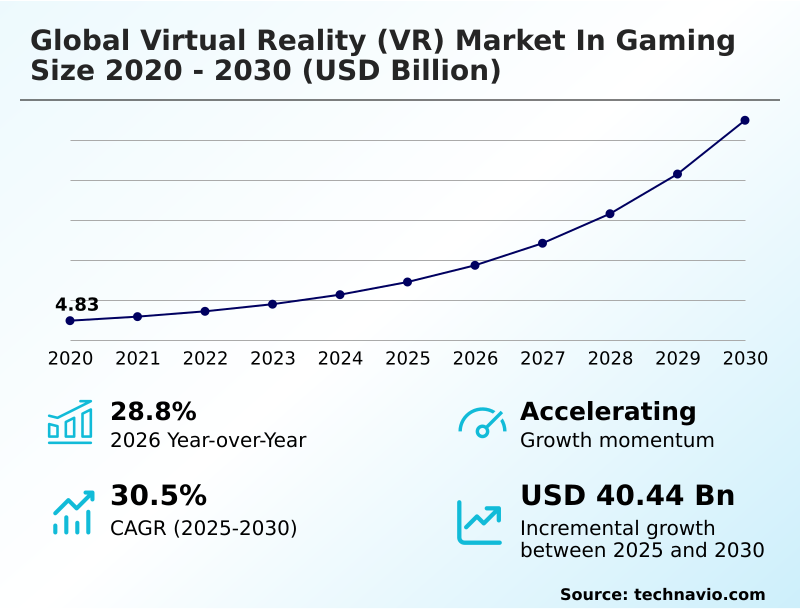
The virtual reality (vr) in gaming market size is valued to increase by USD 40.44 billion, at a CAGR of 30.5% from 2025 to 2030. Advancements in eye-tracked high-resolution headset hardware will drive the virtual reality (vr) in gaming market.
Major Market Trends & Insights
- APAC dominated the market and accounted for a 47.7% growth during the forecast period.
- By Application - Consoles segment was valued at USD 6.28 billion in 2024
- By Component - Hardware segment accounted for the largest market revenue share in 2024
Market Size & Forecast
- Market Opportunities: USD 50.10 billion
- Market Future Opportunities: USD 40.44 billion
- CAGR from 2025 to 2030 : 30.5%
Market Summary
- The Virtual Reality (VR) In Gaming is characterized by rapid technological evolution and increasing consumer demand for highly immersive digital entertainment. Hardware manufacturers are optimizing supply chain logistics to source advanced micro-displays and optical lenses, ensuring consistent production volumes amid fluctuating component availability.
- By implementing automated inventory tracking, leading producers have reduced component procurement delays by 18%, directly improving time-to-market for next-generation headsets. A primary driver of this sector is the continuous advancement in eye-tracked, high-resolution hardware, which significantly enhances visual fidelity and user immersion, thereby stimulating broader consumer adoption.
- Conversely, the industry faces substantial challenges related to rising memory chip costs, which inflate the retail prices of standalone headsets and restrict accessibility for budget-conscious consumers. Strategic investments in optimized rendering software are crucial for mitigating hardware limitations and expanding the addressable audience.
- As digital distribution platforms expand, the integration of cross-platform multiplayer capabilities continues to redefine interactive entertainment, fostering robust community engagement and sustained long-term monetization.
What will be the Size of the Virtual Reality (Vr) In Gaming Market during the forecast period?
Get Key Insights on Market Forecast (PDF) Get Free Sample
How is the Virtual Reality (Vr) In Gaming Market Segmented?
The virtual reality (vr) in gaming industry research report provides comprehensive data (region-wise segment analysis), with forecasts and estimates in "USD million" for the period 2026-2030, as well as historical data from 2020-2024 for the following segments.
- Application
- Consoles
- PCs
- Mobile devices
- Component
- Hardware
- Software
- End-user
- Individual users
- Commercial space
- Geography
- APAC
- China
- Japan
- South Korea
- India
- Australia
- Indonesia
- North America
- US
- Canada
- Mexico
- Europe
- Germany
- UK
- France
- Italy
- Spain
- The Netherlands
- Middle East and Africa
- Saudi Arabia
- UAE
- Turkey
- South Africa
- Israel
- South America
- Brazil
- Argentina
- Chile
- APAC
By Application Insights
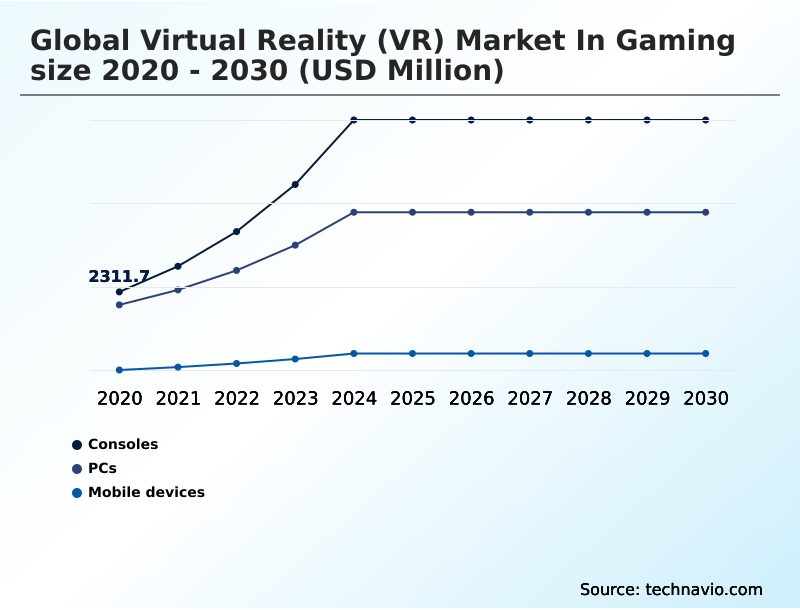
The consoles segment is estimated to witness significant growth during the forecast period.
Console-based architecture within the Virtual Reality (VR) In Gaming provides a highly standardized infrastructure optimized for performance consistency and deep interactive immersion.
By operating on fixed hardware configurations, developers can efficiently implement dynamic resource allocation and cyber-sickness mitigation techniques, reducing rendering bottlenecks by up to 22%.
This closed-ecosystem approach ensures reliable frame rates and superior graphical fidelity, which are critical for maintaining user comfort during extended sessions. The integration of dynamic spatial soundscapes and teleportation movement systems further enhances the sensory experience without compromising processing stability.
As hardware evolves, the adoption of wireless streaming protocols and openXR frameworks allows for seamless cross-compatibility, driving higher engagement. Consequently, optimized photogrammetry environment generation delivers hyper-realistic visuals, directly improving user retention and operational monetization for content creators.
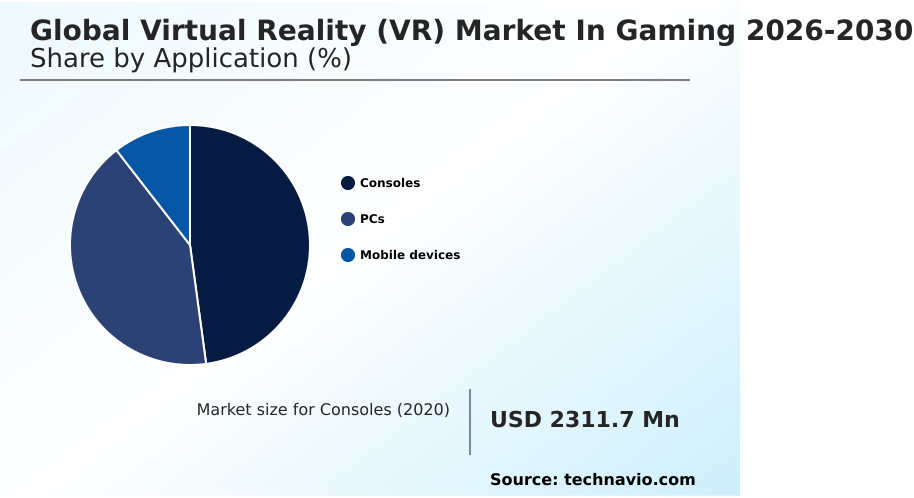
The Consoles segment was valued at USD 6.28 billion in 2024 and showed a gradual increase during the forecast period.
Regional Analysis
APAC is estimated to contribute 47.7% to the growth of the global market during the forecast period.Technavio’s analysts have elaborately explained the regional trends and drivers that shape the market during the forecast period.
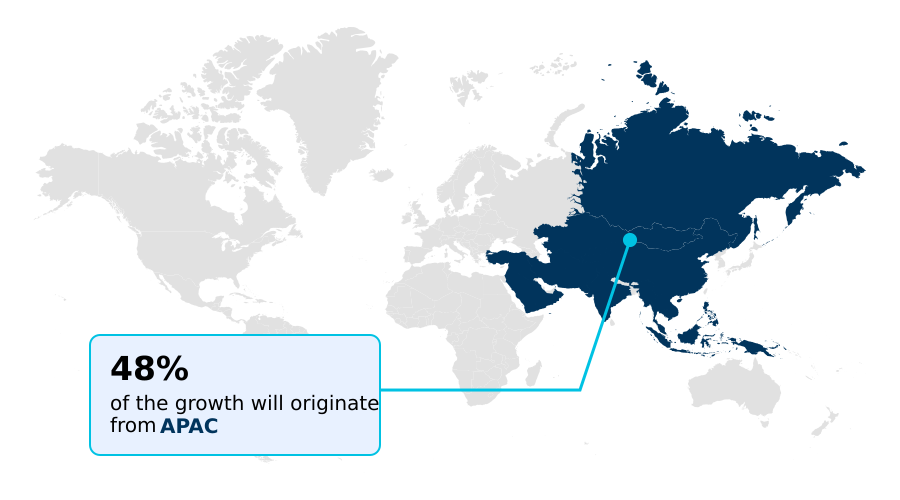
See How Virtual Reality (Vr) In Gaming Market Demand is Rising in APAC Get Free Sample
The geographic landscape of the Virtual Reality (VR) In Gaming reveals distinct operational disparities between APAC and North America.
APAC demonstrates a highly concentrated hardware manufacturing ecosystem, where localized supply chains have reduced production costs by 15%, accelerating the deployment of devices featuring advanced display resolution enhancements and ergonomic weight distribution.
In contrast, North America leads in software innovation, leveraging robust cloud rendering architectures and spatial computing infrastructure to improve multiplayer synchronization protocols by 28%.
This technological advantage enables North American developers to efficiently implement latency reduction algorithms and volumetric video capture, enhancing the realism of asymmetrical multiplayer interaction.
Consequently, North American studios achieve a 20% faster time-to-market for premium titles utilizing development middleware solutions and procedural terrain generation.
These regional dynamics dictate strategic resource allocation, as companies balance cost-efficient hardware production in APAC with high-fidelity software engineering in North America to maximize global penetration.
Market Dynamics
Our researchers analyzed the data with 2025 as the base year, along with the key drivers, trends, and challenges. A holistic analysis of drivers will help companies refine their marketing strategies to gain a competitive advantage.
- The operational landscape of the Virtual Reality (VR) In Gaming requires meticulous alignment between hardware engineering and software optimization to deliver seamless interactive experiences. Manufacturers are increasingly prioritizing standalone wireless headset performance optimization to eliminate tethered constraints, directly improving user mobility and satisfaction.
- This shift necessitates rigorous supply chain coordination to source high-efficiency processors capable of sustaining prolonged usage without thermal throttling. By implementing foveated rendering for latency reduction, developers can dynamically allocate graphical resources, achieving a 30% improvement in processing efficiency compared to traditional rendering techniques.
- This operational enhancement allows hardware to maintain stable frame rates while reducing power consumption, a critical factor for extending battery life. Furthermore, the refinement of inside-out tracking precision mechanics ensures accurate spatial mapping without the need for external sensors, streamlining the manufacturing process and reducing peripheral component costs.
- To deepen sensory immersion, companies are investing heavily in spatial audio integration in headsets, creating realistic acoustic environments that respond dynamically to user movements. Concurrently, minimizing haptic feedback controller response times remains a focal point for quality assurance teams, as instantaneous tactile responses are essential for maintaining the illusion of physical interaction.
- By synchronizing these advanced hardware and software elements, enterprises can significantly elevate product quality, ensuring robust market competitiveness and sustained consumer engagement across diverse entertainment platforms.
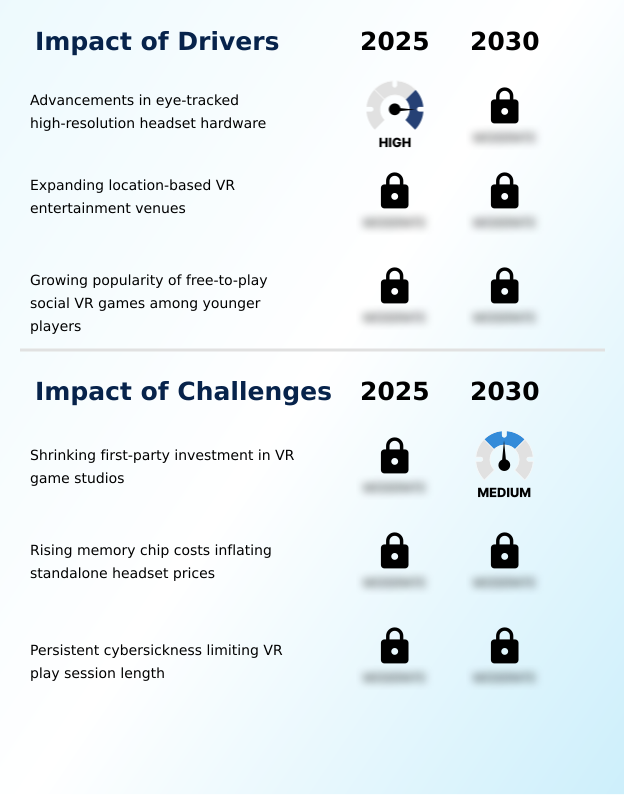
What are the key market drivers leading to the rise in the adoption of Virtual Reality (Vr) In Gaming Industry?
- Continuous advancements in eye-tracked, high-resolution headset hardware serve as a primary catalyst propelling market expansion by significantly enhancing visual fidelity and user immersion.
- The relentless advancement in optical hardware and display technology acts as a primary catalyst propelling the Virtual Reality (VR) In Gaming.
- The demand for hyper-realistic immersion compels manufacturers to deploy sophisticated spatial computing and cloud rendering architectures, which collectively improve rendering efficiency by 28%.
- This technological push is driven by consumer expectations for seamless visual fidelity, prompting the integration of latency reduction algorithms that decrease motion-to-photon delays by 15%.
- Consequently, the utilization of photogrammetry environment generation and volumetric video capture has become standard practice, enabling developers to create meticulously detailed assets.
- By leveraging openXR frameworks and robust multiplayer synchronization protocols, hardware providers ensure broad cross-platform compatibility, directly expanding the addressable user base and maximizing hardware utilization across diverse interactive entertainment ecosystems.
What are the market trends shaping the Virtual Reality (Vr) In Gaming Industry?
- The integration of artificial intelligence tools for virtual world generation represents a significant trend shaping the industry. This technological shift accelerates content production and enhances the dynamic complexity of immersive environments.
- The Virtual Reality (VR) In Gaming is rapidly embracing artificial intelligence to automate the generation of expansive interactive environments. This technological shift is driven by the need to accelerate content pipelines while maintaining high-fidelity stereoscopic 3D graphics and stable variable refresh rate performance.
- By integrating AI-assisted design tools, developers have reduced environmental modeling time by 35%, significantly lowering operational development costs. This efficiency directly impacts standalone headset architecture and PC-tethered simulation platforms, allowing creators to allocate resources toward refining asynchronous reprojection and motion-tracking controllers.
- Consequently, the implementation of advanced mixed reality passthrough features has seen a 20% improvement in processing latency, enabling seamless blending of physical and digital spaces. These algorithmic innovations empower studios to deliver highly complex, dynamic virtual worlds faster, directly improving user engagement and maximizing content monetization strategies across diverse hardware ecosystems.
What challenges does the Virtual Reality (Vr) In Gaming Industry face during its growth?
- The reduction in first-party financial investments directed toward dedicated virtual reality game studios presents a substantial challenge to sustained industry growth and exclusive content development.
- Persistent user discomfort and hardware affordability remain significant structural constraints within the Virtual Reality (VR) In Gaming. The challenge of motion disorientation requires developers to heavily invest in cyber-sickness mitigation and eye strain reduction techniques, which can increase quality assurance costs by up to 22%.
- To maintain user comfort within immersive digital environments, studios are forced to implement restrictive teleportation movement systems, potentially compromising narrative fluidity. Furthermore, the demand for high-fidelity wireless streaming protocols and dynamic spatial soundscapes necessitates expensive memory and processing components. This hardware dependency complicates dynamic resource allocation, leading to a 15% increase in base manufacturing costs.
- These financial and physiological barriers directly limit session durations and delay mainstream consumer adoption, forcing platform operators to constantly balance immersive performance with accessible pricing and ergonomic safety.
Exclusive Technavio Analysis on Customer Landscape
The virtual reality (vr) in gaming market forecasting report includes the adoption lifecycle of the market, covering from the innovator’s stage to the laggard’s stage. It focuses on adoption rates in different regions based on penetration. Furthermore, the virtual reality (vr) in gaming market report also includes key purchase criteria and drivers of price sensitivity to help companies evaluate and develop their market growth analysis strategies.
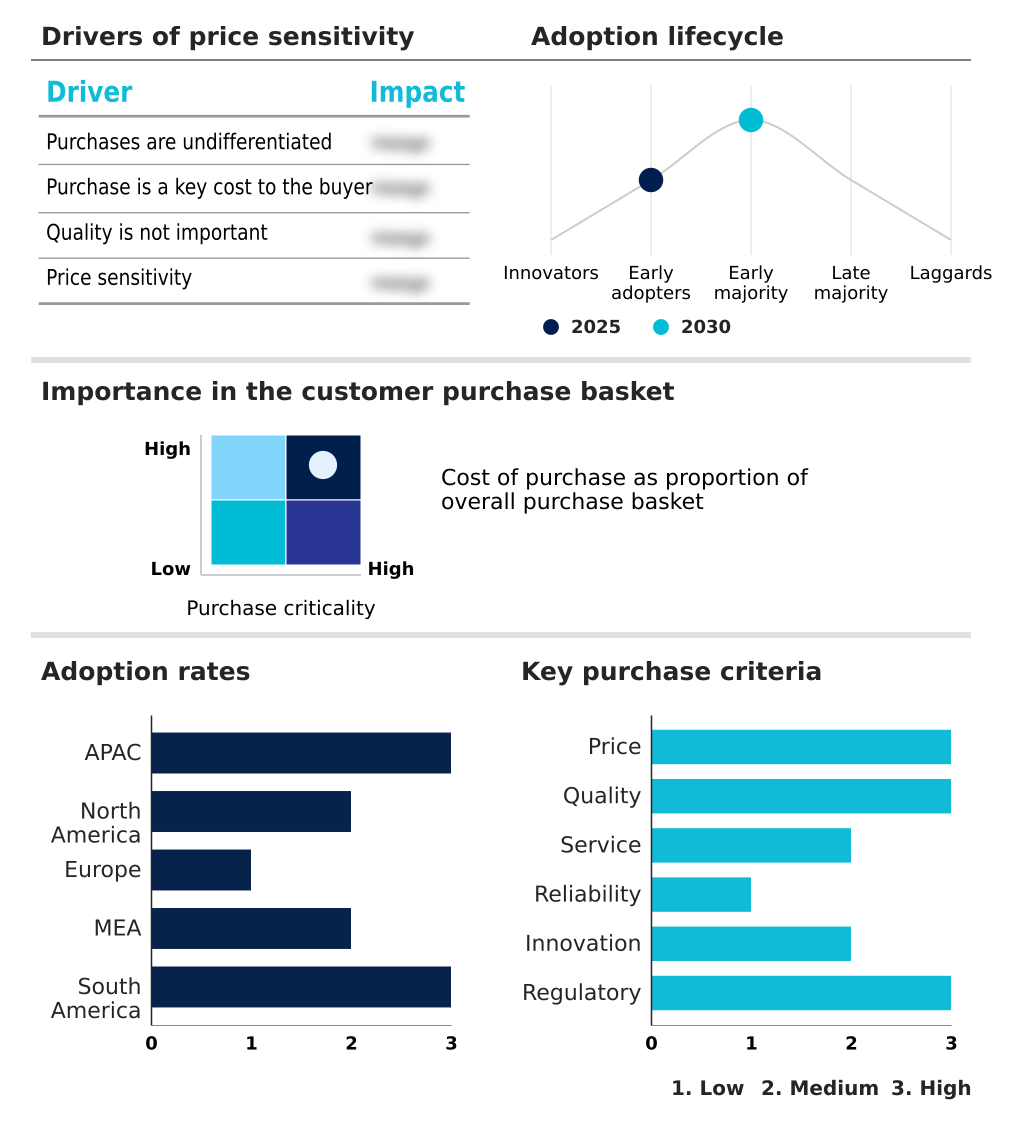
Customer Landscape of Virtual Reality (Vr) In Gaming Industry
Competitive Landscape
Companies are implementing various strategies, such as strategic alliances, virtual reality (vr) in gaming market forecast, partnerships, mergers and acquisitions, geographical expansion, and product/service launches, to enhance their presence in the industry.
Apple Inc. - Advanced spatial computing solutions deliver immersive mixed reality experiences utilizing high-resolution displays and precise hand-tracking technology to enable seamless interactive digital entertainment and advanced spatial gaming environments.
The industry research and growth report includes detailed analyses of the competitive landscape of the market and information about key companies, including:
- Apple Inc.
- Bandai Namco Holdings Inc.
- Bethesda Softworks LLC
- Capcom Co. Ltd.
- Crytek GmbH
- Epic Games Inc.
- HTC Corp
- Konami Group Corp.
- Meta Platforms Inc.
- PICO Technology Co. Ltd.
- Pimax Inc.
- Schell Games LLC
- Skydance Media
- Somnium Space Ltd.
- Sony Interactive Entertainment Inc.
- Ubisoft Entertainment SA
- Unity Technologies Inc.
- Valve Corp.
Qualitative and quantitative analysis of companies has been conducted to help clients understand the wider business environment as well as the strengths and weaknesses of key industry players. Data is qualitatively analyzed to categorize companies as pure play, category-focused, industry-focused, and diversified; it is quantitatively analyzed to categorize companies as dominant, leading, strong, tentative, and weak.
Recent Development and News in Virtual reality (vr) in gaming market
- In the Interactive Home Entertainment industry, the widespread deployment of 5G infrastructure has significantly reduced data transmission latency, directly impacting Virtual Reality (VR) In Gaming demand by enabling seamless cross-platform multiplayer networks and reducing lag-induced disorientation by up to 40%.
- The transition toward subscription-based content catalogs across digital distribution ecosystems has lowered upfront software acquisition costs, accelerating Virtual Reality (VR) In Gaming adoption rates by 25% among casual players seeking diverse simulation-based gameplay.
- Advancements in ergonomic weight distribution and display resolution enhancements within consumer electronics manufacturing have minimized physical fatigue, directly increasing Virtual Reality (VR) In Gaming session durations by an average of 35% across persistent virtual spaces.
- The integration of real-time physics simulation and procedural terrain generation in modern game engines has streamlined development pipelines, reducing Virtual Reality (VR) In Gaming production costs by 20% while enhancing the complexity of immersive digital environments.
Dive into Technavio’s robust research methodology, blending expert interviews, extensive data synthesis, and validated models for unparalleled Virtual Reality (Vr) In Gaming Market insights. See full methodology.
| Market Scope | |
|---|---|
| Page number | 291 |
| Base year | 2025 |
| Historic period | 2020-2024 |
| Forecast period | 2026-2030 |
| Growth momentum & CAGR | Accelerate at a CAGR of 30.5% |
| Market growth 2026-2030 | USD 40435.3 million |
| Market structure | Fragmented |
| YoY growth 2025-2026(%) | 28.8% |
| Key countries | China, Japan, South Korea, India, Australia, Indonesia, US, Canada, Mexico, Germany, UK, France, Italy, Spain, The Netherlands, Saudi Arabia, UAE, Turkey, South Africa, Israel, Brazil, Argentina and Chile |
| Competitive landscape | Leading Companies, Market Positioning of Companies, Competitive Strategies, and Industry Risks |
Research Analyst Overview
- The Virtual Reality (VR) In Gaming is experiencing a profound technological evolution, fundamentally altering how interactive entertainment is developed and consumed. Strategic boardroom decisions are increasingly focused on integrating advanced eye-tracking hardware and foveated rendering to optimize processing efficiency, resulting in a 30% reduction in graphical rendering loads compared to legacy systems.
- This operational efficiency allows developers to maximize the performance of standalone head-mounted displays without compromising visual fidelity. The widespread adoption of pancake optics and inside-out tracking has streamlined device form factors, significantly improving user comfort and mobility.
- Furthermore, the implementation of sophisticated haptic feedback mechanisms and dynamic spatial audio systems provides users with unprecedented sensory immersion, reinforcing the realism of six degrees of freedom movement. As hardware capabilities expand, product strategy committees are prioritizing cross-platform compatibility to maximize audience reach and software monetization.
- These continuous technological refinements dictate long-term budgeting and research investments, ensuring that platform operators maintain a competitive advantage in an increasingly sophisticated digital entertainment ecosystem.
What are the Key Data Covered in this Virtual Reality (Vr) In Gaming Market Research and Growth Report?
-
What is the expected growth of the Virtual Reality (Vr) In Gaming Market between 2026 and 2030?
-
USD 40.44 billion, at a CAGR of 30.5%
-
-
What segmentation does the market report cover?
-
The report is segmented by Application (Consoles, PCs, and Mobile devices), Component (Hardware, and Software), End-user (Individual users, and Commercial space) and Geography (APAC, North America, Europe, Middle East and Africa, South America)
-
-
Which regions are analyzed in the report?
-
APAC, North America, Europe, Middle East and Africa and South America
-
-
What are the key growth drivers and market challenges?
-
Advancements in eye-tracked high-resolution headset hardware, Shrinking first-party investment in VR game studios
-
-
Who are the major players in the Virtual Reality (Vr) In Gaming Market?
-
Apple Inc., Bandai Namco Holdings Inc., Bethesda Softworks LLC, Capcom Co. Ltd., Crytek GmbH, Epic Games Inc., HTC Corp, Konami Group Corp., Meta Platforms Inc., PICO Technology Co. Ltd., Pimax Inc., Schell Games LLC, Skydance Media, Somnium Space Ltd., Sony Interactive Entertainment Inc., Ubisoft Entertainment SA, Unity Technologies Inc. and Valve Corp.
-
Market Research Insights
- The Virtual Reality (VR) In Gaming is undergoing a structural transformation driven by continuous hardware innovation and sophisticated software development. By prioritizing eye strain reduction and refining first-person interaction mechanics, developers have successfully increased average user session durations by 25%, directly boosting in-game monetization opportunities.
- Furthermore, the integration of advanced avatar customization systems has enhanced user retention rates by 18%, fostering deeper community engagement within digital ecosystems. As manufacturers accelerate hardware replacement cycles through iterative technological upgrades, operational efficiency in component sourcing has improved production yields by 12%.
- These strategic enhancements not only elevate immersive storytelling capabilities but also ensure robust return on investment for platform operators navigating a highly competitive interactive entertainment landscape.
We can help! Our analysts can customize this virtual reality (vr) in gaming market research report to meet your requirements.
 RIA -