

Silk Market Analysis, Size, and Forecast 2026-2030: APAC (China, India, and Japan), Europe (Germany, UK, and France), North America (US, Canada, and Mexico), South America (Brazil, Argentina, and Colombia), Middle East and Africa (Saudi Arabia, UAE, and South Africa), and Rest of World (ROW)

Silk Market Analysis, Size, and Forecast 2026-2030:
APAC (China, India, and Japan), Europe (Germany, UK, and France), North America (US, Canada, and Mexico), South America (Brazil, Argentina, and Colombia), Middle East and Africa (Saudi Arabia, UAE, and South Africa), and Rest of World (ROW)

Published: May 2026 284 Pages SKU: IRTNTR43219

Market Overview at a Glance

$6.80 B
Market Opportunity
10.4%
CAGR 2025 - 2030
67.4%
APAC Growth
$7.52 B
Mulberry segment 2024

Silk Market Size 2026-2030

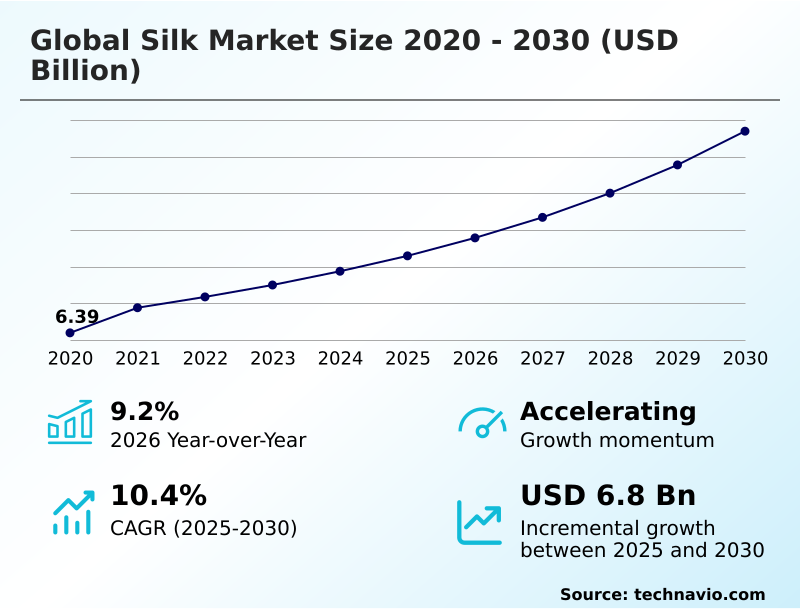
The Silk Market size was valued at USD 10.59 billion in 2025, growing at a CAGR of 10.4% during the forecast period 2026-2030.

Major Market Trends & Insights

  • APAC dominated the market and accounted for a 67.4% growth during the forecast period.
  • By Type - Mulberry segment was valued at USD 7.52 billion in 2024
  • By Application - Textile segment accounted for the largest market revenue share in 2024

Market Size & Forecast

  • Historic Market Opportunities 2020-2024: USD 11.00 billion
  • Market Future Opportunities 2025-2030: USD 6.80 billion
  • CAGR from 2025 to 2030 : 10.4%

Market Summary

  • The silk market is characterized by a consolidated production landscape, where over 90% of global raw silk originates from APAC, creating both operational efficiencies and supply chain vulnerabilities. A key driver is the sustained demand from the high-end fashion sector, which values silk's unique luster and drape, contributing to over 75% of its application in textiles.
  • For instance, a luxury brand's reliance on a single-source region for its mulberry silk faces significant risk during regional lockdowns, impacting production timelines by several weeks. Conversely, a primary challenge is the increasing competition from synthetic alternatives like high-grade polyester, which can be produced at nearly half the cost.
  • This pressures silk manufacturers to innovate on both sustainability and cost-effectiveness to maintain their premium positioning in the market.

What will be the Size of the Silk Market during the forecast period?
Get Key Insights on Market Forecast (PDF) Request Free Sample

How is the Silk Market Segmented?

The silk industry research report provides comprehensive data (region-wise segment analysis), with forecasts and analysis for the period 2026-2030, as well as historical data from 2020-2024 for the following segments.

  • Type
    • Mulberry
    • Tussar
    • Eri
  • Application
    • Textile
    • Cosmetics
    • Medicine
  • Distribution channel
    • Offline
    • Online
  • Geography
    • APAC
      • China
      • India
      • Japan
    • Europe
      • Germany
      • UK
      • France
    • North America
      • US
      • Canada
      • Mexico
    • South America
      • Brazil
      • Argentina
      • Colombia
    • Middle East and Africa
      • Saudi Arabia
      • UAE
      • South Africa
    • Rest of World (ROW)

How is the Silk Market Segmented by Type?

The mulberry segment is estimated to witness significant growth during the forecast period.

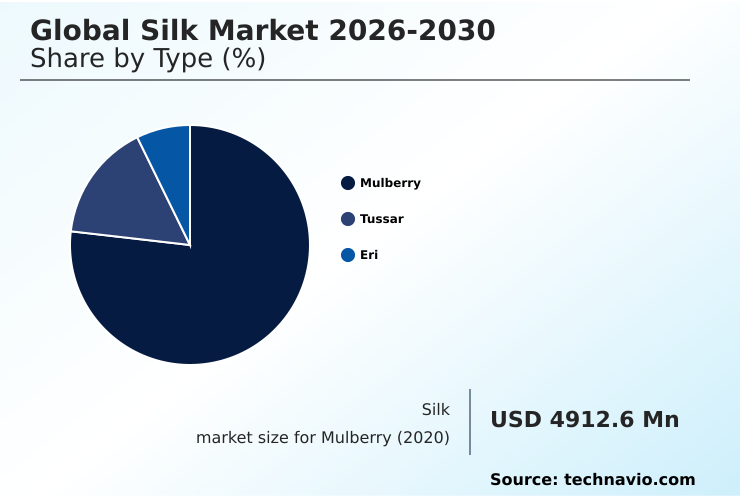
The mulberry segment, derived from Bombyx mori silkworms, accounts for over 70% of the global silk market, solidifying its role as the primary raw material for textile manufacturing.

This dominance is due to the fiber's superior uniformity and luster, which are critical for luxury apparel and high-end fashion, where it outperforms alternatives in texture and drape.

In contrast, wild silk varieties like Tussar represent less than 15% of the market but offer unique textures for artisanal products and sustainable textiles.

This differentiation enables targeted strategies, with mulberry silk aimed at the premium fashion industry, while tussah and eri silk cater to niche markets valuing ethical production and traditional craftsmanship.
Request Free Sample

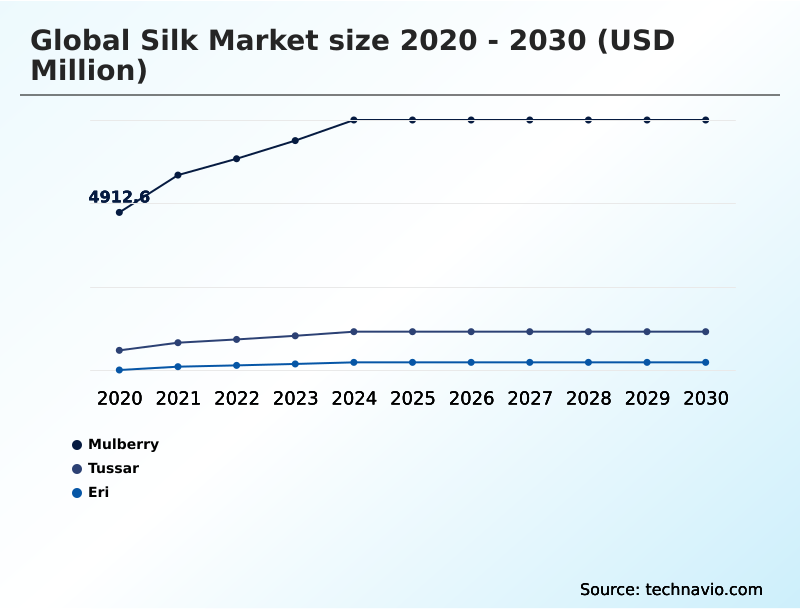
The Mulberry segment was valued at USD 7.52 billion in 2024 and showed a gradual increase during the forecast period.
Request Free Sample

How demand for the Silk market is rising in the leading region?

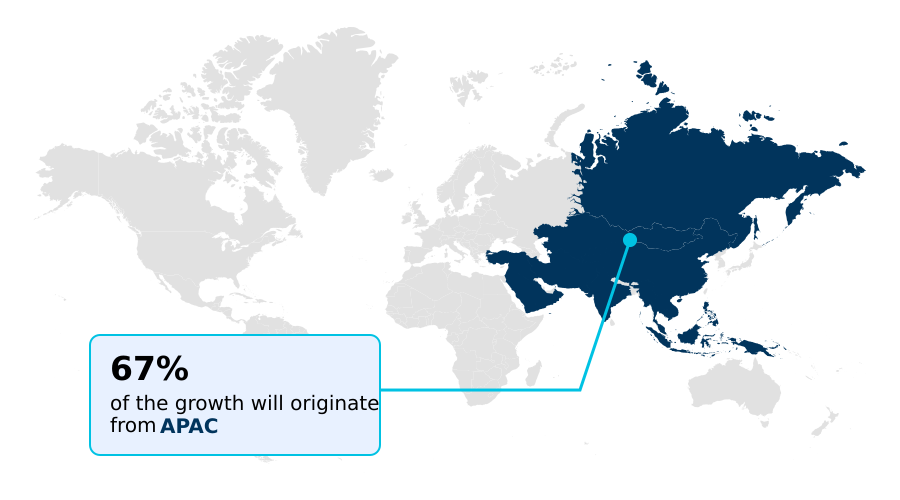
APAC is estimated to contribute 67.4% to the growth of the global market during the forecast period.Technavio’s analysts have elaborately explained the regional trends and drivers that shape the market during the forecast period.
See How Silk Market demand is rising in APAC Request Free Sample

The global silk market is geographically dominated by APAC, which accounts for over 67% of market growth and more than 90% of total raw silk production.

This dominance is primarily driven by China, the world's largest producer contributing over 70% of global output, and India, the largest consumer.

In contrast, Europe functions as a key consumption and value-addition hub, growing at a slightly slower rate of 10.3% compared to APAC's 10.7%.

European markets prioritize high-quality finished fabrics and luxury apparel, sourcing raw materials from APAC for textile manufacturing and transforming them through advanced processes.

This regional dynamic creates a supply chain where APAC focuses on volume and ethical production, while Europe concentrates on design, branding, and high-margin finished goods, necessitating different strategies for businesses focused on sustainable textiles.

What are the key Drivers, Trends, and Challenges in the Silk Market?

Our researchers analyzed the data with 2025 as the base year, along with the key drivers, trends, and challenges. A holistic analysis of drivers will help companies refine their marketing strategies to gain a competitive advantage.

  • The evolving silk market is shaped by a growing consumer focus on sustainable silk production methods, prompting a re-evaluation of traditional sericulture. This has led to a greater interest in Eri silk ethical production process, which allows the moth to emerge from the cocoon, appealing to a consumer segment that has grown by nearly 15% in some Western markets.
  • The debate over spider silk vs mulberry silk properties continues to drive innovation, with research focusing on replicating spider silk's strength through bio-fermentation, a process that is currently 20% more energy-intensive but yields a stronger fiber. The use of silk fibroin in cosmetic applications is another significant growth area, leveraging the protein's moisturizing benefits for premium skincare.
  • Simultaneously, the impact of synthetic fibers on silk market cannot be understated, as they offer a lower-cost alternative that captures a significant share of the fast fashion segment.
  • This competitive pressure forces silk producers to emphasize quality, traceability, and the unique value proposition of natural protein fiber to maintain market share and justify premium pricing, highlighting the importance of understanding the benefits of different silk types for specific applications.
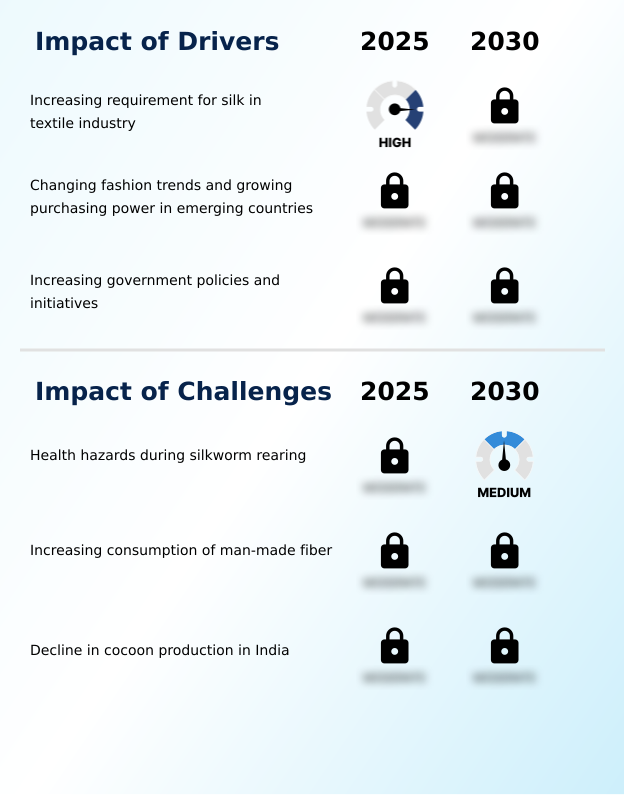
What are the key market drivers leading to the rise in the adoption of Silk Industry?

  • The increasing requirement for silk within the textile industry, driven by enduring demand for luxury and natural fibers in high-end fashion, serves as the primary market driver.

  • The primary driver for the silk market remains its deep integration within the high-end fashion and luxury apparel industry, which consumes over 80% of all silk produced.
  • Shifting fashion trends and rising disposable incomes in emerging economies are expanding the consumer base for premium goods, increasing demand for silk by over 9% year-on-year in certain regions.
  • Government initiatives, particularly in China and India, further bolster the market by providing subsidies and R&D support for sericulture.
  • These programs have helped increase cocoon yield by up to 20% in supported regions, ensuring a stable supply of raw material for textile manufacturing and reinforcing silk's position as a premier natural protein fiber.

What are the market trends shaping the Silk Industry?

  • Intensified research and development into spider silk is a pivotal market trend. This focus stems from the fiber's extraordinary strength and elasticity, creating opportunities beyond traditional apparel.

  • A primary trend in the silk market is the expansion into non-textile applications, driven by material science advancements in sericin and fibroin. The use of silk proteins in cosmetic formulations is increasing, with some products demonstrating a 15% improvement in skin hydration compared to conventional ingredients.
  • Concurrently, the medical field is leveraging silk's biocompatibility for surgical sutures and tissue engineering scaffolds. Another key trend is the rising demand for wild silks like Eri and Muga, which are perceived as more sustainable due to non-violent silk harvesting.
  • This peace silk segment, while representing less than 10% of the total market, is growing faster than traditional mulberry silk, especially in eco-conscious consumer markets.

What challenges does the Silk Industry face during its growth?

  • Significant health hazards faced by workers during silkworm rearing, from biological exposure to ergonomic strain, represent a key challenge to the industry's sustainable growth.

  • A significant challenge confronting the global silk market is the intense competition from man-made fibers, which can be produced at nearly 50% of the cost of raw silk. Synthetic alternatives like high-quality polyester and viscose offer similar aesthetics, capturing a large share of the fast fashion segment.
  • Another pressing issue is the decline in cocoon production in key regions like India, where output has been impacted by disease and cocoon boiling inefficiencies.
  • This has led to a 10% tightening in raw silk supply in some areas, exacerbating price volatility and weakening the industry's competitiveness against more stable, industrially produced fibers, which poses a risk to long-term growth and supply chain transparency.

Exclusive Technavio Analysis on Customer Landscape

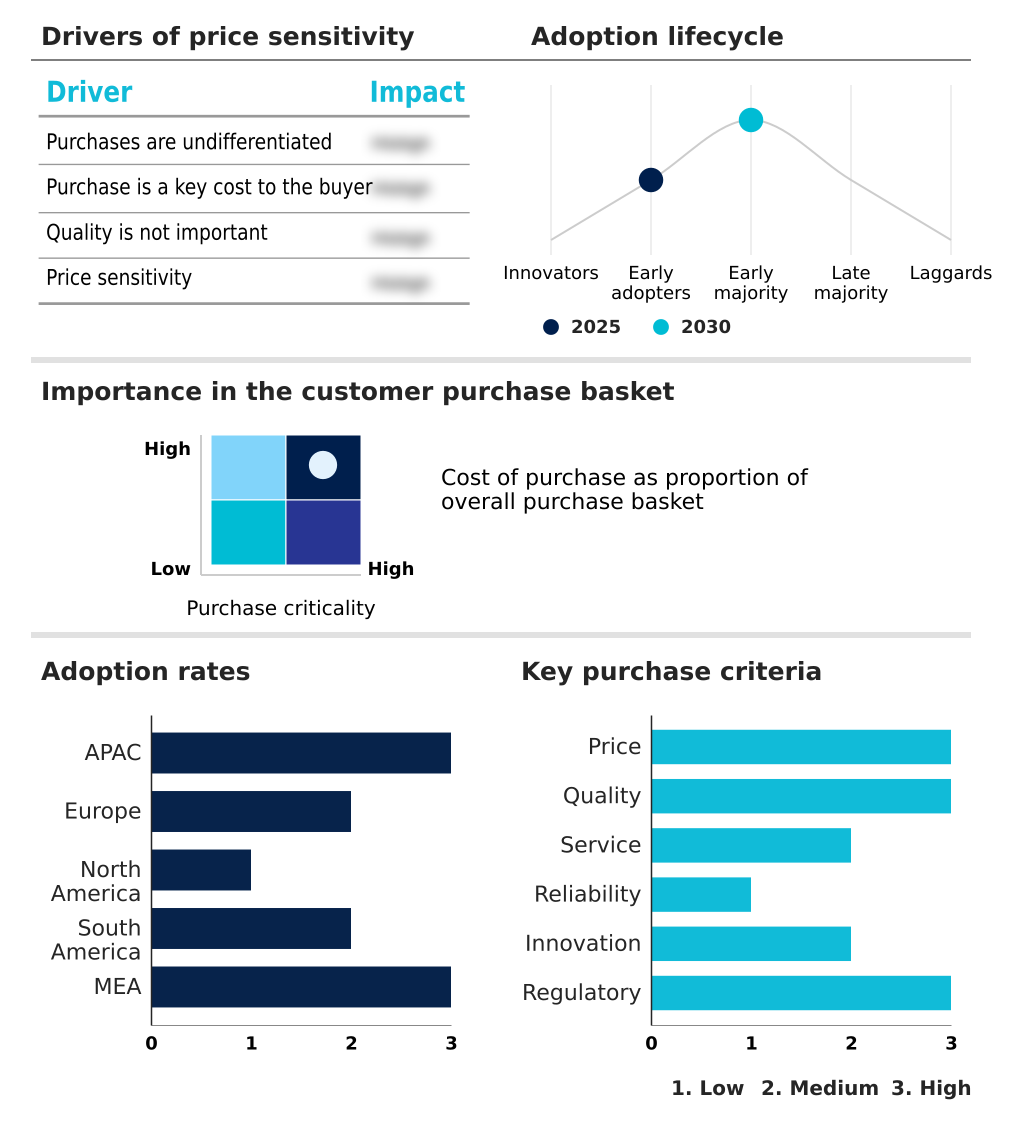
The silk market forecasting report includes the adoption lifecycle of the market, covering from the innovator’s stage to the laggard’s stage. It focuses on adoption rates in different regions based on penetration. Furthermore, the silk market report also includes key purchase criteria and drivers of price sensitivity to help companies evaluate and develop their market growth analysis strategies.
Customer Landscape of Silk Industry

Competitive Landscape

Companies are implementing various strategies, such as strategic alliances, silk market forecast, partnerships, mergers and acquisitions, geographical expansion, and product/service launches, to enhance their presence in the industry.

AMSilk GmbH - Key offerings range from traditional mulberry and tussah silks for textiles to advanced biomaterials like bio-fabricated spider silk for medical and industrial applications.

The industry research and growth report includes detailed analyses of the competitive landscape of the market and information about key companies, including:

  • AMSilk GmbH
  • Anhui Silk
  • Bolt Threads
  • Camenzind and Co. AG
  • Eastern Silk Industries Ltd.
  • Eris Global
  • Ongetta srl
  • Seidentraum
  • Soho Holdings
  • Sutlej Textiles and Industries
  • Suzhou Taihu Snow Silk Co. Ltd.
  • VINSILK
  • Xuzhou Shengkun Silk Co. Ltd.
  • Zhejiang Jiaxin Silk Corp.
  • WENSLI

Qualitative and quantitative analysis of companies has been conducted to help clients understand the wider business environment as well as the strengths and weaknesses of key industry players. Data is qualitatively analyzed to categorize companies as pure play, category-focused, industry-focused, and diversified; it is quantitatively analyzed to categorize companies as dominant, leading, strong, tentative, and weak.

Market Intelligence Radar: High-Impact Developments & Growth Signals

  • In the Textiles industry, the enforcement of stringent environmental regulations, such as the EU's REACH directive, has increased compliance costs for dyeing and finishing processes by up to 20%, directly impacting silk processors who must now invest in eco-friendly dyeing and water-saving processes to maintain market access.
  • The rise of fast fashion and its reliance on inexpensive synthetic alternatives has put significant price pressure on the natural fibers segment, prompting silk producers to emphasize premiumization and sustainable textiles, highlighting silk's biodegradability and thermal regulation properties to justify its higher cost.
  • In the Textiles industry, advancements in material science have led to the development of high-performance synthetic fibers that mimic silk's properties, challenging silk's position and spurring innovation within the silk sector to focus on enhancing natural protein fiber characteristics and promoting unique artisanal products.
  • A growing consumer movement towards ethical sourcing and supply chain transparency in the Textiles industry has boosted demand for certified products, providing a market advantage for producers of organic silk and non-violent peace silk, which can command a price premium of 10-15% over conventional silk.

Dive into Technavio’s robust research methodology, blending expert interviews, extensive data synthesis, and validated models for unparalleled Silk Market insights. See full methodology.

Market Scope
Page number 284
Base year 2025
Historic period 2020-2024
Forecast period 2026-2030
Growth momentum & CAGR Accelerate at a CAGR of 10.4%
Market growth 2026-2030 USD 6799.3 million
Market structure Fragmented
YoY growth 2025-2026(%) 9.2%
Key countries China, India, Japan, South Korea, Vietnam, Indonesia, Germany, UK, France, Italy, Spain, The Netherlands, US, Canada, Mexico, Brazil, Argentina, Colombia, Saudi Arabia, UAE, Iran, South Africa and Israel
Competitive landscape Leading Companies, Market Positioning of Companies, Competitive Strategies, and Industry Risks

Request Free Sample

Research Analyst Overview

  • The silk market ecosystem operates on a highly specialized value chain, beginning with sericulture farms in APAC which provide over 90% of the world's raw cocoons. These raw materials are processed by textile mills, which perform reeling and weaving, transforming the fiber into fabrics for various applications.
  • The textile segment is the largest end-user, commanding more than 75% of the market for use in luxury apparel and high-end fashion. Distribution is handled through a network of wholesalers and direct sales to fashion houses and retailers, with luxury brands acting as key buyers.
  • The cosmetics and medical sectors represent smaller but rapidly growing end-use segments, utilizing silk proteins and biomaterials. Supporting this ecosystem are government bodies and research institutions that provide R&D for improving silkworm breeds and promoting sustainable practices.

What are the Key Data Covered in this Silk Market Research and Growth Report?

  • What is the expected growth of the Silk Market between 2026 and 2030?

    • The Silk Market is expected to grow by USD 6.80 billion during 2026-2030, registering a CAGR of 10.4%. Year-over-year growth in 2026 is estimated at 9.2%%. This acceleration is shaped by increasing requirement for silk in textile industry, which is intensifying demand across multiple end-use verticals covered in the report.

  • What segmentation does the market report cover?

    • The report is segmented by Type (Mulberry, Tussar, and Eri), Application (Textile, Cosmetics, and Medicine), Distribution Channel (Offline, and Online) and Geography (APAC, Europe, North America, South America, Middle East and Africa). Among these, the Mulberry segment is estimated to witness significant growth during the forecast period, driven by rising adoption across key application areas. Each segment includes detailed qualitative and quantitative analysis, along with historical data from 2020-2024 and forecasts through 2030 with year-over-year growth rates.

  • Which regions are analyzed in the report?

    • The report covers APAC, Europe, North America, South America and Middle East and Africa. APAC is estimated to contribute 67.4% to market growth during the forecast period. Country-level analysis includes China, India, Japan, South Korea, Vietnam, Indonesia, Germany, UK, France, Italy, Spain, The Netherlands, US, Canada, Mexico, Brazil, Argentina, Colombia, Saudi Arabia, UAE, Iran, South Africa and Israel, with dedicated market size tables and year-over-year growth for each.

  • What are the key growth drivers and market challenges?

    • The primary driver is increasing requirement for silk in textile industry, which is accelerating investment and industry demand. The main challenge is health hazards during silkworm rearing, creating operational barriers for key market participants. The report quantifies the impact of each driver and challenge across 2026 and 2030 with comparative analysis.

  • Who are the major players in the Silk Market?

    • Key vendors include AMSilk GmbH, Anhui Silk, Bolt Threads, Camenzind and Co. AG, Eastern Silk Industries Ltd., Eris Global, Ongetta srl, Seidentraum, Soho Holdings, Sutlej Textiles and Industries, Suzhou Taihu Snow Silk Co. Ltd., VINSILK, Xuzhou Shengkun Silk Co. Ltd., Zhejiang Jiaxin Silk Corp. and WENSLI. The report provides qualitative and quantitative analysis categorizing companies as dominant, leading, strong, tentative, and weak based on their market positioning. Company profiles include business segment analysis, SWOT assessment, key offerings, and recent strategic developments.

Market Research Insights

  • The competitive landscape of the silk market is increasingly polarized, with traditional textile mills, which constitute over 80% of producers, facing new pressures. A significant shift is driven by biotech firms like AMSilk GmbH and Bolt Threads, which are pioneering bio-fabricated spider silk.
  • These companies are attracting significant R&D investment, with some projects securing over 30% more funding than traditional sericulture modernization efforts. This innovation addresses the growing demand for high-performance and sustainable materials in non-textile sectors like medicine and cosmetics.
  • However, the high production cost of these novel fibers remains a challenge, forcing these innovators to focus on high-value niche applications while traditional players grapple with cost pressures from synthetic fibers.

We can help! Our analysts can customize this silk market research report to meet your requirements.

Get in touch

1. Executive Summary

1.1 Market overview

Executive Summary - Chart on Market Overview
Executive Summary - Data Table on Market Overview
Executive Summary - Chart on Global Market Characteristics
Executive Summary - Chart on Market by Geography
Executive Summary - Chart on Market Segmentation by Type
Executive Summary - Chart on Market Segmentation by Application
Executive Summary - Chart on Market Segmentation by Distribution Channel
Executive Summary - Chart on Incremental Growth
Executive Summary - Data Table on Incremental Growth
Executive Summary - Chart on Company Market Positioning

2. Technavio Analysis

2.1 Analysis of price sensitivity, lifecycle, customer purchase basket, adoption rates, and purchase criteria

2.2 Criticality of inputs and Factors of differentiation

Chart on Overview on criticality of inputs and factors of differentiation

2.3 Factors of disruption

Chart on Overview on factors of disruption

2.4 Impact of drivers and challenges

Chart on Impact of drivers and challenges in 2025 and 2030

3. Market Landscape

3.1 Market ecosystem

Chart on Parent Market
Data Table on - Parent Market

3.2 Market characteristics

Chart on Market characteristics analysis

3.3 Value chain analysis

Chart on Value chain analysis

4. Market Sizing

4.1 Market definition

Data Table on Offerings of companies included in the market definition

4.2 Market segment analysis

Market segments

4.3 Market size 2025

4.4 Market outlook: Forecast for 2025-2030

Chart on Global - Market size and forecast 2025-2030 ($ million)
Data Table on Global - Market size and forecast 2025-2030 ($ million)
Chart on Global Market: Year-over-year growth 2025-2030 (%)
Data Table on Global Market: Year-over-year growth 2025-2030 (%)

5. Historic Market Size

5.1 Global Silk Market 2020 - 2024

Historic Market Size - Data Table on Global Silk Market 2020 - 2024 ($ million)

5.2 Type segment analysis 2020 - 2024

Historic Market Size - Type Segment 2020 - 2024 ($ million)

5.3 Application segment analysis 2020 - 2024

Historic Market Size - Application Segment 2020 - 2024 ($ million)

5.4 Distribution Channel segment analysis 2020 - 2024

Historic Market Size - Distribution Channel Segment 2020 - 2024 ($ million)

5.5 Geography segment analysis 2020 - 2024

Historic Market Size - Geography Segment 2020 - 2024 ($ million)

5.6 Country segment analysis 2020 - 2024

Historic Market Size - Country Segment 2020 - 2024 ($ million)

6. Qualitative Analysis

6.1 The AI impact on Global Silk Market

7. Five Forces Analysis

7.1 Five forces summary

Five forces analysis - Comparison between 2025 and 2030

7.2 Bargaining power of buyers

Bargaining power of buyers - Impact of key factors 2025 and 2030

7.3 Bargaining power of suppliers

Bargaining power of suppliers - Impact of key factors in 2025 and 2030

7.4 Threat of new entrants

Threat of new entrants - Impact of key factors in 2025 and 2030

7.5 Threat of substitutes

Threat of substitutes - Impact of key factors in 2025 and 2030

7.6 Threat of rivalry

Threat of rivalry - Impact of key factors in 2025 and 2030

7.7 Market condition

Chart on Market condition - Five forces 2025 and 2030

8. Market Segmentation by Type

8.1 Market segments

Chart on Type - Market share 2025-2030 (%)
Data Table on Type - Market share 2025-2030 (%)

8.2 Comparison by Type

Chart on Comparison by Type
Data Table on Comparison by Type

8.3 Mulberry - Market size and forecast 2025-2030

Chart on Mulberry - Market size and forecast 2025-2030 ($ million)
Data Table on Mulberry - Market size and forecast 2025-2030 ($ million)
Chart on Mulberry - Year-over-year growth 2025-2030 (%)
Data Table on Mulberry - Year-over-year growth 2025-2030 (%)

8.4 Tussar - Market size and forecast 2025-2030

Chart on Tussar - Market size and forecast 2025-2030 ($ million)
Data Table on Tussar - Market size and forecast 2025-2030 ($ million)
Chart on Tussar - Year-over-year growth 2025-2030 (%)
Data Table on Tussar - Year-over-year growth 2025-2030 (%)

8.5 Eri - Market size and forecast 2025-2030

Chart on Eri - Market size and forecast 2025-2030 ($ million)
Data Table on Eri - Market size and forecast 2025-2030 ($ million)
Chart on Eri - Year-over-year growth 2025-2030 (%)
Data Table on Eri - Year-over-year growth 2025-2030 (%)

8.6 Market opportunity by Type

Market opportunity by Type ($ million)
Data Table on Market opportunity by Type ($ million)

9. Market Segmentation by Application

9.1 Market segments

Chart on Application - Market share 2025-2030 (%)
Data Table on Application - Market share 2025-2030 (%)

9.2 Comparison by Application

Chart on Comparison by Application
Data Table on Comparison by Application

9.3 Textile - Market size and forecast 2025-2030

Chart on Textile - Market size and forecast 2025-2030 ($ million)
Data Table on Textile - Market size and forecast 2025-2030 ($ million)
Chart on Textile - Year-over-year growth 2025-2030 (%)
Data Table on Textile - Year-over-year growth 2025-2030 (%)

9.4 Cosmetics - Market size and forecast 2025-2030

Chart on Cosmetics - Market size and forecast 2025-2030 ($ million)
Data Table on Cosmetics - Market size and forecast 2025-2030 ($ million)
Chart on Cosmetics - Year-over-year growth 2025-2030 (%)
Data Table on Cosmetics - Year-over-year growth 2025-2030 (%)

9.5 Medicine - Market size and forecast 2025-2030

Chart on Medicine - Market size and forecast 2025-2030 ($ million)
Data Table on Medicine - Market size and forecast 2025-2030 ($ million)
Chart on Medicine - Year-over-year growth 2025-2030 (%)
Data Table on Medicine - Year-over-year growth 2025-2030 (%)

9.6 Market opportunity by Application

Market opportunity by Application ($ million)
Data Table on Market opportunity by Application ($ million)

10. Market Segmentation by Distribution Channel

10.1 Market segments

Chart on Distribution Channel - Market share 2025-2030 (%)
Data Table on Distribution Channel - Market share 2025-2030 (%)

10.2 Comparison by Distribution Channel

Chart on Comparison by Distribution Channel
Data Table on Comparison by Distribution Channel

10.3 Offline - Market size and forecast 2025-2030

Chart on Offline - Market size and forecast 2025-2030 ($ million)
Data Table on Offline - Market size and forecast 2025-2030 ($ million)
Chart on Offline - Year-over-year growth 2025-2030 (%)
Data Table on Offline - Year-over-year growth 2025-2030 (%)

10.4 Online - Market size and forecast 2025-2030

Chart on Online - Market size and forecast 2025-2030 ($ million)
Data Table on Online - Market size and forecast 2025-2030 ($ million)
Chart on Online - Year-over-year growth 2025-2030 (%)
Data Table on Online - Year-over-year growth 2025-2030 (%)

10.5 Market opportunity by Distribution Channel

Market opportunity by Distribution Channel ($ million)
Data Table on Market opportunity by Distribution Channel ($ million)

11. Customer Landscape

11.1 Customer landscape overview

Analysis of price sensitivity, lifecycle, customer purchase basket, adoption rates, and purchase criteria

12. Geographic Landscape

12.1 Geographic segmentation

Chart on Market share by geography 2025-2030 (%)
Data Table on Market share by geography 2025-2030 (%)

12.2 Geographic comparison

Chart on Geographic comparison
Data Table on Geographic comparison

12.3 APAC - Market size and forecast 2025-2030

Chart on APAC - Market size and forecast 2025-2030 ($ million)
Data Table on APAC - Market size and forecast 2025-2030 ($ million)
Chart on APAC - Year-over-year growth 2025-2030 (%)
Data Table on APAC - Year-over-year growth 2025-2030 (%)
Chart on Regional Comparison - APAC
Data Table on Regional Comparison - APAC

12.3.1 China - Market size and forecast 2025-2030

Chart on China - Market size and forecast 2025-2030 ($ million)
Data Table on China - Market size and forecast 2025-2030 ($ million)
Chart on China - Year-over-year growth 2025-2030 (%)
Data Table on China - Year-over-year growth 2025-2030 (%)

12.3.2 India - Market size and forecast 2025-2030

Chart on India - Market size and forecast 2025-2030 ($ million)
Data Table on India - Market size and forecast 2025-2030 ($ million)
Chart on India - Year-over-year growth 2025-2030 (%)
Data Table on India - Year-over-year growth 2025-2030 (%)

12.3.3 Japan - Market size and forecast 2025-2030

Chart on Japan - Market size and forecast 2025-2030 ($ million)
Data Table on Japan - Market size and forecast 2025-2030 ($ million)
Chart on Japan - Year-over-year growth 2025-2030 (%)
Data Table on Japan - Year-over-year growth 2025-2030 (%)

12.3.4 South Korea - Market size and forecast 2025-2030

Chart on South Korea - Market size and forecast 2025-2030 ($ million)
Data Table on South Korea - Market size and forecast 2025-2030 ($ million)
Chart on South Korea - Year-over-year growth 2025-2030 (%)
Data Table on South Korea - Year-over-year growth 2025-2030 (%)

12.3.5 Vietnam - Market size and forecast 2025-2030

Chart on Vietnam - Market size and forecast 2025-2030 ($ million)
Data Table on Vietnam - Market size and forecast 2025-2030 ($ million)
Chart on Vietnam - Year-over-year growth 2025-2030 (%)
Data Table on Vietnam - Year-over-year growth 2025-2030 (%)

12.3.6 Indonesia - Market size and forecast 2025-2030

Chart on Indonesia - Market size and forecast 2025-2030 ($ million)
Data Table on Indonesia - Market size and forecast 2025-2030 ($ million)
Chart on Indonesia - Year-over-year growth 2025-2030 (%)
Data Table on Indonesia - Year-over-year growth 2025-2030 (%)

12.4 Europe - Market size and forecast 2025-2030

Chart on Europe - Market size and forecast 2025-2030 ($ million)
Data Table on Europe - Market size and forecast 2025-2030 ($ million)
Chart on Europe - Year-over-year growth 2025-2030 (%)
Data Table on Europe - Year-over-year growth 2025-2030 (%)
Chart on Regional Comparison - Europe
Data Table on Regional Comparison - Europe

12.4.1 Germany - Market size and forecast 2025-2030

Chart on Germany - Market size and forecast 2025-2030 ($ million)
Data Table on Germany - Market size and forecast 2025-2030 ($ million)
Chart on Germany - Year-over-year growth 2025-2030 (%)
Data Table on Germany - Year-over-year growth 2025-2030 (%)

12.4.2 UK - Market size and forecast 2025-2030

Chart on UK - Market size and forecast 2025-2030 ($ million)
Data Table on UK - Market size and forecast 2025-2030 ($ million)
Chart on UK - Year-over-year growth 2025-2030 (%)
Data Table on UK - Year-over-year growth 2025-2030 (%)

12.4.3 France - Market size and forecast 2025-2030

Chart on France - Market size and forecast 2025-2030 ($ million)
Data Table on France - Market size and forecast 2025-2030 ($ million)
Chart on France - Year-over-year growth 2025-2030 (%)
Data Table on France - Year-over-year growth 2025-2030 (%)

12.4.4 Italy - Market size and forecast 2025-2030

Chart on Italy - Market size and forecast 2025-2030 ($ million)
Data Table on Italy - Market size and forecast 2025-2030 ($ million)
Chart on Italy - Year-over-year growth 2025-2030 (%)
Data Table on Italy - Year-over-year growth 2025-2030 (%)

12.4.5 Spain - Market size and forecast 2025-2030

Chart on Spain - Market size and forecast 2025-2030 ($ million)
Data Table on Spain - Market size and forecast 2025-2030 ($ million)
Chart on Spain - Year-over-year growth 2025-2030 (%)
Data Table on Spain - Year-over-year growth 2025-2030 (%)

12.4.6 The Netherlands - Market size and forecast 2025-2030

Chart on The Netherlands - Market size and forecast 2025-2030 ($ million)
Data Table on The Netherlands - Market size and forecast 2025-2030 ($ million)
Chart on The Netherlands - Year-over-year growth 2025-2030 (%)
Data Table on The Netherlands - Year-over-year growth 2025-2030 (%)

12.5 North America - Market size and forecast 2025-2030

Chart on North America - Market size and forecast 2025-2030 ($ million)
Data Table on North America - Market size and forecast 2025-2030 ($ million)
Chart on North America - Year-over-year growth 2025-2030 (%)
Data Table on North America - Year-over-year growth 2025-2030 (%)
Chart on Regional Comparison - North America
Data Table on Regional Comparison - North America

12.5.1 US - Market size and forecast 2025-2030

Chart on US - Market size and forecast 2025-2030 ($ million)
Data Table on US - Market size and forecast 2025-2030 ($ million)
Chart on US - Year-over-year growth 2025-2030 (%)
Data Table on US - Year-over-year growth 2025-2030 (%)

12.5.2 Canada - Market size and forecast 2025-2030

Chart on Canada - Market size and forecast 2025-2030 ($ million)
Data Table on Canada - Market size and forecast 2025-2030 ($ million)
Chart on Canada - Year-over-year growth 2025-2030 (%)
Data Table on Canada - Year-over-year growth 2025-2030 (%)

12.5.3 Mexico - Market size and forecast 2025-2030

Chart on Mexico - Market size and forecast 2025-2030 ($ million)
Data Table on Mexico - Market size and forecast 2025-2030 ($ million)
Chart on Mexico - Year-over-year growth 2025-2030 (%)
Data Table on Mexico - Year-over-year growth 2025-2030 (%)

12.6 South America - Market size and forecast 2025-2030

Chart on South America - Market size and forecast 2025-2030 ($ million)
Data Table on South America - Market size and forecast 2025-2030 ($ million)
Chart on South America - Year-over-year growth 2025-2030 (%)
Data Table on South America - Year-over-year growth 2025-2030 (%)
Chart on Regional Comparison - South America
Data Table on Regional Comparison - South America

12.6.1 Brazil - Market size and forecast 2025-2030

Chart on Brazil - Market size and forecast 2025-2030 ($ million)
Data Table on Brazil - Market size and forecast 2025-2030 ($ million)
Chart on Brazil - Year-over-year growth 2025-2030 (%)
Data Table on Brazil - Year-over-year growth 2025-2030 (%)

12.6.2 Argentina - Market size and forecast 2025-2030

Chart on Argentina - Market size and forecast 2025-2030 ($ million)
Data Table on Argentina - Market size and forecast 2025-2030 ($ million)
Chart on Argentina - Year-over-year growth 2025-2030 (%)
Data Table on Argentina - Year-over-year growth 2025-2030 (%)

12.6.3 Colombia - Market size and forecast 2025-2030

Chart on Colombia - Market size and forecast 2025-2030 ($ million)
Data Table on Colombia - Market size and forecast 2025-2030 ($ million)
Chart on Colombia - Year-over-year growth 2025-2030 (%)
Data Table on Colombia - Year-over-year growth 2025-2030 (%)

12.7 Middle East and Africa - Market size and forecast 2025-2030

Chart on Middle East and Africa - Market size and forecast 2025-2030 ($ million)
Data Table on Middle East and Africa - Market size and forecast 2025-2030 ($ million)
Chart on Middle East and Africa - Year-over-year growth 2025-2030 (%)
Data Table on Middle East and Africa - Year-over-year growth 2025-2030 (%)
Chart on Regional Comparison - Middle East and Africa
Data Table on Regional Comparison - Middle East and Africa

12.7.1 Saudi Arabia - Market size and forecast 2025-2030

Chart on Saudi Arabia - Market size and forecast 2025-2030 ($ million)
Data Table on Saudi Arabia - Market size and forecast 2025-2030 ($ million)
Chart on Saudi Arabia - Year-over-year growth 2025-2030 (%)
Data Table on Saudi Arabia - Year-over-year growth 2025-2030 (%)

12.7.2 UAE - Market size and forecast 2025-2030

Chart on UAE - Market size and forecast 2025-2030 ($ million)
Data Table on UAE - Market size and forecast 2025-2030 ($ million)
Chart on UAE - Year-over-year growth 2025-2030 (%)
Data Table on UAE - Year-over-year growth 2025-2030 (%)

12.7.3 Iran - Market size and forecast 2025-2030

Chart on Iran - Market size and forecast 2025-2030 ($ million)
Data Table on Iran - Market size and forecast 2025-2030 ($ million)
Chart on Iran - Year-over-year growth 2025-2030 (%)
Data Table on Iran - Year-over-year growth 2025-2030 (%)

12.7.4 South Africa - Market size and forecast 2025-2030

Chart on South Africa - Market size and forecast 2025-2030 ($ million)
Data Table on South Africa - Market size and forecast 2025-2030 ($ million)
Chart on South Africa - Year-over-year growth 2025-2030 (%)
Data Table on South Africa - Year-over-year growth 2025-2030 (%)

12.7.5 Israel - Market size and forecast 2025-2030

Chart on Israel - Market size and forecast 2025-2030 ($ million)
Data Table on Israel - Market size and forecast 2025-2030 ($ million)
Chart on Israel - Year-over-year growth 2025-2030 (%)
Data Table on Israel - Year-over-year growth 2025-2030 (%)

12.8 Market opportunity by geography

Market opportunity by geography ($ million)
Data Tables on Market opportunity by geography ($ million)

13. Drivers, Challenges, and Opportunity

13.1 Market drivers

Increasing requirement for silk in textile industry
Changing fashion trends and growing purchasing power in emerging countries
Increasing government policies and initiatives

13.2 Market challenges

Health hazards during silkworm rearing
Increasing consumption of man-made fiber
Decline in cocoon production in India

13.3 Impact of drivers and challenges

Impact of drivers and challenges in 2025 and 2030

13.4 Market opportunities

Increasing research and development on spider silk
Increasing use of silk in medical applications
Increasing demand for Eri and Muga silk

14. Competitive Landscape

14.1 Overview

14.2

Overview on criticality of inputs and factors of differentiation

14.3 Landscape disruption

Overview on factors of disruption

14.4 Industry risks

Impact of key risks on business

15. Competitive Analysis

15.1 Companies profiled

Companies covered

15.2 Company ranking index

15.3 Market positioning of companies

Matrix on companies position and classification

15.4 AMSilk GmbH

AMSilk GmbH - Overview
AMSilk GmbH - Product / Service
AMSilk GmbH - Key offerings
SWOT

15.5 Anhui Silk

Anhui Silk - Overview
Anhui Silk - Product / Service
Anhui Silk - Key offerings
SWOT

15.6 Bolt Threads

Bolt Threads - Overview
Bolt Threads - Product / Service
Bolt Threads - Key offerings
SWOT

15.7 Camenzind and Co. AG

Camenzind and Co. AG - Overview
Camenzind and Co. AG - Product / Service
Camenzind and Co. AG - Key offerings
SWOT

15.8 Eastern Silk Industries Ltd.

Eastern Silk Industries Ltd. - Overview
Eastern Silk Industries Ltd. - Product / Service
Eastern Silk Industries Ltd. - Key offerings
SWOT

15.9 Eris Global

Eris Global - Overview
Eris Global - Product / Service
Eris Global - Key offerings
SWOT

15.10 Ongetta srl

Ongetta srl - Overview
Ongetta srl - Product / Service
Ongetta srl - Key offerings
SWOT

15.11 Seidentraum

Seidentraum - Overview
Seidentraum - Product / Service
Seidentraum - Key offerings
SWOT

15.12 Soho Holdings

Soho Holdings - Overview
Soho Holdings - Product / Service
Soho Holdings - Key offerings
SWOT

15.13 Sutlej Textiles and Industries

Sutlej Textiles and Industries - Overview
Sutlej Textiles and Industries - Business segments
Sutlej Textiles and Industries - Key offerings
Sutlej Textiles and Industries - Segment focus
SWOT

15.14 Suzhou Taihu Snow Silk Co. Ltd.

Suzhou Taihu Snow Silk Co. Ltd. - Overview
Suzhou Taihu Snow Silk Co. Ltd. - Product / Service
Suzhou Taihu Snow Silk Co. Ltd. - Key offerings
SWOT

15.15 VINSILK

VINSILK - Overview
VINSILK - Product / Service
VINSILK - Key offerings
SWOT

15.16 Xuzhou Shengkun Silk Co. Ltd.

Xuzhou Shengkun Silk Co. Ltd. - Overview
Xuzhou Shengkun Silk Co. Ltd. - Product / Service
Xuzhou Shengkun Silk Co. Ltd. - Key offerings
SWOT

15.17 Zhejiang Jiaxin Silk Corp.

Zhejiang Jiaxin Silk Corp. - Overview
Zhejiang Jiaxin Silk Corp. - Product / Service
Zhejiang Jiaxin Silk Corp. - Key offerings
SWOT

15.18 WENSLI

WENSLI - Overview
WENSLI - Product / Service
WENSLI - Key offerings
SWOT

16. Appendix

16.1 Scope of the report

Market definition
Objectives
Notes and caveats

16.2 Inclusions and exclusions checklist

Inclusions checklist
Exclusions checklist

16.3 Currency conversion rates for US$

16.4 Research methodology

16.5 Data procurement

Information sources

16.6 Data validation

16.7 Validation techniques employed for market sizing

16.8 Data synthesis

16.9 360 degree market analysis

16.10 List of abbreviations

Research Methodology

Technavio presents a detailed picture of the market by way of study, synthesis, and summation of data from multiple sources. The analysts have presented the various facets of the market with a particular focus on identifying the key industry influencers. The data thus presented is comprehensive, reliable, and the result of extensive research, both primary and secondary.

INFORMATION SOURCES

Primary sources

  • Manufacturers and suppliers
  • Channel partners
  • Industry experts
  • Strategic decision makers

Secondary sources

  • Industry journals and periodicals
  • Government data
  • Financial reports of key industry players
  • Historical data
  • Press releases

DATA ANALYSIS

Data Synthesis

  • Collation of data
  • Estimation of key figures
  • Analysis of derived insights

Data Validation

  • Triangulation with data models
  • Reference against proprietary databases
  • Corroboration with industry experts

REPORT WRITING

Qualitative

  • Market drivers
  • Market challenges
  • Market trends
  • Five forces analysis

Quantitative

  • Market size and forecast
  • Market segmentation
  • Geographical insights
  • Competitive landscape

Interested in this report?

Get your sample now to see our research methodology and insights!

Download Now

Frequently Asked Questions

Silk market growth will increase by USD 6799.3 million during 2026-2030.

The Silk market is expected to grow at a CAGR of 10.4% during 2026-2030.

Silk market is segmented by Type (Mulberry, Tussar, Eri) Application (Textile, Cosmetics, Medicine) Distribution channel (Offline, Online)

AMSilk GmbH, Anhui Silk, Bolt Threads, Camenzind and Co. AG, Eastern Silk Industries Ltd., Eris Global, Ongetta srl, Seidentraum, Soho Holdings, Sutlej Textiles and Industries, Suzhou Taihu Snow Silk Co. Ltd., VINSILK, Xuzhou Shengkun Silk Co. Ltd., Zhejiang Jiaxin Silk Corp., WENSLI are a few of the key vendors in the Silk market.

APAC will register the highest growth rate of 67.4% among the other regions. Therefore, the Silk market in APAC is expected to garner significant business opportunities for the vendors during the forecast period.

China, India, Japan, South Korea, Vietnam, Indonesia, Germany, UK, France, Italy, Spain, The Netherlands, US, Canada, Mexico, Brazil, Argentina, Colombia, Saudi Arabia, UAE, Iran, South Africa, Israel

  • Increasing requirement for silk in textile industry is the driving factor this market.

The Silk market vendors should focus on grabbing business opportunities from the Type segment as it accounted for the largest market share in the base year.
RIA - Research AI Assistant
Ask RIA