


Recreational Equipment Market Size and Growth Forecast 2026-2030
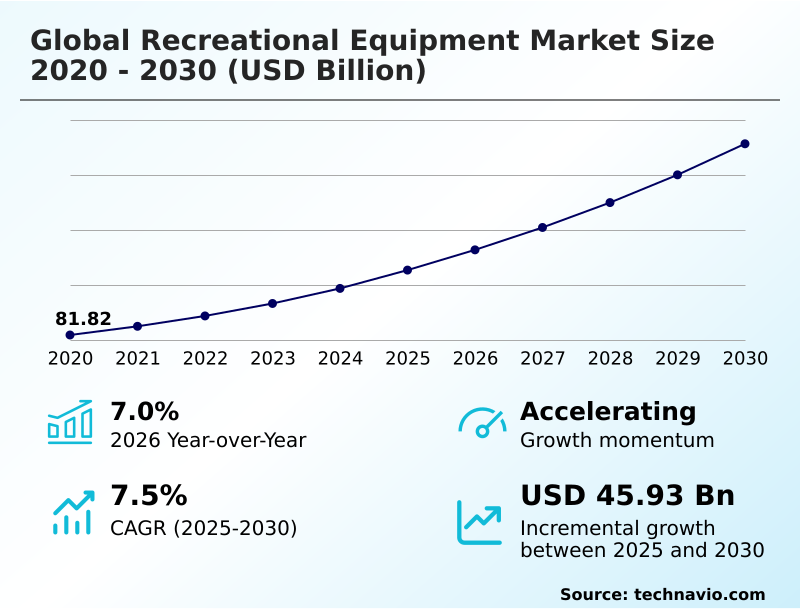
The Recreational Equipment Market size was valued at USD 105.42 billion in 2025 growing at a CAGR of 7.5% during the forecast period 2026-2030.
APAC accounts for 29.2% of incremental growth during the forecast period. The Camping and hiking gear segment by Product was valued at USD 42.04 billion in 2024, while the Residential users segment holds the largest revenue share by End-user.
The market is projected to grow by USD 69.53 billion from 2020 to 2030, with USD 45.93 billion of the growth expected during the forecast period of 2025 to 2030.
Get Key Insights on Market Forecast (PDF) Request Free Sample
Recreational Equipment Market Overview
The recreational equipment market is defined by a continuous push for performance and sustainability, with a notable 7.0% year-over-year growth reflecting strong consumer engagement. A key dynamic is the integration of advanced technologies into traditional gear; smart wearable integration and performance enhancing sportswear are no longer niche, but core to product development. This is driven by consumer demand for data-driven training and enhanced safety. For example, a manufacturer of cycling safety helmets now incorporates multi-directional impact protection systems and integrated communication systems, leveraging aerodynamic design principles tested in wind tunnels. These helmets, made from impact-resistant materials, can reduce rotational forces during an impact, a critical factor in preventing brain injury, as specified by testing protocols like those from Virginia Tech. This focus on verifiable safety and performance, coupled with the trend towards eco-friendly manufacturing, dictates procurement decisions for both individual consumers and commercial operators.
Drivers, Trends, and Challenges in the Recreational Equipment Market
Strategic decision-making in the recreational equipment market is increasingly complex, influenced by granular consumer queries like the best lightweight tent for solo backpacking or the impact of biometric sensors on fitness training.
Procurement managers for adventure tourism companies now scrutinize the technical specifications for climbing ropes and thermal insulation standards for sleeping bags to ensure compliance with safety regulations like the Consumer Product Safety Act (CPSA).
The trend toward personalization means consumers are evaluating the custom fitting process for ski boots and seeking out the benefits of carbon fiber in bicycle frames before purchase.
In manufacturing, a focus on eco-friendly materials in outdoor apparel has led to operational shifts, where the adoption of a new waterless dyeing process can be over 50% more capital-intensive upfront than traditional methods but yields significant long-term savings on water and effluent treatment costs.
This environment requires brands to provide detailed guidance, from how to choose a gravel bike for beginners to maintenance tips for high-end mountain bikes, to build trust and capture market share in a landscape shaped by informed, specific consumer needs.
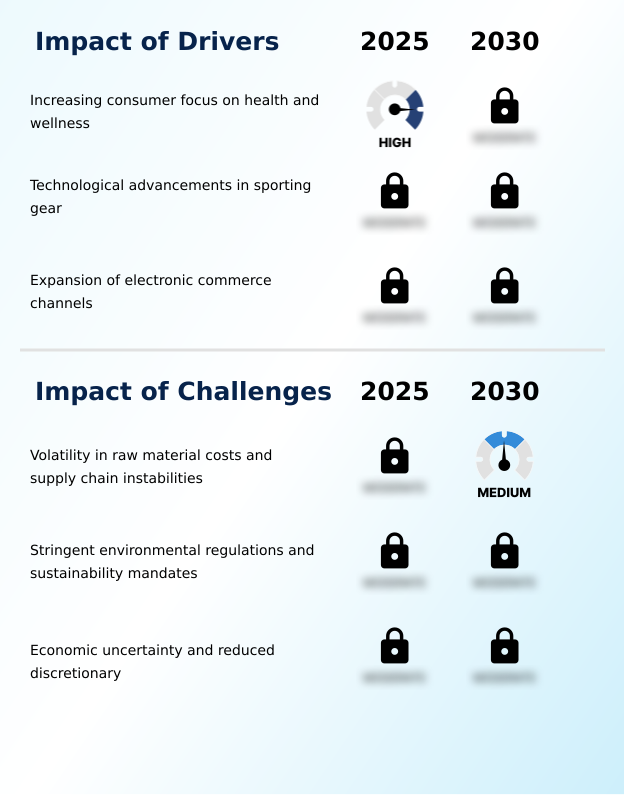
Primary Growth Driver: The primary market driver is the increasing consumer focus on health and wellness, which is boosting demand for recreational activities and related equipment.
Technological advancements are a primary driver, particularly the smart wearable integration within personal fitness equipment. Devices with biometric sensors and gps-enabled navigation are becoming standard, offering users real-time performance data.
This connected fitness technology is attracting a tech-savvy demographic, while innovations in lightweight materials like advanced carbon fiber composites enhance performance in products like all-terrain bicycles.
Furthermore, 3d printing customization is enabling the creation of customized sports equipment, from footwear to helmets, tailored to individual anatomy.
This fusion of digital tech and material science compels frequent upgrades, driving replacement sales for everything from smart fitness watches to outdoor navigation devices.
Emerging Market Trend: A significant market trend is the increasing adoption of sustainable and eco-friendly manufacturing practices. This shift is driven by consumer demand and regulatory pressures for environmental accountability.
The adoption of sustainable manufacturing processes is reshaping the recreational equipment market, with a focus on a circular economy. Manufacturers are increasingly utilizing recycled plastic materials and plant-based polymers to meet consumer demand for eco-conscious outdoor products and adhere to standards like the Global Recycled Standard (GRS).
This shift towards eco-friendly manufacturing and sustainable activewear is not just about material sourcing but also includes modular equipment design to facilitate repairs and extend product lifecycles. The rise of rental platforms and certified second-hand marketplaces for specialized sporting goods further exemplifies this trend, creating new revenue streams while reducing waste and promoting resource efficiency.
Key Industry Challenge: A key challenge facing the industry is the volatility in raw material costs and persistent supply chain instabilities, which impact profitability and production schedules.
The industry faces significant headwinds from material cost volatility and supply chain disruptions affecting key inputs like high-performance polymers and durable alloy frames. The production of robust equipment, such as machines with reinforced steel frames and high-torque motors, relies on a stable supply of these commodities.
Concurrently, stringent regulations like the EU's REACH directive impose compliance burdens and R&D costs for developing alternative, compliant materials without compromising performance. This forces manufacturers to either absorb costs, risking margin compression, or pass them to consumers, potentially reducing demand for non-essential premium golf clubs and other high-ticket items, especially amid economic uncertainty.
Explore Full Market Dynamics Analysis Request Free Sample
Recreational Equipment Market Segmentation
The recreational equipment industry research report provides comprehensive data including region-wise segment analysis, with forecasts and analysis for the period 2026-2030, as well as historical data from 2020-2024 for the following segments.
Product Segment Analysis
The camping and hiking gear segment is estimated to witness significant growth during the forecast period.
The market segmentation reveals camping and hiking gear as a dominant category, representing over 42% of sales in 2024. This segment's growth is propelled by consumer demand for equipment that enhances outdoor experiences through superior technical specifications.
Key innovations focus on lightweight materials and ergonomic equipment design, evident in products featuring carbon fiber composites and waterproof breathable fabrics.
Adherence to performance benchmarks, such as ISO 23537 for thermal insulation technology in sleeping bags, is critical for brand credibility.
The emphasis on foldable equipment design and portability in portable camping solutions also caters to a broad consumer base, from families to solo adventurers seeking lightweight backpacking gear.
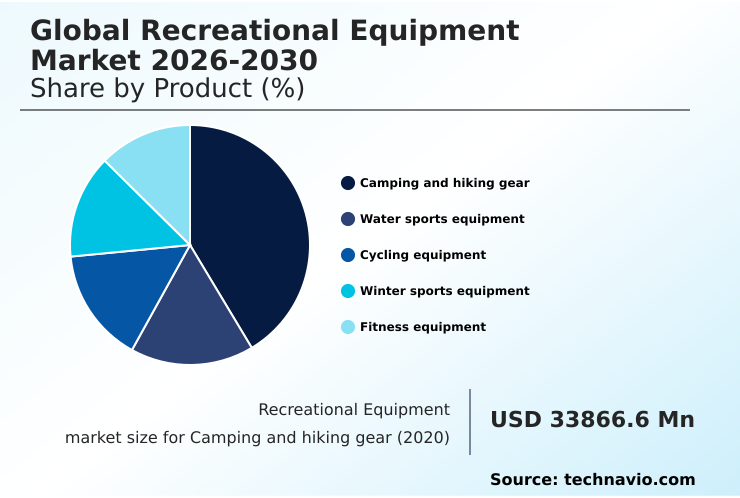
The Camping and hiking gear segment was valued at USD 42.04 billion in 2024 and showed a gradual increase during the forecast period.
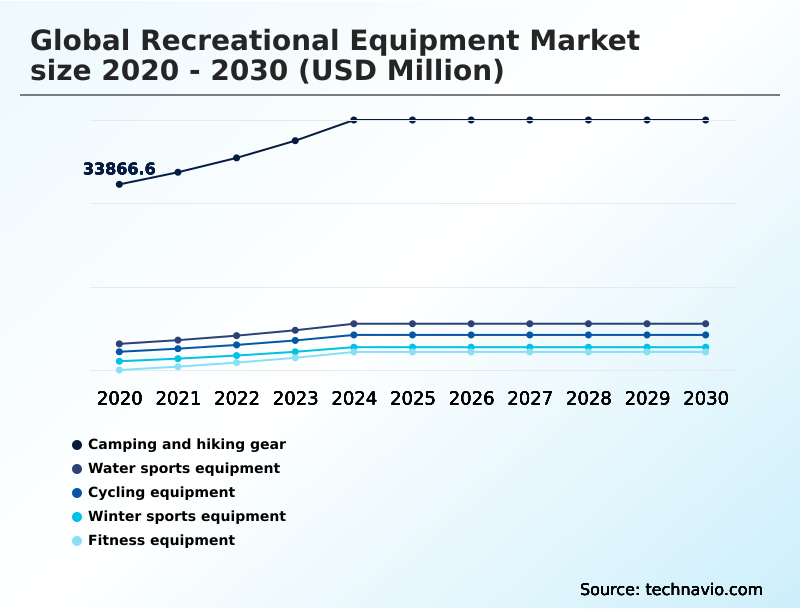
Recreational Equipment Market by Region: APAC Leads with 29.2% Growth Share
APAC is estimated to contribute 29.2% to the growth of the global market during the forecast period.
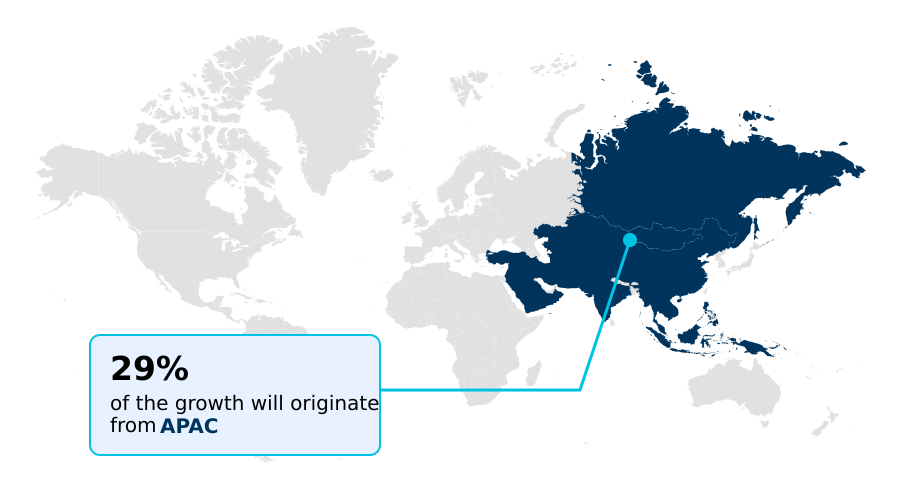
The geographic landscape is diverse, with APAC poised to contribute 29.2% of the market's incremental growth, driven by rising disposable incomes.
In North America, which accounts for nearly 29% of the growth opportunity, demand is mature for outdoor adventure gear and winter sports safety gear. European markets, contributing over 25%, prioritize urban mobility equipment and gear compliant with strict environmental standards.
In emerging South American and Middle Eastern markets, growth is linked to expanding tourism infrastructure, which boosts demand for recreational boating equipment and water sports accessories.
This regional variation requires manufacturers to tailor their product offerings, from durable hiking footwear for alpine regions to advanced marine electronics for coastal markets.
Customer Landscape Analysis for the Recreational Equipment Market
The recreational equipment market forecasting report includes the adoption lifecycle of the market, covering from the innovator’s stage to the laggard’s stage. It focuses on adoption rates in different regions based on penetration. Furthermore, the recreational equipment market report also includes key purchase criteria and drivers of price sensitivity to help companies evaluate and develop their market growth analysis strategies.
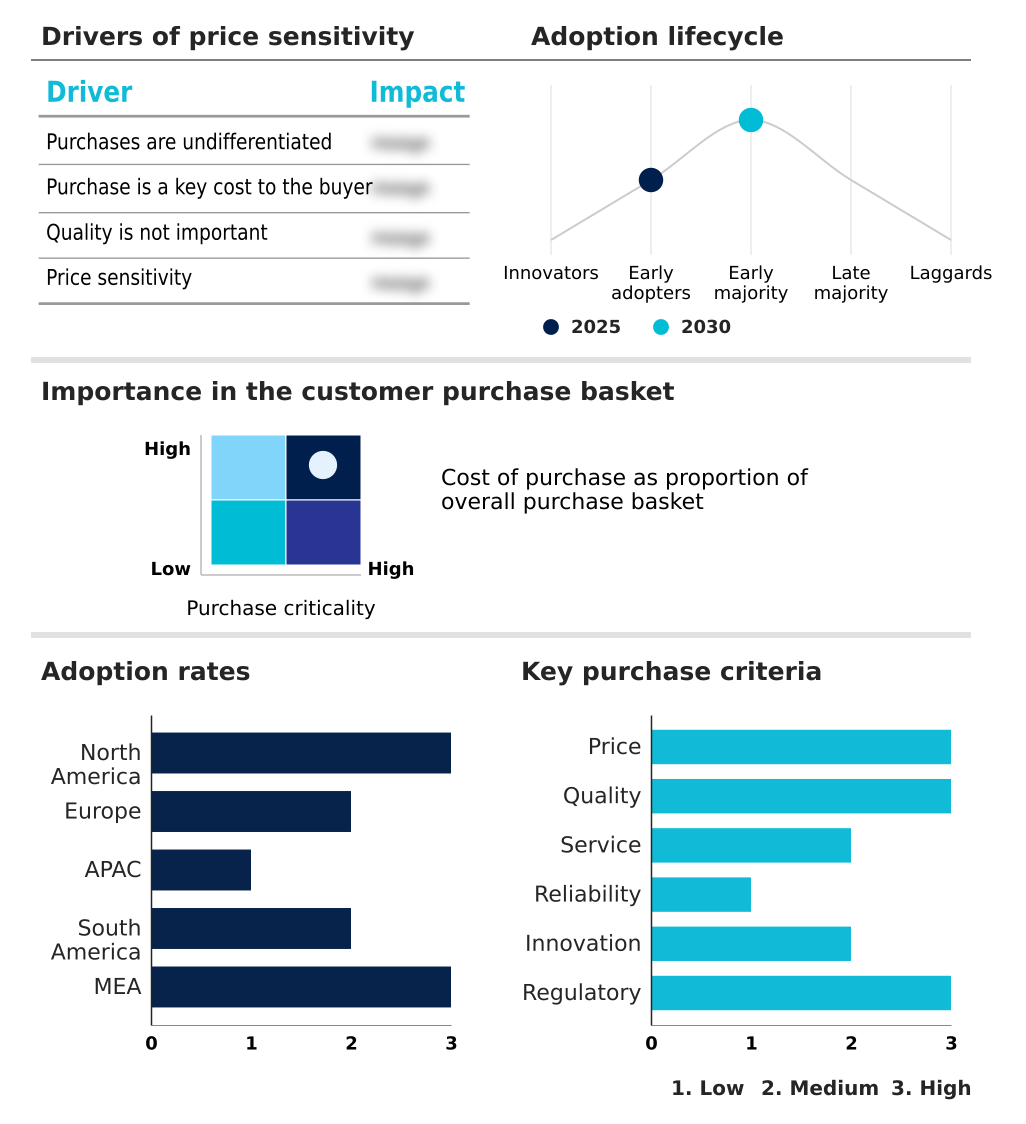
Competitive Landscape of the Recreational Equipment Market
Companies are implementing various strategies, such as strategic alliances, partnerships, mergers and acquisitions, geographical expansion, and product/service launches, to enhance their presence in the recreational equipment market industry.
Amer Sports Corp. - Offers a diversified portfolio of recreational equipment spanning winter sports, racquet sports, and performance outdoor apparel, catering to varied athletic and leisure consumer segments.
The industry research and growth report includes detailed analyses of the competitive landscape of the market and information about key companies, including:
- Amer Sports Corp.
- Brunswick Corp.
- Clarus Corp.
- Columbia Sportswear Co.
- Decathlon SA
- Deckers Outdoor Corp.
- Garmin Ltd.
- HEAD Sport GmbH
- Naturehike
- Newell Brands Inc.
- Nike Inc.
- Patagonia Inc.
- Peloton Interactive Inc.
- Recreational Equipment Inc.
- The North Face
- Topgolf Callaway Brands Corp.
- Trek Bicycle Corp.
- VF Corp.
- Vista Outdoor Inc.
- Yonex Co. Ltd.
Qualitative and quantitative analysis of companies has been conducted to help clients understand the wider business environment as well as the strengths and weaknesses of key industry players. Data is qualitatively analyzed to categorize companies as pure play, category-focused, industry-focused, and diversified; it is quantitatively analyzed to categorize companies as dominant, leading, strong, tentative, and weak.
Recent Developments in the Recreational Equipment Market
- In May 2025, iFIT Inc., a leader in connected fitness, announced its strategic acquisition of Reform RX, a provider of advanced Pilates reformers, signaling a significant expansion into the home-based, low-impact strength training segment.
- In April 2025, Raleigh introduced the Raleigh ONE, a new urban commuter e-bike featuring smart connectivity and a lightweight frame, designed to meet growing demand for sustainable urban mobility solutions.
- In March 2025, Mountain Equipment, a specialist in alpine gear, launched its Xenith sleeping bag collection, showcasing new lightweight materials and designs to optimize warmth-to-weight performance for backcountry adventurers.
- In January 2025, ALPS Mountaineering, a manufacturer of performance outdoor gear, introduced a new series of backpacking sleeping bags, enhancing its product line for wilderness exploration and family camping.
Research Analyst Overview: Recreational Equipment Market
The recreational equipment market's growth trajectory is tied to material science and digital integration, with boardroom decisions increasingly focused on sustainable R&D investment. The adoption of lightweight materials, particularly advanced carbon fiber composites, in everything from bicycle frames to ski boots is a critical differentiator. These materials offer superior strength-to-weight ratios, a key purchasing factor.
However, their material cost volatility and complex production, governed by standards like ASTM D7290 for composite testing, present supply chain risks. Simultaneously, the market is being reshaped by smart wearable integration. A prime example is the use of embedded biometric sensors and gps-enabled navigation in high-performance athletic apparel and smart fitness watches.
This trend allows for 3d printing customization of gear based on performance data, creating a powerful ecosystem of connected fitness technology and athletic training accessories. Companies that can navigate the high CAPEX of sustainable manufacturing processes while mastering the integration of digital features will secure a competitive advantage in a market where consumers demand both peak performance and environmental responsibility.
Dive into Technavio’s robust research methodology, blending expert interviews, extensive data synthesis, and validated models for unparalleled Recreational Equipment Market insights. See full methodology.
| Market Scope | |
|---|---|
| Page number | 319 |
| Base year | 2025 |
| Historic period | 2020-2024 |
| Forecast period | 2026-2030 |
| Growth momentum & CAGR | Accelerate at a CAGR of 7.5% |
| Market growth 2026-2030 | USD 45929.7 million |
| Market structure | Fragmented |
| YoY growth 2025-2026(%) | 7.0% |
| Key countries | US, Canada, Mexico, Germany, UK, France, Italy, Spain, The Netherlands, China, India, Japan, South Korea, Australia, Indonesia, Brazil, Argentina, Colombia, Saudi Arabia, UAE, South Africa, Turkey and Israel |
| Competitive landscape | Leading Companies, Market Positioning of Companies, Competitive Strategies, and Industry Risks |
Recreational Equipment Market: Key Questions Answered in This Report
-
What is the expected growth of the Recreational Equipment Market between 2026 and 2030?
-
The Recreational Equipment Market is expected to grow by USD 45.93 billion during 2026-2030, registering a CAGR of 7.5%. Year-over-year growth in 2026 is estimated at 7.0%%. This acceleration is shaped by increasing consumer focus on health and wellness , which is intensifying demand across multiple end-use verticals covered in the report.
-
-
What segmentation does the market report cover?
-
The report is segmented by Product (Camping and hiking gear, Water sports equipment, Cycling equipment, Winter sports equipment, and Fitness equipment), End-user (Residential users, Commercial facilities, Sports clubs, and Adventure tourism operators), Distribution Channel (Specialty stores, Mass merchandisers, Online retailers, and Department stores) and Geography (North America, Europe, APAC, South America, Middle East and Africa). Among these, the Camping and hiking gear segment is estimated to witness significant growth during the forecast period, driven by rising adoption across key application areas. Each segment includes detailed qualitative and quantitative analysis, along with historical data from 2020-2024 and forecasts through 2030 with year-over-year growth rates.
-
-
Which regions are analyzed in the report?
-
The report covers North America, Europe, APAC, South America and Middle East and Africa. APAC is estimated to contribute 29.2% to market growth during the forecast period. Country-level analysis includes US, Canada, Mexico, Germany, UK, France, Italy, Spain, The Netherlands, China, India, Japan, South Korea, Australia, Indonesia, Brazil, Argentina, Colombia, Saudi Arabia, UAE, South Africa, Turkey and Israel, with dedicated market size tables and year-over-year growth for each.
-
-
What are the key growth drivers and market challenges?
-
The primary driver is increasing consumer focus on health and wellness , which is accelerating investment and industry demand. The main challenge is volatility in raw material costs and supply chain instabilities, creating operational barriers for key market participants. The report quantifies the impact of each driver and challenge across 2026 and 2030 with comparative analysis.
-
-
Who are the major players in the Recreational Equipment Market?
-
Key vendors include Amer Sports Corp., Brunswick Corp., Clarus Corp., Columbia Sportswear Co., Decathlon SA, Deckers Outdoor Corp., Garmin Ltd., HEAD Sport GmbH, Naturehike, Newell Brands Inc., Nike Inc., Patagonia Inc., Peloton Interactive Inc., Recreational Equipment Inc., The North Face, Topgolf Callaway Brands Corp., Trek Bicycle Corp., VF Corp., Vista Outdoor Inc. and Yonex Co. Ltd.. The report provides qualitative and quantitative analysis categorizing companies as dominant, leading, strong, tentative, and weak based on their market positioning. Company profiles include business segment analysis, SWOT assessment, key offerings, and recent strategic developments.
-
Recreational Equipment Market Research Insights
Market dynamics are shaped by a competitive push for innovation across segments, with APAC showing the highest regional growth potential at an 8.7% CAGR, compared to North America's 6.7%. Consumers are increasingly seeking specialized sporting goods that offer tangible performance benefits, driving the adoption of high-performance athletic apparel and outdoor adventure gear.
This trend is evident in the development of professional-grade climbing tools and backcountry safety equipment, which must meet stringent UIAA safety standards. In practice, a user's choice between different ergonomic backpack design models is heavily influenced by reviews of their load distribution efficiency and materials, such as sweat-resistant upholstery on contact points.
This granular focus on user experience and safety compliance is a critical differentiator for brands in a crowded marketplace.
We can help! Our analysts can customize this recreational equipment market research report to meet your requirements.
 RIA -
RIA -