


Microcontroller (MCU) Market Analysis, Size, and Forecast 2026-2030: APAC (China, Japan, and India), Europe (Germany, UK, and France), North America (US, Canada, and Mexico), South America (Brazil and Argentina), Middle East and Africa (Saudi Arabia, UAE, and South Africa), and Rest of World (ROW)

Microcontroller (MCU) Market Analysis, Size, and Forecast 2026-2030:
APAC (China, Japan, and India), Europe (Germany, UK, and France), North America (US, Canada, and Mexico), South America (Brazil and Argentina), Middle East and Africa (Saudi Arabia, UAE, and South Africa), and Rest of World (ROW)

Published: May 2026 300 Pages SKU: IRTNTR44449

Market Overview at a Glance

$12.49 B
Market Opportunity
7.8%
CAGR 2025 - 2030
67.9%
APAC Growth
$9.73 B
Automotive segment 2024

Microcontroller (MCU) Market Size 2026-2030

The microcontroller (mcu) market size is valued to increase by USD 12.49 billion, at a CAGR of 7.8% from 2025 to 2030. Proliferation of automotive electrification and advanced driver assistance systems will drive the microcontroller (mcu) market.

Major Market Trends & Insights

  • APAC dominated the market and accounted for a 67.9% growth during the forecast period.
  • By Application - Automotive segment was valued at USD 9.73 billion in 2024
  • By Product - 32-bit microcontrollers segment accounted for the largest market revenue share in 2024

Market Size & Forecast

  • Market Opportunities: USD 21.11 billion
  • Market Future Opportunities: USD 12.49 billion
  • CAGR from 2025 to 2030 : 7.8%

Market Summary

  • The Microcontroller (MCU) Market is undergoing a significant transformation, driven by the migration of computational intelligence to the network edge. This shift toward on-device computing is propelled by demands for lower latency, enhanced data privacy, and greater energy efficiency across the industrial, automotive, and consumer sectors.
  • Architectures are evolving beyond simple control functions to become sophisticated systems-on-chip capable of handling machine learning workloads and advanced sensor fusion. For instance, in an industrial setting, a modern 32-bit microcontroller with an integrated neural processing unit can execute predictive maintenance algorithms directly on a production line machine.
  • This capability allows for the early detection of potential failures without relying on a constant cloud connection, reducing operational downtime and improving overall equipment effectiveness. Concurrently, the industry faces challenges related to escalating design complexity and the need for robust, hardware-level security.
  • The adoption of open-source standards like RISC-V is emerging as a key trend, offering greater design flexibility and mitigating supply chain vulnerabilities in a landscape shaped by geopolitical dynamics. The market's trajectory is defined by this balance between advancing performance and navigating structural industry shifts.

What will be the Size of the Microcontroller (MCU) Market during the forecast period?
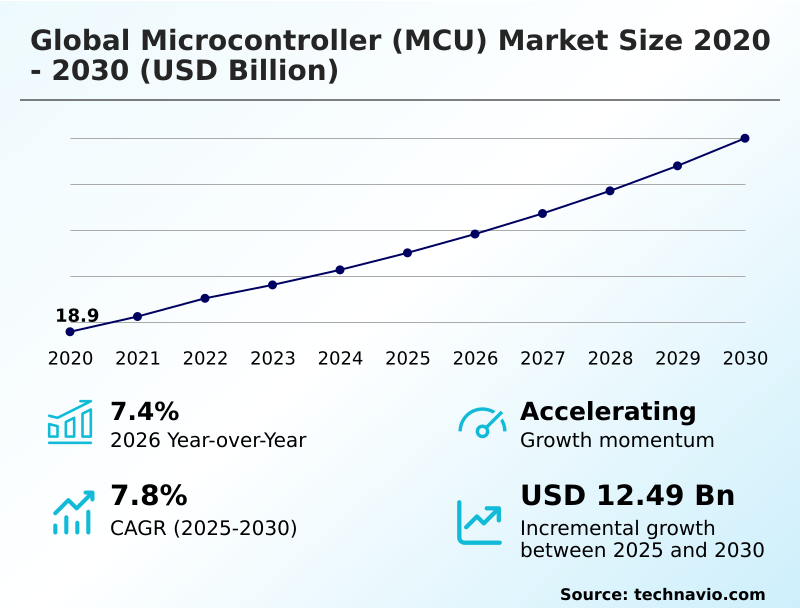
Get Key Insights on Market Forecast (PDF) Get Free Sample

How is the Microcontroller (MCU) Market Segmented?

The microcontroller (mcu) industry research report provides comprehensive data (region-wise segment analysis), with forecasts and estimates in "USD million" for the period 2026-2030, as well as historical data from 2020-2024 for the following segments.

  • Application
    • Automotive
    • Consumer devices
    • Industrial
    • Others
  • Product
    • 32-bit microcontrollers
    • 16-bit microcontrollers
    • 8-bit microcontrollers
  • Type
    • Reduced instruction set computer (RISC)
    • Complex instruction set computer (CISC)
  • Geography
    • APAC
      • China
      • Japan
      • India
    • Europe
      • Germany
      • UK
      • France
    • North America
      • US
      • Canada
      • Mexico
    • South America
      • Brazil
      • Argentina
    • Middle East and Africa
      • Saudi Arabia
      • UAE
      • South Africa
    • Rest of World (ROW)

By Application Insights

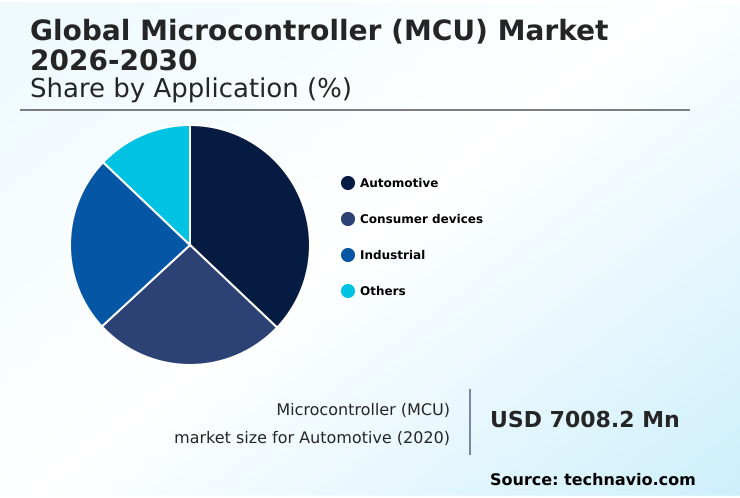
The automotive segment is estimated to witness significant growth during the forecast period.

The automotive segment's demand for advanced embedded processing is driven by the transition to the software-defined vehicle (SDV).

This shift necessitates a complex zonal architecture managed by high-performance, automotive-grade MCU units capable of handling advanced driver-assistance systems (ADAS) and vehicle-to-everything (V2X) communication. Integrating features like a CAN FD interface and sophisticated sensor fusion algorithms is now standard.

To meet stringent functional safety ISO 26262 requirements in these mission-critical environments, manufacturers are focusing on system-level integration for components like the battery management system (BMS).

This approach streamlines development and has demonstrated the ability to improve operational efficiency in managing connected car features by more than 15% through optimized high-speed communication interfaces.
Get Free Sample

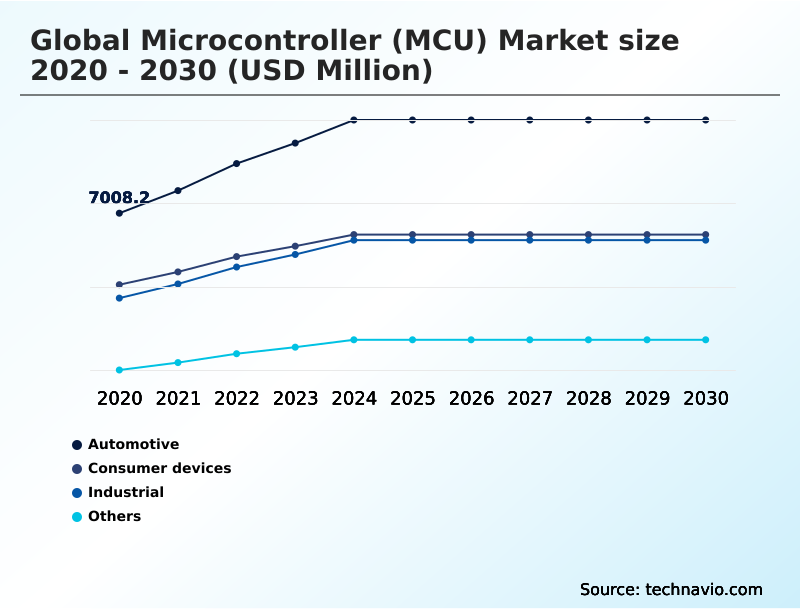
The Automotive segment was valued at USD 9.73 billion in 2024 and showed a gradual increase during the forecast period.
Get Free Sample

Regional Analysis

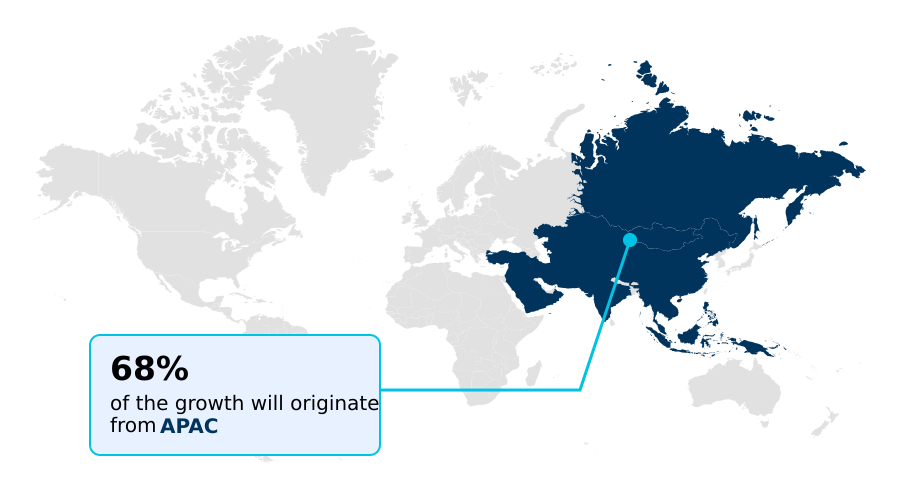
APAC is estimated to contribute 67.9% to the growth of the global market during the forecast period.Technavio’s analysts have elaborately explained the regional trends and drivers that shape the market during the forecast period.
See How Microcontroller (MCU) Market Demand is Rising in APAC Get Free Sample

The geographic landscape of the market is characterized by distinct regional specializations.

APAC remains the dominant force in high-volume manufacturing, accounting for over 67% of the market's incremental growth, and is a major consumer of 8-bit microcontroller and 16-bit microcontroller units for consumer electronics and wearable technology.

In contrast, North America and Europe are centers for semiconductor innovation, focusing on high-value applications. These regions lead in the development of complex system-on-chip (SoC) solutions and mixed-signal controller designs for the automotive, industrial, and medical sectors.

The demand for advanced features like over-the-air (OTA) updates and sophisticated human-machine interface (HMI) systems in these markets drives the adoption of processors with larger embedded flash memory.

This dynamic creates a balanced global ecosystem, with one region excelling in scale and the others in technological specialization.

Market Dynamics

Our researchers analyzed the data with 2025 as the base year, along with the key drivers, trends, and challenges. A holistic analysis of drivers will help companies refine their marketing strategies to gain a competitive advantage.

  • Selecting the right embedded processor requires a deep understanding of application-specific needs across diverse sectors. For connected devices, a low-power microcontroller for IoT sensors is essential for extending battery life, while a wireless MCU for smart home hubs must balance connectivity with robust performance.
  • In the automotive industry, the choice of an automotive microcontroller for ADAS applications is dictated by stringent safety standards, leading to demand for a functional safety certified automotive MCU. As vehicles evolve, a dual-core MCU for automotive gateways manages data flow, while a specialized MCU for battery management in EVs is critical for efficiency and safety.
  • The rise of software-defined vehicles is driven by the zonal controller for software-defined vehicles, often requiring a 32-bit MCU with integrated CAN FD. In industrial settings, a real-time MCU for industrial motor control ensures precision, and an industrial automation PLC with MCU forms the backbone of smart factories.
  • Security is a universal concern, addressed by a secure boot microcontroller for payment systems and an MCU with hardware security for IIoT. The growth of artificial intelligence at the edge is creating new comparisons, with engineers evaluating the best MCU for running TinyML models and reviewing edge AI MCU performance benchmarks.
  • Development is supported by platforms like the RISC-V core microcontroller development kit, while legacy systems still rely on the 8-bit microcontroller with core independent peripherals. Specialized markets, such as healthcare and automotive, demand a high-precision ADC microcontroller for medical use and a 16-bit MCU for automotive body electronics.
  • For designers, MCU selection for low-latency applications and optimizing power management for battery-powered MCUs are critical considerations, where custom solutions can offer a 15% performance advantage over off-the-shelf components but with longer supply chain lead times.
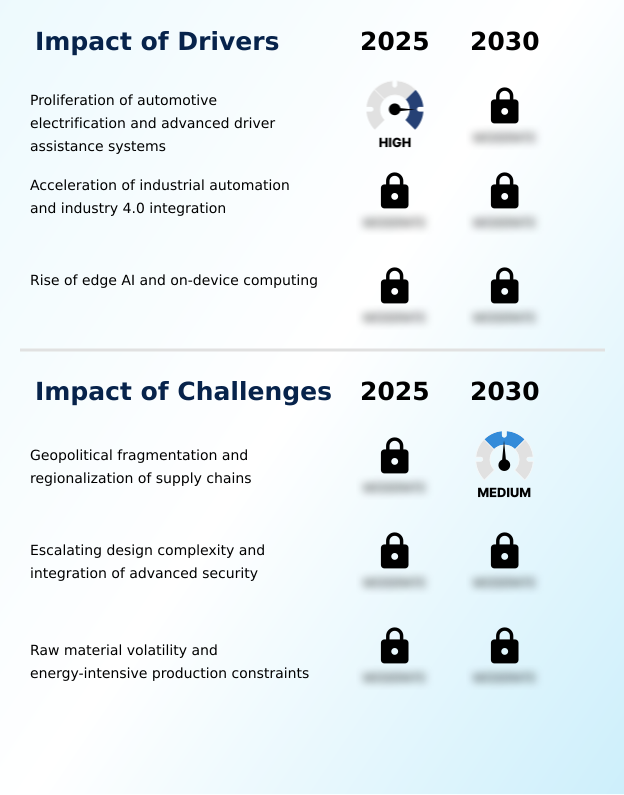
What are the key market drivers leading to the rise in the adoption of Microcontroller (MCU) Industry?

  • A key market driver is the proliferation of automotive electrification and the rapid integration of advanced driver assistance systems in modern vehicles.

  • Market growth is significantly propelled by the digitization of industrial environments. The integration of the industrial internet of things (IIoT) is driving demand for ruggedized components in industrial control systems and for the programmable logic controller (PLC).
  • This shift toward factory floor digitization relies on decentralized intelligence, where a 32-bit microcontroller running a real-time operating system (RTOS) can execute predictive maintenance protocols. Such deployments have been shown to increase equipment uptime by up to 20%.
  • The need for energy-efficient production is also fueling the adoption of advanced motor control systems and power management IC (PMIC) solutions.
  • These systems enable smart grid technologies and are fundamental to the operational efficiency of modern manufacturing, where real-time control can reduce energy consumption by 12%.

What are the market trends shaping the Microcontroller (MCU) Industry?

  • A primary trend influencing the market is the integration of artificial intelligence and machine learning at the network edge. This allows for enhanced on-device processing and real-time decision-making in connected systems.

  • Key trends are reshaping the market by embedding intelligence directly into hardware. The adoption of edge AI processing, powered by a dedicated neural processing unit (NPU), allows for complex TinyML applications to run directly on-device. This use of hardware acceleration delivers a performance increase of over 50% for inference tasks compared to software-only execution.
  • The move toward open standards, particularly the RISC-V architecture, is providing an alternative to the dominant ARM Cortex-M core, offering greater flexibility for an application-specific instruction set. This trend enables on-device computing in smart home appliances and other connected products, improving low-latency decision-making.
  • Furthermore, advancements in wireless connectivity and a more sophisticated embedded software ecosystem are lowering the barrier to entry for developing these intelligent systems, which are consistently exceeding previous power efficiency benchmarks.

What challenges does the Microcontroller (MCU) Industry face during its growth?

  • A significant market challenge stems from geopolitical fragmentation and the corresponding strategic regionalization of global semiconductor supply chains.

  • The market is navigating significant challenges related to design complexity and security. The push for a single-chip solution that integrates multi-core architectures and advanced peripherals escalates the complexity of embedded systems design and firmware development.
  • Integrating a hardware security module (HSM) to manage secure boot and cryptographic operations is now mandatory in many sectors, driving up R&D costs by as much as 25%. This focus on cybersecurity threat mitigation is critical for high-performance data networking and resource-constrained hardware.
  • Furthermore, ensuring supply chain resilience has become a primary concern, forcing a strategic re-evaluation of global manufacturing dependencies. This environment complicates semiconductor innovation, as companies must balance technological advancement with the need for a secure and stable supply of components, including precision analog peripherals.

Exclusive Technavio Analysis on Customer Landscape

The microcontroller (mcu) market forecasting report includes the adoption lifecycle of the market, covering from the innovator’s stage to the laggard’s stage. It focuses on adoption rates in different regions based on penetration. Furthermore, the microcontroller (mcu) market report also includes key purchase criteria and drivers of price sensitivity to help companies evaluate and develop their market growth analysis strategies.
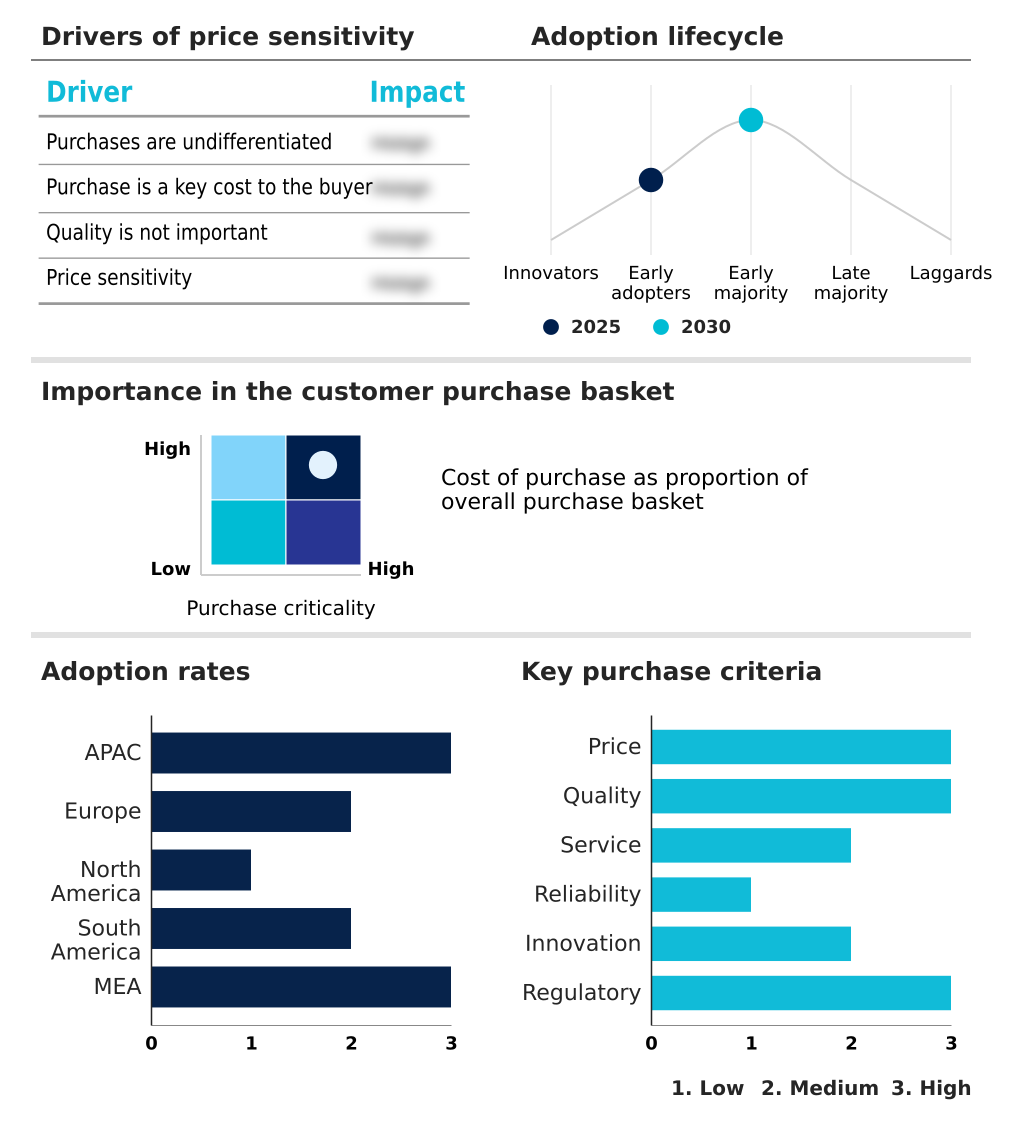
Customer Landscape of Microcontroller (MCU) Industry

Competitive Landscape

Companies are implementing various strategies, such as strategic alliances, microcontroller (mcu) market forecast, partnerships, mergers and acquisitions, geographical expansion, and product/service launches, to enhance their presence in the industry.

Analog Devices Inc. - Offerings are centered on precision analog and mixed-signal microcontrollers, delivering high-performance data conversion and sensor interface solutions for specialized embedded systems.

The industry research and growth report includes detailed analyses of the competitive landscape of the market and information about key companies, including:

  • Analog Devices Inc.
  • Espressif Systems Shanghai
  • Fujitsu Ltd.
  • GigaDevice Semiconductor Inc
  • Infineon Technologies AG
  • Intel Corp.
  • Microchip Technology Inc.
  • Nordic Semiconductor ASA
  • Nuvoton Technology Corp.
  • NXP Semiconductors NV
  • ON Semiconductor Corp.
  • Panasonic Holdings Corp.
  • Parallax Inc.
  • Realtek Semiconductor Corp.
  • Renesas Electronics Corp.
  • Silicon Laboratories Inc.
  • STMicroelectronics NV
  • Texas Instruments Inc.
  • Toshiba Corp.
  • Yamaichi Electronics Co. Ltd.

Qualitative and quantitative analysis of companies has been conducted to help clients understand the wider business environment as well as the strengths and weaknesses of key industry players. Data is qualitatively analyzed to categorize companies as pure play, category-focused, industry-focused, and diversified; it is quantitatively analyzed to categorize companies as dominant, leading, strong, tentative, and weak.

Recent Development and News in Microcontroller (mcu) market

  • In May, 2025, a leading European semiconductor manufacturer launched a new series of automotive microcontrollers featuring the open-source RISC-V architecture, designed to enhance data throughput in Level 3 autonomous driving systems.
  • In April, 2025, a major mobile technology firm released its latest microcontroller series for smart appliances, which integrates a dedicated neural processing unit to enable localized voice recognition without cloud dependency.
  • In March, 2025, NXP Semiconductors launched the FRDM Automotive platform, a development ecosystem designed to accelerate software creation and reduce complexity for its S32 family of automotive processing microcontrollers.
  • In January, 2025, Texas Instruments introduced its new MSPM0G5187 microcontroller family, which incorporates the TinyEngine neural processing unit to improve deep learning inference performance and energy efficiency at the edge.

Dive into Technavio’s robust research methodology, blending expert interviews, extensive data synthesis, and validated models for unparalleled Microcontroller (MCU) Market insights. See full methodology.

Market Scope
Page number 300
Base year 2025
Historic period 2020-2024
Forecast period 2026-2030
Growth momentum & CAGR Accelerate at a CAGR of 7.8%
Market growth 2026-2030 USD 12490.6 million
Market structure Fragmented
YoY growth 2025-2026(%) 7.4%
Key countries China, Japan, India, South Korea, Australia, Indonesia, Germany, UK, France, Italy, Spain, The Netherlands, US, Canada, Mexico, Brazil, Argentina, Chile, Saudi Arabia, UAE, South Africa, Israel and Turkey
Competitive landscape Leading Companies, Market Positioning of Companies, Competitive Strategies, and Industry Risks

Request Free Sample

Research Analyst Overview

  • The market is defined by a rapid evolution in embedded systems design, where the convergence of performance, security, and connectivity dictates strategic direction. The industry is moving beyond standalone components toward a single-chip solution approach, integrating multi-core architectures and extensive embedded flash memory.
  • This trend is driven by the demand for sophisticated edge AI processing and TinyML applications, which rely on hardware acceleration from a dedicated neural processing unit (NPU). Boardroom decisions are increasingly focused on firmware development for the software-defined vehicle (SDV), where a zonal architecture and over-the-air (OTA) updates are becoming standard.
  • This requires robust automotive-grade MCU platforms that meet functional safety ISO 26262 standards and feature a CAN FD interface. Security is non-negotiable, with the hardware security module (HSM), secure boot, and advanced cryptographic operations forming a critical defense layer.
  • In industrial control systems, the programmable logic controller (PLC) and motor control systems are transitioning from the traditional 8-bit microcontroller and 16-bit microcontroller to the more powerful 32-bit microcontroller running a real-time operating system (RTOS). This architectural shift, often leveraging ARM Cortex-M core or RISC-V architecture, can reduce computational overhead by over 30%.
  • This advancement is critical for managing wireless connectivity, sensor fusion algorithms, and the battery management system (BMS) in the expanding internet of things (IoT) ecosystem. The integration of a power management IC (PMIC) and a high-precision analog-to-digital converter (ADC) into a mixed-signal controller creates a highly efficient human-machine interface (HMI).

What are the Key Data Covered in this Microcontroller (MCU) Market Research and Growth Report?

  • What is the expected growth of the Microcontroller (MCU) Market between 2026 and 2030?

    • USD 12.49 billion, at a CAGR of 7.8%

  • What segmentation does the market report cover?

    • The report is segmented by Application (Automotive, Consumer devices, Industrial, and Others), Product (32-bit microcontrollers, 16-bit microcontrollers, and 8-bit microcontrollers), Type (Reduced instruction set computer (RISC), and Complex instruction set computer (CISC)) and Geography (APAC, Europe, North America, South America, Middle East and Africa)

  • Which regions are analyzed in the report?

    • APAC, Europe, North America, South America and Middle East and Africa

  • What are the key growth drivers and market challenges?

    • Proliferation of automotive electrification and advanced driver assistance systems, Geopolitical fragmentation and regionalization of supply chains

  • Who are the major players in the Microcontroller (MCU) Market?

    • Analog Devices Inc., Espressif Systems Shanghai, Fujitsu Ltd., GigaDevice Semiconductor Inc, Infineon Technologies AG, Intel Corp., Microchip Technology Inc., Nordic Semiconductor ASA, Nuvoton Technology Corp., NXP Semiconductors NV, ON Semiconductor Corp., Panasonic Holdings Corp., Parallax Inc., Realtek Semiconductor Corp., Renesas Electronics Corp., Silicon Laboratories Inc., STMicroelectronics NV, Texas Instruments Inc., Toshiba Corp. and Yamaichi Electronics Co. Ltd.

Market Research Insights

  • The market's momentum is sustained by continuous semiconductor innovation that enables new applications in resource-constrained hardware. The shift toward decentralized intelligence allows for real-time data processing, which can reduce network latency by up to 40% in industrial internet of things (IIoT) deployments. Embedded software ecosystems are becoming more sophisticated to manage the complexity of multi-core architectures and high-performance data networking.
  • In the context of on-device computing, next-generation components are achieving power efficiency benchmarks that are over 25% better than their predecessors, extending the operational life of battery-powered devices. This focus on low-latency decision-making is critical in mission-critical environments where system responsiveness is paramount.

We can help! Our analysts can customize this microcontroller (mcu) market research report to meet your requirements.

Get in touch

1. Executive Summary

1.1 Market overview

Executive Summary - Chart on Market Overview
Executive Summary - Data Table on Market Overview
Executive Summary - Chart on Global Market Characteristics
Executive Summary - Chart on Market by Geography
Executive Summary - Chart on Market Segmentation by Application
Executive Summary - Chart on Market Segmentation by Product
Executive Summary - Chart on Market Segmentation by Type
Executive Summary - Chart on Incremental Growth
Executive Summary - Data Table on Incremental Growth
Executive Summary - Chart on Company Market Positioning

2. Technavio Analysis

2.1 Analysis of price sensitivity, lifecycle, customer purchase basket, adoption rates, and purchase criteria

2.2 Criticality of inputs and Factors of differentiation

Chart on Overview on criticality of inputs and factors of differentiation

2.3 Factors of disruption

Chart on Overview on factors of disruption

2.4 Impact of drivers and challenges

Chart on Impact of drivers and challenges in 2025 and 2030

3. Market Landscape

3.1 Market ecosystem

Chart on Parent Market
Data Table on - Parent Market

3.2 Market characteristics

Chart on Market characteristics analysis

3.3 Value chain analysis

Chart on Value chain analysis

4. Market Sizing

4.1 Market definition

Data Table on Offerings of companies included in the market definition

4.2 Market segment analysis

Market segments

4.3 Market size 2025

4.4 Market outlook: Forecast for 2025-2030

Chart on Global - Market size and forecast 2025-2030 ($ million)
Data Table on Global - Market size and forecast 2025-2030 ($ million)
Chart on Global Market: Year-over-year growth 2025-2030 (%)
Data Table on Global Market: Year-over-year growth 2025-2030 (%)

5. Historic Market Size

5.1 Global Microcontroller (MCU) Market 2020 - 2024

Historic Market Size - Data Table on Global Microcontroller (MCU) Market 2020 - 2024 ($ million)

5.2 Application segment analysis 2020 - 2024

Historic Market Size - Application Segment 2020 - 2024 ($ million)

5.3 Product segment analysis 2020 - 2024

Historic Market Size - Product Segment 2020 - 2024 ($ million)

5.4 Type segment analysis 2020 - 2024

Historic Market Size - Type Segment 2020 - 2024 ($ million)

5.5 Geography segment analysis 2020 - 2024

Historic Market Size - Geography Segment 2020 - 2024 ($ million)

5.6 Country segment analysis 2020 - 2024

Historic Market Size - Country Segment 2020 - 2024 ($ million)

6. Qualitative Analysis

6.1 Impact of AI in global microcontroller (MCU) market

6.2 Impact of geopolitical conflict on global microcontroller (MCU) market

7. Five Forces Analysis

7.1 Five forces summary

Five forces analysis - Comparison between 2025 and 2030

7.2 Bargaining power of buyers

Bargaining power of buyers - Impact of key factors 2025 and 2030

7.3 Bargaining power of suppliers

Bargaining power of suppliers - Impact of key factors in 2025 and 2030

7.4 Threat of new entrants

Threat of new entrants - Impact of key factors in 2025 and 2030

7.5 Threat of substitutes

Threat of substitutes - Impact of key factors in 2025 and 2030

7.6 Threat of rivalry

Threat of rivalry - Impact of key factors in 2025 and 2030

7.7 Market condition

Chart on Market condition - Five forces 2025 and 2030

8. Market Segmentation by Application

8.1 Market segments

Chart on Application - Market share 2025-2030 (%)
Data Table on Application - Market share 2025-2030 (%)

8.2 Comparison by Application

Chart on Comparison by Application
Data Table on Comparison by Application

8.3 Automotive - Market size and forecast 2025-2030

Chart on Automotive - Market size and forecast 2025-2030 ($ million)
Data Table on Automotive - Market size and forecast 2025-2030 ($ million)
Chart on Automotive - Year-over-year growth 2025-2030 (%)
Data Table on Automotive - Year-over-year growth 2025-2030 (%)

8.4 Consumer devices - Market size and forecast 2025-2030

Chart on Consumer devices - Market size and forecast 2025-2030 ($ million)
Data Table on Consumer devices - Market size and forecast 2025-2030 ($ million)
Chart on Consumer devices - Year-over-year growth 2025-2030 (%)
Data Table on Consumer devices - Year-over-year growth 2025-2030 (%)

8.5 Industrial - Market size and forecast 2025-2030

Chart on Industrial - Market size and forecast 2025-2030 ($ million)
Data Table on Industrial - Market size and forecast 2025-2030 ($ million)
Chart on Industrial - Year-over-year growth 2025-2030 (%)
Data Table on Industrial - Year-over-year growth 2025-2030 (%)

8.6 Others - Market size and forecast 2025-2030

Chart on Others - Market size and forecast 2025-2030 ($ million)
Data Table on Others - Market size and forecast 2025-2030 ($ million)
Chart on Others - Year-over-year growth 2025-2030 (%)
Data Table on Others - Year-over-year growth 2025-2030 (%)

8.7 Market opportunity by Application

Market opportunity by Application ($ million)
Data Table on Market opportunity by Application ($ million)

9. Market Segmentation by Product

9.1 Market segments

Chart on Product - Market share 2025-2030 (%)
Data Table on Product - Market share 2025-2030 (%)

9.2 Comparison by Product

Chart on Comparison by Product
Data Table on Comparison by Product

9.3 32-bit microcontrollers - Market size and forecast 2025-2030

Chart on 32-bit microcontrollers - Market size and forecast 2025-2030 ($ million)
Data Table on 32-bit microcontrollers - Market size and forecast 2025-2030 ($ million)
Chart on 32-bit microcontrollers - Year-over-year growth 2025-2030 (%)
Data Table on 32-bit microcontrollers - Year-over-year growth 2025-2030 (%)

9.4 16-bit microcontrollers - Market size and forecast 2025-2030

Chart on 16-bit microcontrollers - Market size and forecast 2025-2030 ($ million)
Data Table on 16-bit microcontrollers - Market size and forecast 2025-2030 ($ million)
Chart on 16-bit microcontrollers - Year-over-year growth 2025-2030 (%)
Data Table on 16-bit microcontrollers - Year-over-year growth 2025-2030 (%)

9.5 8-bit microcontrollers - Market size and forecast 2025-2030

Chart on 8-bit microcontrollers - Market size and forecast 2025-2030 ($ million)
Data Table on 8-bit microcontrollers - Market size and forecast 2025-2030 ($ million)
Chart on 8-bit microcontrollers - Year-over-year growth 2025-2030 (%)
Data Table on 8-bit microcontrollers - Year-over-year growth 2025-2030 (%)

9.6 Market opportunity by Product

Market opportunity by Product ($ million)
Data Table on Market opportunity by Product ($ million)

10. Market Segmentation by Type

10.1 Market segments

Chart on Type - Market share 2025-2030 (%)
Data Table on Type - Market share 2025-2030 (%)

10.2 Comparison by Type

Chart on Comparison by Type
Data Table on Comparison by Type

10.3 Reduced instruction set computer (RISC) - Market size and forecast 2025-2030

Chart on Reduced instruction set computer (RISC) - Market size and forecast 2025-2030 ($ million)
Data Table on Reduced instruction set computer (RISC) - Market size and forecast 2025-2030 ($ million)
Chart on Reduced instruction set computer (RISC) - Year-over-year growth 2025-2030 (%)
Data Table on Reduced instruction set computer (RISC) - Year-over-year growth 2025-2030 (%)

10.4 Complex instruction set computer (CISC) - Market size and forecast 2025-2030

Chart on Complex instruction set computer (CISC) - Market size and forecast 2025-2030 ($ million)
Data Table on Complex instruction set computer (CISC) - Market size and forecast 2025-2030 ($ million)
Chart on Complex instruction set computer (CISC) - Year-over-year growth 2025-2030 (%)
Data Table on Complex instruction set computer (CISC) - Year-over-year growth 2025-2030 (%)

10.5 Market opportunity by Type

Market opportunity by Type ($ million)
Data Table on Market opportunity by Type ($ million)

11. Customer Landscape

11.1 Customer landscape overview

Analysis of price sensitivity, lifecycle, customer purchase basket, adoption rates, and purchase criteria

12. Geographic Landscape

12.1 Geographic segmentation

Chart on Market share by geography 2025-2030 (%)
Data Table on Market share by geography 2025-2030 (%)

12.2 Geographic comparison

Chart on Geographic comparison
Data Table on Geographic comparison

12.3 APAC - Market size and forecast 2025-2030

Chart on APAC - Market size and forecast 2025-2030 ($ million)
Data Table on APAC - Market size and forecast 2025-2030 ($ million)
Chart on APAC - Year-over-year growth 2025-2030 (%)
Data Table on APAC - Year-over-year growth 2025-2030 (%)
Chart on Regional Comparison - APAC
Data Table on Regional Comparison - APAC

12.3.1 China - Market size and forecast 2025-2030

Chart on China - Market size and forecast 2025-2030 ($ million)
Data Table on China - Market size and forecast 2025-2030 ($ million)
Chart on China - Year-over-year growth 2025-2030 (%)
Data Table on China - Year-over-year growth 2025-2030 (%)

12.3.2 Japan - Market size and forecast 2025-2030

Chart on Japan - Market size and forecast 2025-2030 ($ million)
Data Table on Japan - Market size and forecast 2025-2030 ($ million)
Chart on Japan - Year-over-year growth 2025-2030 (%)
Data Table on Japan - Year-over-year growth 2025-2030 (%)

12.3.3 India - Market size and forecast 2025-2030

Chart on India - Market size and forecast 2025-2030 ($ million)
Data Table on India - Market size and forecast 2025-2030 ($ million)
Chart on India - Year-over-year growth 2025-2030 (%)
Data Table on India - Year-over-year growth 2025-2030 (%)

12.3.4 South Korea - Market size and forecast 2025-2030

Chart on South Korea - Market size and forecast 2025-2030 ($ million)
Data Table on South Korea - Market size and forecast 2025-2030 ($ million)
Chart on South Korea - Year-over-year growth 2025-2030 (%)
Data Table on South Korea - Year-over-year growth 2025-2030 (%)

12.3.5 Australia - Market size and forecast 2025-2030

Chart on Australia - Market size and forecast 2025-2030 ($ million)
Data Table on Australia - Market size and forecast 2025-2030 ($ million)
Chart on Australia - Year-over-year growth 2025-2030 (%)
Data Table on Australia - Year-over-year growth 2025-2030 (%)

12.3.6 Indonesia - Market size and forecast 2025-2030

Chart on Indonesia - Market size and forecast 2025-2030 ($ million)
Data Table on Indonesia - Market size and forecast 2025-2030 ($ million)
Chart on Indonesia - Year-over-year growth 2025-2030 (%)
Data Table on Indonesia - Year-over-year growth 2025-2030 (%)

12.4 Europe - Market size and forecast 2025-2030

Chart on Europe - Market size and forecast 2025-2030 ($ million)
Data Table on Europe - Market size and forecast 2025-2030 ($ million)
Chart on Europe - Year-over-year growth 2025-2030 (%)
Data Table on Europe - Year-over-year growth 2025-2030 (%)
Chart on Regional Comparison - Europe
Data Table on Regional Comparison - Europe

12.4.1 Germany - Market size and forecast 2025-2030

Chart on Germany - Market size and forecast 2025-2030 ($ million)
Data Table on Germany - Market size and forecast 2025-2030 ($ million)
Chart on Germany - Year-over-year growth 2025-2030 (%)
Data Table on Germany - Year-over-year growth 2025-2030 (%)

12.4.2 UK - Market size and forecast 2025-2030

Chart on UK - Market size and forecast 2025-2030 ($ million)
Data Table on UK - Market size and forecast 2025-2030 ($ million)
Chart on UK - Year-over-year growth 2025-2030 (%)
Data Table on UK - Year-over-year growth 2025-2030 (%)

12.4.3 France - Market size and forecast 2025-2030

Chart on France - Market size and forecast 2025-2030 ($ million)
Data Table on France - Market size and forecast 2025-2030 ($ million)
Chart on France - Year-over-year growth 2025-2030 (%)
Data Table on France - Year-over-year growth 2025-2030 (%)

12.4.4 Italy - Market size and forecast 2025-2030

Chart on Italy - Market size and forecast 2025-2030 ($ million)
Data Table on Italy - Market size and forecast 2025-2030 ($ million)
Chart on Italy - Year-over-year growth 2025-2030 (%)
Data Table on Italy - Year-over-year growth 2025-2030 (%)

12.4.5 Spain - Market size and forecast 2025-2030

Chart on Spain - Market size and forecast 2025-2030 ($ million)
Data Table on Spain - Market size and forecast 2025-2030 ($ million)
Chart on Spain - Year-over-year growth 2025-2030 (%)
Data Table on Spain - Year-over-year growth 2025-2030 (%)

12.4.6 The Netherlands - Market size and forecast 2025-2030

Chart on The Netherlands - Market size and forecast 2025-2030 ($ million)
Data Table on The Netherlands - Market size and forecast 2025-2030 ($ million)
Chart on The Netherlands - Year-over-year growth 2025-2030 (%)
Data Table on The Netherlands - Year-over-year growth 2025-2030 (%)

12.5 North America - Market size and forecast 2025-2030

Chart on North America - Market size and forecast 2025-2030 ($ million)
Data Table on North America - Market size and forecast 2025-2030 ($ million)
Chart on North America - Year-over-year growth 2025-2030 (%)
Data Table on North America - Year-over-year growth 2025-2030 (%)
Chart on Regional Comparison - North America
Data Table on Regional Comparison - North America

12.5.1 US - Market size and forecast 2025-2030

Chart on US - Market size and forecast 2025-2030 ($ million)
Data Table on US - Market size and forecast 2025-2030 ($ million)
Chart on US - Year-over-year growth 2025-2030 (%)
Data Table on US - Year-over-year growth 2025-2030 (%)

12.5.2 Canada - Market size and forecast 2025-2030

Chart on Canada - Market size and forecast 2025-2030 ($ million)
Data Table on Canada - Market size and forecast 2025-2030 ($ million)
Chart on Canada - Year-over-year growth 2025-2030 (%)
Data Table on Canada - Year-over-year growth 2025-2030 (%)

12.5.3 Mexico - Market size and forecast 2025-2030

Chart on Mexico - Market size and forecast 2025-2030 ($ million)
Data Table on Mexico - Market size and forecast 2025-2030 ($ million)
Chart on Mexico - Year-over-year growth 2025-2030 (%)
Data Table on Mexico - Year-over-year growth 2025-2030 (%)

12.6 South America - Market size and forecast 2025-2030

Chart on South America - Market size and forecast 2025-2030 ($ million)
Data Table on South America - Market size and forecast 2025-2030 ($ million)
Chart on South America - Year-over-year growth 2025-2030 (%)
Data Table on South America - Year-over-year growth 2025-2030 (%)
Chart on Regional Comparison - South America
Data Table on Regional Comparison - South America

12.6.1 Brazil - Market size and forecast 2025-2030

Chart on Brazil - Market size and forecast 2025-2030 ($ million)
Data Table on Brazil - Market size and forecast 2025-2030 ($ million)
Chart on Brazil - Year-over-year growth 2025-2030 (%)
Data Table on Brazil - Year-over-year growth 2025-2030 (%)

12.6.2 Argentina - Market size and forecast 2025-2030

Chart on Argentina - Market size and forecast 2025-2030 ($ million)
Data Table on Argentina - Market size and forecast 2025-2030 ($ million)
Chart on Argentina - Year-over-year growth 2025-2030 (%)
Data Table on Argentina - Year-over-year growth 2025-2030 (%)

12.6.3 Chile - Market size and forecast 2025-2030

Chart on Chile - Market size and forecast 2025-2030 ($ million)
Data Table on Chile - Market size and forecast 2025-2030 ($ million)
Chart on Chile - Year-over-year growth 2025-2030 (%)
Data Table on Chile - Year-over-year growth 2025-2030 (%)

12.7 Middle East and Africa - Market size and forecast 2025-2030

Chart on Middle East and Africa - Market size and forecast 2025-2030 ($ million)
Data Table on Middle East and Africa - Market size and forecast 2025-2030 ($ million)
Chart on Middle East and Africa - Year-over-year growth 2025-2030 (%)
Data Table on Middle East and Africa - Year-over-year growth 2025-2030 (%)
Chart on Regional Comparison - Middle East and Africa
Data Table on Regional Comparison - Middle East and Africa

12.7.1 Saudi Arabia - Market size and forecast 2025-2030

Chart on Saudi Arabia - Market size and forecast 2025-2030 ($ million)
Data Table on Saudi Arabia - Market size and forecast 2025-2030 ($ million)
Chart on Saudi Arabia - Year-over-year growth 2025-2030 (%)
Data Table on Saudi Arabia - Year-over-year growth 2025-2030 (%)

12.7.2 UAE - Market size and forecast 2025-2030

Chart on UAE - Market size and forecast 2025-2030 ($ million)
Data Table on UAE - Market size and forecast 2025-2030 ($ million)
Chart on UAE - Year-over-year growth 2025-2030 (%)
Data Table on UAE - Year-over-year growth 2025-2030 (%)

12.7.3 South Africa - Market size and forecast 2025-2030

Chart on South Africa - Market size and forecast 2025-2030 ($ million)
Data Table on South Africa - Market size and forecast 2025-2030 ($ million)
Chart on South Africa - Year-over-year growth 2025-2030 (%)
Data Table on South Africa - Year-over-year growth 2025-2030 (%)

12.7.4 Israel - Market size and forecast 2025-2030

Chart on Israel - Market size and forecast 2025-2030 ($ million)
Data Table on Israel - Market size and forecast 2025-2030 ($ million)
Chart on Israel - Year-over-year growth 2025-2030 (%)
Data Table on Israel - Year-over-year growth 2025-2030 (%)

12.7.5 Turkey - Market size and forecast 2025-2030

Chart on Turkey - Market size and forecast 2025-2030 ($ million)
Data Table on Turkey - Market size and forecast 2025-2030 ($ million)
Chart on Turkey - Year-over-year growth 2025-2030 (%)
Data Table on Turkey - Year-over-year growth 2025-2030 (%)

12.8 Market opportunity by geography

Market opportunity by geography ($ million)
Data Tables on Market opportunity by geography ($ million)

13. Drivers, Challenges, and Opportunity

13.1 Market drivers

Proliferation of automotive electrification and advanced driver assistance systems
Acceleration of industrial automation and industry 4.0 integration
Rise of edge AI and on-device computing

13.2 Market challenges

Geopolitical fragmentation and regionalization of supply chains
Escalating design complexity and integration of advanced security
Raw material volatility and energy-intensive production constraints

13.3 Impact of drivers and challenges

Impact of drivers and challenges in 2025 and 2030

13.4 Market opportunities

Integration of AI and ML at network edge
Transition toward zonal architectures in software-defined vehicles
Adoption of open-source hardware and modular architecture

14. Competitive Landscape

14.1 Overview

14.2

Overview on criticality of inputs and factors of differentiation

14.3 Landscape disruption

Overview on factors of disruption

14.4 Industry risks

Impact of key risks on business

15. Competitive Analysis

15.1 Companies profiled

Companies covered

15.2 Company ranking index

15.3 Market positioning of companies

Matrix on companies position and classification

15.4 Analog Devices Inc.

Analog Devices Inc. - Overview
Analog Devices Inc. - Business segments
Analog Devices Inc. - Key offerings
Analog Devices Inc. - Segment focus
SWOT

15.5 Espressif Systems Shanghai

Espressif Systems Shanghai - Overview
Espressif Systems Shanghai - Product / Service
Espressif Systems Shanghai - Key offerings
SWOT

15.6 GigaDevice Semiconductor Inc

GigaDevice Semiconductor Inc - Overview
GigaDevice Semiconductor Inc - Product / Service
GigaDevice Semiconductor Inc - Key offerings
SWOT

15.7 Infineon Technologies AG

Infineon Technologies AG - Overview
Infineon Technologies AG - Business segments
Infineon Technologies AG - Key news
Infineon Technologies AG - Key offerings
Infineon Technologies AG - Segment focus
SWOT

15.8 Intel Corp.

Intel Corp. - Overview
Intel Corp. - Business segments
Intel Corp. - Key news
Intel Corp. - Key offerings
Intel Corp. - Segment focus
SWOT

15.9 Microchip Technology Inc.

Microchip Technology Inc. - Overview
Microchip Technology Inc. - Business segments
Microchip Technology Inc. - Key offerings
Microchip Technology Inc. - Segment focus
SWOT

15.10 Nordic Semiconductor ASA

Nordic Semiconductor ASA - Overview
Nordic Semiconductor ASA - Product / Service
Nordic Semiconductor ASA - Key offerings
SWOT

15.11 Nuvoton Technology Corp.

Nuvoton Technology Corp. - Overview
Nuvoton Technology Corp. - Business segments
Nuvoton Technology Corp. - Key offerings
Nuvoton Technology Corp. - Segment focus
SWOT

15.12 NXP Semiconductors NV

NXP Semiconductors NV - Overview
NXP Semiconductors NV - Business segments
NXP Semiconductors NV - Key news
NXP Semiconductors NV - Key offerings
NXP Semiconductors NV - Segment focus
SWOT

15.13 ON Semiconductor Corp.

ON Semiconductor Corp. - Overview
ON Semiconductor Corp. - Business segments
ON Semiconductor Corp. - Key news
ON Semiconductor Corp. - Key offerings
ON Semiconductor Corp. - Segment focus
SWOT

15.14 Realtek Semiconductor Corp.

Realtek Semiconductor Corp. - Overview
Realtek Semiconductor Corp. - Product / Service
Realtek Semiconductor Corp. - Key offerings
SWOT

15.15 Renesas Electronics Corp.

Renesas Electronics Corp. - Overview
Renesas Electronics Corp. - Business segments
Renesas Electronics Corp. - Key offerings
Renesas Electronics Corp. - Segment focus
SWOT

15.16 Silicon Laboratories Inc.

Silicon Laboratories Inc. - Overview
Silicon Laboratories Inc. - Product / Service
Silicon Laboratories Inc. - Key news
Silicon Laboratories Inc. - Key offerings
SWOT

15.17 STMicroelectronics NV

STMicroelectronics NV - Overview
STMicroelectronics NV - Business segments
STMicroelectronics NV - Key offerings
STMicroelectronics NV - Segment focus
SWOT

15.18 Texas Instruments Inc.

Texas Instruments Inc. - Overview
Texas Instruments Inc. - Business segments
Texas Instruments Inc. - Key offerings
Texas Instruments Inc. - Segment focus
SWOT

16. Appendix

16.1 Scope of the report

Market definition
Objectives
Notes and caveats

16.2 Inclusions and exclusions checklist

Inclusions checklist
Exclusions checklist

16.3 Currency conversion rates for US$

16.4 Research methodology

16.5 Data procurement

Information sources

16.6 Data validation

16.7 Validation techniques employed for market sizing

16.8 Data synthesis

16.9 360 degree market analysis

16.10 List of abbreviations

Research Methodology

Technavio presents a detailed picture of the market by way of study, synthesis, and summation of data from multiple sources. The analysts have presented the various facets of the market with a particular focus on identifying the key industry influencers. The data thus presented is comprehensive, reliable, and the result of extensive research, both primary and secondary.

INFORMATION SOURCES

Primary sources

  • Manufacturers and suppliers
  • Channel partners
  • Industry experts
  • Strategic decision makers

Secondary sources

  • Industry journals and periodicals
  • Government data
  • Financial reports of key industry players
  • Historical data
  • Press releases

DATA ANALYSIS

Data Synthesis

  • Collation of data
  • Estimation of key figures
  • Analysis of derived insights

Data Validation

  • Triangulation with data models
  • Reference against proprietary databases
  • Corroboration with industry experts

REPORT WRITING

Qualitative

  • Market drivers
  • Market challenges
  • Market trends
  • Five forces analysis

Quantitative

  • Market size and forecast
  • Market segmentation
  • Geographical insights
  • Competitive landscape

Interested in this report?

Get your sample now to see our research methodology and insights!

Download Now

Frequently Asked Questions

Microcontroller (MCU) market growth will increase by USD 12490.6 million during 2026-2030.

The Microcontroller (MCU) market is expected to grow at a CAGR of 7.8% during 2026-2030.

Microcontroller (MCU) market is segmented by Application (Automotive, Consumer devices, Industrial, Others) Product (32-bit microcontrollers, 16-bit microcontrollers, 8-bit microcontrollers) Type (Reduced instruction set computer (RISC), Complex instruction set computer (CISC))

Analog Devices Inc., Espressif Systems Shanghai, Fujitsu Ltd., GigaDevice Semiconductor Inc, Infineon Technologies AG, Intel Corp., Microchip Technology Inc., Nordic Semiconductor ASA, Nuvoton Technology Corp., NXP Semiconductors NV, ON Semiconductor Corp., Panasonic Holdings Corp., Parallax Inc., Realtek Semiconductor Corp., Renesas Electronics Corp., Silicon Laboratories Inc., STMicroelectronics NV, Texas Instruments Inc., Toshiba Corp., Yamaichi Electronics Co. Ltd. are a few of the key vendors in the Microcontroller (MCU) market.

APAC will register the highest growth rate of 67.9% among the other regions. Therefore, the Microcontroller (MCU) market in APAC is expected to garner significant business opportunities for the vendors during the forecast period.

China, Japan, India, South Korea, Australia, Indonesia, Germany, UK, France, Italy, Spain, The Netherlands, US, Canada, Mexico, Brazil, Argentina, Chile, Saudi Arabia, UAE, South Africa, Israel, Turkey

  • Proliferation of automotive electrification and advanced driver assistance systems is the driving factor this market.

The Microcontroller (MCU) market vendors should focus on grabbing business opportunities from the Application segment as it accounted for the largest market share in the base year.
RIA - Research AI Assistant
Ask RIA