



Meal Coupons Market Size and Growth Forecast 2026-2030
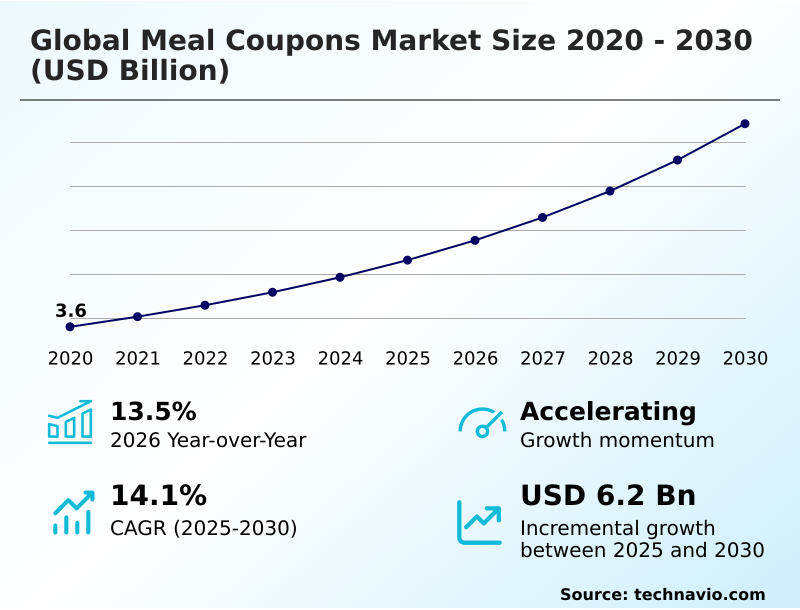
The Meal Coupons Market size was valued at USD 6.63 billion in 2025 growing at a CAGR of 14.1% during the forecast period 2026-2030.
North America accounts for 34.6% of incremental growth during the forecast period. The Food delivery promo codes segment by Product was valued at USD 1.98 billion in 2024, while the Digital meal coupons segment holds the largest revenue share by Type.
The market is projected to grow by USD 9.22 billion from 2020 to 2030, with USD 6.20 billion of the growth expected during the forecast period of 2025 to 2030.
Get Key Insights on Market Forecast (PDF) Request Free Sample
Meal Coupons Market Overview
The meal coupons market is undergoing a fundamental transformation from a transactional perk to a strategic tool for corporate wellness programs and employee retention strategies. With year-over-year growth accelerating past 13%, this evolution is propelled by the widespread adoption of digital meal vouchers and integrated mobile payment applications. This shift enables robust employee benefit administration and provides critical support for a remote workforce. A typical deployment in the professional services sector involves integrating a unified benefits platform with existing payroll, allowing for the automated distribution of tax-advantaged subsidies that employees can redeem via near field communication (NFC) enabled prepaid debit cards. This not only enhances corporate culture but also addresses talent attraction and retention challenges, particularly in North America, which accounts for over 34% of the market's incremental growth. The focus remains on improving employee purchasing power while navigating complex fintech security standards and social welfare policies.
Drivers, Trends, and Challenges in the Meal Coupons Market
The evolution of meal benefits into sophisticated digital ecosystems introduces significant operational complexity for global employers. Successfully integrating meal benefits with HCM platforms is no longer a value-add but a baseline expectation, essential for automating workflows and ensuring data consistency. However, this integration magnifies cybersecurity risks in digital benefit platforms, demanding stringent security protocols and continuous threat monitoring.
Boardroom conversations now center on measuring ROI of employee wellness benefits, a metric that is increasingly tied to ESG reporting for employee benefit programs. For instance, a firm structuring tax-efficient remote work benefits must also consider the impact of inflation on fixed-value benefits and its effect on employee morale.
In Italy, the national budget law directly alters the financial model for these benefits. Deploying biometric authentication for payments helps mitigate fraud but raises questions about balancing security with user convenience. This complexity extends to building a diverse merchant acquirer network, where navigating food service commission disputes is a constant operational reality.
Ultimately, the challenge lies in managing multi-jurisdictional tax compliance and personalizing benefits using machine learning, all while containing administrative costs, which digital platforms can reduce by over 40% compared to manual paper-based systems.
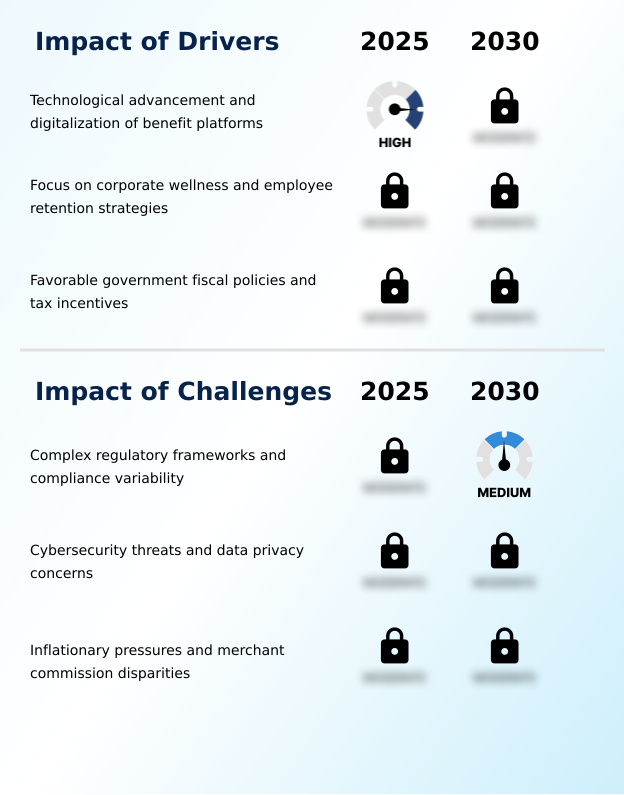
Primary Growth Driver: Technological advancements and the comprehensive digitalization of benefit platforms are the primary forces driving market growth, replacing legacy systems with efficient, secure, and user-friendly digital solutions.
The primary market driver is the comprehensive digital transformation in HR, where meal benefits are a key tool for enhancing corporate culture enhancement and supporting a hybrid work model.
The adoption of technologies like biometric payment verification and seamless digital wallet integration into mobile payment applications offers a superior employee experience, which is crucial for talent attraction and retention.
These systems provide a more efficient alternative to traditional methods, addressing the needs of a modern workforce.
In North America, which accounts for the largest share of market growth, companies are rapidly implementing these employee retention strategies as part of a broader move toward digitized, flexible benefit packages that cater to both on-site and remote staff.
Emerging Market Trend: The market is increasingly defined by the strategic integration of sustainable practices and social responsibility within benefit programs, aligning corporate values with employee wellness and environmental objectives.
The market is moving beyond simple meal subsidies toward integrated nutritional wellness platforms. This trend is driven by corporate social responsibility initiatives and the demand for personalized nutritional guidance to support employee well-being. Providers are leveraging technology to enhance the user experience (UX) design of their applications, incorporating features that track employee engagement metrics and offer sustainable benefit solutions.
For instance, platforms are now facilitating ESG reporting for employee benefit programs by quantifying the carbon footprint reduction from using digital versus paper vouchers. This alignment of benefits with corporate values is becoming a key differentiator, particularly in the European market, which accounts for over 26% of demand, where regulatory and consumer pressures for sustainability are highest.
Key Industry Challenge: The necessity of navigating complex, fragmented regulatory frameworks and ensuring compliance with variable fiscal laws across different jurisdictions presents a significant and persistent challenge for market participants.
Navigating disparate regulatory frameworks is the most significant market challenge. Providers face the high cost of regulatory compliance management, including adherence to strict tax code compliance and data protection laws like GDPR. Managing multi-jurisdictional tax compliance for multinational clients adds another layer of complexity.
On the operational front, balancing merchant commission fees with the need to maintain a broad, accessible network creates constant friction, impacting small business merchant relations. Furthermore, the increasing sophistication of cyber threats requires continuous investment in fintech security standards to mitigate cybersecurity risks in digital benefit platforms, protecting both corporate and employee data from breaches and fraudulent activities.
Explore Full Market Dynamics Analysis Request Free Sample
Meal Coupons Market Segmentation
The meal coupons industry research report provides comprehensive data including region-wise segment analysis, with forecasts and analysis for the period 2026-2030, as well as historical data from 2020-2024 for the following segments.
Product Segment Analysis
The food delivery promo codes segment is estimated to witness significant growth during the forecast period.
The food delivery promo codes segment is driven by the corporate shift to supporting hybrid and remote work models, where traditional on-premise benefits are obsolete.
These digital meal vouchers function within closed-loop payment systems, allowing for precise budgetary control through integrated expense management software. This digital fulfillment drastically reduces administrative overhead reduction compared to physical voucher logistics.
For human resources, the primary value is in streamlined employee benefit administration and access to real-time transaction data, enabling agile adjustments to workforce wellness programs.
The segment's expansion, accounting for over 37% of the total market, underscores the strategic pivot toward flexible, location-agnostic compensation tools that cater to the modern professional's demand for convenience and choice.
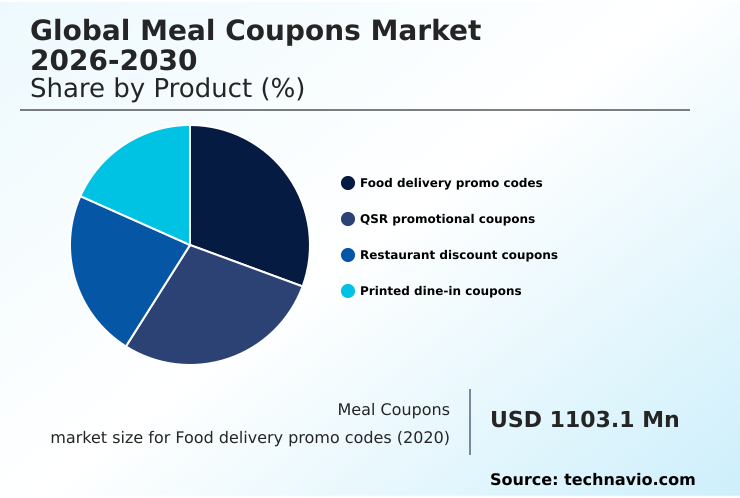
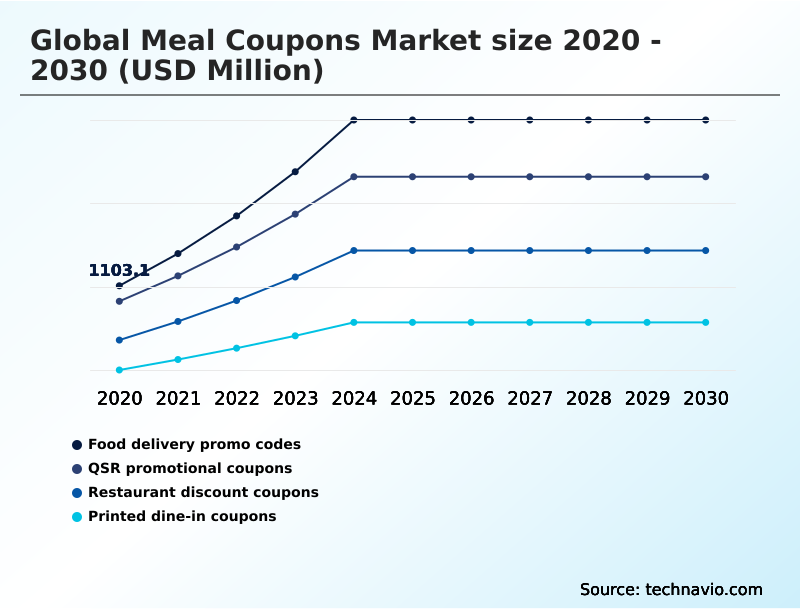
The Food delivery promo codes segment was valued at USD 1.98 billion in 2024 and showed a gradual increase during the forecast period.
Meal Coupons Market by Region: North America Leads with 34.6% Growth Share
North America is estimated to contribute 34.6% to the growth of the global market during the forecast period.
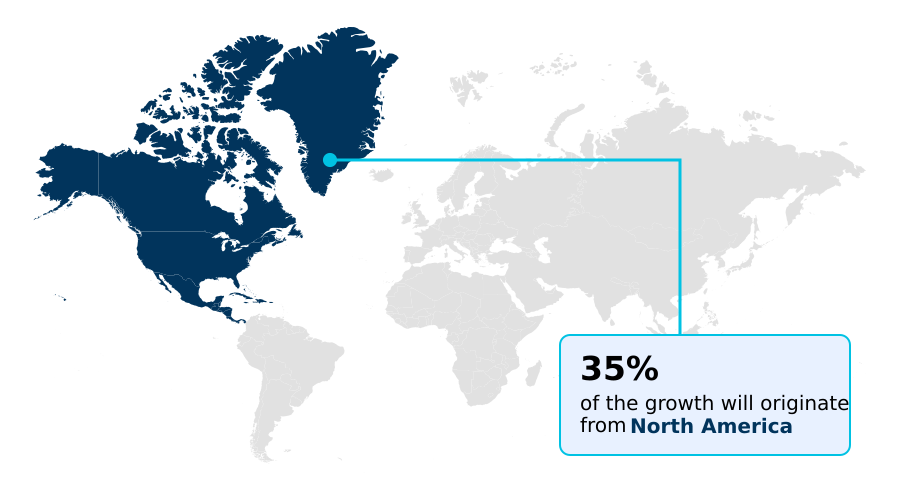
The geographic landscape is characterized by diverse adoption models, with North America contributing over 34% of market growth, driven by a focus on flexible benefits for a hybrid work model.
In Europe, long-standing social welfare policies create a stable, regulated environment, while APAC is the fastest-growing region, leveraging widespread food delivery integration.
A key operational challenge in emerging markets is expanding the merchant acceptance network to ensure remote workforce benefits are viable. This requires sophisticated point-of-sale (POS) integration and partnerships with local food service aggregators.
Successfully executing a multi-country benefit rollout hinges on a provider's ability to adapt its platform to local payment infrastructures and consumer habits, directly impacting employee purchasing power and the overall effectiveness of the program.
Customer Landscape Analysis for the Meal Coupons Market
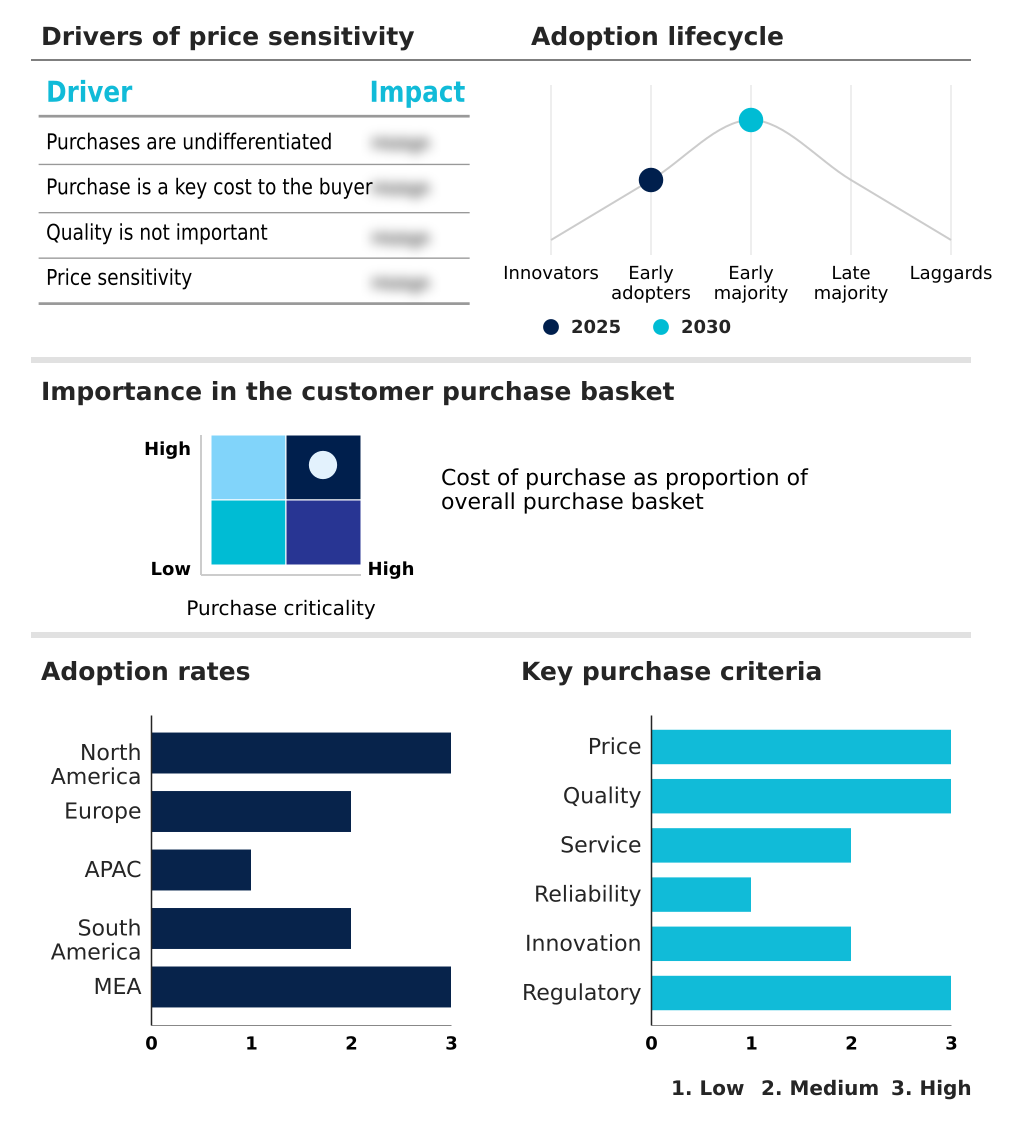
The meal coupons market forecasting report includes the adoption lifecycle of the market, covering from the innovator’s stage to the laggard’s stage. It focuses on adoption rates in different regions based on penetration. Furthermore, the meal coupons market report also includes key purchase criteria and drivers of price sensitivity to help companies evaluate and develop their market growth analysis strategies.
Competitive Landscape of the Meal Coupons Market
Companies are implementing various strategies, such as strategic alliances, partnerships, mergers and acquisitions, geographical expansion, and product/service launches, to enhance their presence in the meal coupons market industry.
Benify AB - Providers deliver tax-advantaged digital meal benefits and corporate wellness solutions, enabling employers to enhance compensation packages and support employee purchasing power through secure, unified platforms.
The industry research and growth report includes detailed analyses of the competitive landscape of the market and information about key companies, including:
- Benify AB
- Blackhawk Network Holdings Inc.
- Circula GmbH
- DOORDASH INC.
- Edenred SE
- ezCater Inc.
- Giftbit Inc.
- Givex Corp.
- InComm Payments
- Just Eat Takeaway.com B.V.
- Pluxee Group
- Reward Gateway UK Ltd.
- SAP SE
- Sharebite Inc.
- Uber Technologies Inc.
- UP COOP
- Vantage Circle.
- Workday Inc.
- Worklife.
- Zeta Services Inc.
Qualitative and quantitative analysis of companies has been conducted to help clients understand the wider business environment as well as the strengths and weaknesses of key industry players. Data is qualitatively analyzed to categorize companies as pure play, category-focused, industry-focused, and diversified; it is quantitatively analyzed to categorize companies as dominant, leading, strong, tentative, and weak.
Recent Developments in the Meal Coupons Market
- In May, 2025, Pluxee Group announced the implementation of a global carbon-offsetting initiative, enabling corporate clients to track and report the reduced environmental impact of digital transactions compared to paper vouchers.
- In April, 2025, Edenred SE introduced a biometric payment verification feature for its digital meal cards in several European markets, allowing users to authorize transactions with mobile device fingerprint sensors for enhanced security.
- In March, 2025, a major global fast-food franchise partnered with a European digital benefits provider to enable instant redemption of corporate meal credits directly through the restaurant's existing loyalty application, streamlining the user experience.
- In January, 2025, a prominent London-based technology firm launched a 'Sunrise Nutrition' program, providing its hybrid workforce with digital credits specifically for breakfast items, redeemable during morning hours at a curated network of local cafes.
Research Analyst Overview: Meal Coupons Market
The meal coupons market has fundamentally shifted from a simple employee perk to a critical component of strategic human capital management, embedded within unified benefits platforms. This transition is driven by the need for effective employee retention strategies in a competitive global labor market. Digital meal vouchers, integrated with expense management software and payroll integration services, are now standard.
Boardroom decisions increasingly focus on leveraging these flexible benefit packages to bolster corporate social responsibility credentials and support a distributed remote workforce. A key factor is regulatory compliance management, particularly with mandates like France's decree requiring a near-total shift to digital formats, which pressures companies to abandon legacy paper systems.
For procurement decision-makers, vendor selection now prioritizes platforms offering robust data privacy and security, a vast merchant acceptance network, and features like biometric payment verification. The challenge of managing merchant commission fees while delivering a seamless experience via mobile payment applications and digital wallet integration remains a central operational focus for providers.
Dive into Technavio’s robust research methodology, blending expert interviews, extensive data synthesis, and validated models for unparalleled Meal Coupons Market insights. See full methodology.
| Market Scope | |
|---|---|
| Page number | 301 |
| Base year | 2025 |
| Historic period | 2020-2024 |
| Forecast period | 2026-2030 |
| Growth momentum & CAGR | Accelerate at a CAGR of 14.1% |
| Market growth 2026-2030 | USD 6198.5 million |
| Market structure | Fragmented |
| YoY growth 2025-2026(%) | 13.5% |
| Key countries | US, Canada, Mexico, UK, Germany, France, Italy, Spain, The Netherlands, China, India, Japan, South Korea, Australia, Indonesia, Brazil, Argentina, Chile, Saudi Arabia, UAE, South Africa, Israel and Turkey |
| Competitive landscape | Leading Companies, Market Positioning of Companies, Competitive Strategies, and Industry Risks |
Meal Coupons Market: Key Questions Answered in This Report
-
What is the expected growth of the Meal Coupons Market between 2026 and 2030?
-
The Meal Coupons Market is expected to grow by USD 6.20 billion during 2026-2030, registering a CAGR of 14.1%. Year-over-year growth in 2026 is estimated at 13.5%%. This acceleration is shaped by technological advancement and digitalization of benefit platforms, which is intensifying demand across multiple end-use verticals covered in the report.
-
-
What segmentation does the market report cover?
-
The report is segmented by Product (Food delivery promo codes, QSR promotional coupons, Restaurant discount coupons, and Printed dine-in coupons), Type (Digital meal coupons, and Paper meal coupons), Product Type (Dinner coupons, Lunch coupons, Multi use coupons, and Breakfast coupons) and Geography (North America, Europe, APAC, South America, Middle East and Africa). Among these, the Food delivery promo codes segment is estimated to witness significant growth during the forecast period, driven by rising adoption across key application areas. Each segment includes detailed qualitative and quantitative analysis, along with historical data from 2020-2024 and forecasts through 2030 with year-over-year growth rates.
-
-
Which regions are analyzed in the report?
-
The report covers North America, Europe, APAC, South America and Middle East and Africa. North America is estimated to contribute 34.6% to market growth during the forecast period. Country-level analysis includes US, Canada, Mexico, UK, Germany, France, Italy, Spain, The Netherlands, China, India, Japan, South Korea, Australia, Indonesia, Brazil, Argentina, Chile, Saudi Arabia, UAE, South Africa, Israel and Turkey, with dedicated market size tables and year-over-year growth for each.
-
-
What are the key growth drivers and market challenges?
-
The primary driver is technological advancement and digitalization of benefit platforms, which is accelerating investment and industry demand. The main challenge is complex regulatory frameworks and compliance variability, creating operational barriers for key market participants. The report quantifies the impact of each driver and challenge across 2026 and 2030 with comparative analysis.
-
-
Who are the major players in the Meal Coupons Market?
-
Key vendors include Benify AB, Blackhawk Network Holdings Inc., Circula GmbH, DOORDASH INC., Edenred SE, ezCater Inc., Giftbit Inc., Givex Corp., InComm Payments, Just Eat Takeaway.com B.V., Pluxee Group, Reward Gateway UK Ltd., SAP SE, Sharebite Inc., Uber Technologies Inc., UP COOP, Vantage Circle., Workday Inc., Worklife. and Zeta Services Inc.. The report provides qualitative and quantitative analysis categorizing companies as dominant, leading, strong, tentative, and weak based on their market positioning. Company profiles include business segment analysis, SWOT assessment, key offerings, and recent strategic developments.
-
Meal Coupons Market Research Insights
Market dynamics are increasingly influenced by the need to balance security and convenience in digital benefit ecosystems. The imperative for compliance with data privacy and security mandates, such as the General Data Protection Regulation (GDPR) in Europe, dictates the architecture of these platforms, requiring robust data encryption protocols and secure fintech security standards.
In practice, a multinational corporation implementing a multi-country benefit rollout must ensure its platform can handle variable tax code compliance while offering a consistent user experience (UX) design.
This digital transformation in HR is not merely about replacing paper; it is about creating sustainable benefit solutions that enhance corporate culture enhancement, a key factor in talent attraction and retention for hybrid work models.
We can help! Our analysts can customize this meal coupons market research report to meet your requirements.
 RIA -
RIA -