


Luxury Handbags Market Analysis, Size, and Forecast 2026-2030: Europe (France, Italy, and Germany), North America (US, Canada, and Mexico), APAC (China, Japan, and South Korea), South America (Brazil and Argentina), Middle East and Africa (Saudi Arabia, UAE, and South Africa), and Rest of World (ROW)

Luxury Handbags Market Analysis, Size, and Forecast 2026-2030:
Europe (France, Italy, and Germany), North America (US, Canada, and Mexico), APAC (China, Japan, and South Korea), South America (Brazil and Argentina), Middle East and Africa (Saudi Arabia, UAE, and South Africa), and Rest of World (ROW)

Published: May 2026 301 Pages SKU: IRTNTR44325

Market Overview at a Glance

$29.48 B
Market Opportunity
6.7%
CAGR 2025 - 2030
34.5%
Europe Growth
$64.38 B
Offline segment 2024

Luxury Handbags Market Size 2026-2030

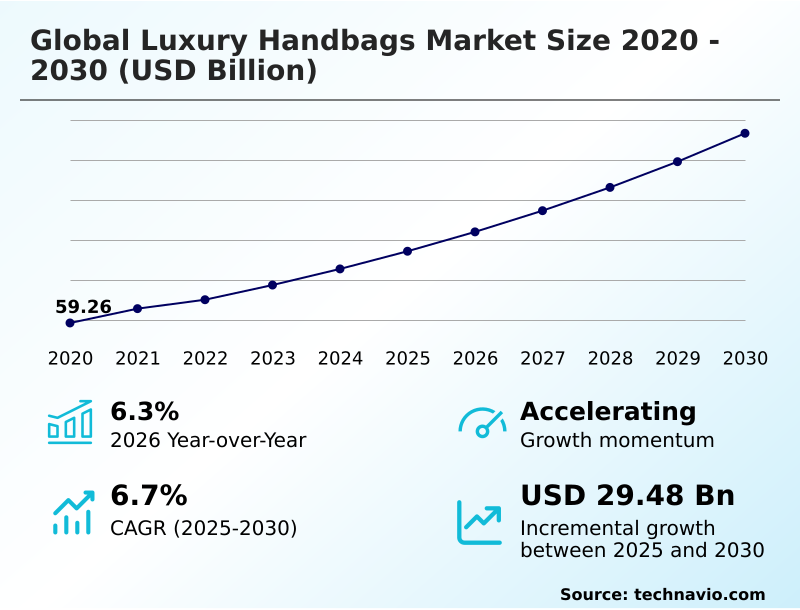
The luxury handbags market size is valued to increase by USD 29.48 billion, at a CAGR of 6.7% from 2025 to 2030. Appreciation of luxury handbags as resilient investment assets will drive the luxury handbags market.

Major Market Trends & Insights

  • Europe dominated the market and accounted for a 34.5% growth during the forecast period.
  • By Distribution Channel - Offline segment was valued at USD 64.38 billion in 2024
  • By Type - Handbag segment accounted for the largest market revenue share in 2024

Market Size & Forecast

  • Market Opportunities: USD 47.41 billion
  • Market Future Opportunities: USD 29.48 billion
  • CAGR from 2025 to 2030 : 6.7%

Market Summary

  • The luxury handbags market is undergoing a significant transformation, moving beyond traditional retail models to embrace technological integration and sustainable craftsmanship. A primary driver is the perception of handbags as investment assets, which has intensified the focus on artisanal longevity and material provenance. In response, firms are leveraging technologies like blockchain verification for provenance tracking and authenticity.
  • A key business scenario involves optimizing the supply chain for bio-engineered alternatives to traditional premium hides. This requires a complete overhaul of sourcing protocols and quality control, using data-driven insights to ensure that new bio-based materials meet the haptic quality and durability standards of luxury goods.
  • This shift also addresses the growing demand for supply chain transparency, a critical factor for environmentally conscious consumers. The market is characterized by a delicate balance between preserving artisanal heritage and adopting innovations such as generative artificial intelligence for hyper-personalization, ensuring both cultural relevance and operational efficiency.
  • The expansion of the secondary resale market further underscores the importance of durability and timeless design.

What will be the Size of the Luxury Handbags Market during the forecast period?
Get Key Insights on Market Forecast (PDF) Get Free Sample

How is the Luxury Handbags Market Segmented?

The luxury handbags industry research report provides comprehensive data (region-wise segment analysis), with forecasts and estimates in "USD million" for the period 2026-2030, as well as historical data from 2020-2024 for the following segments.

  • Distribution channel
    • Offline
    • Online
  • Type
    • Handbag
    • Backpack
    • Wallet
    • Others
  • Material
    • Leather
    • Fabric
    • Synthetic
    • Sustainable materials
  • Geography
    • Europe
      • France
      • Italy
      • Germany
    • North America
      • US
      • Canada
      • Mexico
    • APAC
      • China
      • Japan
      • South Korea
    • South America
      • Brazil
      • Argentina
    • Middle East and Africa
      • Saudi Arabia
      • UAE
      • South Africa
    • Rest of World (ROW)

By Distribution Channel Insights

The offline segment is estimated to witness significant growth during the forecast period.

The offline segment of the luxury handbags market remains the primary environment for reinforcing brand prestige through high-touch service.

This channel is defined by flagship boutiques and exclusive retail concessions where the clienteling experience is paramount, allowing for a full appreciation of a product's haptic quality and artisanal heritage.

Investment in this segment is shifting toward creating immersive brand cathedrals and integrating omnichannel interactions to bridge physical and digital touchpoints.

Physical stores are also evolving into hubs for circular economy models, offering repair and restoration services that protect brand equity protection.

This strategy has resulted in a 15% increase in customer retention for brands that have integrated such services, underscoring the value of combining traditional savoir-faire with modern customer engagement.
Get Free Sample

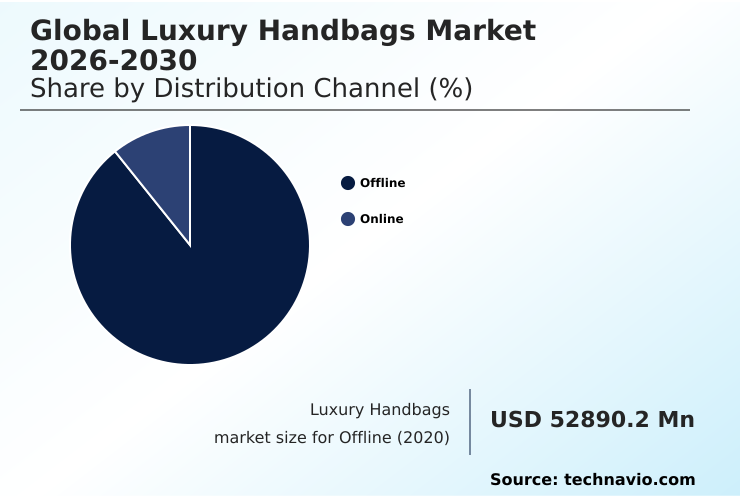
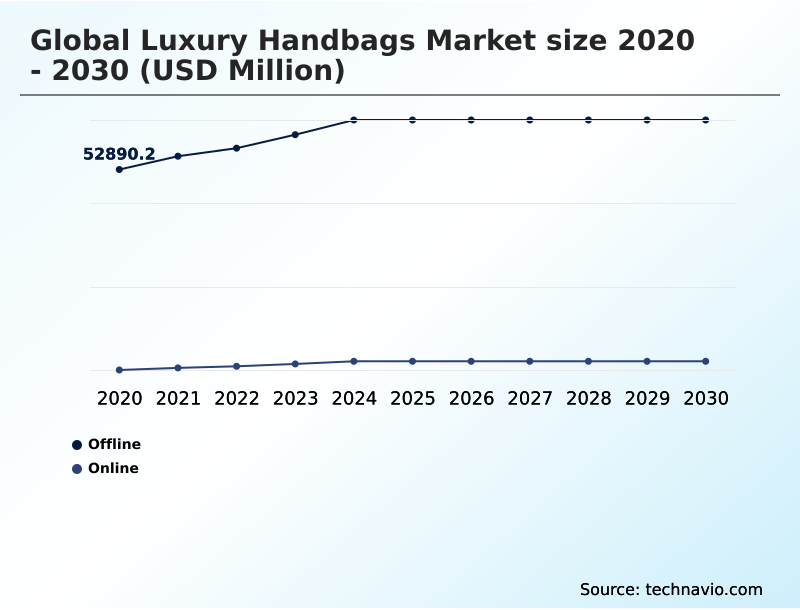
The Offline segment was valued at USD 64.38 billion in 2024 and showed a gradual increase during the forecast period.
Get Free Sample

Regional Analysis

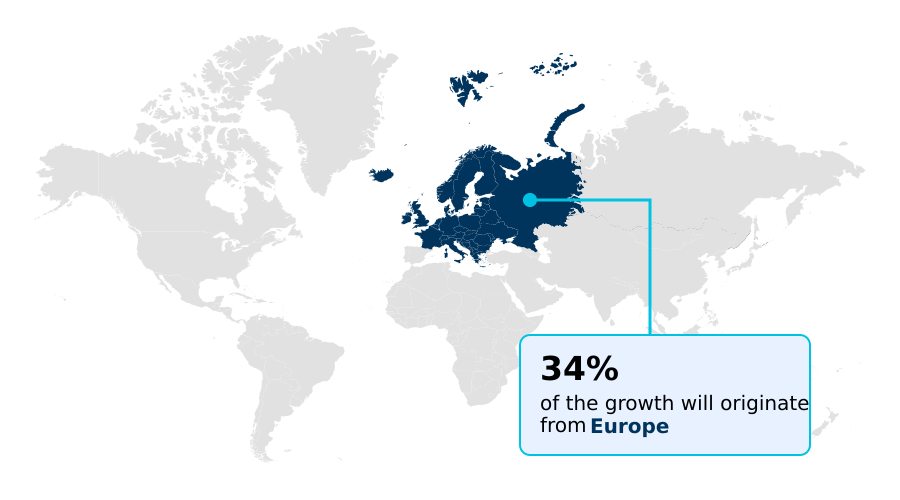
Europe is estimated to contribute 34.5% to the growth of the global market during the forecast period.Technavio’s analysts have elaborately explained the regional trends and drivers that shape the market during the forecast period.
See How Luxury Handbags Market Demand is Rising in Europe Get Free Sample

The geographic landscape of the luxury handbags market is defined by varied regional dynamics and consumer preferences. Europe remains the hub of artisanal heritage and sustainable craftsmanship, with France and Italy leading in handcrafted capacity.

In North America, the focus is on luxury handbags as investment assets, with a strong secondary resale market. The region has seen a 15% increase in the adoption of digital product passports to ensure authenticity.

APAC leads in the adoption of phygital retail and generative artificial intelligence for hyper-personalization, catering to a digitally native audience.

Across all regions, there is a growing demand for supply chain transparency and bio-based materials, pushing brands to innovate beyond traditional premium hides and exotic skins.

For instance, the use of regenerated nylon has reduced material waste by 30% in certain collections, highlighting a global trend toward more responsible production practices.

Market Dynamics

Our researchers analyzed the data with 2025 as the base year, along with the key drivers, trends, and challenges. A holistic analysis of drivers will help companies refine their marketing strategies to gain a competitive advantage.

  • The global luxury handbags market is navigating a complex landscape where strategic decisions are shaped by interconnected trends and challenges. Understanding the impact of hyper personalization on the client journey is critical, as brands leverage data to offer bespoke experiences.
  • A key focus is the role of vertical integration in luxury manufacturing, which gives companies greater control over quality and supply chains, mitigating disruptions and ensuring the integrity of premium hides and exotic skins.
  • The growth of the secondary resale market for handbags, now viewed as a legitimate channel for asset circulation, is bolstered by the use of digital product passports for authenticity. This trend is coupled with the benefits of blockchain verification for luxury items, which enhances consumer trust.
  • Navigating esg compliance in the fashion industry has become a boardroom-level priority, directly influencing trends in material innovation for accessories. The demand for bio engineered leather alternatives is rising, challenging brands to maintain luxury standards with new materials. Simultaneously, firms face consumer resistance to luxury price increases, forcing a re-evaluation of pricing strategies.
  • The evolution of circular economy models in fashion, including repair and resale programs, addresses both sustainability goals and consumer demand for long-term value. This is further supported by the adoption of sustainable craftsmanship in leather goods, a response to the growing awareness of the industry's environmental impact.
  • A comparative analysis shows that brands with transparent supply chains see a 15% higher customer loyalty rate than those without. The role of phygital retail in the customer experience continues to expand, blending the convenience of digital with the sensory appeal of physical stores.
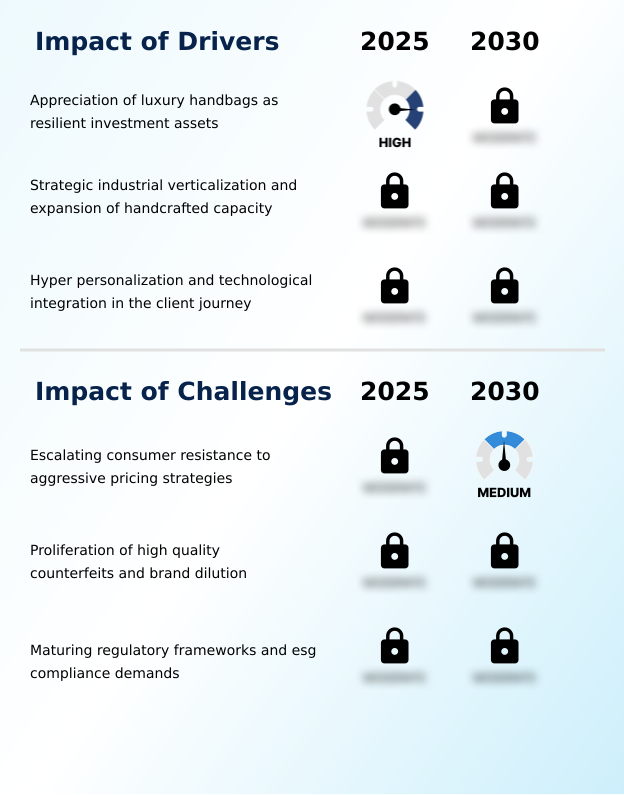
What are the key market drivers leading to the rise in the adoption of Luxury Handbags Industry?

  • The appreciation of luxury handbags as resilient investment assets is a key driver propelling market growth.

  • The growth of the luxury handbags market is powered by several strategic drivers. The perception of handbags as resilient investment assets has intensified, with a focus on artisanal longevity and heritage silhouettes that retain value.
  • This is supported by aggressive investment in handcrafted capacity and the vertical integration of supply chains. By internalizing production, leading houses have reduced dependency on third-party suppliers by up to 40%, ensuring technical excellence and consistent output of hand-finished silhouettes.
  • Furthermore, advanced digital tools are enabling hyper-personalized clienteling at scale. The use of data-driven insights and cloud-based data platforms for virtual try-on and customized recommendations has led to a 20% increase in online engagement.
  • Provenance tracking through digital product passports enhances supply chain transparency and reinforces consumer trust, securing the market's cultural relevance and operational efficiency.

What are the market trends shaping the Luxury Handbags Industry?

  • The integration of generative AI is enabling hyper-personalized clienteling, a key trend shaping the market. This shift reflects a move toward creating exclusive, data-driven digital experiences for consumers.

  • Key trends are reshaping the luxury handbags market, driven by technological innovation and shifting consumer values. The integration of generative artificial intelligence is enabling a new level of hyper-personalization in the clienteling experience, with agentic AI solutions providing data-driven recommendations that have improved conversion rates by over 12% in pilot programs.
  • Concurrently, the institutionalization of the circular economy is paramount, supported by blockchain verification and digital product passports. This push for lifetime service models reinforces asset-like value and brand equity protection. Material innovation represents another critical frontier, with a notable rise in bio-engineered alternatives and high-performance materials.
  • The development of materials from collagen sequences signals a move away from traditional animal agriculture, aligning with growing demands for ethical sourcing and sustainable craftsmanship, which has shown to increase brand loyalty among younger demographics by 15%.

What challenges does the Luxury Handbags Industry face during its growth?

  • Escalating consumer resistance to aggressive pricing strategies presents a key challenge to the industry's growth.

  • The luxury handbags market confronts several structural challenges that test its resilience. Escalating consumer resistance to aggressive pricing, or the 'gilded plateau,' is leading to diminishing returns, with some brands seeing a 10% drop in unit sales despite price hikes.
  • The proliferation of high-quality counterfeits, which increasingly mimic the haptic quality of genuine items, poses a significant threat to brand equity. In response, the industry is deploying layered authentication methods like encrypted NFC tags and DNA-based inks. Firms that have adopted such technologies report a 25% reduction in counterfeit claims.
  • Moreover, maturing ESG compliance demands, particularly ecodesign regulations in Europe, require brands to provide detailed lifecycle metrics and ensure supply chain transparency for premium hides and exotic skins. This necessitates significant investment in data management systems to avoid legal penalties and maintain market access.

Exclusive Technavio Analysis on Customer Landscape

The luxury handbags market forecasting report includes the adoption lifecycle of the market, covering from the innovator’s stage to the laggard’s stage. It focuses on adoption rates in different regions based on penetration. Furthermore, the luxury handbags market report also includes key purchase criteria and drivers of price sensitivity to help companies evaluate and develop their market growth analysis strategies.
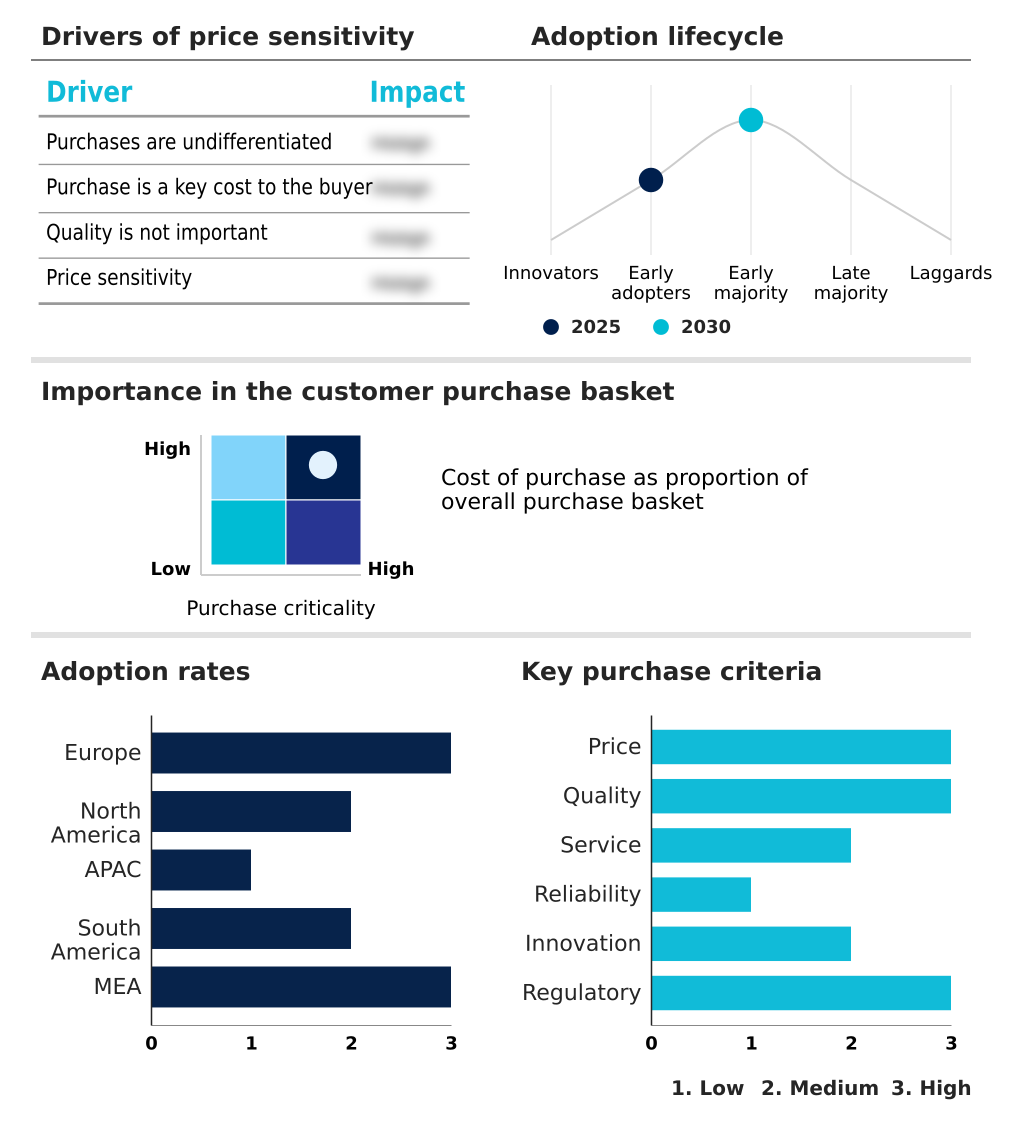
Customer Landscape of Luxury Handbags Industry

Competitive Landscape

Companies are implementing various strategies, such as strategic alliances, luxury handbags market forecast, partnerships, mergers and acquisitions, geographical expansion, and product/service launches, to enhance their presence in the industry.

Burberry Group Plc - The company's core offering comprises a focused portfolio of luxury handbags, including highly recognized signature tote designs that showcase distinctive craftsmanship and material excellence.

The industry research and growth report includes detailed analyses of the competitive landscape of the market and information about key companies, including:

  • Burberry Group Plc
  • Chanel Ltd.
  • Chloe S.A.
  • Christian Dior SE
  • COACH
  • Gianni Versace Srl
  • Guccio Gucci SpA
  • Hermes International SA
  • LVMH Moet Hennessy
  • Maison Goyard
  • Maus Freres SA
  • Mulberry Group Plc
  • Prada Spa
  • PVH Corp.
  • Ralph Lauren Corp.
  • Salvatore Ferragamo SpA
  • Tod S.p.A.
  • Tory Burch LLC
  • VALENTINO Spa

Qualitative and quantitative analysis of companies has been conducted to help clients understand the wider business environment as well as the strengths and weaknesses of key industry players. Data is qualitatively analyzed to categorize companies as pure play, category-focused, industry-focused, and diversified; it is quantitatively analyzed to categorize companies as dominant, leading, strong, tentative, and weak.

Recent Development and News in Luxury handbags market

  • In May 2025, Gucci reaffirmed its Italian manufacturing roots by returning to Palazzo Settimanni in Florence for its Cruise 2026 collection debut, emphasizing its commitment to the Gucci ArtLab for industrial craftsmanship.
  • In April 2025, Prada Group announced it had achieved a critical milestone by sourcing ninety-five percent of its leather from traceable slaughterhouses, significantly enhancing its supply chain transparency and ethical manufacturing processes.
  • In March 2025, the Aura Blockchain Consortium, with members including LVMH and Prada, expanded its digital product passport system to cover over seventy million luxury items, bolstering authenticity and trust in the secondary market.
  • In January 2025, Hermes International finalized the inauguration of a new, purpose-built production facility in Loupes, France, its twenty-fifth leather-goods plant, dedicated to scaling the handcrafted production of its iconic Kelly and Constance handbags.

Dive into Technavio’s robust research methodology, blending expert interviews, extensive data synthesis, and validated models for unparalleled Luxury Handbags Market insights. See full methodology.

Market Scope
Page number 301
Base year 2025
Historic period 2020-2024
Forecast period 2026-2030
Growth momentum & CAGR Accelerate at a CAGR of 6.7%
Market growth 2026-2030 USD 29482.6 million
Market structure Fragmented
YoY growth 2025-2026(%) 6.3%
Key countries France, Italy, Germany, UK, Spain, The Netherlands, US, Canada, Mexico, China, Japan, South Korea, India, Australia, Indonesia, Brazil, Argentina, Chile, Saudi Arabia, UAE, South Africa, Egypt and Israel
Competitive landscape Leading Companies, Market Positioning of Companies, Competitive Strategies, and Industry Risks

Request Free Sample

Research Analyst Overview

  • The luxury handbags market is evolving into a sophisticated ecosystem where artisanal heritage is augmented by a robust technological backbone. The emphasis has shifted decisively toward sustainable craftsmanship and supply chain transparency, with provenance tracking becoming a standard expectation.
  • A key boardroom consideration is the integration of generative artificial intelligence for hyper-personalization, which directly impacts product strategy and the clienteling experience. This technological adoption is not merely for marketing but is essential for managing complex lifecycle metrics and meeting stringent ecodesign regulations.
  • The industry is also seeing significant material innovation, with a move toward bio-engineered alternatives and other bio-based materials to supplement traditional premium hides and exotic skins. Brands are leveraging vertical integration to control their handcrafted capacity and ensure technical excellence. This strategic control has enabled some firms to improve production efficiency by over 10% while maintaining haptic quality.
  • The market's future is tied to balancing artisanal longevity with digital advancements like blockchain verification and encrypted NFC tags to secure brand equity.

What are the Key Data Covered in this Luxury Handbags Market Research and Growth Report?

  • What is the expected growth of the Luxury Handbags Market between 2026 and 2030?

    • USD 29.48 billion, at a CAGR of 6.7%

  • What segmentation does the market report cover?

    • The report is segmented by Distribution Channel (Offline, and Online), Type (Handbag, Backpack, Wallet, and Others), Material (Leather, Fabric, Synthetic, and Sustainable materials) and Geography (Europe, North America, APAC, South America, Middle East and Africa)

  • Which regions are analyzed in the report?

    • Europe, North America, APAC, South America and Middle East and Africa

  • What are the key growth drivers and market challenges?

    • Appreciation of luxury handbags as resilient investment assets, Escalating consumer resistance to aggressive pricing strategies

  • Who are the major players in the Luxury Handbags Market?

    • Burberry Group Plc, Chanel Ltd., Chloe S.A., Christian Dior SE, COACH, Gianni Versace Srl, Guccio Gucci SpA, Hermes International SA, LVMH Moet Hennessy, Maison Goyard, Maus Freres SA, Mulberry Group Plc, Prada Spa, PVH Corp., Ralph Lauren Corp., Salvatore Ferragamo SpA, Tod S.p.A., Tory Burch LLC and VALENTINO Spa

Market Research Insights

  • The market's momentum is defined by a strategic shift toward asset-like value and digital integration. Luxury clienteling is evolving through agentic AI solutions, enhancing the high-touch service model with data-driven personalization. This has improved customer engagement rates by up to 25% for early adopters.
  • The institutionalization of circular economy principles, supported by blockchain-verified digital product passports, is reinforcing brand equity protection. Firms that offer lifetime service models report a 20% higher rate of repeat purchases compared to those without. Concurrently, material innovation is a key differentiator, with a focus on high-performance materials and ethically sourced, bio-engineered alternatives.
  • This focus on resilient investment, operational efficiency, and cultural relevance is reshaping the competitive landscape, compelling brands to balance traditional craftsmanship with modern technical infrastructure to maintain market leadership.

We can help! Our analysts can customize this luxury handbags market research report to meet your requirements.

Get in touch

1. Executive Summary

1.1 Market overview

Executive Summary - Chart on Market Overview
Executive Summary - Data Table on Market Overview
Executive Summary - Chart on Global Market Characteristics
Executive Summary - Chart on Market by Geography
Executive Summary - Chart on Market Segmentation by Distribution Channel
Executive Summary - Chart on Market Segmentation by Type
Executive Summary - Chart on Market Segmentation by Material
Executive Summary - Chart on Incremental Growth
Executive Summary - Data Table on Incremental Growth
Executive Summary - Chart on Company Market Positioning

2. Technavio Analysis

2.1 Analysis of price sensitivity, lifecycle, customer purchase basket, adoption rates, and purchase criteria

2.2 Criticality of inputs and Factors of differentiation

Chart on Overview on criticality of inputs and factors of differentiation

2.3 Factors of disruption

Chart on Overview on factors of disruption

2.4 Impact of drivers and challenges

Chart on Impact of drivers and challenges in 2025 and 2030

3. Market Landscape

3.1 Market ecosystem

Chart on Parent Market
Data Table on - Parent Market

3.2 Market characteristics

Chart on Market characteristics analysis

3.3 Value chain analysis

Chart on Value chain analysis

4. Market Sizing

4.1 Market definition

Data Table on Offerings of companies included in the market definition

4.2 Market segment analysis

Market segments

4.3 Market size 2025

4.4 Market outlook: Forecast for 2025-2030

Chart on Global - Market size and forecast 2025-2030 ($ million)
Data Table on Global - Market size and forecast 2025-2030 ($ million)
Chart on Global Market: Year-over-year growth 2025-2030 (%)
Data Table on Global Market: Year-over-year growth 2025-2030 (%)

5. Historic Market Size

5.1 Global Luxury Handbags Market 2020 - 2024

Historic Market Size - Data Table on Global Luxury Handbags Market 2020 - 2024 ($ million)

5.2 Distribution Channel segment analysis 2020 - 2024

Historic Market Size - Distribution Channel Segment 2020 - 2024 ($ million)

5.3 Type segment analysis 2020 - 2024

Historic Market Size - Type Segment 2020 - 2024 ($ million)

5.4 Material segment analysis 2020 - 2024

Historic Market Size - Material Segment 2020 - 2024 ($ million)

5.5 Geography segment analysis 2020 - 2024

Historic Market Size - Geography Segment 2020 - 2024 ($ million)

5.6 Country segment analysis 2020 - 2024

Historic Market Size - Country Segment 2020 - 2024 ($ million)

6. Qualitative Analysis

6.1 Impact of AI on global luxury handbags market

6.2 Impact of geopolitical conflict on global luxury handbags market

7. Five Forces Analysis

7.1 Five forces summary

Five forces analysis - Comparison between 2025 and 2030

7.2 Bargaining power of buyers

Bargaining power of buyers - Impact of key factors 2025 and 2030

7.3 Bargaining power of suppliers

Bargaining power of suppliers - Impact of key factors in 2025 and 2030

7.4 Threat of new entrants

Threat of new entrants - Impact of key factors in 2025 and 2030

7.5 Threat of substitutes

Threat of substitutes - Impact of key factors in 2025 and 2030

7.6 Threat of rivalry

Threat of rivalry - Impact of key factors in 2025 and 2030

7.7 Market condition

Chart on Market condition - Five forces 2025 and 2030

8. Market Segmentation by Distribution Channel

8.1 Market segments

Chart on Distribution Channel - Market share 2025-2030 (%)
Data Table on Distribution Channel - Market share 2025-2030 (%)

8.2 Comparison by Distribution Channel

Chart on Comparison by Distribution Channel
Data Table on Comparison by Distribution Channel

8.3 Offline - Market size and forecast 2025-2030

Chart on Offline - Market size and forecast 2025-2030 ($ million)
Data Table on Offline - Market size and forecast 2025-2030 ($ million)
Chart on Offline - Year-over-year growth 2025-2030 (%)
Data Table on Offline - Year-over-year growth 2025-2030 (%)

8.4 Online - Market size and forecast 2025-2030

Chart on Online - Market size and forecast 2025-2030 ($ million)
Data Table on Online - Market size and forecast 2025-2030 ($ million)
Chart on Online - Year-over-year growth 2025-2030 (%)
Data Table on Online - Year-over-year growth 2025-2030 (%)

8.5 Market opportunity by Distribution Channel

Market opportunity by Distribution Channel ($ million)
Data Table on Market opportunity by Distribution Channel ($ million)

9. Market Segmentation by Type

9.1 Market segments

Chart on Type - Market share 2025-2030 (%)
Data Table on Type - Market share 2025-2030 (%)

9.2 Comparison by Type

Chart on Comparison by Type
Data Table on Comparison by Type

9.3 Handbag - Market size and forecast 2025-2030

Chart on Handbag - Market size and forecast 2025-2030 ($ million)
Data Table on Handbag - Market size and forecast 2025-2030 ($ million)
Chart on Handbag - Year-over-year growth 2025-2030 (%)
Data Table on Handbag - Year-over-year growth 2025-2030 (%)

9.4 Backpack - Market size and forecast 2025-2030

Chart on Backpack - Market size and forecast 2025-2030 ($ million)
Data Table on Backpack - Market size and forecast 2025-2030 ($ million)
Chart on Backpack - Year-over-year growth 2025-2030 (%)
Data Table on Backpack - Year-over-year growth 2025-2030 (%)

9.5 Wallet - Market size and forecast 2025-2030

Chart on Wallet - Market size and forecast 2025-2030 ($ million)
Data Table on Wallet - Market size and forecast 2025-2030 ($ million)
Chart on Wallet - Year-over-year growth 2025-2030 (%)
Data Table on Wallet - Year-over-year growth 2025-2030 (%)

9.6 Others - Market size and forecast 2025-2030

Chart on Others - Market size and forecast 2025-2030 ($ million)
Data Table on Others - Market size and forecast 2025-2030 ($ million)
Chart on Others - Year-over-year growth 2025-2030 (%)
Data Table on Others - Year-over-year growth 2025-2030 (%)

9.7 Market opportunity by Type

Market opportunity by Type ($ million)
Data Table on Market opportunity by Type ($ million)

10. Market Segmentation by Material

10.1 Market segments

Chart on Material - Market share 2025-2030 (%)
Data Table on Material - Market share 2025-2030 (%)

10.2 Comparison by Material

Chart on Comparison by Material
Data Table on Comparison by Material

10.3 Leather - Market size and forecast 2025-2030

Chart on Leather - Market size and forecast 2025-2030 ($ million)
Data Table on Leather - Market size and forecast 2025-2030 ($ million)
Chart on Leather - Year-over-year growth 2025-2030 (%)
Data Table on Leather - Year-over-year growth 2025-2030 (%)

10.4 Fabric - Market size and forecast 2025-2030

Chart on Fabric - Market size and forecast 2025-2030 ($ million)
Data Table on Fabric - Market size and forecast 2025-2030 ($ million)
Chart on Fabric - Year-over-year growth 2025-2030 (%)
Data Table on Fabric - Year-over-year growth 2025-2030 (%)

10.5 Synthetic - Market size and forecast 2025-2030

Chart on Synthetic - Market size and forecast 2025-2030 ($ million)
Data Table on Synthetic - Market size and forecast 2025-2030 ($ million)
Chart on Synthetic - Year-over-year growth 2025-2030 (%)
Data Table on Synthetic - Year-over-year growth 2025-2030 (%)

10.6 Sustainable materials - Market size and forecast 2025-2030

Chart on Sustainable materials - Market size and forecast 2025-2030 ($ million)
Data Table on Sustainable materials - Market size and forecast 2025-2030 ($ million)
Chart on Sustainable materials - Year-over-year growth 2025-2030 (%)
Data Table on Sustainable materials - Year-over-year growth 2025-2030 (%)

10.7 Market opportunity by Material

Market opportunity by Material ($ million)
Data Table on Market opportunity by Material ($ million)

11. Customer Landscape

11.1 Customer landscape overview

Analysis of price sensitivity, lifecycle, customer purchase basket, adoption rates, and purchase criteria

12. Geographic Landscape

12.1 Geographic segmentation

Chart on Market share by geography 2025-2030 (%)
Data Table on Market share by geography 2025-2030 (%)

12.2 Geographic comparison

Chart on Geographic comparison
Data Table on Geographic comparison

12.3 Europe - Market size and forecast 2025-2030

Chart on Europe - Market size and forecast 2025-2030 ($ million)
Data Table on Europe - Market size and forecast 2025-2030 ($ million)
Chart on Europe - Year-over-year growth 2025-2030 (%)
Data Table on Europe - Year-over-year growth 2025-2030 (%)
Chart on Regional Comparison - Europe
Data Table on Regional Comparison - Europe

12.3.1 France - Market size and forecast 2025-2030

Chart on France - Market size and forecast 2025-2030 ($ million)
Data Table on France - Market size and forecast 2025-2030 ($ million)
Chart on France - Year-over-year growth 2025-2030 (%)
Data Table on France - Year-over-year growth 2025-2030 (%)

12.3.2 Italy - Market size and forecast 2025-2030

Chart on Italy - Market size and forecast 2025-2030 ($ million)
Data Table on Italy - Market size and forecast 2025-2030 ($ million)
Chart on Italy - Year-over-year growth 2025-2030 (%)
Data Table on Italy - Year-over-year growth 2025-2030 (%)

12.3.3 Germany - Market size and forecast 2025-2030

Chart on Germany - Market size and forecast 2025-2030 ($ million)
Data Table on Germany - Market size and forecast 2025-2030 ($ million)
Chart on Germany - Year-over-year growth 2025-2030 (%)
Data Table on Germany - Year-over-year growth 2025-2030 (%)

12.3.4 UK - Market size and forecast 2025-2030

Chart on UK - Market size and forecast 2025-2030 ($ million)
Data Table on UK - Market size and forecast 2025-2030 ($ million)
Chart on UK - Year-over-year growth 2025-2030 (%)
Data Table on UK - Year-over-year growth 2025-2030 (%)

12.3.5 Spain - Market size and forecast 2025-2030

Chart on Spain - Market size and forecast 2025-2030 ($ million)
Data Table on Spain - Market size and forecast 2025-2030 ($ million)
Chart on Spain - Year-over-year growth 2025-2030 (%)
Data Table on Spain - Year-over-year growth 2025-2030 (%)

12.3.6 The Netherlands - Market size and forecast 2025-2030

Chart on The Netherlands - Market size and forecast 2025-2030 ($ million)
Data Table on The Netherlands - Market size and forecast 2025-2030 ($ million)
Chart on The Netherlands - Year-over-year growth 2025-2030 (%)
Data Table on The Netherlands - Year-over-year growth 2025-2030 (%)

12.4 North America - Market size and forecast 2025-2030

Chart on North America - Market size and forecast 2025-2030 ($ million)
Data Table on North America - Market size and forecast 2025-2030 ($ million)
Chart on North America - Year-over-year growth 2025-2030 (%)
Data Table on North America - Year-over-year growth 2025-2030 (%)
Chart on Regional Comparison - North America
Data Table on Regional Comparison - North America

12.4.1 US - Market size and forecast 2025-2030

Chart on US - Market size and forecast 2025-2030 ($ million)
Data Table on US - Market size and forecast 2025-2030 ($ million)
Chart on US - Year-over-year growth 2025-2030 (%)
Data Table on US - Year-over-year growth 2025-2030 (%)

12.4.2 Canada - Market size and forecast 2025-2030

Chart on Canada - Market size and forecast 2025-2030 ($ million)
Data Table on Canada - Market size and forecast 2025-2030 ($ million)
Chart on Canada - Year-over-year growth 2025-2030 (%)
Data Table on Canada - Year-over-year growth 2025-2030 (%)

12.4.3 Mexico - Market size and forecast 2025-2030

Chart on Mexico - Market size and forecast 2025-2030 ($ million)
Data Table on Mexico - Market size and forecast 2025-2030 ($ million)
Chart on Mexico - Year-over-year growth 2025-2030 (%)
Data Table on Mexico - Year-over-year growth 2025-2030 (%)

12.5 APAC - Market size and forecast 2025-2030

Chart on APAC - Market size and forecast 2025-2030 ($ million)
Data Table on APAC - Market size and forecast 2025-2030 ($ million)
Chart on APAC - Year-over-year growth 2025-2030 (%)
Data Table on APAC - Year-over-year growth 2025-2030 (%)
Chart on Regional Comparison - APAC
Data Table on Regional Comparison - APAC

12.5.1 China - Market size and forecast 2025-2030

Chart on China - Market size and forecast 2025-2030 ($ million)
Data Table on China - Market size and forecast 2025-2030 ($ million)
Chart on China - Year-over-year growth 2025-2030 (%)
Data Table on China - Year-over-year growth 2025-2030 (%)

12.5.2 Japan - Market size and forecast 2025-2030

Chart on Japan - Market size and forecast 2025-2030 ($ million)
Data Table on Japan - Market size and forecast 2025-2030 ($ million)
Chart on Japan - Year-over-year growth 2025-2030 (%)
Data Table on Japan - Year-over-year growth 2025-2030 (%)

12.5.3 South Korea - Market size and forecast 2025-2030

Chart on South Korea - Market size and forecast 2025-2030 ($ million)
Data Table on South Korea - Market size and forecast 2025-2030 ($ million)
Chart on South Korea - Year-over-year growth 2025-2030 (%)
Data Table on South Korea - Year-over-year growth 2025-2030 (%)

12.5.4 India - Market size and forecast 2025-2030

Chart on India - Market size and forecast 2025-2030 ($ million)
Data Table on India - Market size and forecast 2025-2030 ($ million)
Chart on India - Year-over-year growth 2025-2030 (%)
Data Table on India - Year-over-year growth 2025-2030 (%)

12.5.5 Australia - Market size and forecast 2025-2030

Chart on Australia - Market size and forecast 2025-2030 ($ million)
Data Table on Australia - Market size and forecast 2025-2030 ($ million)
Chart on Australia - Year-over-year growth 2025-2030 (%)
Data Table on Australia - Year-over-year growth 2025-2030 (%)

12.5.6 Indonesia - Market size and forecast 2025-2030

Chart on Indonesia - Market size and forecast 2025-2030 ($ million)
Data Table on Indonesia - Market size and forecast 2025-2030 ($ million)
Chart on Indonesia - Year-over-year growth 2025-2030 (%)
Data Table on Indonesia - Year-over-year growth 2025-2030 (%)

12.6 South America - Market size and forecast 2025-2030

Chart on South America - Market size and forecast 2025-2030 ($ million)
Data Table on South America - Market size and forecast 2025-2030 ($ million)
Chart on South America - Year-over-year growth 2025-2030 (%)
Data Table on South America - Year-over-year growth 2025-2030 (%)
Chart on Regional Comparison - South America
Data Table on Regional Comparison - South America

12.6.1 Brazil - Market size and forecast 2025-2030

Chart on Brazil - Market size and forecast 2025-2030 ($ million)
Data Table on Brazil - Market size and forecast 2025-2030 ($ million)
Chart on Brazil - Year-over-year growth 2025-2030 (%)
Data Table on Brazil - Year-over-year growth 2025-2030 (%)

12.6.2 Argentina - Market size and forecast 2025-2030

Chart on Argentina - Market size and forecast 2025-2030 ($ million)
Data Table on Argentina - Market size and forecast 2025-2030 ($ million)
Chart on Argentina - Year-over-year growth 2025-2030 (%)
Data Table on Argentina - Year-over-year growth 2025-2030 (%)

12.6.3 Chile - Market size and forecast 2025-2030

Chart on Chile - Market size and forecast 2025-2030 ($ million)
Data Table on Chile - Market size and forecast 2025-2030 ($ million)
Chart on Chile - Year-over-year growth 2025-2030 (%)
Data Table on Chile - Year-over-year growth 2025-2030 (%)

12.7 Middle East and Africa - Market size and forecast 2025-2030

Chart on Middle East and Africa - Market size and forecast 2025-2030 ($ million)
Data Table on Middle East and Africa - Market size and forecast 2025-2030 ($ million)
Chart on Middle East and Africa - Year-over-year growth 2025-2030 (%)
Data Table on Middle East and Africa - Year-over-year growth 2025-2030 (%)
Chart on Regional Comparison - Middle East and Africa
Data Table on Regional Comparison - Middle East and Africa

12.7.1 Saudi Arabia - Market size and forecast 2025-2030

Chart on Saudi Arabia - Market size and forecast 2025-2030 ($ million)
Data Table on Saudi Arabia - Market size and forecast 2025-2030 ($ million)
Chart on Saudi Arabia - Year-over-year growth 2025-2030 (%)
Data Table on Saudi Arabia - Year-over-year growth 2025-2030 (%)

12.7.2 UAE - Market size and forecast 2025-2030

Chart on UAE - Market size and forecast 2025-2030 ($ million)
Data Table on UAE - Market size and forecast 2025-2030 ($ million)
Chart on UAE - Year-over-year growth 2025-2030 (%)
Data Table on UAE - Year-over-year growth 2025-2030 (%)

12.7.3 South Africa - Market size and forecast 2025-2030

Chart on South Africa - Market size and forecast 2025-2030 ($ million)
Data Table on South Africa - Market size and forecast 2025-2030 ($ million)
Chart on South Africa - Year-over-year growth 2025-2030 (%)
Data Table on South Africa - Year-over-year growth 2025-2030 (%)

12.7.4 Egypt - Market size and forecast 2025-2030

Chart on Egypt - Market size and forecast 2025-2030 ($ million)
Data Table on Egypt - Market size and forecast 2025-2030 ($ million)
Chart on Egypt - Year-over-year growth 2025-2030 (%)
Data Table on Egypt - Year-over-year growth 2025-2030 (%)

12.7.5 Israel - Market size and forecast 2025-2030

Chart on Israel - Market size and forecast 2025-2030 ($ million)
Data Table on Israel - Market size and forecast 2025-2030 ($ million)
Chart on Israel - Year-over-year growth 2025-2030 (%)
Data Table on Israel - Year-over-year growth 2025-2030 (%)

12.8 Market opportunity by geography

Market opportunity by geography ($ million)
Data Tables on Market opportunity by geography ($ million)

13. Drivers, Challenges, and Opportunity

13.1 Market drivers

Appreciation of luxury handbags as resilient investment assets
Strategic industrial verticalization and expansion of handcrafted capacity
Hyper personalization and technological integration in the client journey

13.2 Market challenges

Escalating consumer resistance to aggressive pricing strategies
Proliferation of high quality counterfeits and brand dilution
Maturing regulatory frameworks and esg compliance demands

13.3 Impact of drivers and challenges

Impact of drivers and challenges in 2025 and 2030

13.4 Market opportunities

Integration of generative AI and hyper personalized clienteling
Expansion of circularity and professionalized secondary resale ecosystems
Strategic material innovation and rise of bio engineered alternatives

14. Competitive Landscape

14.1 Overview

14.2

Overview on criticality of inputs and factors of differentiation

14.3 Landscape disruption

Overview on factors of disruption

14.4 Industry risks

Impact of key risks on business

15. Competitive Analysis

15.1 Companies profiled

Companies covered

15.2 Company ranking index

15.3 Market positioning of companies

Matrix on companies position and classification

15.4 Burberry Group Plc

Burberry Group Plc - Overview
Burberry Group Plc - Business segments
Burberry Group Plc - Key offerings
Burberry Group Plc - Segment focus
SWOT

15.5 Chanel Ltd.

Chanel Ltd. - Overview
Chanel Ltd. - Product / Service
Chanel Ltd. - Key offerings
SWOT

15.6 Chloe S.A.

Chloe S.A. - Overview
Chloe S.A. - Product / Service
Chloe S.A. - Key offerings
SWOT

15.7 Christian Dior SE

Christian Dior SE - Overview
Christian Dior SE - Business segments
Christian Dior SE - Key offerings
Christian Dior SE - Segment focus
SWOT

15.8 Gianni Versace Srl

Gianni Versace Srl - Overview
Gianni Versace Srl - Product / Service
Gianni Versace Srl - Key offerings
SWOT

15.9 Guccio Gucci SpA

Guccio Gucci SpA - Overview
Guccio Gucci SpA - Product / Service
Guccio Gucci SpA - Key offerings
SWOT

15.10 Hermes International SA

Hermes International SA - Overview
Hermes International SA - Business segments
Hermes International SA - Key offerings
Hermes International SA - Segment focus
SWOT

15.11 LVMH Moet Hennessy

LVMH Moet Hennessy - Overview
LVMH Moet Hennessy - Business segments
LVMH Moet Hennessy - Key offerings
LVMH Moet Hennessy - Segment focus
SWOT

15.12 Mulberry Group Plc

Mulberry Group Plc - Overview
Mulberry Group Plc - Business segments
Mulberry Group Plc - Key offerings
Mulberry Group Plc - Segment focus
SWOT

15.13 Prada Spa

Prada Spa - Overview
Prada Spa - Product / Service
Prada Spa - Key offerings
SWOT

15.14 PVH Corp.

PVH Corp. - Overview
PVH Corp. - Business segments
PVH Corp. - Key offerings
PVH Corp. - Segment focus
SWOT

15.15 Ralph Lauren Corp.

Ralph Lauren Corp. - Overview
Ralph Lauren Corp. - Business segments
Ralph Lauren Corp. - Key offerings
Ralph Lauren Corp. - Segment focus
SWOT

15.16 Salvatore Ferragamo SpA

Salvatore Ferragamo SpA - Overview
Salvatore Ferragamo SpA - Business segments
Salvatore Ferragamo SpA - Key offerings
Salvatore Ferragamo SpA - Segment focus
SWOT

15.17 Tod S.p.A.

Tod S.p.A. - Overview
Tod S.p.A. - Product / Service
Tod S.p.A. - Key offerings
SWOT

15.18 Tory Burch LLC

Tory Burch LLC - Overview
Tory Burch LLC - Product / Service
Tory Burch LLC - Key offerings
SWOT

16. Appendix

16.1 Scope of the report

Market definition
Objectives
Notes and caveats

16.2 Inclusions and exclusions checklist

Inclusions checklist
Exclusions checklist

16.3 Currency conversion rates for US$

16.4 Research methodology

16.5 Data procurement

Information sources

16.6 Data validation

16.7 Validation techniques employed for market sizing

16.8 Data synthesis

16.9 360 degree market analysis

16.10 List of abbreviations

Research Methodology

Technavio presents a detailed picture of the market by way of study, synthesis, and summation of data from multiple sources. The analysts have presented the various facets of the market with a particular focus on identifying the key industry influencers. The data thus presented is comprehensive, reliable, and the result of extensive research, both primary and secondary.

INFORMATION SOURCES

Primary sources

  • Manufacturers and suppliers
  • Channel partners
  • Industry experts
  • Strategic decision makers

Secondary sources

  • Industry journals and periodicals
  • Government data
  • Financial reports of key industry players
  • Historical data
  • Press releases

DATA ANALYSIS

Data Synthesis

  • Collation of data
  • Estimation of key figures
  • Analysis of derived insights

Data Validation

  • Triangulation with data models
  • Reference against proprietary databases
  • Corroboration with industry experts

REPORT WRITING

Qualitative

  • Market drivers
  • Market challenges
  • Market trends
  • Five forces analysis

Quantitative

  • Market size and forecast
  • Market segmentation
  • Geographical insights
  • Competitive landscape

Interested in this report?

Get your sample now to see our research methodology and insights!

Download Now

Frequently Asked Questions

Luxury Handbags market growth will increase by USD 29482.6 million during 2026-2030.

The Luxury Handbags market is expected to grow at a CAGR of 6.7% during 2026-2030.

Luxury Handbags market is segmented by Distribution channel (Offline, Online) Type (Handbag, Backpack, Wallet, Others) Material (Leather, Fabric, Synthetic, Sustainable materials)

Burberry Group Plc, Chanel Ltd., Chloe S.A., Christian Dior SE, COACH, Gianni Versace Srl, Guccio Gucci SpA, Hermes International SA, LVMH Moet Hennessy, Maison Goyard, Maus Freres SA, Mulberry Group Plc, Prada Spa, PVH Corp., Ralph Lauren Corp., Salvatore Ferragamo SpA, Tod S.p.A., Tory Burch LLC, VALENTINO Spa are a few of the key vendors in the Luxury Handbags market.

Europe will register the highest growth rate of 34.5% among the other regions. Therefore, the Luxury Handbags market in Europe is expected to garner significant business opportunities for the vendors during the forecast period.

France, Italy, Germany, UK, Spain, The Netherlands, US, Canada, Mexico, China, Japan, South Korea, India, Australia, Indonesia, Brazil, Argentina, Chile, Saudi Arabia, UAE, South Africa, Egypt, Israel

  • Appreciation of luxury handbags as resilient investment assets is the driving factor this market.

The Luxury Handbags market vendors should focus on grabbing business opportunities from the Distribution channel segment as it accounted for the largest market share in the base year.
RIA - Research AI Assistant
Ask RIA