


Independent Software Vendors (isvs) Market Analysis, Size, and Forecast 2026-2030: North America (US, Canada, and Mexico), Europe (UK, Germany, and France), APAC (China, Japan, and India), South America (Brazil and Argentina), Middle East and Africa (Saudi Arabia, Israel, and UAE), and Rest of World (ROW)

Independent Software Vendors (isvs) Market Analysis, Size, and Forecast 2026-2030:
North America (US, Canada, and Mexico), Europe (UK, Germany, and France), APAC (China, Japan, and India), South America (Brazil and Argentina), Middle East and Africa (Saudi Arabia, Israel, and UAE), and Rest of World (ROW)

Published: May 2026 302 Pages SKU: IRTNTR71857

Market Overview at a Glance

$2.40 B
Market Opportunity
13.7%
CAGR 2025 - 2030
37.1%
North America Growth
$1.64 B
On-premises segment 2024

Independent Software Vendors (isvs) Market Size 2026-2030

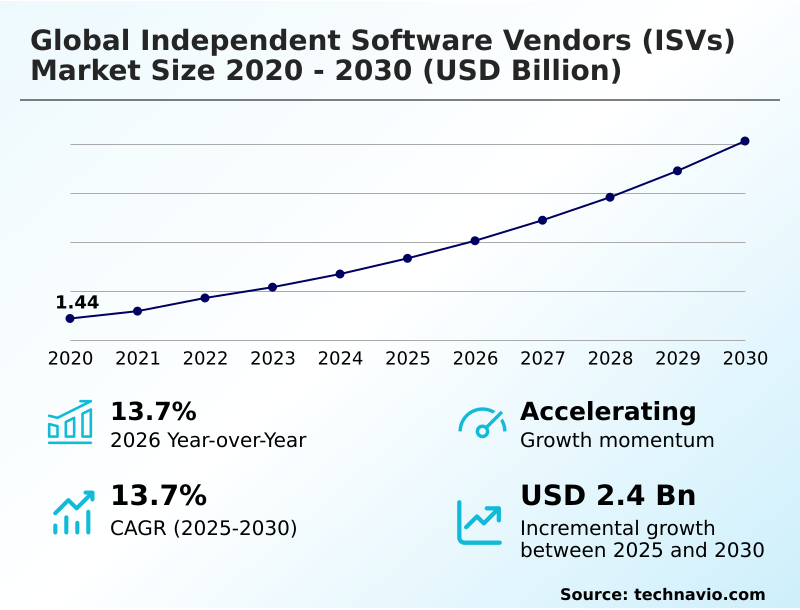
The independent software vendors (isvs) market size is valued to increase by USD 2.40 billion, at a CAGR of 13.7% from 2025 to 2030. Widespread adoption of digital transformation initiatives will drive the independent software vendors (isvs) market.

Major Market Trends & Insights

  • North America dominated the market and accounted for a 37.1% growth during the forecast period.
  • By Deployment - On-premises segment was valued at USD 1.64 billion in 2024
  • By Component - Software segment accounted for the largest market revenue share in 2024

Market Size & Forecast

  • Market Opportunities: USD 3.63 billion
  • Market Future Opportunities: USD 2.40 billion
  • CAGR from 2025 to 2030 : 13.7%

Market Summary

  • The Independent Software Vendors (ISVs) market is central to the ongoing digital transformation across all business sectors. The fundamental shift from traditional licensed software to dynamic, subscription-based models, predominantly delivered as software as a service (SaaS), has democratized access to powerful tools.
  • ISVs are no longer just creating applications; they are engineering cloud-native applications that serve as the backbone for modern enterprise operations. A key aspect of this evolution is the deep integration of AI-powered analytics, which transforms business data into actionable intelligence.
  • For instance, in the manufacturing sector, a vertical-specific application from an ISV can use machine learning algorithms to analyze sensor data from factory equipment, predicting maintenance needs before failures occur and significantly reducing operational downtime. This level of specialization, combined with robust cybersecurity solutions and a focus on data privacy compliance, is what defines the value proposition of modern ISVs.
  • They provide the critical enterprise resource planning (ERP) and customer relationship management (CRM) functionalities that enable businesses to scale, innovate, and compete effectively.

What will be the Size of the Independent Software Vendors (isvs) Market during the forecast period?
Get Key Insights on Market Forecast (PDF) Get Free Sample

How is the Independent Software Vendors (isvs) Market Segmented?

The independent software vendors (isvs) industry research report provides comprehensive data (region-wise segment analysis), with forecasts and estimates in "USD million" for the period 2026-2030, as well as historical data from 2020-2024 for the following segments.

  • Deployment
    • On-premises
    • Cloud based
  • Component
    • Software
    • Services
  • End-user
    • BFSI
    • IT and telecom
    • Logistics
    • Education
    • Others
  • Geography
    • North America
      • US
      • Canada
      • Mexico
    • Europe
      • UK
      • Germany
      • France
    • APAC
      • China
      • Japan
      • India
    • South America
      • Brazil
      • Argentina
    • Middle East and Africa
      • Saudi Arabia
      • Israel
      • UAE
    • Rest of World (ROW)

By Deployment Insights

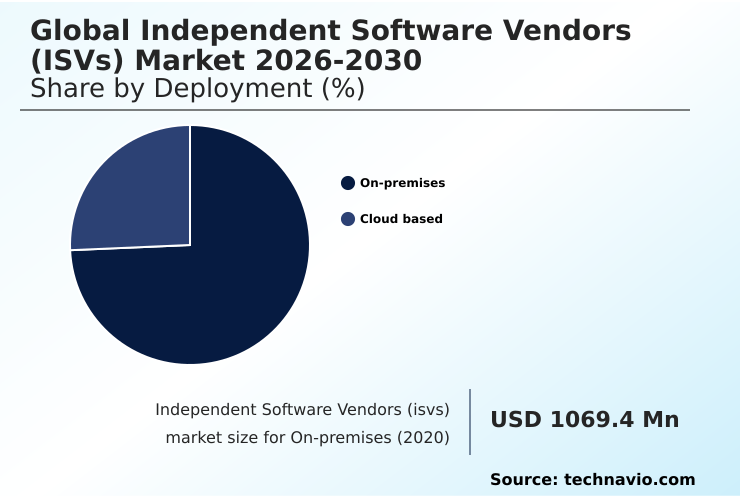
The on-premises segment is estimated to witness significant growth during the forecast period.

The on-premises segment remains a cornerstone of the market, particularly for organizations with stringent security and data governance frameworks. Industries such as finance and healthcare prioritize this model for its unparalleled control over sensitive information, ensuring data sovereignty compliance.

This deployment avoids the multi-tenant architectures of software as a service (SaaS), offering a secure perimeter for enterprise software integration and legacy systems.

While hybrid cloud deployment strategies are emerging, on-premises solutions provide a 25% greater degree of direct data control, a critical factor in regulated environments.

Effective B2B software marketing for these solutions emphasizes security, reliability, and robust identity and access management (IAM), appealing to enterprises where data control is non-negotiable.
Get Free Sample

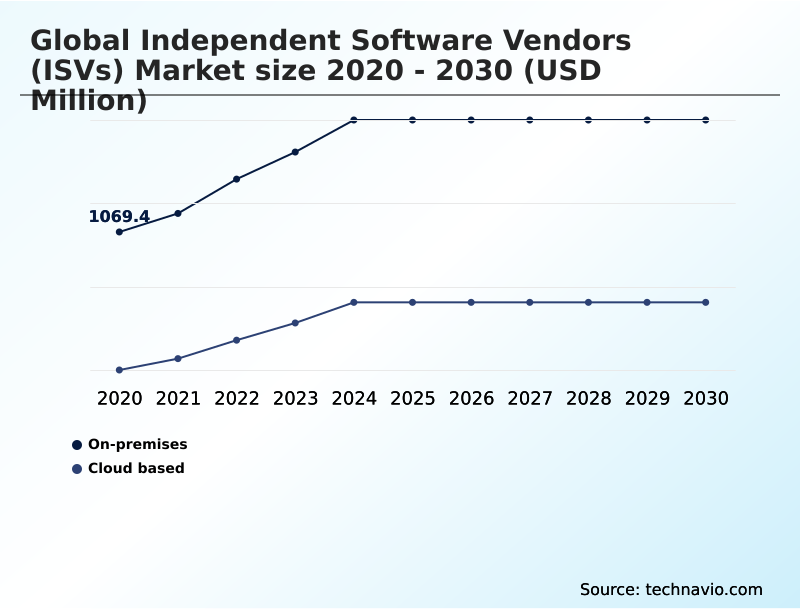
The On-premises segment was valued at USD 1.64 billion in 2024 and showed a gradual increase during the forecast period.
Get Free Sample

Regional Analysis

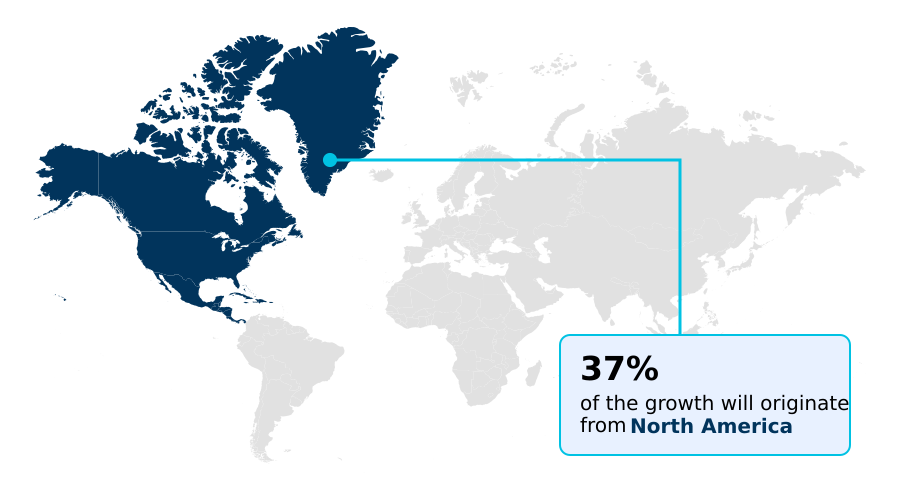
North America is estimated to contribute 37.1% to the growth of the global market during the forecast period.Technavio’s analysts have elaborately explained the regional trends and drivers that shape the market during the forecast period.
See How Independent Software Vendors (isvs) Market Demand is Rising in North America Get Free Sample

The geographic landscape is characterized by varying rates of technological adoption and strategic focus. In North America, the maturity of the market is evident, with enterprise adoption of multi-cloud environments surpassing 90%.

This drives demand for sophisticated hybrid cloud deployment and management tools. Meanwhile, the APAC region is exhibiting the fastest growth in the adoption of cloud-native applications, with annual uptake increasing by over 35%.

This surge is fueled by a mobile-first population and the rapid digitalization of small and medium-sized enterprises. European markets prioritize data privacy compliance and data governance frameworks, creating strong demand for ISVs specializing in cybersecurity solutions and regulatory technology.

Success in this fragmented global environment requires ISVs to tailor their go-to-market strategies, considering regional infrastructure, regulatory climates, and the prevalence of legacy systems.

Market Dynamics

Our researchers analyzed the data with 2025 as the base year, along with the key drivers, trends, and challenges. A holistic analysis of drivers will help companies refine their marketing strategies to gain a competitive advantage.

  • Understanding the future trends in enterprise application software is crucial for market stakeholders. The impact of AI on ISV product development is profound, compelling vendors to integrate generative AI into existing software and explore new monetization strategies for API-first companies.
  • This technological shift is part of a broader discussion about building a successful ISV partner ecosystem, where navigating the ISV co-sell programs of hyperscalers becomes a key competency. Simultaneously, ISV strategies for international market entry must now account for complex global data privacy regulations impacting ISVs. The debate over comparing on-premise vs.
  • cloud-based ISV solutions continues, though the challenges of migrating legacy systems to the cloud are being addressed with new tools. The importance of cybersecurity for SaaS providers cannot be overstated, with security best practices for multi-tenant SaaS apps becoming a standard requirement.
  • For sustained growth, customer retention strategies for SaaS businesses are paramount, as are solutions to the persistent talent acquisition challenges for software vendors. The role of ISVs in driving industry 4.0 is expanding, especially with the adoption of low-code platforms in enterprises and the rise of vertical market specialization for ISVs.
  • Businesses that leverage specialized ISV solutions for the financial services industry, for instance, report compliance-related error reductions that are twice as effective as those using generic platforms. As firms learn how ISVs can leverage big data analytics, the role of ISVs in smart city development is also becoming increasingly significant, highlighting the diverse impact of this dynamic industry.
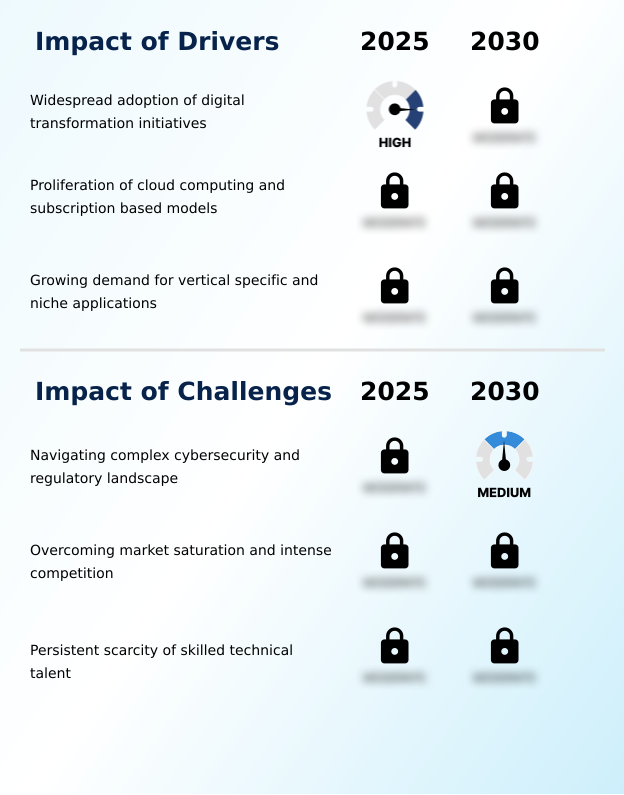
What are the key market drivers leading to the rise in the adoption of Independent Software Vendors (isvs) Industry?

  • The widespread adoption of digital transformation initiatives across industries serves as a primary market driver, compelling organizations to integrate advanced software solutions.

  • The pervasive wave of digital transformation across all sectors is the primary market driver.
  • Businesses are compelled to adopt cloud-native applications and software as a service (SaaS) solutions to enhance efficiency and maintain competitiveness, with cloud adoption often reducing initial infrastructure costs by up to 60%.
  • This fuels the demand for subscription-based models that offer scalability and predictable spending. The proliferation of multi-cloud environments and hybrid cloud deployment strategies creates a significant opportunity for ISVs that provide interoperable and flexible enterprise software.
  • Furthermore, the growing need for vertical-specific applications tailored to the unique requirements of industries like finance and healthcare drives innovation.
  • These specialized solutions offer functionalities that generic enterprise resource planning (ERP) or customer relationship management (CRM) systems cannot, delivering a higher return on investment.

What are the market trends shaping the Independent Software Vendors (isvs) Industry?

  • The pervasive integration of artificial intelligence and machine learning represents a defining market trend. This evolution transforms software from systems of record into intelligent platforms capable of predictive insights.

  • A defining trend is the deep integration of artificial intelligence, which is transforming software into systems of intelligence. ISVs are embedding AI-powered analytics and machine learning integration into core products, enabling functionalities like predictive insights and automated workflows, which can increase data processing accuracy by up to 25%.
  • This shift is compelling vendors to adopt an API-first architecture, allowing for seamless connection with other intelligent systems. The rise of low-code development and no-code platforms further democratizes innovation, empowering non-technical users to create and customize applications. This trend accelerates digital transformation within organizations, allowing them to develop vertical-specific applications more rapidly.
  • A focus on enterprise software integration is critical, as customers demand cohesive systems rather than siloed tools.

What challenges does the Independent Software Vendors (isvs) Industry face during its growth?

  • Navigating the increasingly complex cybersecurity threat environment and the fragmented global regulatory landscape presents a formidable challenge for market participants.

  • A formidable challenge is the increasingly sophisticated cybersecurity landscape, where a single data breach can reduce an ISV's valuation by over 15%. ISVs are high-value targets, requiring constant investment in cybersecurity solutions and threat intelligence platforms to protect sensitive customer data within multi-tenant architectures. Compounding this is the complex web of data privacy compliance and data sovereignty compliance regulations worldwide.
  • Navigating these rules demands significant resources, diverting focus from core product innovation. Furthermore, market saturation and intense competition, driven by low barriers to entry, create immense pricing pressure. The persistent scarcity of skilled talent in areas like DevSecOps pipelines and generative AI development further constrains growth, making it difficult for ISVs to innovate and scale effectively.

Exclusive Technavio Analysis on Customer Landscape

The independent software vendors (isvs) market forecasting report includes the adoption lifecycle of the market, covering from the innovator’s stage to the laggard’s stage. It focuses on adoption rates in different regions based on penetration. Furthermore, the independent software vendors (isvs) market report also includes key purchase criteria and drivers of price sensitivity to help companies evaluate and develop their market growth analysis strategies.
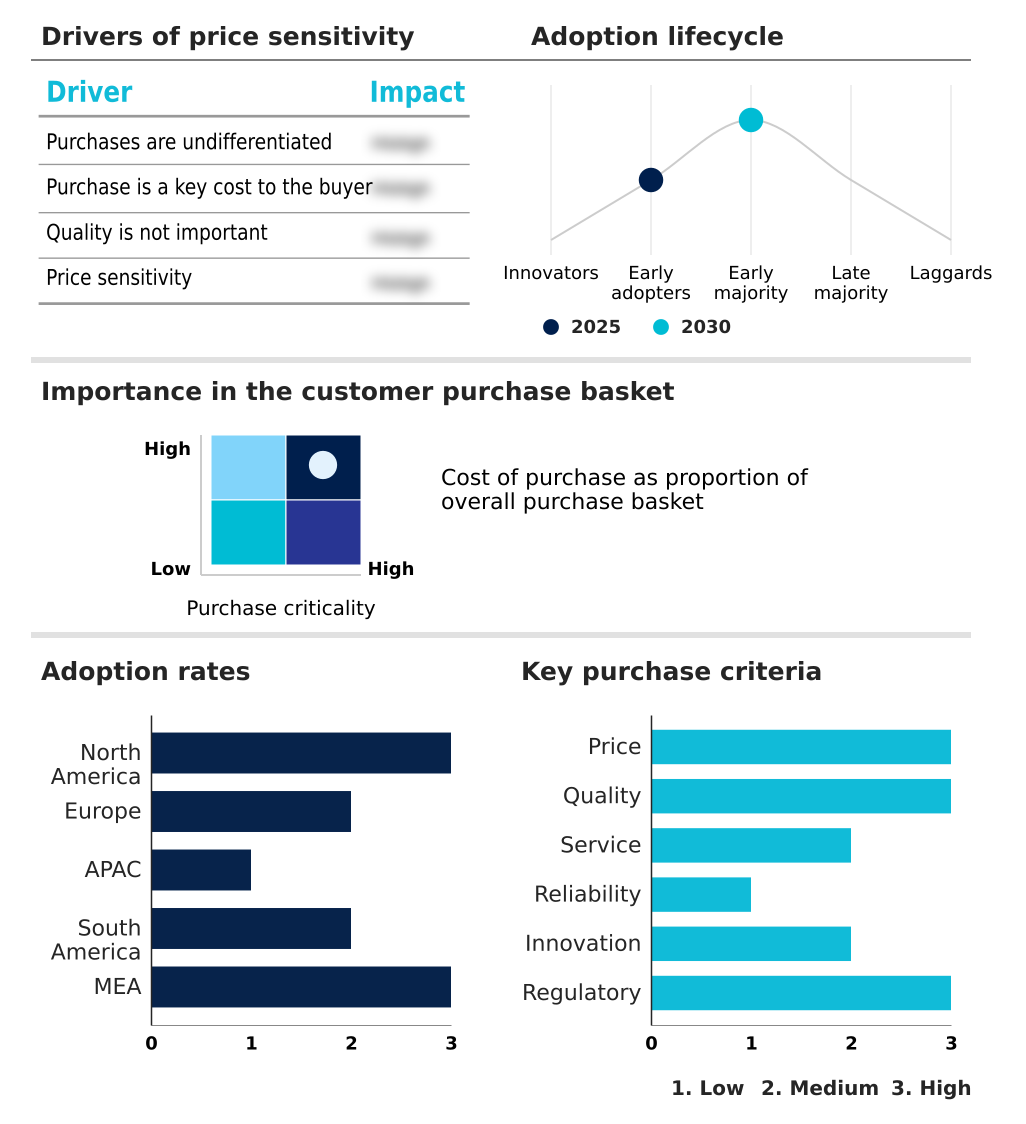
Customer Landscape of Independent Software Vendors (isvs) Industry

Competitive Landscape

Companies are implementing various strategies, such as strategic alliances, independent software vendors (isvs) market forecast, partnerships, mergers and acquisitions, geographical expansion, and product/service launches, to enhance their presence in the industry.

Adobe Inc. - A leading provider of integrated creative, customer experience, and digital document software platforms designed for enterprise and commercial markets.

The industry research and growth report includes detailed analyses of the competitive landscape of the market and information about key companies, including:

  • Adobe Inc.
  • Atlassian Corp.
  • Autodesk Inc.
  • Cisco Systems Inc.
  • Commvault Systems Inc.
  • CrowdStrike Inc.
  • Dynatrace Inc.
  • Google LLC
  • HP Inc.
  • HubSpot Inc.
  • IBM Corp.
  • Microsoft Corp.
  • Oracle Corp.
  • Palo Alto Networks Inc.
  • Salesforce Inc.
  • SAP SE
  • ServiceNow Inc.
  • Snowflake Inc.
  • Veeva Systems Inc.
  • Workday Inc.

Qualitative and quantitative analysis of companies has been conducted to help clients understand the wider business environment as well as the strengths and weaknesses of key industry players. Data is qualitatively analyzed to categorize companies as pure play, category-focused, industry-focused, and diversified; it is quantitatively analyzed to categorize companies as dominant, leading, strong, tentative, and weak.

Recent Development and News in Independent software vendors (isvs) market

  • In September 2024, Oracle Corp. announced a major update to its Fusion Cloud Applications, integrating new generative AI capabilities to automate financial planning and supply chain management tasks for enterprises.
  • In November 2024, ServiceNow Inc. and IBM Corp. expanded their strategic partnership to offer a joint solution combining ServiceNow's Now Platform with IBM's Watson AI for IT operations (AIOps), aiming to accelerate incident resolution for large organizations.
  • In February 2025, Salesforce Inc. completed its acquisition of a leading data privacy management platform for approximately $1.2 billion, enhancing its Customer 360 platform with advanced data governance and compliance features.
  • In May 2025, SAP SE launched its new industry-specific cloud solution for the renewable energy sector, providing tailored ERP and asset management tools to support the global energy transition.

Dive into Technavio’s robust research methodology, blending expert interviews, extensive data synthesis, and validated models for unparalleled Independent Software Vendors (isvs) Market insights. See full methodology.

Market Scope
Page number 302
Base year 2025
Historic period 2020-2024
Forecast period 2026-2030
Growth momentum & CAGR Accelerate at a CAGR of 13.7%
Market growth 2026-2030 USD 2403.9 million
Market structure Fragmented
YoY growth 2025-2026(%) 13.7%
Key countries US, Canada, Mexico, UK, Germany, France, Italy, Spain, The Netherlands, China, Japan, India, South Korea, Australia, Indonesia, Brazil, Argentina, Chile, Saudi Arabia, Israel, UAE, South Africa and Turkey
Competitive landscape Leading Companies, Market Positioning of Companies, Competitive Strategies, and Industry Risks

Request Free Sample

Research Analyst Overview

  • The Independent Software Vendors (ISVs) market is undergoing a profound evolution driven by digital transformation and the universal shift to subscription-based models. The core of the market is the widespread adoption of software as a service (SaaS), with ISVs building cloud-native applications on microservices architecture and leveraging containerization technology.
  • This transition is facilitated by the proliferation of multi-cloud environments and hybrid cloud deployment, forcing a strategic reconsideration of enterprise software. The integration of advanced technologies is a key differentiator. The use of machine learning integration and AI-powered analytics is now standard, while the push toward agentic AI capabilities and generative AI models is redefining product roadmaps.
  • This shift toward intelligent automation, including robotic process automation (RPA) and business process management (BPM), allows enterprises to achieve more than a 30% improvement in process automation. ISVs are delivering critical enterprise resource planning (ERP), customer relationship management (CRM), supply chain management (SCM), and product lifecycle management (PLM) solutions.
  • Boardroom discussions now center on the strategic adoption of vertical-specific applications, unified communication platforms, and augmented reality (AR) tools. This innovation must be balanced with robust cybersecurity solutions, threat intelligence platforms, and stringent data privacy compliance to address complex data governance frameworks, particularly with the rise of Internet of Things (IoT) integration and edge computing solutions.

What are the Key Data Covered in this Independent Software Vendors (isvs) Market Research and Growth Report?

  • What is the expected growth of the Independent Software Vendors (isvs) Market between 2026 and 2030?

    • USD 2.40 billion, at a CAGR of 13.7%

  • What segmentation does the market report cover?

    • The report is segmented by Deployment (On-premises, and Cloud based), Component (Software, and Services), End-user (BFSI, IT and telecom, Logistics, Education, and Others) and Geography (North America, Europe, APAC, South America, Middle East and Africa)

  • Which regions are analyzed in the report?

    • North America, Europe, APAC, South America and Middle East and Africa

  • What are the key growth drivers and market challenges?

    • Widespread adoption of digital transformation initiatives, Navigating complex cybersecurity and regulatory landscape

  • Who are the major players in the Independent Software Vendors (isvs) Market?

    • Adobe Inc., Atlassian Corp., Autodesk Inc., Cisco Systems Inc., Commvault Systems Inc., CrowdStrike Inc., Dynatrace Inc., Google LLC, HP Inc., HubSpot Inc., IBM Corp., Microsoft Corp., Oracle Corp., Palo Alto Networks Inc., Salesforce Inc., SAP SE, ServiceNow Inc., Snowflake Inc., Veeva Systems Inc. and Workday Inc.

Market Research Insights

  • Market dynamics are increasingly shaped by strategic collaborations and platform-centric growth models. Independent Software Vendors (ISVs) participating in formal co-sell initiatives with major cloud providers report up to a 40% faster sales cycle compared to those operating independently. An effective cloud marketplace strategy is no longer optional, as it provides direct access to enterprise buyers.
  • Furthermore, a pivot towards vertical industry solutions and niche software markets is proving highly effective, with specialists in areas like fintech software development and healthtech application platforms achieving over 25% higher customer retention rates. The success of these strategies hinges on robust ISV partner programs that facilitate deep enterprise software integration.
  • These ecosystems foster innovation and provide the specialized digital transformation services that enterprises now demand, creating a clear competitive advantage in a crowded field.

We can help! Our analysts can customize this independent software vendors (isvs) market research report to meet your requirements.

Get in touch

1. Executive Summary

1.1 Market overview

Executive Summary - Chart on Market Overview
Executive Summary - Data Table on Market Overview
Executive Summary - Chart on Global Market Characteristics
Executive Summary - Chart on Market by Geography
Executive Summary - Chart on Market Segmentation by Deployment
Executive Summary - Chart on Market Segmentation by Component
Executive Summary - Chart on Market Segmentation by End-user
Executive Summary - Chart on Incremental Growth
Executive Summary - Data Table on Incremental Growth
Executive Summary - Chart on Company Market Positioning

2. Technavio Analysis

2.1 Analysis of price sensitivity, lifecycle, customer purchase basket, adoption rates, and purchase criteria

2.2 Criticality of inputs and Factors of differentiation

Chart on Overview on criticality of inputs and factors of differentiation

2.3 Factors of disruption

Chart on Overview on factors of disruption

2.4 Impact of drivers and challenges

Chart on Impact of drivers and challenges in 2025 and 2030

3. Market Landscape

3.1 Market ecosystem

Chart on Parent Market
Data Table on - Parent Market

3.2 Market characteristics

Chart on Market characteristics analysis

3.3 Value chain analysis

Chart on Value chain analysis

4. Market Sizing

4.1 Market definition

Data Table on Offerings of companies included in the market definition

4.2 Market segment analysis

Market segments

4.3 Market size 2025

4.4 Market outlook: Forecast for 2025-2030

Chart on Global - Market size and forecast 2025-2030 ($ million)
Data Table on Global - Market size and forecast 2025-2030 ($ million)
Chart on Global Market: Year-over-year growth 2025-2030 (%)
Data Table on Global Market: Year-over-year growth 2025-2030 (%)

5. Historic Market Size

5.1 Global Independent Software Vendors (ISVs) Market 2020 - 2024

Historic Market Size - Data Table on Global Independent Software Vendors (ISVs) Market 2020 - 2024 ($ million)

5.2 Deployment segment analysis 2020 - 2024

Historic Market Size - Deployment Segment 2020 - 2024 ($ million)

5.3 Component segment analysis 2020 - 2024

Historic Market Size - Component Segment 2020 - 2024 ($ million)

5.4 End-user segment analysis 2020 - 2024

Historic Market Size - End-user Segment 2020 - 2024 ($ million)

5.5 Geography segment analysis 2020 - 2024

Historic Market Size - Geography Segment 2020 - 2024 ($ million)

5.6 Country segment analysis 2020 - 2024

Historic Market Size - Country Segment 2020 - 2024 ($ million)

6. Qualitative Analysis

6.1 Impact of AI on global independent software vendors (ISVs) market

6.2 Impact of geopolitical conflicts on global independent software vendors (ISVs) market

7. Five Forces Analysis

7.1 Five forces summary

Five forces analysis - Comparison between 2025 and 2030

7.2 Bargaining power of buyers

Bargaining power of buyers - Impact of key factors 2025 and 2030

7.3 Bargaining power of suppliers

Bargaining power of suppliers - Impact of key factors in 2025 and 2030

7.4 Threat of new entrants

Threat of new entrants - Impact of key factors in 2025 and 2030

7.5 Threat of substitutes

Threat of substitutes - Impact of key factors in 2025 and 2030

7.6 Threat of rivalry

Threat of rivalry - Impact of key factors in 2025 and 2030

7.7 Market condition

Chart on Market condition - Five forces 2025 and 2030

8. Market Segmentation by Deployment

8.1 Market segments

Chart on Deployment - Market share 2025-2030 (%)
Data Table on Deployment - Market share 2025-2030 (%)

8.2 Comparison by Deployment

Chart on Comparison by Deployment
Data Table on Comparison by Deployment

8.3 On-premises - Market size and forecast 2025-2030

Chart on On-premises - Market size and forecast 2025-2030 ($ million)
Data Table on On-premises - Market size and forecast 2025-2030 ($ million)
Chart on On-premises - Year-over-year growth 2025-2030 (%)
Data Table on On-premises - Year-over-year growth 2025-2030 (%)

8.4 Cloud based - Market size and forecast 2025-2030

Chart on Cloud based - Market size and forecast 2025-2030 ($ million)
Data Table on Cloud based - Market size and forecast 2025-2030 ($ million)
Chart on Cloud based - Year-over-year growth 2025-2030 (%)
Data Table on Cloud based - Year-over-year growth 2025-2030 (%)

8.5 Market opportunity by Deployment

Market opportunity by Deployment ($ million)
Data Table on Market opportunity by Deployment ($ million)

9. Market Segmentation by Component

9.1 Market segments

Chart on Component - Market share 2025-2030 (%)
Data Table on Component - Market share 2025-2030 (%)

9.2 Comparison by Component

Chart on Comparison by Component
Data Table on Comparison by Component

9.3 Software - Market size and forecast 2025-2030

Chart on Software - Market size and forecast 2025-2030 ($ million)
Data Table on Software - Market size and forecast 2025-2030 ($ million)
Chart on Software - Year-over-year growth 2025-2030 (%)
Data Table on Software - Year-over-year growth 2025-2030 (%)

9.4 Services - Market size and forecast 2025-2030

Chart on Services - Market size and forecast 2025-2030 ($ million)
Data Table on Services - Market size and forecast 2025-2030 ($ million)
Chart on Services - Year-over-year growth 2025-2030 (%)
Data Table on Services - Year-over-year growth 2025-2030 (%)

9.5 Market opportunity by Component

Market opportunity by Component ($ million)
Data Table on Market opportunity by Component ($ million)

10. Market Segmentation by End-user

10.1 Market segments

Chart on End-user - Market share 2025-2030 (%)
Data Table on End-user - Market share 2025-2030 (%)

10.2 Comparison by End-user

Chart on Comparison by End-user
Data Table on Comparison by End-user

10.3 BFSI - Market size and forecast 2025-2030

Chart on BFSI - Market size and forecast 2025-2030 ($ million)
Data Table on BFSI - Market size and forecast 2025-2030 ($ million)
Chart on BFSI - Year-over-year growth 2025-2030 (%)
Data Table on BFSI - Year-over-year growth 2025-2030 (%)

10.4 IT and telecom - Market size and forecast 2025-2030

Chart on IT and telecom - Market size and forecast 2025-2030 ($ million)
Data Table on IT and telecom - Market size and forecast 2025-2030 ($ million)
Chart on IT and telecom - Year-over-year growth 2025-2030 (%)
Data Table on IT and telecom - Year-over-year growth 2025-2030 (%)

10.5 Logistics - Market size and forecast 2025-2030

Chart on Logistics - Market size and forecast 2025-2030 ($ million)
Data Table on Logistics - Market size and forecast 2025-2030 ($ million)
Chart on Logistics - Year-over-year growth 2025-2030 (%)
Data Table on Logistics - Year-over-year growth 2025-2030 (%)

10.6 Education - Market size and forecast 2025-2030

Chart on Education - Market size and forecast 2025-2030 ($ million)
Data Table on Education - Market size and forecast 2025-2030 ($ million)
Chart on Education - Year-over-year growth 2025-2030 (%)
Data Table on Education - Year-over-year growth 2025-2030 (%)

10.7 Others - Market size and forecast 2025-2030

Chart on Others - Market size and forecast 2025-2030 ($ million)
Data Table on Others - Market size and forecast 2025-2030 ($ million)
Chart on Others - Year-over-year growth 2025-2030 (%)
Data Table on Others - Year-over-year growth 2025-2030 (%)

10.8 Market opportunity by End-user

Market opportunity by End-user ($ million)
Data Table on Market opportunity by End-user ($ million)

11. Customer Landscape

11.1 Customer landscape overview

Analysis of price sensitivity, lifecycle, customer purchase basket, adoption rates, and purchase criteria

12. Geographic Landscape

12.1 Geographic segmentation

Chart on Market share by geography 2025-2030 (%)
Data Table on Market share by geography 2025-2030 (%)

12.2 Geographic comparison

Chart on Geographic comparison
Data Table on Geographic comparison

12.3 North America - Market size and forecast 2025-2030

Chart on North America - Market size and forecast 2025-2030 ($ million)
Data Table on North America - Market size and forecast 2025-2030 ($ million)
Chart on North America - Year-over-year growth 2025-2030 (%)
Data Table on North America - Year-over-year growth 2025-2030 (%)
Chart on Regional Comparison - North America
Data Table on Regional Comparison - North America

12.3.1 US - Market size and forecast 2025-2030

Chart on US - Market size and forecast 2025-2030 ($ million)
Data Table on US - Market size and forecast 2025-2030 ($ million)
Chart on US - Year-over-year growth 2025-2030 (%)
Data Table on US - Year-over-year growth 2025-2030 (%)

12.3.2 Canada - Market size and forecast 2025-2030

Chart on Canada - Market size and forecast 2025-2030 ($ million)
Data Table on Canada - Market size and forecast 2025-2030 ($ million)
Chart on Canada - Year-over-year growth 2025-2030 (%)
Data Table on Canada - Year-over-year growth 2025-2030 (%)

12.3.3 Mexico - Market size and forecast 2025-2030

Chart on Mexico - Market size and forecast 2025-2030 ($ million)
Data Table on Mexico - Market size and forecast 2025-2030 ($ million)
Chart on Mexico - Year-over-year growth 2025-2030 (%)
Data Table on Mexico - Year-over-year growth 2025-2030 (%)

12.4 Europe - Market size and forecast 2025-2030

Chart on Europe - Market size and forecast 2025-2030 ($ million)
Data Table on Europe - Market size and forecast 2025-2030 ($ million)
Chart on Europe - Year-over-year growth 2025-2030 (%)
Data Table on Europe - Year-over-year growth 2025-2030 (%)
Chart on Regional Comparison - Europe
Data Table on Regional Comparison - Europe

12.4.1 UK - Market size and forecast 2025-2030

Chart on UK - Market size and forecast 2025-2030 ($ million)
Data Table on UK - Market size and forecast 2025-2030 ($ million)
Chart on UK - Year-over-year growth 2025-2030 (%)
Data Table on UK - Year-over-year growth 2025-2030 (%)

12.4.2 Germany - Market size and forecast 2025-2030

Chart on Germany - Market size and forecast 2025-2030 ($ million)
Data Table on Germany - Market size and forecast 2025-2030 ($ million)
Chart on Germany - Year-over-year growth 2025-2030 (%)
Data Table on Germany - Year-over-year growth 2025-2030 (%)

12.4.3 France - Market size and forecast 2025-2030

Chart on France - Market size and forecast 2025-2030 ($ million)
Data Table on France - Market size and forecast 2025-2030 ($ million)
Chart on France - Year-over-year growth 2025-2030 (%)
Data Table on France - Year-over-year growth 2025-2030 (%)

12.4.4 Italy - Market size and forecast 2025-2030

Chart on Italy - Market size and forecast 2025-2030 ($ million)
Data Table on Italy - Market size and forecast 2025-2030 ($ million)
Chart on Italy - Year-over-year growth 2025-2030 (%)
Data Table on Italy - Year-over-year growth 2025-2030 (%)

12.4.5 Spain - Market size and forecast 2025-2030

Chart on Spain - Market size and forecast 2025-2030 ($ million)
Data Table on Spain - Market size and forecast 2025-2030 ($ million)
Chart on Spain - Year-over-year growth 2025-2030 (%)
Data Table on Spain - Year-over-year growth 2025-2030 (%)

12.4.6 The Netherlands - Market size and forecast 2025-2030

Chart on The Netherlands - Market size and forecast 2025-2030 ($ million)
Data Table on The Netherlands - Market size and forecast 2025-2030 ($ million)
Chart on The Netherlands - Year-over-year growth 2025-2030 (%)
Data Table on The Netherlands - Year-over-year growth 2025-2030 (%)

12.5 APAC - Market size and forecast 2025-2030

Chart on APAC - Market size and forecast 2025-2030 ($ million)
Data Table on APAC - Market size and forecast 2025-2030 ($ million)
Chart on APAC - Year-over-year growth 2025-2030 (%)
Data Table on APAC - Year-over-year growth 2025-2030 (%)
Chart on Regional Comparison - APAC
Data Table on Regional Comparison - APAC

12.5.1 China - Market size and forecast 2025-2030

Chart on China - Market size and forecast 2025-2030 ($ million)
Data Table on China - Market size and forecast 2025-2030 ($ million)
Chart on China - Year-over-year growth 2025-2030 (%)
Data Table on China - Year-over-year growth 2025-2030 (%)

12.5.2 Japan - Market size and forecast 2025-2030

Chart on Japan - Market size and forecast 2025-2030 ($ million)
Data Table on Japan - Market size and forecast 2025-2030 ($ million)
Chart on Japan - Year-over-year growth 2025-2030 (%)
Data Table on Japan - Year-over-year growth 2025-2030 (%)

12.5.3 India - Market size and forecast 2025-2030

Chart on India - Market size and forecast 2025-2030 ($ million)
Data Table on India - Market size and forecast 2025-2030 ($ million)
Chart on India - Year-over-year growth 2025-2030 (%)
Data Table on India - Year-over-year growth 2025-2030 (%)

12.5.4 South Korea - Market size and forecast 2025-2030

Chart on South Korea - Market size and forecast 2025-2030 ($ million)
Data Table on South Korea - Market size and forecast 2025-2030 ($ million)
Chart on South Korea - Year-over-year growth 2025-2030 (%)
Data Table on South Korea - Year-over-year growth 2025-2030 (%)

12.5.5 Australia - Market size and forecast 2025-2030

Chart on Australia - Market size and forecast 2025-2030 ($ million)
Data Table on Australia - Market size and forecast 2025-2030 ($ million)
Chart on Australia - Year-over-year growth 2025-2030 (%)
Data Table on Australia - Year-over-year growth 2025-2030 (%)

12.5.6 Indonesia - Market size and forecast 2025-2030

Chart on Indonesia - Market size and forecast 2025-2030 ($ million)
Data Table on Indonesia - Market size and forecast 2025-2030 ($ million)
Chart on Indonesia - Year-over-year growth 2025-2030 (%)
Data Table on Indonesia - Year-over-year growth 2025-2030 (%)

12.6 South America - Market size and forecast 2025-2030

Chart on South America - Market size and forecast 2025-2030 ($ million)
Data Table on South America - Market size and forecast 2025-2030 ($ million)
Chart on South America - Year-over-year growth 2025-2030 (%)
Data Table on South America - Year-over-year growth 2025-2030 (%)
Chart on Regional Comparison - South America
Data Table on Regional Comparison - South America

12.6.1 Brazil - Market size and forecast 2025-2030

Chart on Brazil - Market size and forecast 2025-2030 ($ million)
Data Table on Brazil - Market size and forecast 2025-2030 ($ million)
Chart on Brazil - Year-over-year growth 2025-2030 (%)
Data Table on Brazil - Year-over-year growth 2025-2030 (%)

12.6.2 Argentina - Market size and forecast 2025-2030

Chart on Argentina - Market size and forecast 2025-2030 ($ million)
Data Table on Argentina - Market size and forecast 2025-2030 ($ million)
Chart on Argentina - Year-over-year growth 2025-2030 (%)
Data Table on Argentina - Year-over-year growth 2025-2030 (%)

12.6.3 Chile - Market size and forecast 2025-2030

Chart on Chile - Market size and forecast 2025-2030 ($ million)
Data Table on Chile - Market size and forecast 2025-2030 ($ million)
Chart on Chile - Year-over-year growth 2025-2030 (%)
Data Table on Chile - Year-over-year growth 2025-2030 (%)

12.7 Middle East and Africa - Market size and forecast 2025-2030

Chart on Middle East and Africa - Market size and forecast 2025-2030 ($ million)
Data Table on Middle East and Africa - Market size and forecast 2025-2030 ($ million)
Chart on Middle East and Africa - Year-over-year growth 2025-2030 (%)
Data Table on Middle East and Africa - Year-over-year growth 2025-2030 (%)
Chart on Regional Comparison - Middle East and Africa
Data Table on Regional Comparison - Middle East and Africa

12.7.1 Saudi Arabia - Market size and forecast 2025-2030

Chart on Saudi Arabia - Market size and forecast 2025-2030 ($ million)
Data Table on Saudi Arabia - Market size and forecast 2025-2030 ($ million)
Chart on Saudi Arabia - Year-over-year growth 2025-2030 (%)
Data Table on Saudi Arabia - Year-over-year growth 2025-2030 (%)

12.7.2 Israel - Market size and forecast 2025-2030

Chart on Israel - Market size and forecast 2025-2030 ($ million)
Data Table on Israel - Market size and forecast 2025-2030 ($ million)
Chart on Israel - Year-over-year growth 2025-2030 (%)
Data Table on Israel - Year-over-year growth 2025-2030 (%)

12.7.3 UAE - Market size and forecast 2025-2030

Chart on UAE - Market size and forecast 2025-2030 ($ million)
Data Table on UAE - Market size and forecast 2025-2030 ($ million)
Chart on UAE - Year-over-year growth 2025-2030 (%)
Data Table on UAE - Year-over-year growth 2025-2030 (%)

12.7.4 South Africa - Market size and forecast 2025-2030

Chart on South Africa - Market size and forecast 2025-2030 ($ million)
Data Table on South Africa - Market size and forecast 2025-2030 ($ million)
Chart on South Africa - Year-over-year growth 2025-2030 (%)
Data Table on South Africa - Year-over-year growth 2025-2030 (%)

12.7.5 Turkey - Market size and forecast 2025-2030

Chart on Turkey - Market size and forecast 2025-2030 ($ million)
Data Table on Turkey - Market size and forecast 2025-2030 ($ million)
Chart on Turkey - Year-over-year growth 2025-2030 (%)
Data Table on Turkey - Year-over-year growth 2025-2030 (%)

12.8 Market opportunity by geography

Market opportunity by geography ($ million)
Data Tables on Market opportunity by geography ($ million)

13. Drivers, Challenges, and Opportunity

13.1 Market drivers

Widespread adoption of digital transformation initiatives
Proliferation of cloud computing and subscription based models
Growing demand for vertical specific and niche applications

13.2 Market challenges

Navigating complex cybersecurity and regulatory landscape
Overcoming market saturation and intense competition
Persistent scarcity of skilled technical talent

13.3 Impact of drivers and challenges

Impact of drivers and challenges in 2025 and 2030

13.4 Market opportunities

Pervasive integration of AI and ML
Ascendance of low code and no code development platforms
Intensified focus on API first strategies and ecosystem building

14. Competitive Landscape

14.1 Overview

14.2

Overview on criticality of inputs and factors of differentiation

14.3 Landscape disruption

Overview on factors of disruption

14.4 Industry risks

Impact of key risks on business

15. Competitive Analysis

15.1 Companies profiled

Companies covered

15.2 Company ranking index

15.3 Market positioning of companies

Matrix on companies position and classification

15.4 Adobe Inc.

Adobe Inc. - Overview
Adobe Inc. - Business segments
Adobe Inc. - Key offerings
Adobe Inc. - Segment focus
SWOT

15.5 Atlassian Corp.

Atlassian Corp. - Overview
Atlassian Corp. - Product / Service
Atlassian Corp. - Key offerings
SWOT

15.6 Autodesk Inc.

Autodesk Inc. - Overview
Autodesk Inc. - Business segments
Autodesk Inc. - Key offerings
Autodesk Inc. - Segment focus
SWOT

15.7 Cisco Systems Inc.

Cisco Systems Inc. - Overview
Cisco Systems Inc. - Business segments
Cisco Systems Inc. - Key news
Cisco Systems Inc. - Key offerings
Cisco Systems Inc. - Segment focus
SWOT

15.8 Commvault Systems Inc.

Commvault Systems Inc. - Overview
Commvault Systems Inc. - Product / Service
Commvault Systems Inc. - Key news
Commvault Systems Inc. - Key offerings
SWOT

15.9 CrowdStrike Inc.

CrowdStrike Inc. - Overview
CrowdStrike Inc. - Product / Service
CrowdStrike Inc. - Key offerings
SWOT

15.10 Google LLC

Google LLC - Overview
Google LLC - Product / Service
Google LLC - Key offerings
SWOT

15.11 HP Inc.

HP Inc. - Overview
HP Inc. - Business segments
HP Inc. - Key news
HP Inc. - Key offerings
HP Inc. - Segment focus
SWOT

15.12 IBM Corp.

IBM Corp. - Overview
IBM Corp. - Business segments
IBM Corp. - Key news
IBM Corp. - Key offerings
IBM Corp. - Segment focus
SWOT

15.13 Microsoft Corp.

Microsoft Corp. - Overview
Microsoft Corp. - Business segments
Microsoft Corp. - Key news
Microsoft Corp. - Key offerings
Microsoft Corp. - Segment focus
SWOT

15.14 Oracle Corp.

Oracle Corp. - Overview
Oracle Corp. - Business segments
Oracle Corp. - Key news
Oracle Corp. - Key offerings
Oracle Corp. - Segment focus
SWOT

15.15 Palo Alto Networks Inc.

Palo Alto Networks Inc. - Overview
Palo Alto Networks Inc. - Business segments
Palo Alto Networks Inc. - Key offerings
Palo Alto Networks Inc. - Segment focus
SWOT

15.16 Salesforce Inc.

Salesforce Inc. - Overview
Salesforce Inc. - Business segments
Salesforce Inc. - Key news
Salesforce Inc. - Key offerings
Salesforce Inc. - Segment focus
SWOT

15.17 SAP SE

SAP SE - Overview
SAP SE - Business segments
SAP SE - Key news
SAP SE - Key offerings
SAP SE - Segment focus
SWOT

15.18 ServiceNow Inc.

ServiceNow Inc. - Overview
ServiceNow Inc. - Product / Service
ServiceNow Inc. - Key news
ServiceNow Inc. - Key offerings
SWOT

16. Appendix

16.1 Scope of the report

Market definition
Objectives
Notes and caveats

16.2 Inclusions and exclusions checklist

Inclusions checklist
Exclusions checklist

16.3 Currency conversion rates for US$

16.4 Research methodology

16.5 Data procurement

Information sources

16.6 Data validation

16.7 Validation techniques employed for market sizing

16.8 Data synthesis

16.9 360 degree market analysis

16.10 List of abbreviations

Research Methodology

Technavio presents a detailed picture of the market by way of study, synthesis, and summation of data from multiple sources. The analysts have presented the various facets of the market with a particular focus on identifying the key industry influencers. The data thus presented is comprehensive, reliable, and the result of extensive research, both primary and secondary.

INFORMATION SOURCES

Primary sources

  • Manufacturers and suppliers
  • Channel partners
  • Industry experts
  • Strategic decision makers

Secondary sources

  • Industry journals and periodicals
  • Government data
  • Financial reports of key industry players
  • Historical data
  • Press releases

DATA ANALYSIS

Data Synthesis

  • Collation of data
  • Estimation of key figures
  • Analysis of derived insights

Data Validation

  • Triangulation with data models
  • Reference against proprietary databases
  • Corroboration with industry experts

REPORT WRITING

Qualitative

  • Market drivers
  • Market challenges
  • Market trends
  • Five forces analysis

Quantitative

  • Market size and forecast
  • Market segmentation
  • Geographical insights
  • Competitive landscape

Interested in this report?

Get your sample now to see our research methodology and insights!

Download Now

Frequently Asked Questions

Independent Software Vendors (isvs) market growth will increase by USD 2403.9 million during 2026-2030.

The Independent Software Vendors (isvs) market is expected to grow at a CAGR of 13.7% during 2026-2030.

Independent Software Vendors (isvs) market is segmented by Deployment (On-premises, Cloud based) Component (Software, Services) End-user (BFSI, IT and telecom, Logistics, Education, Others)

Adobe Inc., Atlassian Corp., Autodesk Inc., Cisco Systems Inc., Commvault Systems Inc., CrowdStrike Inc., Dynatrace Inc., Google LLC, HP Inc., HubSpot Inc., IBM Corp., Microsoft Corp., Oracle Corp., Palo Alto Networks Inc., Salesforce Inc., SAP SE, ServiceNow Inc., Snowflake Inc., Veeva Systems Inc., Workday Inc. are a few of the key vendors in the Independent Software Vendors (isvs) market.

North America will register the highest growth rate of 37.1% among the other regions. Therefore, the Independent Software Vendors (isvs) market in North America is expected to garner significant business opportunities for the vendors during the forecast period.

US, Canada, Mexico, UK, Germany, France, Italy, Spain, The Netherlands, China, Japan, India, South Korea, Australia, Indonesia, Brazil, Argentina, Chile, Saudi Arabia, Israel, UAE, South Africa, Turkey

  • Widespread adoption of digital transformation initiatives is the driving factor this market.

The Independent Software Vendors (isvs) market vendors should focus on grabbing business opportunities from the Deployment segment as it accounted for the largest market share in the base year.
RIA - Research AI Assistant
Ask RIA