

Green AI Infrastructure Market Analysis, Size, and Forecast 2026-2030: North America (US, Canada, and Mexico), APAC (China, Japan, and India), Europe (Germany, UK, and France), South America (Brazil, Argentina, and Chile), Middle East and Africa (Saudi Arabia, UAE, and South Africa), and Rest of World (ROW)

Green AI Infrastructure Market Analysis, Size, and Forecast 2026-2030:
North America (US, Canada, and Mexico), APAC (China, Japan, and India), Europe (Germany, UK, and France), South America (Brazil, Argentina, and Chile), Middle East and Africa (Saudi Arabia, UAE, and South Africa), and Rest of World (ROW)

Published: May 2026 314 Pages SKU: IRTNTR80679

Market Overview at a Glance

$25.82 B
Market Opportunity
34.8%
CAGR 2025 - 2030
41%
North America Growth
$2.72 B
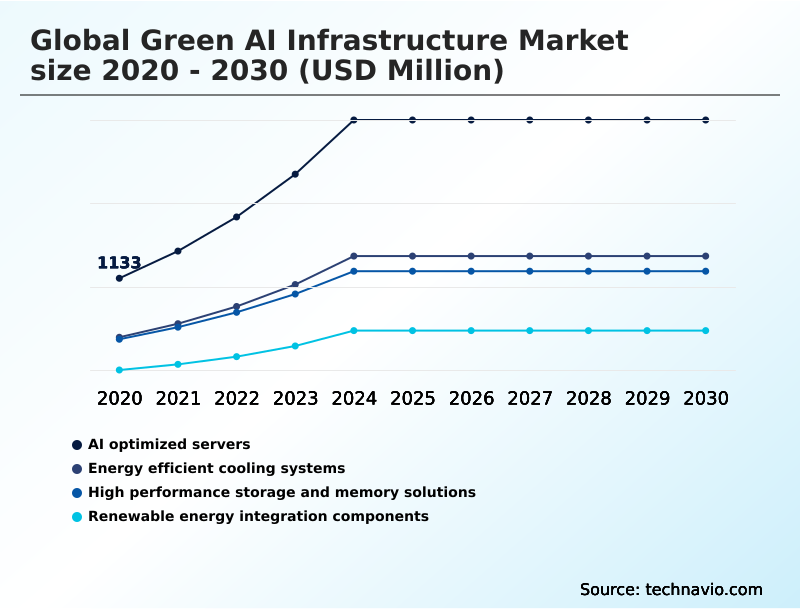
AI optimized servers segment 2024

Green Ai Infrastructure Market Size and Growth Forecast 2026-2030

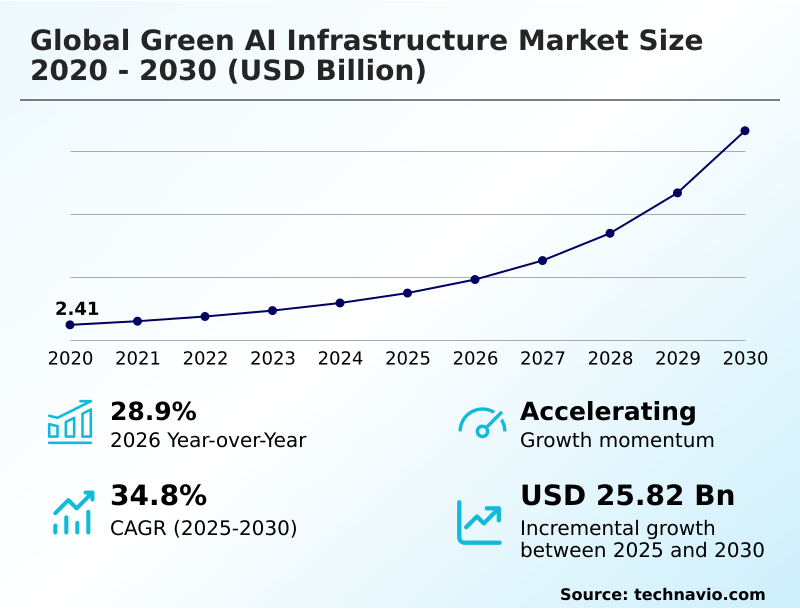
The Green Ai Infrastructure Market size was valued at USD 7.47 billion in 2025 growing at a CAGR of 34.8% during the forecast period 2026-2030.

North America accounts for 41% of incremental growth during the forecast period. The AI optimized servers segment by Product was valued at USD 2.72 billion in 2024, while the Cloud service providers segment holds the largest revenue share by End-user.

The market is projected to grow by USD 30.88 billion from 2020 to 2030, with USD 25.82 billion of the growth expected during the forecast period of 2025 to 2030.
Get Key Insights on Market Forecast (PDF) Request Free Sample

Green Ai Infrastructure Market Overview

The green AI infrastructure market is fundamentally shaped by the operational imperative to reconcile the exponential growth of high-performance computing (HPC) workloads with escalating energy costs and stringent environmental mandates. This has shifted procurement focus toward sustainable IT infrastructure that prioritizes data center energy efficiency and a low power usage effectiveness (PUE) ratio. For instance, a hyperscale facility in a water-stressed region implementing closed-loop cooling systems can reduce water consumption by over 95% compared to evaporative cooling towers, a critical factor for operational licensing under frameworks like the EU Green Deal. This move toward green computing solutions is not just about compliance but also about resource resilience, with North America contributing over 41% to incremental growth, driven by investments in renewable energy integration and carbon-aware computing. Enterprises are increasingly adopting AI workload optimization techniques and specialized low-power processors to ensure that the expansion of AI capabilities does not lead to an unsustainable increase in their carbon footprint, making carbon footprint tracking a standard practice in IT operations. The development of grid-interactive data centers further enhances sustainability by allowing facilities to support local energy grids during peak demand.

Drivers, Trends, and Challenges in the Green Ai Infrastructure Market

Strategic decisions within the green AI infrastructure market are increasingly shaped by complex operational and financial trade-offs. For instance, the discussion around direct-to-chip vs immersion cooling efficiency is central to a data center's design, as liquid cooling can reduce energy consumption for thermal management by up to 90% compared to traditional air-based systems.

This directly influences the PUE calculation for green data centers, a key metric for reporting under energy management standards like ISO 50001.

A financial services firm operating a private high-performance computing cluster must carefully evaluate the ROI of renewable energy in data centers, weighing the high initial CapEx of on-site solar or wind against long-term energy cost savings and price stability.

The impact of EU Green Deal on data centers extends beyond European borders, setting global benchmarks for carbon reporting and influencing the design of next-generation facilities worldwide.

Consequently, optimizing HPC workloads for energy efficiency through software-based energy-aware scheduling and hardware co-design is no longer a niche practice but a critical component of maintaining a competitive and compliant operational posture in an energy-constrained digital economy.
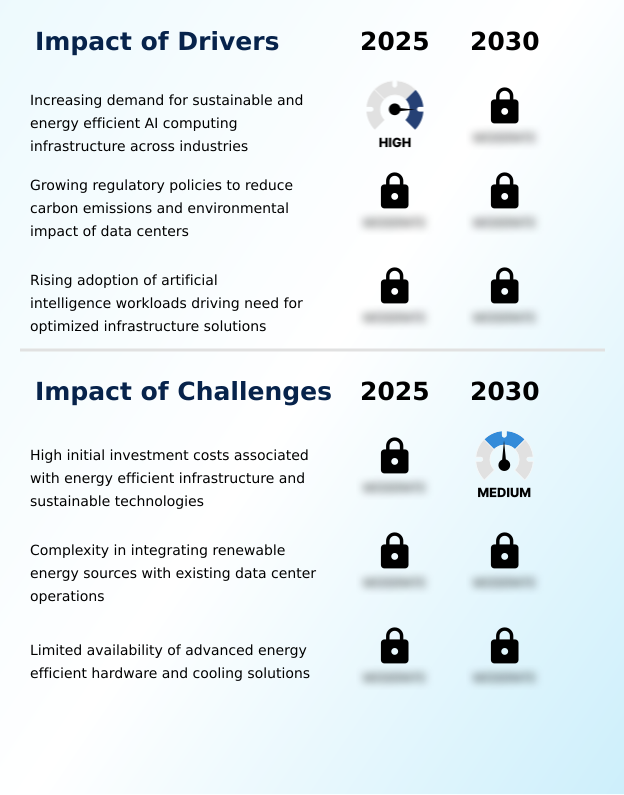
Primary Growth Driver: The increasing demand for sustainable and energy-efficient AI computing infrastructure across industries is a key driver for market growth.

Market expansion, underscored by a year-over-year growth of 28.9%, is primarily fueled by mounting regulatory pressure and corporate sustainability mandates.

Growing awareness of the environmental impact of AI and its associated AI hardware energy consumption has made IT carbon emissions reduction a C-suite priority.

This driver is reinforced by stringent regulatory policies, such as the EU's Corporate Sustainability Reporting Directive, which require transparent reporting on energy use and carbon footprint.

As a result, enterprises and cloud providers are compelled to invest in data center cooling innovations and energy-efficient hardware.

The sheer computational demand of modern AI models necessitates infrastructure that is not only powerful but also sustainable, creating a persistent demand cycle for green computing solutions.

Emerging Market Trend: The adoption of advanced cooling technologies, particularly liquid cooling, is a significant trend, driven by the need for improved energy efficiency in high-density computing environments.

Key trends are centered on mitigating the intensive energy profile of AI workloads. The adoption of liquid cooling technologies is paramount, as direct-to-chip and immersion systems can reduce cooling-related energy consumption by up to 90% compared to legacy air-based methods. This allows for higher rack densities and directly improves data center sustainability metrics.

Beyond cooling, there is a strong push toward waste heat recovery, where thermal output is repurposed for district heating, turning a liability into a community asset. On the silicon level, the development of energy-efficient processors and long-term research into neuromorphic computing aim to fundamentally lower the power required for computation.

These hardware innovations are complemented by software advancements that enable more efficient AI model training, collectively driving the industry toward more sustainable operations.

Key Industry Challenge: High initial investment costs for energy-efficient infrastructure and sustainable technologies represent a primary challenge affecting market growth.

Significant headwinds persist, primarily the high initial investment costs associated with deploying advanced green infrastructure. The capital outlay for specialized thermal management solutions, high performance storage and memory solutions, and systems for sustainable power management can be prohibitive for smaller enterprises.

This financial barrier is compounded by supply chain vulnerabilities for critical components like specialized processors and liquid cooling hardware, leading to long lead times and project delays. Furthermore, the complexity of integrating these new systems with legacy infrastructure and implementing sophisticated software for energy-aware scheduling requires a specialized skillset that is in short supply.

These challenges can slow the pace of adoption and create a tiered market where only the most well-capitalized organizations can fully realize the benefits of the latest green AI hardware.

Explore Full Market Dynamics Analysis Request Free Sample

Green Ai Infrastructure Market Segmentation

The green ai infrastructure industry research report provides comprehensive data including region-wise segment analysis, with forecasts and analysis for the period 2026-2030, as well as historical data from 2020-2024 for the following segments.

Market Segment by Product
  • AI optimized servers
  • Energy efficient cooling systems
  • High performance storage and memory solutions
  • Renewable energy integration components
Market Segment by End-user
  • Cloud service providers
  • Enterprises
  • Government
  • Research institutions and AI startups
Market Segment by Deployment
  • Cloud based
  • Hybrid and edge-computing environments
  • On premises
Market Segment by Geography
North America
US, Canada, Mexico
APAC
China, Japan, India, South Korea, Australia, Indonesia
Europe
Germany, UK, France, Italy, Spain, The Netherlands
South America
Brazil, Argentina, Chile
Middle East and Africa
Saudi Arabia, UAE, South Africa, Israel, Turkey

Product Segment Analysis

The ai optimized servers segment is estimated to witness significant growth during the forecast period.

The AI optimized servers segment constitutes the foundational hardware layer, engineered to deliver higher compute density with a significantly lower power profile.

These specialized units are shifting from general-purpose designs toward architectures utilizing dedicated tensor processing units (TPU) and application-specific integrated circuits (ASIC), which are engineered for the high parallel workloads of deep learning.

The primary goal is to maximize throughput-per-watt, ensuring that the massive energy requirements of training large language models do not create unsustainable operational costs.

This focus on AI workload optimization is critical as the segment represents the largest portion of the market, reflecting procurement decisions driven by total cost of ownership and the need for sustainable high-performance computing to align with corporate environmental goals.
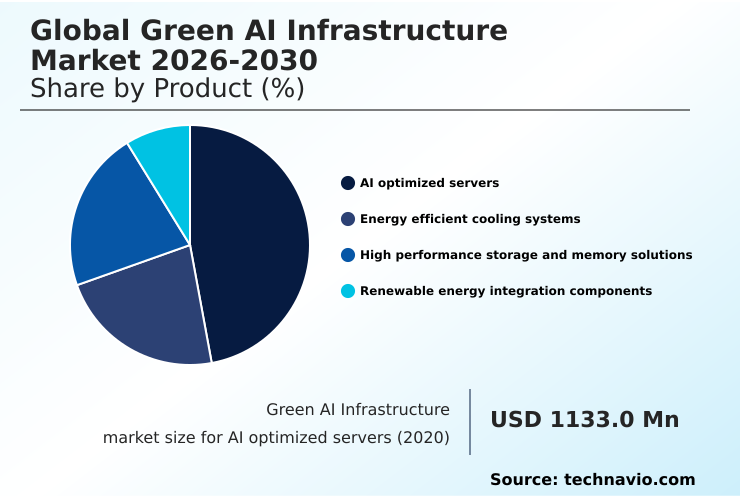
The AI optimized servers segment was valued at USD 2.72 billion in 2024 and showed a gradual increase during the forecast period.
Green Ai Infrastructure Market by Region: North America Leads with 41% Growth Share

North America is estimated to contribute 41% to the growth of the global market during the forecast period.
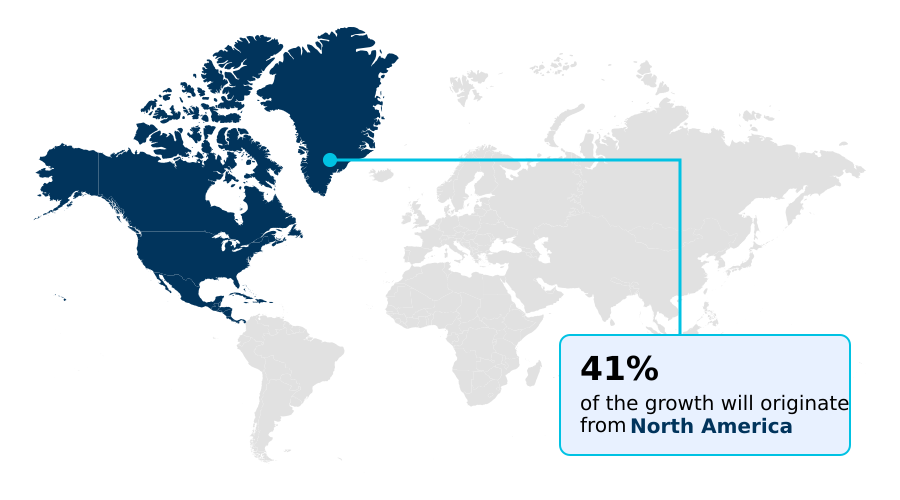
North America, contributing approximately 41% of the market's incremental growth, leads in the deployment of sustainable AI infrastructure, propelled by federal incentives like the Inflation Reduction Act and a high concentration of hyperscale data centers.

The region's focus on IT carbon emissions reduction drives innovation in increasing server rack density through advanced thermal management.

In contrast, APAC, which accounts for over 27% of growth, is rapidly expanding its capacity with a focus on localized edge computing hardware to serve its vast digital-native population.

Europe emphasizes regulatory compliance, pushing for green data center certification under frameworks like the EU's Corporate Sustainability Reporting Directive. Across all regions, sustainable computing research is pivotal for developing next-generation solutions that balance performance with environmental responsibility.

Customer Landscape Analysis for the Green Ai Infrastructure Market

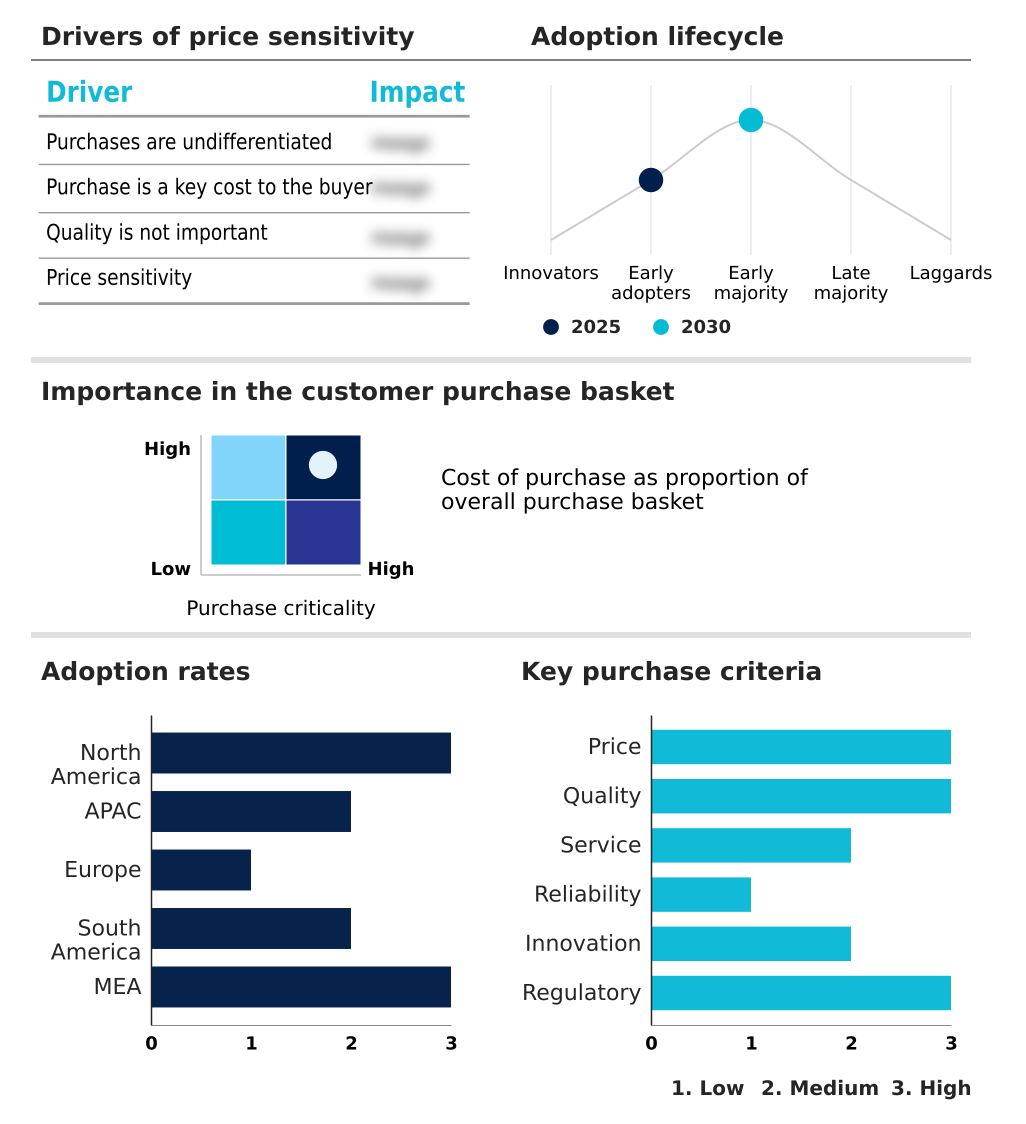
The green ai infrastructure market forecasting report includes the adoption lifecycle of the market, covering from the innovator’s stage to the laggard’s stage. It focuses on adoption rates in different regions based on penetration. Furthermore, the green ai infrastructure market report also includes key purchase criteria and drivers of price sensitivity to help companies evaluate and develop their market growth analysis strategies.
Competitive Landscape of the Green Ai Infrastructure Market

Companies are implementing various strategies, such as strategic alliances, partnerships, mergers and acquisitions, geographical expansion, and product/service launches, to enhance their presence in the green ai infrastructure market industry.

ABB Ltd. - Offerings include energy-efficient electrification, smart grid integration, and AI-enabled industrial automation designed to reduce power consumption and emissions across industrial and data center applications.

The industry research and growth report includes detailed analyses of the competitive landscape of the market and information about key companies, including:

  • ABB Ltd.
  • Advanced Micro Devices Inc.
  • Alibaba Cloud
  • Amazon Web Services Inc.
  • Cisco Systems Inc.
  • Dell Technologies Inc.
  • Eaton Corp. Plc
  • Equinix Inc.
  • Google LLC
  • Hewlett Packard Enterprise Co.
  • Huawei Technologies Co. Ltd.
  • IBM Corp.
  • Intel Corp.
  • Lenovo Group Ltd.
  • Microsoft Corp.
  • NVIDIA Corp.
  • Oracle Corp.
  • Schneider Electric SE
  • Siemens AG
  • Tencent Holdings Ltd.
  • Vertiv Holdings Co.

Qualitative and quantitative analysis of companies has been conducted to help clients understand the wider business environment as well as the strengths and weaknesses of key industry players. Data is qualitatively analyzed to categorize companies as pure play, category-focused, industry-focused, and diversified; it is quantitatively analyzed to categorize companies as dominant, leading, strong, tentative, and weak.

Recent Developments in the Green Ai Infrastructure Market

  • In March, 2025, Google LLC achieved 24/7 carbon-free energy operation in key European data center regions by integrating advanced geothermal and solar power sources to meet enterprise demand for sustainable computing.
  • In April, 2025, Schneider Electric launched its new prefabricated liquid-cooled data center modules, which feature an integrated system to reuse waste heat for providing hot water to adjacent industrial facilities.
  • In September, 2025, Meta Platforms Incorporated revealed a comprehensive redesign of its global data center architecture, specifically optimized for its Llama 4 model series, incorporating standard integrated solar power and proprietary liquid cooling blocks.
  • In November, 2025, Intel Corporation unveiled its latest series of specialized processors, featuring a breakthrough backside power delivery architecture that reduces electrical resistance and improves energy efficiency by 20%.

Research Analyst Overview: Green Ai Infrastructure Market

The accelerating market momentum, with a CAGR of 34.8%, reflects a fundamental shift in capital expenditure priorities at the boardroom level. Decisions now pivot on the total cost of ownership of AI optimized servers and their supporting infrastructure, rather than just initial hardware cost. A key consideration is the transition to advanced thermal management solutions.

Adopting direct-to-chip cooling or full immersion cooling has profound implications for server rack density and facility design, directly impacting power usage effectiveness (PUE), a critical metric for green data center certification. This shift is driven by the intensive heat generated by high-performance computing (HPC) systems running on tensor processing units (TPU) and application-specific integrated circuits (ASIC).

To manage this, operators are deploying comprehensive data center infrastructure management (DCIM) platforms for carbon footprint tracking and sustainable power management. The infrastructure stack now incorporates everything from low-power processors and closed-loop cooling systems to smart grid controllers that enable grid-interactive data centers.

Furthermore, integrating renewable energy integration, leveraging waste heat recovery, and exploring futuristic technologies like neuromorphic computing are becoming standard practice for achieving true carbon-aware computing.

Dive into Technavio’s robust research methodology, blending expert interviews, extensive data synthesis, and validated models for unparalleled Green Ai Infrastructure Market insights. See full methodology.

Request Free Sample

Market Scope
Page number 314
Base year 2025
Historic period 2020-2024
Forecast period 2026-2030
Growth momentum & CAGR Accelerate at a CAGR of 34.8%
Market growth 2026-2030 USD 25820.7 million
Market structure Fragmented
YoY growth 2025-2026(%) 28.9%
Key countries US, Canada, Mexico, China, Japan, India, South Korea, Australia, Indonesia, Germany, UK, France, Italy, Spain, The Netherlands, Brazil, Argentina, Chile, Saudi Arabia, UAE, South Africa, Israel and Turkey
Competitive landscape Leading Companies, Market Positioning of Companies, Competitive Strategies, and Industry Risks

Green Ai Infrastructure Market: Key Questions Answered in This Report

  • What is the expected growth of the Green Ai Infrastructure Market between 2026 and 2030?

    • The Green Ai Infrastructure Market is expected to grow by USD 25.82 billion during 2026-2030, registering a CAGR of 34.8%. Year-over-year growth in 2026 is estimated at 28.9%%. This acceleration is shaped by increasing demand for sustainable and energy efficient ai computing infrastructure across industries, which is intensifying demand across multiple end-use verticals covered in the report.

  • What segmentation does the market report cover?

    • The report is segmented by Product (AI optimized servers, Energy efficient cooling systems, High performance storage and memory solutions, and Renewable energy integration components), End-user (Cloud service providers, Enterprises, Government, and Research institutions and AI startups), Deployment (Cloud based, Hybrid and edge-computing environments, and On premises) and Geography (North America, APAC, Europe, South America, Middle East and Africa). Among these, the AI optimized servers segment is estimated to witness significant growth during the forecast period, driven by rising adoption across key application areas. Each segment includes detailed qualitative and quantitative analysis, along with historical data from 2020-2024 and forecasts through 2030 with year-over-year growth rates.

  • Which regions are analyzed in the report?

    • The report covers North America, APAC, Europe, South America and Middle East and Africa. North America is estimated to contribute 41% to market growth during the forecast period. Country-level analysis includes US, Canada, Mexico, China, Japan, India, South Korea, Australia, Indonesia, Germany, UK, France, Italy, Spain, The Netherlands, Brazil, Argentina, Chile, Saudi Arabia, UAE, South Africa, Israel and Turkey, with dedicated market size tables and year-over-year growth for each.

  • What are the key growth drivers and market challenges?

    • The primary driver is increasing demand for sustainable and energy efficient ai computing infrastructure across industries, which is accelerating investment and industry demand. The main challenge is high initial investment costs associated with energy efficient infrastructure and sustainable technologies, creating operational barriers for key market participants. The report quantifies the impact of each driver and challenge across 2026 and 2030 with comparative analysis.

  • Who are the major players in the Green Ai Infrastructure Market?

    • Key vendors include ABB Ltd., Advanced Micro Devices Inc., Alibaba Cloud, Amazon Web Services Inc., Cisco Systems Inc., Dell Technologies Inc., Eaton Corp. Plc, Equinix Inc., Google LLC, Hewlett Packard Enterprise Co., Huawei Technologies Co. Ltd., IBM Corp., Intel Corp., Lenovo Group Ltd., Microsoft Corp., NVIDIA Corp., Oracle Corp., Schneider Electric SE, Siemens AG, Tencent Holdings Ltd. and Vertiv Holdings Co.. The report provides qualitative and quantitative analysis categorizing companies as dominant, leading, strong, tentative, and weak based on their market positioning. Company profiles include business segment analysis, SWOT assessment, key offerings, and recent strategic developments.

Green Ai Infrastructure Market Research Insights

Market dynamics are increasingly dictated by the dual pressures of regulatory compliance and the immense energy demands of AI model training. The push for IT infrastructure sustainability, underscored by policies like the EU Green Deal, compels organizations to prioritize reducing their data center carbon footprint.

This is particularly evident among cloud service providers, whose market segment is more than double that of enterprises, reflecting their scale in deploying sustainable cloud computing solutions. These hyperscalers leverage AI for energy optimization and advanced data center power management to offer competitive services.

This creates a market where AI infrastructure for sustainability is not just a feature but a core competitive differentiator, forcing all players to re-evaluate their hardware and operational strategies to meet both performance and environmental targets.

We can help! Our analysts can customize this green ai infrastructure market research report to meet your requirements.

Get in touch

1. Executive Summary

1.1 Market overview

Executive Summary - Chart on Market Overview
Executive Summary - Data Table on Market Overview
Executive Summary - Chart on Global Market Characteristics
Executive Summary - Chart on Market by Geography
Executive Summary - Chart on Market Segmentation by Product
Executive Summary - Chart on Market Segmentation by End-user
Executive Summary - Chart on Market Segmentation by Deployment
Executive Summary - Chart on Incremental Growth
Executive Summary - Data Table on Incremental Growth
Executive Summary - Chart on Company Market Positioning

2. Technavio Analysis

2.1 Analysis of price sensitivity, lifecycle, customer purchase basket, adoption rates, and purchase criteria

2.2 Criticality of inputs and Factors of differentiation

Chart on Overview on criticality of inputs and factors of differentiation

2.3 Factors of disruption

Chart on Overview on factors of disruption

2.4 Impact of drivers and challenges

Chart on Impact of drivers and challenges in 2025 and 2030

3. Market Landscape

3.1 Market ecosystem

Chart on Parent Market
Data Table on - Parent Market

3.2 Market characteristics

Chart on Market characteristics analysis

3.3 Value chain analysis

Chart on Value chain analysis

4. Market Sizing

4.1 Market definition

Data Table on Offerings of companies included in the market definition

4.2 Market segment analysis

Market segments

4.3 Market size 2025

4.4 Market outlook: Forecast for 2025-2030

Chart on Global - Market size and forecast 2025-2030 ($ million)
Data Table on Global - Market size and forecast 2025-2030 ($ million)
Chart on Global Market: Year-over-year growth 2025-2030 (%)
Data Table on Global Market: Year-over-year growth 2025-2030 (%)

5. Historic Market Size

5.1 Global Green AI Infrastructure Market 2020 - 2024

Historic Market Size - Data Table on Global Green AI Infrastructure Market 2020 - 2024 ($ million)

5.2 Product segment analysis 2020 - 2024

Historic Market Size - Product Segment 2020 - 2024 ($ million)

5.3 End-user segment analysis 2020 - 2024

Historic Market Size - End-user Segment 2020 - 2024 ($ million)

5.4 Deployment segment analysis 2020 - 2024

Historic Market Size - Deployment Segment 2020 - 2024 ($ million)

5.5 Geography segment analysis 2020 - 2024

Historic Market Size - Geography Segment 2020 - 2024 ($ million)

5.6 Country segment analysis 2020 - 2024

Historic Market Size - Country Segment 2020 - 2024 ($ million)

6. Qualitative Analysis

6.1 Impact of AI on Global Green AI Infrastructure Market

6.2 Impact of Geopolitical Conflicts on Global Green AI Infrastructure Market

7. Five Forces Analysis

7.1 Five forces summary

Five forces analysis - Comparison between 2025 and 2030

7.2 Bargaining power of buyers

Bargaining power of buyers - Impact of key factors 2025 and 2030

7.3 Bargaining power of suppliers

Bargaining power of suppliers - Impact of key factors in 2025 and 2030

7.4 Threat of new entrants

Threat of new entrants - Impact of key factors in 2025 and 2030

7.5 Threat of substitutes

Threat of substitutes - Impact of key factors in 2025 and 2030

7.6 Threat of rivalry

Threat of rivalry - Impact of key factors in 2025 and 2030

7.7 Market condition

Chart on Market condition - Five forces 2025 and 2030

8. Market Segmentation by Product

8.1 Market segments

Chart on Product - Market share 2025-2030 (%)
Data Table on Product - Market share 2025-2030 (%)

8.2 Comparison by Product

Chart on Comparison by Product
Data Table on Comparison by Product

8.3 AI optimized servers - Market size and forecast 2025-2030

Chart on AI optimized servers - Market size and forecast 2025-2030 ($ million)
Data Table on AI optimized servers - Market size and forecast 2025-2030 ($ million)
Chart on AI optimized servers - Year-over-year growth 2025-2030 (%)
Data Table on AI optimized servers - Year-over-year growth 2025-2030 (%)

8.4 Energy efficient cooling systems - Market size and forecast 2025-2030

Chart on Energy efficient cooling systems - Market size and forecast 2025-2030 ($ million)
Data Table on Energy efficient cooling systems - Market size and forecast 2025-2030 ($ million)
Chart on Energy efficient cooling systems - Year-over-year growth 2025-2030 (%)
Data Table on Energy efficient cooling systems - Year-over-year growth 2025-2030 (%)

8.5 High performance storage and memory solutions - Market size and forecast 2025-2030

Chart on High performance storage and memory solutions - Market size and forecast 2025-2030 ($ million)
Data Table on High performance storage and memory solutions - Market size and forecast 2025-2030 ($ million)
Chart on High performance storage and memory solutions - Year-over-year growth 2025-2030 (%)
Data Table on High performance storage and memory solutions - Year-over-year growth 2025-2030 (%)

8.6 Renewable energy integration components - Market size and forecast 2025-2030

Chart on Renewable energy integration components - Market size and forecast 2025-2030 ($ million)
Data Table on Renewable energy integration components - Market size and forecast 2025-2030 ($ million)
Chart on Renewable energy integration components - Year-over-year growth 2025-2030 (%)
Data Table on Renewable energy integration components - Year-over-year growth 2025-2030 (%)

8.7 Market opportunity by Product

Market opportunity by Product ($ million)
Data Table on Market opportunity by Product ($ million)

9. Market Segmentation by End-user

9.1 Market segments

Chart on End-user - Market share 2025-2030 (%)
Data Table on End-user - Market share 2025-2030 (%)

9.2 Comparison by End-user

Chart on Comparison by End-user
Data Table on Comparison by End-user

9.3 Cloud service providers - Market size and forecast 2025-2030

Chart on Cloud service providers - Market size and forecast 2025-2030 ($ million)
Data Table on Cloud service providers - Market size and forecast 2025-2030 ($ million)
Chart on Cloud service providers - Year-over-year growth 2025-2030 (%)
Data Table on Cloud service providers - Year-over-year growth 2025-2030 (%)

9.4 Enterprises - Market size and forecast 2025-2030

Chart on Enterprises - Market size and forecast 2025-2030 ($ million)
Data Table on Enterprises - Market size and forecast 2025-2030 ($ million)
Chart on Enterprises - Year-over-year growth 2025-2030 (%)
Data Table on Enterprises - Year-over-year growth 2025-2030 (%)

9.5 Government - Market size and forecast 2025-2030

Chart on Government - Market size and forecast 2025-2030 ($ million)
Data Table on Government - Market size and forecast 2025-2030 ($ million)
Chart on Government - Year-over-year growth 2025-2030 (%)
Data Table on Government - Year-over-year growth 2025-2030 (%)

9.6 Research institutions and AI startups - Market size and forecast 2025-2030

Chart on Research institutions and AI startups - Market size and forecast 2025-2030 ($ million)
Data Table on Research institutions and AI startups - Market size and forecast 2025-2030 ($ million)
Chart on Research institutions and AI startups - Year-over-year growth 2025-2030 (%)
Data Table on Research institutions and AI startups - Year-over-year growth 2025-2030 (%)

9.7 Market opportunity by End-user

Market opportunity by End-user ($ million)
Data Table on Market opportunity by End-user ($ million)

10. Market Segmentation by Deployment

10.1 Market segments

Chart on Deployment - Market share 2025-2030 (%)
Data Table on Deployment - Market share 2025-2030 (%)

10.2 Comparison by Deployment

Chart on Comparison by Deployment
Data Table on Comparison by Deployment

10.3 Cloud based - Market size and forecast 2025-2030

Chart on Cloud based - Market size and forecast 2025-2030 ($ million)
Data Table on Cloud based - Market size and forecast 2025-2030 ($ million)
Chart on Cloud based - Year-over-year growth 2025-2030 (%)
Data Table on Cloud based - Year-over-year growth 2025-2030 (%)

10.4 Hybrid and edge-computing environments - Market size and forecast 2025-2030

Chart on Hybrid and edge-computing environments - Market size and forecast 2025-2030 ($ million)
Data Table on Hybrid and edge-computing environments - Market size and forecast 2025-2030 ($ million)
Chart on Hybrid and edge-computing environments - Year-over-year growth 2025-2030 (%)
Data Table on Hybrid and edge-computing environments - Year-over-year growth 2025-2030 (%)

10.5 On premises - Market size and forecast 2025-2030

Chart on On premises - Market size and forecast 2025-2030 ($ million)
Data Table on On premises - Market size and forecast 2025-2030 ($ million)
Chart on On premises - Year-over-year growth 2025-2030 (%)
Data Table on On premises - Year-over-year growth 2025-2030 (%)

10.6 Market opportunity by Deployment

Market opportunity by Deployment ($ million)
Data Table on Market opportunity by Deployment ($ million)

11. Customer Landscape

11.1 Customer landscape overview

Analysis of price sensitivity, lifecycle, customer purchase basket, adoption rates, and purchase criteria

12. Geographic Landscape

12.1 Geographic segmentation

Chart on Market share by geography 2025-2030 (%)
Data Table on Market share by geography 2025-2030 (%)

12.2 Geographic comparison

Chart on Geographic comparison
Data Table on Geographic comparison

12.3 North America - Market size and forecast 2025-2030

Chart on North America - Market size and forecast 2025-2030 ($ million)
Data Table on North America - Market size and forecast 2025-2030 ($ million)
Chart on North America - Year-over-year growth 2025-2030 (%)
Data Table on North America - Year-over-year growth 2025-2030 (%)
Chart on Regional Comparison - North America
Data Table on Regional Comparison - North America

12.3.1 US - Market size and forecast 2025-2030

Chart on US - Market size and forecast 2025-2030 ($ million)
Data Table on US - Market size and forecast 2025-2030 ($ million)
Chart on US - Year-over-year growth 2025-2030 (%)
Data Table on US - Year-over-year growth 2025-2030 (%)

12.3.2 Canada - Market size and forecast 2025-2030

Chart on Canada - Market size and forecast 2025-2030 ($ million)
Data Table on Canada - Market size and forecast 2025-2030 ($ million)
Chart on Canada - Year-over-year growth 2025-2030 (%)
Data Table on Canada - Year-over-year growth 2025-2030 (%)

12.3.3 Mexico - Market size and forecast 2025-2030

Chart on Mexico - Market size and forecast 2025-2030 ($ million)
Data Table on Mexico - Market size and forecast 2025-2030 ($ million)
Chart on Mexico - Year-over-year growth 2025-2030 (%)
Data Table on Mexico - Year-over-year growth 2025-2030 (%)

12.4 APAC - Market size and forecast 2025-2030

Chart on APAC - Market size and forecast 2025-2030 ($ million)
Data Table on APAC - Market size and forecast 2025-2030 ($ million)
Chart on APAC - Year-over-year growth 2025-2030 (%)
Data Table on APAC - Year-over-year growth 2025-2030 (%)
Chart on Regional Comparison - APAC
Data Table on Regional Comparison - APAC

12.4.1 China - Market size and forecast 2025-2030

Chart on China - Market size and forecast 2025-2030 ($ million)
Data Table on China - Market size and forecast 2025-2030 ($ million)
Chart on China - Year-over-year growth 2025-2030 (%)
Data Table on China - Year-over-year growth 2025-2030 (%)

12.4.2 Japan - Market size and forecast 2025-2030

Chart on Japan - Market size and forecast 2025-2030 ($ million)
Data Table on Japan - Market size and forecast 2025-2030 ($ million)
Chart on Japan - Year-over-year growth 2025-2030 (%)
Data Table on Japan - Year-over-year growth 2025-2030 (%)

12.4.3 India - Market size and forecast 2025-2030

Chart on India - Market size and forecast 2025-2030 ($ million)
Data Table on India - Market size and forecast 2025-2030 ($ million)
Chart on India - Year-over-year growth 2025-2030 (%)
Data Table on India - Year-over-year growth 2025-2030 (%)

12.4.4 South Korea - Market size and forecast 2025-2030

Chart on South Korea - Market size and forecast 2025-2030 ($ million)
Data Table on South Korea - Market size and forecast 2025-2030 ($ million)
Chart on South Korea - Year-over-year growth 2025-2030 (%)
Data Table on South Korea - Year-over-year growth 2025-2030 (%)

12.4.5 Australia - Market size and forecast 2025-2030

Chart on Australia - Market size and forecast 2025-2030 ($ million)
Data Table on Australia - Market size and forecast 2025-2030 ($ million)
Chart on Australia - Year-over-year growth 2025-2030 (%)
Data Table on Australia - Year-over-year growth 2025-2030 (%)

12.4.6 Indonesia - Market size and forecast 2025-2030

Chart on Indonesia - Market size and forecast 2025-2030 ($ million)
Data Table on Indonesia - Market size and forecast 2025-2030 ($ million)
Chart on Indonesia - Year-over-year growth 2025-2030 (%)
Data Table on Indonesia - Year-over-year growth 2025-2030 (%)

12.5 Europe - Market size and forecast 2025-2030

Chart on Europe - Market size and forecast 2025-2030 ($ million)
Data Table on Europe - Market size and forecast 2025-2030 ($ million)
Chart on Europe - Year-over-year growth 2025-2030 (%)
Data Table on Europe - Year-over-year growth 2025-2030 (%)
Chart on Regional Comparison - Europe
Data Table on Regional Comparison - Europe

12.5.1 Germany - Market size and forecast 2025-2030

Chart on Germany - Market size and forecast 2025-2030 ($ million)
Data Table on Germany - Market size and forecast 2025-2030 ($ million)
Chart on Germany - Year-over-year growth 2025-2030 (%)
Data Table on Germany - Year-over-year growth 2025-2030 (%)

12.5.2 UK - Market size and forecast 2025-2030

Chart on UK - Market size and forecast 2025-2030 ($ million)
Data Table on UK - Market size and forecast 2025-2030 ($ million)
Chart on UK - Year-over-year growth 2025-2030 (%)
Data Table on UK - Year-over-year growth 2025-2030 (%)

12.5.3 France - Market size and forecast 2025-2030

Chart on France - Market size and forecast 2025-2030 ($ million)
Data Table on France - Market size and forecast 2025-2030 ($ million)
Chart on France - Year-over-year growth 2025-2030 (%)
Data Table on France - Year-over-year growth 2025-2030 (%)

12.5.4 Italy - Market size and forecast 2025-2030

Chart on Italy - Market size and forecast 2025-2030 ($ million)
Data Table on Italy - Market size and forecast 2025-2030 ($ million)
Chart on Italy - Year-over-year growth 2025-2030 (%)
Data Table on Italy - Year-over-year growth 2025-2030 (%)

12.5.5 Spain - Market size and forecast 2025-2030

Chart on Spain - Market size and forecast 2025-2030 ($ million)
Data Table on Spain - Market size and forecast 2025-2030 ($ million)
Chart on Spain - Year-over-year growth 2025-2030 (%)
Data Table on Spain - Year-over-year growth 2025-2030 (%)

12.5.6 The Netherlands - Market size and forecast 2025-2030

Chart on The Netherlands - Market size and forecast 2025-2030 ($ million)
Data Table on The Netherlands - Market size and forecast 2025-2030 ($ million)
Chart on The Netherlands - Year-over-year growth 2025-2030 (%)
Data Table on The Netherlands - Year-over-year growth 2025-2030 (%)

12.6 South America - Market size and forecast 2025-2030

Chart on South America - Market size and forecast 2025-2030 ($ million)
Data Table on South America - Market size and forecast 2025-2030 ($ million)
Chart on South America - Year-over-year growth 2025-2030 (%)
Data Table on South America - Year-over-year growth 2025-2030 (%)
Chart on Regional Comparison - South America
Data Table on Regional Comparison - South America

12.6.1 Brazil - Market size and forecast 2025-2030

Chart on Brazil - Market size and forecast 2025-2030 ($ million)
Data Table on Brazil - Market size and forecast 2025-2030 ($ million)
Chart on Brazil - Year-over-year growth 2025-2030 (%)
Data Table on Brazil - Year-over-year growth 2025-2030 (%)

12.6.2 Argentina - Market size and forecast 2025-2030

Chart on Argentina - Market size and forecast 2025-2030 ($ million)
Data Table on Argentina - Market size and forecast 2025-2030 ($ million)
Chart on Argentina - Year-over-year growth 2025-2030 (%)
Data Table on Argentina - Year-over-year growth 2025-2030 (%)

12.6.3 Chile - Market size and forecast 2025-2030

Chart on Chile - Market size and forecast 2025-2030 ($ million)
Data Table on Chile - Market size and forecast 2025-2030 ($ million)
Chart on Chile - Year-over-year growth 2025-2030 (%)
Data Table on Chile - Year-over-year growth 2025-2030 (%)

12.7 Middle East and Africa - Market size and forecast 2025-2030

Chart on Middle East and Africa - Market size and forecast 2025-2030 ($ million)
Data Table on Middle East and Africa - Market size and forecast 2025-2030 ($ million)
Chart on Middle East and Africa - Year-over-year growth 2025-2030 (%)
Data Table on Middle East and Africa - Year-over-year growth 2025-2030 (%)
Chart on Regional Comparison - Middle East and Africa
Data Table on Regional Comparison - Middle East and Africa

12.7.1 Saudi Arabia - Market size and forecast 2025-2030

Chart on Saudi Arabia - Market size and forecast 2025-2030 ($ million)
Data Table on Saudi Arabia - Market size and forecast 2025-2030 ($ million)
Chart on Saudi Arabia - Year-over-year growth 2025-2030 (%)
Data Table on Saudi Arabia - Year-over-year growth 2025-2030 (%)

12.7.2 UAE - Market size and forecast 2025-2030

Chart on UAE - Market size and forecast 2025-2030 ($ million)
Data Table on UAE - Market size and forecast 2025-2030 ($ million)
Chart on UAE - Year-over-year growth 2025-2030 (%)
Data Table on UAE - Year-over-year growth 2025-2030 (%)

12.7.3 South Africa - Market size and forecast 2025-2030

Chart on South Africa - Market size and forecast 2025-2030 ($ million)
Data Table on South Africa - Market size and forecast 2025-2030 ($ million)
Chart on South Africa - Year-over-year growth 2025-2030 (%)
Data Table on South Africa - Year-over-year growth 2025-2030 (%)

12.7.4 Israel - Market size and forecast 2025-2030

Chart on Israel - Market size and forecast 2025-2030 ($ million)
Data Table on Israel - Market size and forecast 2025-2030 ($ million)
Chart on Israel - Year-over-year growth 2025-2030 (%)
Data Table on Israel - Year-over-year growth 2025-2030 (%)

12.7.5 Turkey - Market size and forecast 2025-2030

Chart on Turkey - Market size and forecast 2025-2030 ($ million)
Data Table on Turkey - Market size and forecast 2025-2030 ($ million)
Chart on Turkey - Year-over-year growth 2025-2030 (%)
Data Table on Turkey - Year-over-year growth 2025-2030 (%)

12.8 Market opportunity by geography

Market opportunity by geography ($ million)
Data Tables on Market opportunity by geography ($ million)

13. Drivers, Challenges, and Opportunity

13.1 Market drivers

Increasing demand for sustainable and energy efficient AI computing infrastructure across industries
Growing regulatory policies to reduce carbon emissions and environmental impact of data centers
Rising adoption of artificial intelligence workloads driving need for optimized infrastructure solutions

13.2 Market challenges

High initial investment costs associated with energy efficient infrastructure and sustainable technologies
Complexity in integrating renewable energy sources with existing data center operations
Limited availability of advanced energy efficient hardware and cooling solutions

13.3 Impact of drivers and challenges

Impact of drivers and challenges in 2025 and 2030

13.4 Market opportunities

Adoption of advanced cooling technologies such as liquid cooling for improved energy efficiency
Integration of renewable energy sources like solar and wind into data center operations
Development of energy efficient processors and hardware optimized for artificial intelligence workloads

14. Competitive Landscape

14.1 Overview

14.2

Overview on criticality of inputs and factors of differentiation

14.3 Landscape disruption

Overview on factors of disruption

14.4 Industry risks

Impact of key risks on business

15. Competitive Analysis

15.1 Companies profiled

Companies covered

15.2 Company ranking index

15.3 Market positioning of companies

Matrix on companies position and classification

15.4 ABB Ltd.

ABB Ltd. - Overview
ABB Ltd. - Business segments
ABB Ltd. - Key news
ABB Ltd. - Key offerings
ABB Ltd. - Segment focus
SWOT

15.5 Advanced Micro Devices Inc.

Advanced Micro Devices Inc. - Overview
Advanced Micro Devices Inc. - Business segments
Advanced Micro Devices Inc. - Key news
Advanced Micro Devices Inc. - Key offerings
Advanced Micro Devices Inc. - Segment focus
SWOT

15.6 Alibaba Cloud

Alibaba Cloud - Overview
Alibaba Cloud - Product / Service
Alibaba Cloud - Key offerings
SWOT

15.7 Amazon Web Services Inc.

Amazon Web Services Inc. - Overview
Amazon Web Services Inc. - Product / Service
Amazon Web Services Inc. - Key offerings
SWOT

15.8 Cisco Systems Inc.

Cisco Systems Inc. - Overview
Cisco Systems Inc. - Business segments
Cisco Systems Inc. - Key news
Cisco Systems Inc. - Key offerings
Cisco Systems Inc. - Segment focus
SWOT

15.9 Eaton Corp. Plc

Eaton Corp. Plc - Overview
Eaton Corp. Plc - Business segments
Eaton Corp. Plc - Key news
Eaton Corp. Plc - Key offerings
Eaton Corp. Plc - Segment focus
SWOT

15.10 Google LLC

Google LLC - Overview
Google LLC - Product / Service
Google LLC - Key offerings
SWOT

15.11 Hewlett Packard Enterprise Co.

Hewlett Packard Enterprise Co. - Overview
Hewlett Packard Enterprise Co. - Business segments
Hewlett Packard Enterprise Co. - Key news
Hewlett Packard Enterprise Co. - Key offerings
Hewlett Packard Enterprise Co. - Segment focus
SWOT

15.12 Huawei Technologies Co. Ltd.

Huawei Technologies Co. Ltd. - Overview
Huawei Technologies Co. Ltd. - Product / Service
Huawei Technologies Co. Ltd. - Key offerings
SWOT

15.13 IBM Corp.

IBM Corp. - Overview
IBM Corp. - Business segments
IBM Corp. - Key news
IBM Corp. - Key offerings
IBM Corp. - Segment focus
SWOT

15.14 Microsoft Corp.

Microsoft Corp. - Overview
Microsoft Corp. - Business segments
Microsoft Corp. - Key news
Microsoft Corp. - Key offerings
Microsoft Corp. - Segment focus
SWOT

15.15 NVIDIA Corp.

NVIDIA Corp. - Overview
NVIDIA Corp. - Business segments
NVIDIA Corp. - Key news
NVIDIA Corp. - Key offerings
NVIDIA Corp. - Segment focus
SWOT

15.16 Oracle Corp.

Oracle Corp. - Overview
Oracle Corp. - Business segments
Oracle Corp. - Key news
Oracle Corp. - Key offerings
Oracle Corp. - Segment focus
SWOT

15.17 Schneider Electric SE

Schneider Electric SE - Overview
Schneider Electric SE - Business segments
Schneider Electric SE - Key offerings
Schneider Electric SE - Segment focus
SWOT

15.18 Siemens AG

Siemens AG - Overview
Siemens AG - Business segments
Siemens AG - Key news
Siemens AG - Key offerings
Siemens AG - Segment focus
SWOT

16. Appendix

16.1 Scope of the report

Market definition
Objectives
Notes and caveats

16.2 Inclusions and exclusions checklist

Inclusions checklist
Exclusions checklist

16.3 Currency conversion rates for US$

16.4 Research methodology

16.5 Data procurement

Information sources

16.6 Data validation

16.7 Validation techniques employed for market sizing

16.8 Data synthesis

16.9 360 degree market analysis

16.10 List of abbreviations

Research Methodology

Technavio presents a detailed picture of the market by way of study, synthesis, and summation of data from multiple sources. The analysts have presented the various facets of the market with a particular focus on identifying the key industry influencers. The data thus presented is comprehensive, reliable, and the result of extensive research, both primary and secondary.

INFORMATION SOURCES

Primary sources

  • Manufacturers and suppliers
  • Channel partners
  • Industry experts
  • Strategic decision makers

Secondary sources

  • Industry journals and periodicals
  • Government data
  • Financial reports of key industry players
  • Historical data
  • Press releases

DATA ANALYSIS

Data Synthesis

  • Collation of data
  • Estimation of key figures
  • Analysis of derived insights

Data Validation

  • Triangulation with data models
  • Reference against proprietary databases
  • Corroboration with industry experts

REPORT WRITING

Qualitative

  • Market drivers
  • Market challenges
  • Market trends
  • Five forces analysis

Quantitative

  • Market size and forecast
  • Market segmentation
  • Geographical insights
  • Competitive landscape

Interested in this report?

Get your sample now to see our research methodology and insights!

Download Now

Frequently Asked Questions

Green Ai Infrastructure market growth will increase by USD 25820.7 million during 2026-2030.

The Green Ai Infrastructure market is expected to grow at a CAGR of 34.8% during 2026-2030.

Green Ai Infrastructure market is segmented by Product (AI optimized servers, Energy efficient cooling systems, High performance storage and memory solutions, Renewable energy integration components) End-user (Cloud service providers, Enterprises, Government, Research institutions and AI startups) Deployment (Cloud based, Hybrid and edge-computing environments, On premises)

ABB Ltd., Advanced Micro Devices Inc., Alibaba Cloud, Amazon Web Services Inc., Cisco Systems Inc., Dell Technologies Inc., Eaton Corp. Plc, Equinix Inc., Google LLC, Hewlett Packard Enterprise Co., Huawei Technologies Co. Ltd., IBM Corp., Intel Corp., Lenovo Group Ltd., Microsoft Corp., NVIDIA Corp., Oracle Corp., Schneider Electric SE, Siemens AG, Tencent Holdings Ltd., Vertiv Holdings Co. are a few of the key vendors in the Green Ai Infrastructure market.

North America will register the highest growth rate of 41% among the other regions. Therefore, the Green Ai Infrastructure market in North America is expected to garner significant business opportunities for the vendors during the forecast period.

US, Canada, Mexico, China, Japan, India, South Korea, Australia, Indonesia, Germany, UK, France, Italy, Spain, The Netherlands, Brazil, Argentina, Chile, Saudi Arabia, UAE, South Africa, Israel, Turkey

  • Increasing demand for sustainable and energy efficient AI computing infrastructure across industries is the driving factor this market.

The Green Ai Infrastructure market vendors should focus on grabbing business opportunities from the Product segment as it accounted for the largest market share in the base year.
RIA - Research AI Assistant
Ask RIA