


Ai In Nanotechnology Market Size 2026-2030
The ai in nanotechnology market size is valued to increase by USD 19.48 billion, at a CAGR of 22.9% from 2025 to 2030. Accelerated discovery of high-performance engineered nanomaterials will drive the ai in nanotechnology market.
Major Market Trends & Insights
- APAC dominated the market and accounted for a 34% growth during the forecast period.
- By Technology - Machine learning segment was valued at USD 3.55 billion in 2024
- By Application - Nanoelectronics and optoelectronics segment accounted for the largest market revenue share in 2024
Market Size & Forecast
- Market Opportunities: USD 27.85 billion
- Market Future Opportunities: USD 19.48 billion
- CAGR from 2025 to 2030 : 22.9%
Market Summary
- The AI In Nanotechnology Market operates as a highly specialized computational domain where algorithmic models and nanoscale physical sciences intersect to accelerate material discovery. Artificial intelligence drastically transforms traditional laboratory environments by shifting workflows from empirical trial-and-error to predictive virtual screening.
- The non-negotiable business need to lower research outlays while maintaining competitive technology pipelines acts as the primary market driver, compelling semiconductor foundries and biopharmaceutical developers to invest heavily in structural simulation software.
- Within semiconductor fabrication, process engineers utilize physics-informed neural networks to analyze real-time atomic force microscopy data, yielding a 40% improvement in sub-nanometer defect detection compared to legacy optical metrology systems. This operational transition ensures that complex integrated circuits maintain optimal thermal dissipation patterns.
- However, severe data quality inconsistencies and experimental data scarcity continue to restrict algorithmic accuracy, requiring extensive physical validation cycles to prevent model overfitting. Addressing these barriers involves deploying standardized data taxonomies and automated spectral analysis tools across testing facilities, ensuring that predictive algorithms can reliably support sustainable nanomanufacturing and advanced targeted therapeutics.
What will be the Size of the Ai In Nanotechnology Market during the forecast period?
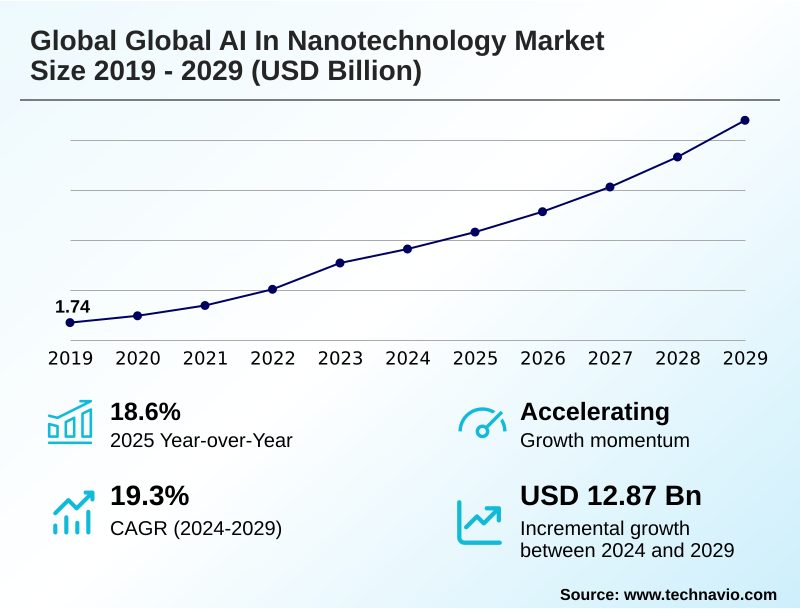
Get Key Insights on Market Forecast (PDF) Get Free Sample
How is the Ai In Nanotechnology Market Segmented?
The ai in nanotechnology industry research report provides comprehensive data (region-wise segment analysis), with forecasts and estimates in "USD million" for the period 2026-2030, as well as historical data from 2020-2024 for the following segments.
- Technology
- Machine learning
- Deep learning
- Natural language processing
- Application
- Nanoelectronics and optoelectronics
- Nanomedicine and drug delivery
- Nanosensors and nanodevices
- End-user
- Electronics and semiconductor
- Healthcare and biomedical
- Energy and environment
- Geography
- North America
- US
- Canada
- Mexico
- APAC
- China
- Japan
- India
- South Korea
- Australia
- Indonesia
- Europe
- Germany
- UK
- France
- Italy
- Spain
- The Netherlands
- Middle East and Africa
- Saudi Arabia
- UAE
- South Africa
- Israel
- Turkey
- South America
- Brazil
- Argentina
- Chile
- North America
By Technology Insights
The machine learning segment is estimated to witness significant growth during the forecast period.
The machine learning algorithms segment commands the primary operational footprint within the Global AI In Nanotechnology Market 2026-2030 by mapping non-linear relationships between synthesis parameters and physical attributes.
Deploying these algorithms allows laboratories to execute highly accurate predictive materials modeling, bypassing traditional empirical trials to map quantum confinement effects. By integrating computational chemistry software, manufacturers have enhanced continuous closed-loop experimentation, reducing physical prototyping waste by 35%.
This technology heavily optimizes real-time process control and nanoscale surface characterization for advanced semiconductor layouts. Industrial operators continuously deploy explainable artificial intelligence frameworks to interpret feature importance when analyzing high-dimensional atomic force microscopy datasets.
This computational transition ensures that complex data streams reliably support accurate molecular dynamics simulations, streamlining sustainable chemical engineering workflows across global fabrication facilities.
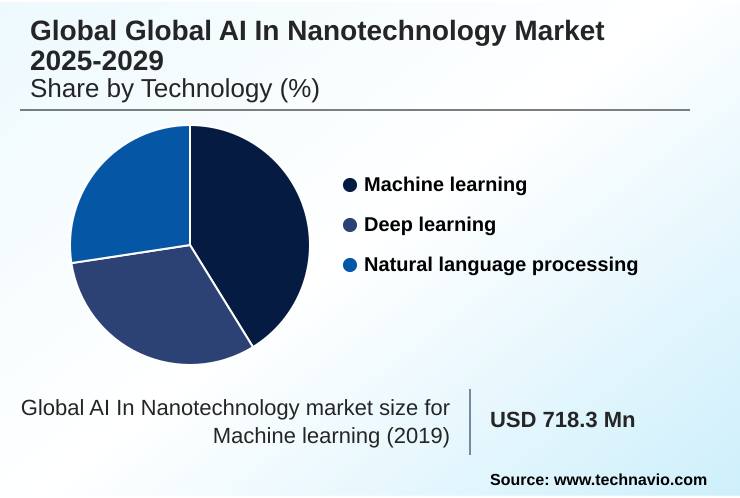
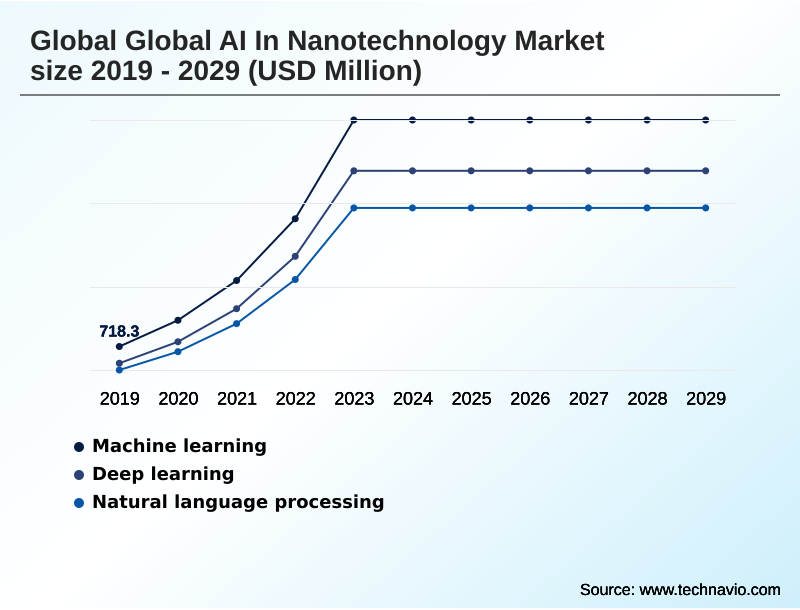
The Machine learning segment was valued at USD 3.55 billion in 2024 and showed a gradual increase during the forecast period.
Regional Analysis
APAC is estimated to contribute 34% to the growth of the global market during the forecast period.Technavio’s analysts have elaborately explained the regional trends and drivers that shape the market during the forecast period.
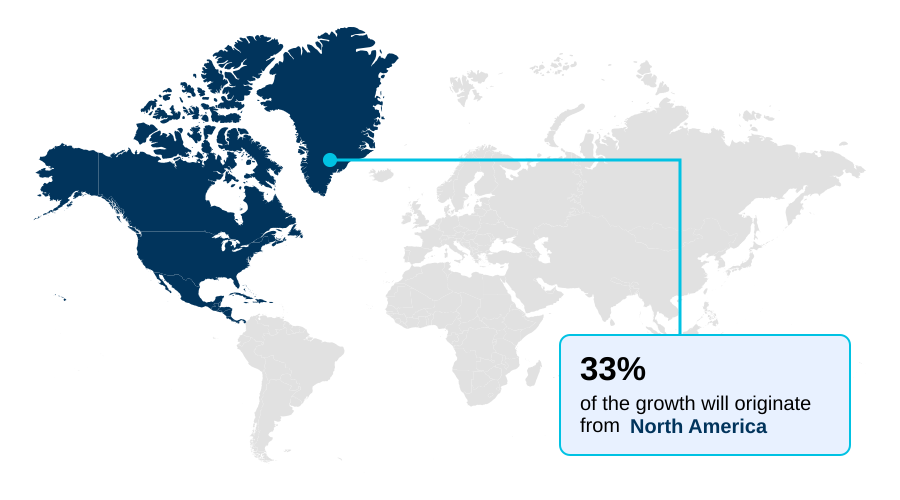
See How Ai In Nanotechnology Market Demand is Rising in APAC Get Free Sample
The Global AI In Nanotechnology Market 2026-2030 exhibits highly stratified geographical development, driven by localized industrial policies and expanding computational nanotechnology research.
North America maintains a dominant operational footprint, utilizing multi-scale atomistic simulations to accelerate targeted nanomedicine delivery, improving drug encapsulation efficiency by over 30%.
Conversely, APAC demonstrates aggressive expansion fueled by sovereign semiconductor manufacturing, where foundries optimize atomic layer deposition processes, achieving a 25% faster reduction in defect rates compared to North American facilities.
European laboratories heavily enforce chemical safety, prioritizing autonomous robotic laboratories equipped with automated spectral analysis tools to design eco-friendly smart nanoscale bio-carriers. Throughout the Middle East, expanding clean water initiatives drive the procurement of AI-modeled functionalized magnetic adsorbents.
Simultaneously, industrial sectors globally deploy advanced structural health sensing networks and real-time characterization instruments to enhance environmental micro-pollutant monitoring, ensuring compliance with strict regional sustainability standards.
Market Dynamics
Our researchers analyzed the data with 2025 as the base year, along with the key drivers, trends, and challenges. A holistic analysis of drivers will help companies refine their marketing strategies to gain a competitive advantage.
- The integration of algorithmic intelligence into physical material science has completely restructured developmental pipelines across the AI In Nanotechnology Market. Research organizations heavily utilize a cloud-native digital materials research platform to execute complex deep learning molecular dynamics simulations, enabling a transition away from costly manual experimentation.
- To support clean energy and advanced semiconductor mandates, engineers rely on machine learning-guided density functional theory to discover optimal catalytic surfaces, accelerating deployment timelines by approximately 35% compared to legacy computational methods. This shift is deeply supported by physics-constrained artificial intelligence modules that ensure generated molecular configurations obey real-world thermodynamic laws.
- In clinical environments, optimizing targeted rna vaccine delivery architectures demands extraordinary precision, prompting developers to deploy ai-driven computer vision models and deep learning-enhanced super-resolution microscopy for atomic-level characterization. Once candidates are identified, laboratories utilize computational inverse design blueprint generation paired with generative neural networks for nanostructures to output highly precise molecular specifications.
- Manufacturing scale-up requires dynamic process analytical technology integration and real-time nanosensor signal processing software to maintain absolute batch consistency. To permanently compress physical research timelines, commercial entities increasingly invest in ai-powered self-driving nanotechnology laboratories equipped with automated robotic liquid handler integration.
- These closed-loop systems function seamlessly alongside automated high-throughput nanoparticle synthesis platforms, allowing research teams to evaluate millions of theoretical combinations rapidly. Furthermore, automated generative design networks integration directly into semiconductor workflows ensures flawless extreme ultraviolet lithography masks, solidifying a highly efficient, predictive industrial ecosystem.
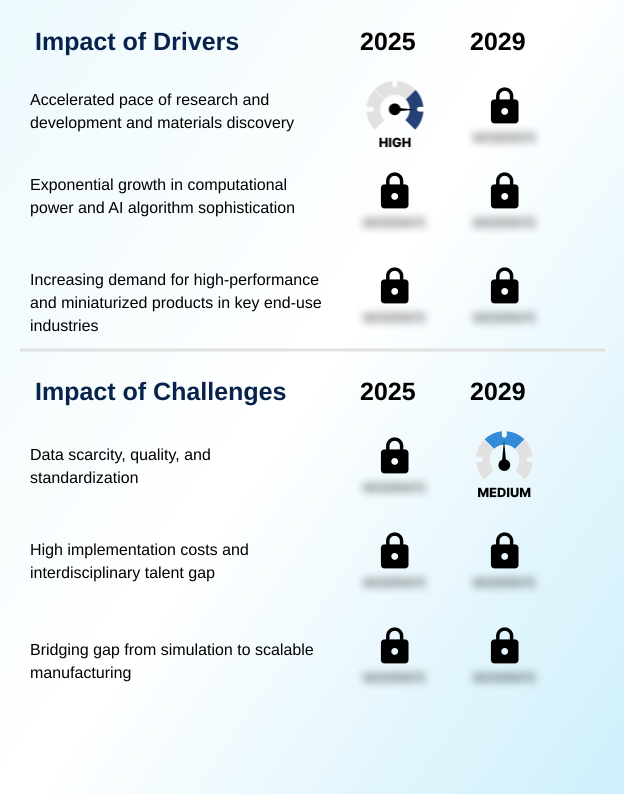
What are the key market drivers leading to the rise in the adoption of Ai In Nanotechnology Industry?
- The accelerated discovery of high-performance engineered nanomaterials acts as a primary macroeconomic driver, compelling industrial conglomerates to adopt artificial intelligence platforms to shorten research timelines and optimize molecular configurations.
- The non-negotiable business imperative to compress material commercialization cycles acts as a powerful macroeconomic driver for the Global AI In Nanotechnology Market 2026-2030.
- Implementing high-throughput virtual screening paired with generative adversarial networks allows manufacturers to evaluate millions of molecular combinations instantly, accelerating patent filings by 45%.
- In semiconductor fabrication, the relentless drive toward gate-all-around nanosheet architectures compels foundries to integrate algorithmic optimization for extreme ultraviolet lithography, cutting atomic-level lattice defect rates by over 30%.
- Furthermore, the rapid expansion of targeted oncology therapies drives intense demand for AI-optimized lipid nanoparticle formulation, improving mRNA encapsulation efficiency by 25%. Beyond biomedicine, algorithms are optimizing solid-state electrolyte interfaces to support zero-emission carbon dioxide reduction technologies.
- Advanced natural language processing tools, utilizing entity recognition algorithms and automated literature extraction, further streamline regulatory compliance by parsing dense chemical safety data.
What are the market trends shaping the Ai In Nanotechnology Industry?
- The commercial development of closed-loop autonomous robotic nanotechnology laboratories represents a defining structural trend. These integrated platforms seamlessly connect generative design software with automated synthesis modules to accelerate nanomaterial discovery without continuous human intervention.
- The widespread industry migration toward physics-informed neural networks constitutes a defining technological trend within the Global AI In Nanotechnology Market 2026-2030. Modern AI architectures now incorporate rigid thermodynamic stability criteria directly into neural network loss functions, reducing required empirical training data volumes by up to 60%.
- This structural shift enables high-speed, quantum-accurate simulations of complex electron transport in transition metal dichalcogenides. Concurrently, environmental sustainability mandates accelerate the adoption of biomimetic nanostructure design using advanced inverse design methodologies, lowering subsequent clinical trial failure rates by 28%. These algorithms empower sensors to achieve unprecedented single-molecule sensitivity and trace analyte detection, fundamentally transforming environmental monitoring.
- Furthermore, integration of super-resolution image reconstruction accelerates the discovery of optimal catalysts for green hydrogen water electrolyzers, driving the clean energy transition and supporting the development of eco-friendly packaging materials.
What challenges does the Ai In Nanotechnology Industry face during its growth?
- Data quality inconsistencies and experimental data scarcity across nanoscale datasets create a structural challenge, leading to model overfitting and hindering the widespread industrial deployment of predictive simulation algorithms.
- The acute global deficit of hybrid professionals possessing expertise in both quantum physics and advanced deep learning models creates a severe structural bottleneck for the Global AI In Nanotechnology Market 2026-2030. Developing precise quantitative structure-activity relationship algorithms requires sophisticated knowledge, yet the prevailing interdisciplinary skills gap inflates specialized recruitment expenditures by nearly 35%.
- Furthermore, managing the transition from simulated density functional theory configurations to scalable automated chemical synthesis introduces substantial physical complexities. Models often fail to account for structural measurement noise, leading to unexpected material agglomeration that can drop manufacturing yield rates by up to 20%.
- The lack of standardized data forces reliance on siloed proprietary industrial data, which severely limits accurate nanoparticle bio-distribution prediction and cell-membrane permeability modeling. These limitations compel equipment fabricators to invest heavily in advanced dynamic process analytical technology to enhance nanoscale defect detection and physical verification.
Exclusive Technavio Analysis on Customer Landscape
The ai in nanotechnology market forecasting report includes the adoption lifecycle of the market, covering from the innovator’s stage to the laggard’s stage. It focuses on adoption rates in different regions based on penetration. Furthermore, the ai in nanotechnology market report also includes key purchase criteria and drivers of price sensitivity to help companies evaluate and develop their market growth analysis strategies.
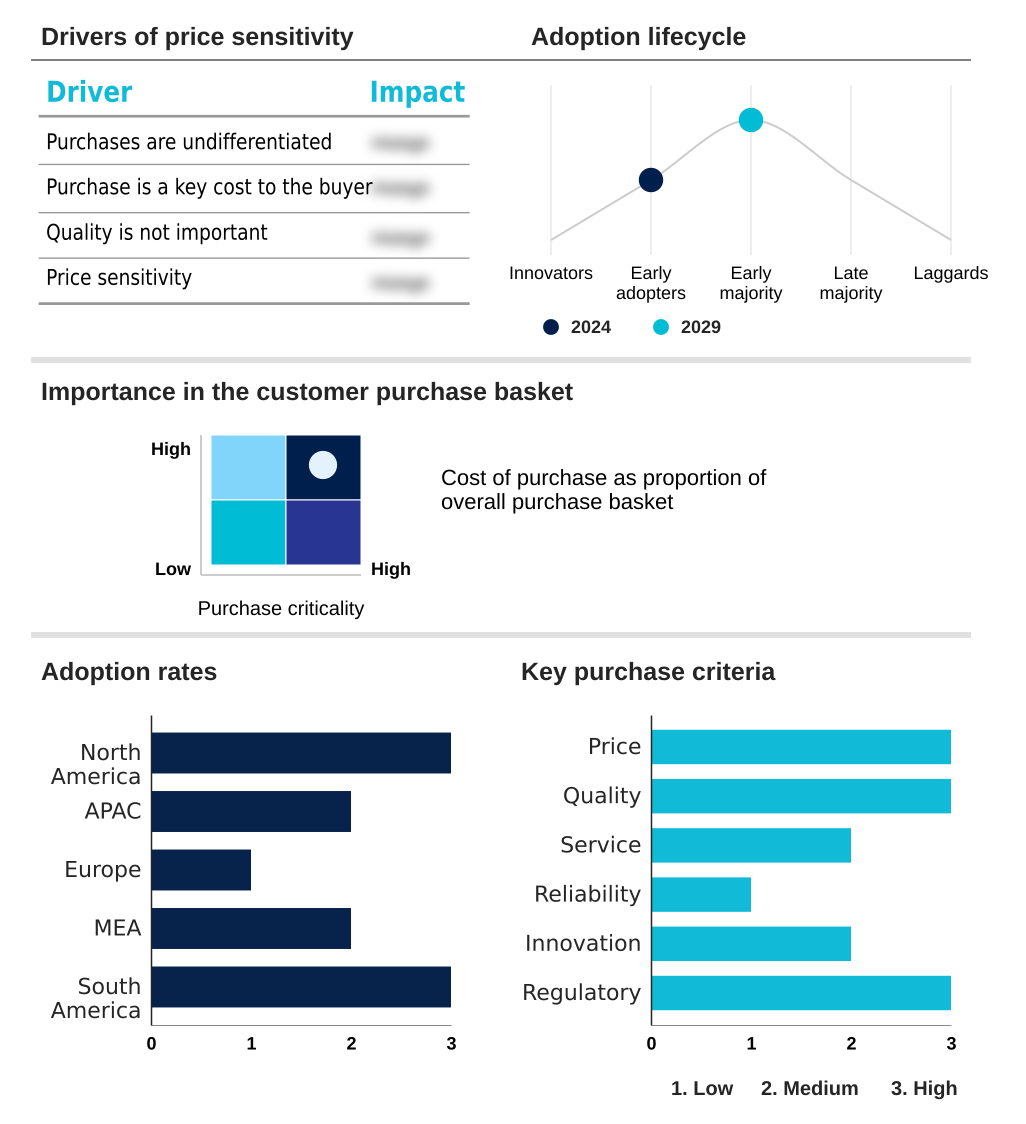
Customer Landscape of Ai In Nanotechnology Industry
Competitive Landscape
Companies are implementing various strategies, such as strategic alliances, ai in nanotechnology market forecast, partnerships, mergers and acquisitions, geographical expansion, and product/service launches, to enhance their presence in the industry.
Accelerated Materials Ltd. - The unified segment provides patented annular microreactors integrated with automated artificial intelligence software to accelerate nanomaterial discovery and streamline laboratory-to-factory scale-up operations.
The industry research and growth report includes detailed analyses of the competitive landscape of the market and information about key companies, including:
- Accelerated Materials Ltd.
- Atinary Technologies Inc.
- Camtek Ltd.
- Citrine Informatics Inc.
- Cusp AI Ltd
- Dunia Innovations GmbH
- Entalpic SAS
- Geinforce Technology Pvt Ltd
- InverseNano Inc.
- Kebotix Inc.
- Mana Bio Ltd.
- Mat3ra Inc.
- Mater AI Ltd
- MaterialsZone Ltd.
- Matlantis Corp
- METiS Therapeutics Inc.
- NanoCure AI Co
- Nova Ltd.
- Raith GmbH
- XtalPi Holdings Ltd
Qualitative and quantitative analysis of companies has been conducted to help clients understand the wider business environment as well as the strengths and weaknesses of key industry players. Data is qualitatively analyzed to categorize companies as pure play, category-focused, industry-focused, and diversified; it is quantitatively analyzed to categorize companies as dominant, leading, strong, tentative, and weak.
Recent Development and News in Ai in nanotechnology market
- In the Biotechnology industry, the structural transition toward personalized targeted oncology therapies mandated stricter purity standards for lipid nanoparticle formulations, directly increasing demand in the Global AI In Nanotechnology Market 2026-2030 by forcing a 40% reduction in tolerable batch-to-batch structural variations using real-time characterization instruments.
- The widespread adoption of continuous closed-loop experimentation within pharmaceutical scale-up facilities lowered raw material waste margins by 25%, simultaneously driving the deployment of machine learning-guided density functional theory tools to model targeted nanomedicine delivery parameters.
- Strict regulatory frameworks concerning synthetic inorganic nanoparticle toxicity accelerated the shift toward biomimetic nanostructure design, generating a 30% surge in procurement of computational chemistry software capable of predicting nanoparticle bio-distribution metrics.
- The integration of automated robotic liquid handler integration into biopharmaceutical research pipelines increased daily sample throughput by up to 500%, fueling the operational necessity for deep learning models to process the resulting high-dimensional data streams for smart nanoscale bio-carriers.
Dive into Technavio’s robust research methodology, blending expert interviews, extensive data synthesis, and validated models for unparalleled Ai In Nanotechnology Market insights. See full methodology.
| Market Scope | |
|---|---|
| Page number | 293 |
| Base year | 2025 |
| Historic period | 2020-2024 |
| Forecast period | 2026-2030 |
| Growth momentum & CAGR | Accelerate at a CAGR of 22.9% |
| Market growth 2026-2030 | USD 19482.4 million |
| Market structure | Fragmented |
| YoY growth 2025-2026(%) | 19.8% |
| Key countries | US, Canada, Mexico, China, Japan, India, South Korea, Australia, Indonesia, Germany, UK, France, Italy, Spain, The Netherlands, Saudi Arabia, UAE, South Africa, Israel, Turkey, Brazil, Argentina and Chile |
| Competitive landscape | Leading Companies, Market Positioning of Companies, Competitive Strategies, and Industry Risks |
Research Analyst Overview
- The structural progression of the Global AI In Nanotechnology Market 2026-2030 is defined by the rapid convergence of predictive algorithmic architectures and atomic-scale fabrication processes. Advanced manufacturing entities aggressively deploy autonomous robotic laboratories to eliminate manual processing constraints, achieving a 40% reduction in research and development cycle times for high-performance engineered materials.
- Utilizing quantitative structure-activity relationship models enables researchers to predict thermodynamic stability before physical synthesis, drastically lowering resource waste. In semiconductor fabrication, automated algorithms continuously optimize atomic layer deposition parameters, ensuring sub-nanometer precision across high-density memory architectures.
- Similarly, the biopharmaceutical sector relies on complex multi-scale atomistic simulations and molecular dynamics simulations to engineer precision nanocarriers for targeted nanomedicine delivery, yielding unprecedented improvements in intracellular therapeutic payload release. Continuous integration of real-time machine learning filters into structural health sensing networks provides highly accurate defect recognition, protecting critical aerospace and industrial infrastructure.
- As precision engineering standards rise, the reliance on high-throughput virtual screening and generative inverse design solidifies a highly optimized, data-driven industrial operating environment.
What are the Key Data Covered in this Ai In Nanotechnology Market Research and Growth Report?
-
What is the expected growth of the Ai In Nanotechnology Market between 2026 and 2030?
-
USD 19.48 billion, at a CAGR of 22.9%
-
-
What segmentation does the market report cover?
-
The report is segmented by Technology (Machine learning, Deep learning, and Natural language processing), Application (Nanoelectronics and optoelectronics, Nanomedicine and drug delivery, and Nanosensors and nanodevices), End-user (Electronics and semiconductor, Healthcare and biomedical, and Energy and environment) and Geography (North America, APAC, Europe, Middle East and Africa, South America)
-
-
Which regions are analyzed in the report?
-
North America, APAC, Europe, Middle East and Africa and South America
-
-
What are the key growth drivers and market challenges?
-
Accelerated discovery of high-performance engineered nanomaterials, Data quality inconsistencies and experimental data scarcity
-
-
Who are the major players in the Ai In Nanotechnology Market?
-
Accelerated Materials Ltd., Atinary Technologies Inc., Camtek Ltd., Citrine Informatics Inc., Cusp AI Ltd, Dunia Innovations GmbH, Entalpic SAS, Geinforce Technology Pvt Ltd, InverseNano Inc., Kebotix Inc., Mana Bio Ltd., Mat3ra Inc., Mater AI Ltd, MaterialsZone Ltd., Matlantis Corp, METiS Therapeutics Inc., NanoCure AI Co, Nova Ltd., Raith GmbH and XtalPi Holdings Ltd
-
Market Research Insights
- The Global AI In Nanotechnology Market 2026-2030 represents a transformative operational shift toward predictive materials modeling and automated nanoscale characterization. By implementing continuous closed-loop experimentation, industrial laboratories have reduced physical prototyping costs by 45%, enabling rapid deployment of targeted oncology therapies.
- Access to curated, proprietary industrial data allows algorithmic models to design highly effective smart nanoscale bio-carriers, improving cellular uptake rates by over 30% compared to traditional formulation methods. Furthermore, advanced pattern recognition integrated into environmental micro-pollutant monitoring sensors has enhanced trace analyte detection accuracy by 22%, significantly lowering compliance penalty risks for chemical manufacturing facilities.
- These predictive capabilities allow enterprises to systematically optimize complex thermodynamic parameters without relying on exhaustive empirical testing.
We can help! Our analysts can customize this ai in nanotechnology market research report to meet your requirements.
 RIA -