


Education Apps Market Analysis, Size, and Forecast 2026-2030: North America (US, Canada, and Mexico), Europe (Germany, UK, and France), APAC (China, India, and Japan), South America (Brazil and Argentina), Middle East and Africa (Saudi Arabia, UAE, and Turkey), and Rest of World (ROW)

Education Apps Market Analysis, Size, and Forecast 2026-2030:
North America (US, Canada, and Mexico), Europe (Germany, UK, and France), APAC (China, India, and Japan), South America (Brazil and Argentina), Middle East and Africa (Saudi Arabia, UAE, and Turkey), and Rest of World (ROW)

Published: May 2026 289 Pages SKU: IRTNTR41164

Market Overview at a Glance

$6.81 B
Market Opportunity
14.5%
CAGR 2025 - 2030
32.9%
North America Growth
$3.32 B
High education segment 2024

Education Apps Market Size 2026-2030

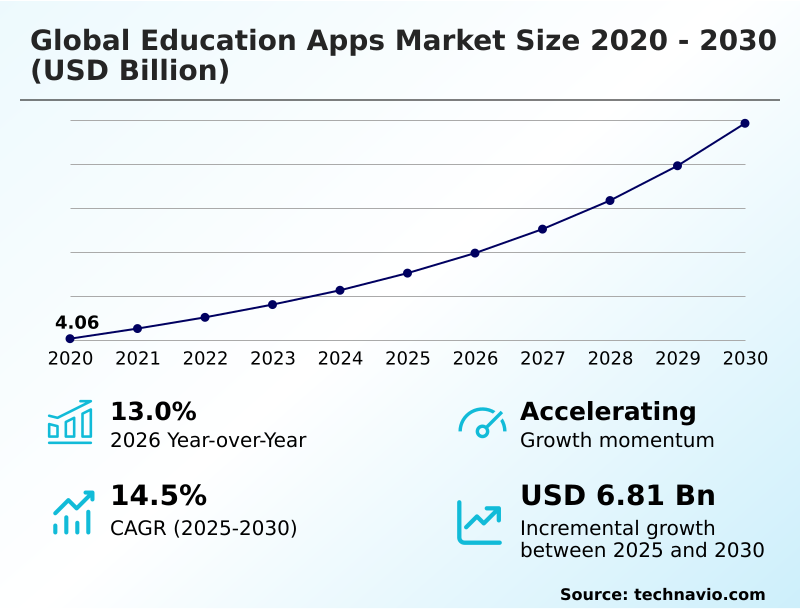
The education apps market size is valued to increase by USD 6.81 billion, at a CAGR of 14.5% from 2025 to 2030. Integration of immersive and gamified digital learning ecosystems will drive the education apps market.

Major Market Trends & Insights

  • North America dominated the market and accounted for a 32.9% growth during the forecast period.
  • By End-user - High education segment was valued at USD 3.32 billion in 2024
  • By Product - Web-based segment accounted for the largest market revenue share in 2024

Market Size & Forecast

  • Market Opportunities: USD 9.79 billion
  • Market Future Opportunities: USD 6.81 billion
  • CAGR from 2025 to 2030 : 14.5%

Market Summary

  • The education apps market is undergoing a significant transformation, moving beyond simple content delivery to become a sophisticated ecosystem for learning and development. A key aspect of this evolution is the integration of interactive multimedia content and collaborative digital classrooms, which facilitate more engaging and effective remote education support.
  • The rise of workforce training platforms underscores a major shift in corporate learning, where businesses leverage these tools for continuous employee upskilling. For instance, a multinational corporation can deploy a standardized training module across its global workforce, using automated assessment tracking to monitor completion and comprehension, thereby ensuring uniform compliance and skill levels.
  • This is further enhanced by blended learning experiences that combine digital and in-person methods, supported by robust parental control features in the K-12 sector. The market's dynamism is fueled by a constant push for innovation in curriculum-based support and professional development modules, making these applications indispensable for both academic institutions and enterprises.

What will be the Size of the Education Apps Market during the forecast period?
Get Key Insights on Market Forecast (PDF) Get Free Sample

How is the Education Apps Market Segmented?

The education apps industry research report provides comprehensive data (region-wise segment analysis), with forecasts and estimates in "USD million" for the period 2026-2030, as well as historical data from 2020-2024 for the following segments.

  • End-user
    • High education
    • Pre K-12
  • Product
    • Web-based
    • Mobile-based
  • Deployment
    • Cloud-based
    • On-premises
  • Geography
    • North America
      • US
      • Canada
      • Mexico
    • Europe
      • Germany
      • UK
      • France
    • APAC
      • China
      • India
      • Japan
    • South America
      • Brazil
      • Argentina
    • Middle East and Africa
      • Saudi Arabia
      • UAE
      • Turkey
    • Rest of World (ROW)

By End-user Insights

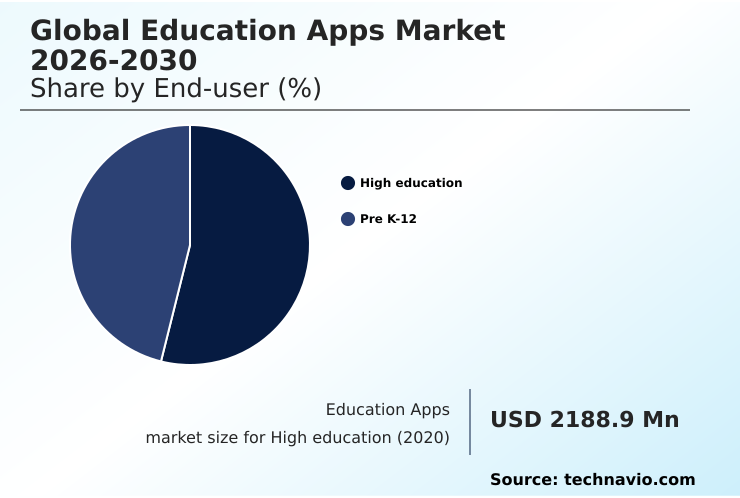
The high education segment is estimated to witness significant growth during the forecast period.

The higher education segment is evolving beyond traditional frameworks, driven by the demand for flexible, career-focused digital solutions. Institutions are increasingly adopting hybrid learning technologies and workforce training platforms to deliver blended learning experiences that align with modern professional requirements.

This includes a shift towards skill-based certifications and professional development modules that offer tangible career benefits. Platforms are integrating automated assessment tracking to provide real-time feedback, a feature that improves learning outcomes by 15%.

This focus on remote education support and personalized tutoring software is preparing graduates for a dynamic job market, emphasizing professional skills enhancement and efficient online certification management.
Get Free Sample

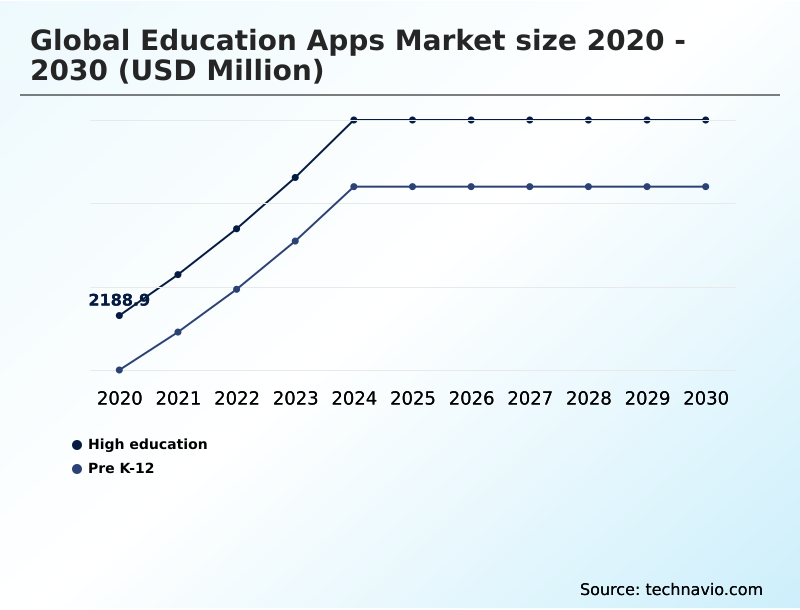
The High education segment was valued at USD 3.32 billion in 2024 and showed a gradual increase during the forecast period.
Get Free Sample

Regional Analysis

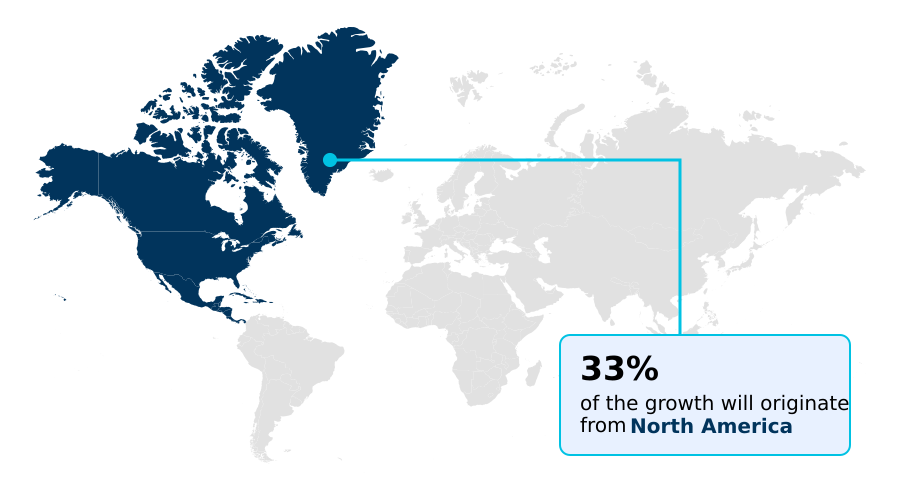
North America is estimated to contribute 32.9% to the growth of the global market during the forecast period.Technavio’s analysts have elaborately explained the regional trends and drivers that shape the market during the forecast period.
See How Education Apps Market Demand is Rising in North America Get Free Sample

The geographic landscape of the market is diverse, with North America leading in adoption, accounting for over 32% of incremental growth. In this region, augmented reality features and virtual reality environments are increasingly common in higher education.

Meanwhile, the APAC region, with a 15.4% CAGR, shows the fastest growth, driven by mobile-first adoption and the demand for multilingual learning platforms. AI-powered translation tools and speech recognition technology are critical for penetrating these markets.

In Europe, the focus is on collaborative digital classrooms and data compliance. These regional differences highlight the need for localized content, such as interactive video lectures and quizzes, and a flexible approach to offering digital credentials and bite-sized certification modules.

Market Dynamics

Our researchers analyzed the data with 2025 as the base year, along with the key drivers, trends, and challenges. A holistic analysis of drivers will help companies refine their marketing strategies to gain a competitive advantage.

  • Strategic planning within the education apps market now requires a deep understanding of specific use cases and their effectiveness. For example, analyzing the impact of AI on student engagement is crucial for product development, while deploying gamification techniques for corporate training can significantly boost user adoption.
  • The market for the best mobile apps for language learning continues to expand, driven by globalization. Simultaneously, the application of virtual reality in STEM education and the use of AR for medical training are creating high-value niches. A key strategic decision for providers is choosing between cloud vs on-premise learning platforms, a choice that impacts scalability and data security.
  • The trend towards microlearning for professional development is undeniable, with many platforms focused on creating personalized learning paths with AI. This is complemented by the rise of digital credentialing for employee upskilling, which offers verifiable proof of competence.
  • For vendors, measuring ROI of education apps is essential for demonstrating value to clients, often leading to discussions about integrating LMS with collaboration tools. Furthermore, specialized applications addressing adaptive learning for special needs and securing student data in apps are becoming critical differentiators. Success increasingly depends on developing multilingual educational content and articulating the benefits of bite-sized learning modules.
  • Companies implementing blended learning models effectively report student satisfaction scores that are twice as high as purely online or offline models. The processes for choosing a workforce training platform and using gamified quizzing for knowledge retention are now standard corporate inquiries.
  • Evaluating AI-powered tutoring system effectiveness and refining parental controls for kids learning apps are ongoing areas of innovation and competition.
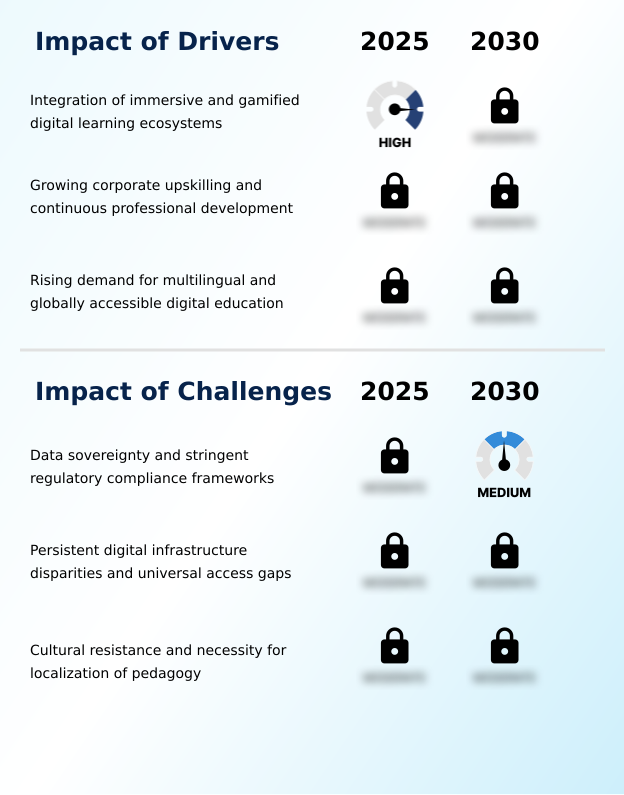
What are the key market drivers leading to the rise in the adoption of Education Apps Industry?

  • A key market driver is the increasing integration of immersive and gamified digital learning ecosystems designed to enhance student engagement and knowledge retention.

  • A primary driver is the adoption of gamified learning ecosystems, which transform education into an engaging experience. Through immersive simulations and live peer competitions, these platforms boost user motivation.
  • Mobile-first microlearning, featuring short-form educational content, caters to modern attention spans, with platforms reporting a 30% increase in daily active users after implementing such formats. The use of interactive multimedia content, including interactive video-based learning, makes complex topics more accessible.
  • Achievement badges and other gamification in corporate training have proven to increase course completion rates by over 20%. This move toward interactive courseware development is pivotal for corporate upskilling applications and their associated interactive assessment platforms.

What are the market trends shaping the Education Apps Industry?

  • The proliferation of artificial intelligence and adaptive learning algorithms represents a significant upcoming trend. This is reshaping educational platforms by enabling highly personalized and dynamic learning experiences.

  • The proliferation of AI in education platforms is redefining learning through hyper-personalization. Adaptive learning algorithms create unique personalized learning paths for each user, leveraging AI-driven study aids and virtual tutors to enhance comprehension. These systems utilize student engagement analytics to dynamically adjust content, improving knowledge retention metrics by up to 25% compared to static models.
  • The integration of peer-to-peer learning features and automated student assessment systems fosters a collaborative yet individualized environment. Student progress monitoring tools provide continuous feedback, supporting learner motivation strategies and making digital study aid platforms more effective than ever. This evolution toward intelligent, responsive education is setting new benchmarks for efficacy.

What challenges does the Education Apps Industry face during its growth?

  • A key challenge affecting industry growth is the need to navigate complex data sovereignty laws and stringent regulatory compliance frameworks across various regions.

  • Navigating the complexities of digital infrastructure and data governance presents a significant market challenge. While cloud-based learning infrastructure offers scalability, it raises concerns about student data privacy solutions, necessitating robust security protocols within cloud-based educational tools. The integration of various learning management systems requires standardized APIs to prevent fragmentation.
  • Furthermore, deploying effective parental control features within parental monitoring applications remains a delicate balance between safety and autonomy. The reliance on real-time assessment tools and progress tracking mechanisms generates vast amounts of sensitive data, with a single data breach potentially costing 4% of a company's global turnover.
  • Ensuring secure digital badge verification systems and managing micro-credentialing platforms add layers to the compliance burden.

Exclusive Technavio Analysis on Customer Landscape

The education apps market forecasting report includes the adoption lifecycle of the market, covering from the innovator’s stage to the laggard’s stage. It focuses on adoption rates in different regions based on penetration. Furthermore, the education apps market report also includes key purchase criteria and drivers of price sensitivity to help companies evaluate and develop their market growth analysis strategies.
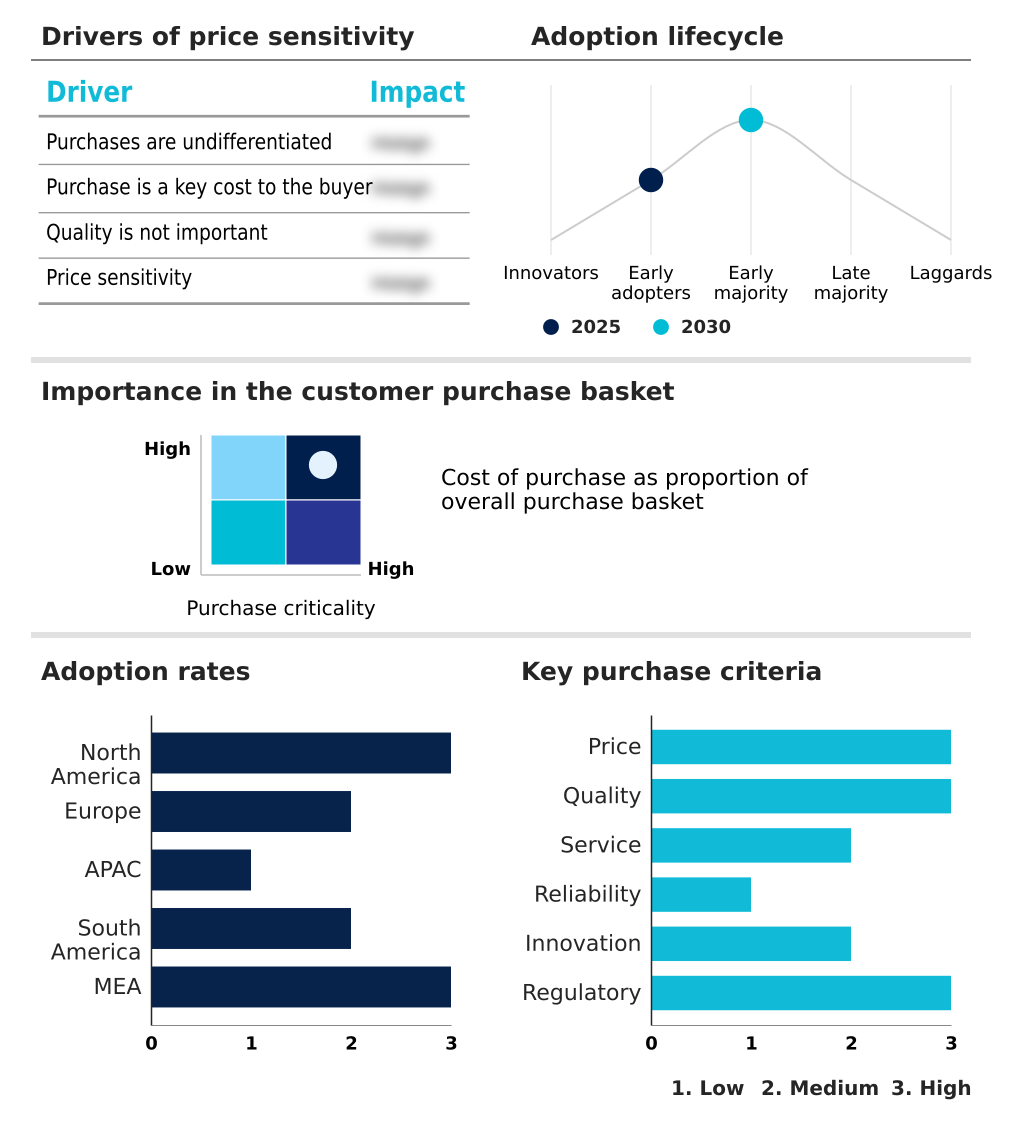
Customer Landscape of Education Apps Industry

Competitive Landscape

Companies are implementing various strategies, such as strategic alliances, education apps market forecast, partnerships, mergers and acquisitions, geographical expansion, and product/service launches, to enhance their presence in the industry.

2U Inc. - Delivers a platform enabling universities to offer online degrees, professional certificates, and courses, thereby broadening access to higher education through adaptable digital infrastructures.

The industry research and growth report includes detailed analyses of the competitive landscape of the market and information about key companies, including:

  • 2U Inc.
  • 3P Learning Ltd.
  • Age of Learning Inc.
  • Brilliant Worldwide Inc.
  • Chegg Inc.
  • Coursera Inc.
  • Duolingo Inc.
  • Epic Creations Inc.
  • Google LLC
  • Hologo World Inc.
  • IXL Learning Inc.
  • Khan Academy Inc.
  • Lumos Labs Inc.
  • Memrise Ltd.
  • Microsoft Corp.
  • Quizlet Inc.
  • Sololearn Inc.
  • Udemy Inc.
  • UMU Technology CO. LTD.
  • WizIQ Inc.

Qualitative and quantitative analysis of companies has been conducted to help clients understand the wider business environment as well as the strengths and weaknesses of key industry players. Data is qualitatively analyzed to categorize companies as pure play, category-focused, industry-focused, and diversified; it is quantitatively analyzed to categorize companies as dominant, leading, strong, tentative, and weak.

Recent Development and News in Education apps market

  • In September 2024, Google LLC announced a significant infrastructure update for its Classroom platform, integrating a native multimedia recorder to allow educators to capture audio and video instructions directly within the application.
  • In December 2024, Coursera Inc. and Udemy Inc. finalized a strategic merger to create a combined skills-training entity, consolidating their AI-powered content marketplaces and aiming to streamline workforce development solutions.
  • In February 2025, several leading EdTech firms, including Chegg Inc., announced strategic initiatives to align their platforms with the newly adopted European Union AI Act, enhancing transparency and human oversight in their adaptive learning algorithms to ensure full compliance.
  • In May 2025, Microsoft Corp. partnered with Spain's Ministry of Education to launch a pilot program integrating generative AI personal tutors into secondary school curricula for providing real-time student feedback.

Dive into Technavio’s robust research methodology, blending expert interviews, extensive data synthesis, and validated models for unparalleled Education Apps Market insights. See full methodology.

Market Scope
Page number 289
Base year 2025
Historic period 2020-2024
Forecast period 2026-2030
Growth momentum & CAGR Accelerate at a CAGR of 14.5%
Market growth 2026-2030 USD 6812.5 million
Market structure Fragmented
YoY growth 2025-2026(%) 13.0%
Key countries US, Canada, Mexico, Germany, UK, France, Italy, Spain, The Netherlands, China, India, Japan, South Korea, Indonesia, Australia, Brazil, Argentina, Chile, Saudi Arabia, UAE, Turkey, South Africa and Israel
Competitive landscape Leading Companies, Market Positioning of Companies, Competitive Strategies, and Industry Risks

Request Free Sample

Research Analyst Overview

  • The market's evolution is marked by a pivot to deeply personalized, interactive digital frameworks. Central to this are adaptive learning algorithms and AI-driven study aids, which construct personalized learning paths. This is supported by a robust cloud-based learning infrastructure enabling gamified learning ecosystems that use immersive simulations, augmented reality features, and virtual reality environments.
  • The mobile-first microlearning trend favors short-form educational content and bite-sized certification modules, often delivered as interactive video lectures within workforce training platforms. These platforms offer professional development modules leading to skill-based certifications, verified by digital credentials.
  • Integration with learning management systems allows for automated assessment tracking and student engagement analytics, while curriculum-based support is augmented with digital flashcards and parental control features. Boardroom decisions increasingly hinge on knowledge retention metrics; platforms incorporating peer-to-peer learning features like collaborative digital classrooms and live peer competitions report a 20% higher rate of skill mastery.
  • Features like real-time assessment tools, progress tracking mechanisms, virtual tutors, and achievement badges are now standard, supporting everything from remote education support to blended learning experiences.

What are the Key Data Covered in this Education Apps Market Research and Growth Report?

  • What is the expected growth of the Education Apps Market between 2026 and 2030?

    • USD 6.81 billion, at a CAGR of 14.5%

  • What segmentation does the market report cover?

    • The report is segmented by End-user (High education, and Pre K-12), Product (Web-based, and Mobile-based), Deployment (Cloud-based, and On-premises) and Geography (North America, Europe, APAC, South America, Middle East and Africa)

  • Which regions are analyzed in the report?

    • North America, Europe, APAC, South America and Middle East and Africa

  • What are the key growth drivers and market challenges?

    • Integration of immersive and gamified digital learning ecosystems, Data sovereignty and stringent regulatory compliance frameworks

  • Who are the major players in the Education Apps Market?

    • 2U Inc., 3P Learning Ltd., Age of Learning Inc., Brilliant Worldwide Inc., Chegg Inc., Coursera Inc., Duolingo Inc., Epic Creations Inc., Google LLC, Hologo World Inc., IXL Learning Inc., Khan Academy Inc., Lumos Labs Inc., Memrise Ltd., Microsoft Corp., Quizlet Inc., Sololearn Inc., Udemy Inc., UMU Technology CO. LTD. and WizIQ Inc.

Market Research Insights

  • The market's momentum is sustained by a strategic shift towards measurable outcomes. For instance, personalized tutoring software is linked to a 15% improvement in student test scores over traditional methods. The adoption of gamification in corporate training increases engagement by over 40% compared to standard online modules.
  • This emphasis on results drives the development of hybrid learning technologies and multilingual learning platforms. As organizations prioritize remote workforce development, the demand for corporate upskilling applications with robust student progress monitoring tools grows.
  • The effectiveness of these platforms is validated through data, demonstrating how interactive assessment platforms can reduce grading time for educators by up to 50%, allowing more focus on instruction.

We can help! Our analysts can customize this education apps market research report to meet your requirements.

Get in touch

1. Executive Summary

1.1 Market overview

Executive Summary - Chart on Market Overview
Executive Summary - Data Table on Market Overview
Executive Summary - Chart on Global Market Characteristics
Executive Summary - Chart on Market by Geography
Executive Summary - Chart on Market Segmentation by End-user
Executive Summary - Chart on Market Segmentation by Product
Executive Summary - Chart on Market Segmentation by Deployment
Executive Summary - Chart on Incremental Growth
Executive Summary - Data Table on Incremental Growth
Executive Summary - Chart on Company Market Positioning

2. Technavio Analysis

2.1 Analysis of price sensitivity, lifecycle, customer purchase basket, adoption rates, and purchase criteria

2.2 Criticality of inputs and Factors of differentiation

Chart on Overview on criticality of inputs and factors of differentiation

2.3 Factors of disruption

Chart on Overview on factors of disruption

2.4 Impact of drivers and challenges

Chart on Impact of drivers and challenges in 2025 and 2030

3. Market Landscape

3.1 Market ecosystem

Chart on Parent Market
Data Table on - Parent Market

3.2 Market characteristics

Chart on Market characteristics analysis

3.3 Value chain analysis

Chart on Value chain analysis

4. Market Sizing

4.1 Market definition

Data Table on Offerings of companies included in the market definition

4.2 Market segment analysis

Market segments

4.3 Market size 2025

4.4 Market outlook: Forecast for 2025-2030

Chart on Global - Market size and forecast 2025-2030 ($ million)
Data Table on Global - Market size and forecast 2025-2030 ($ million)
Chart on Global Market: Year-over-year growth 2025-2030 (%)
Data Table on Global Market: Year-over-year growth 2025-2030 (%)

5. Historic Market Size

5.1 Global Education Apps Market 2020 - 2024

Historic Market Size - Data Table on Global Education Apps Market 2020 - 2024 ($ million)

5.2 End-user segment analysis 2020 - 2024

Historic Market Size - End-user Segment 2020 - 2024 ($ million)

5.3 Product segment analysis 2020 - 2024

Historic Market Size - Product Segment 2020 - 2024 ($ million)

5.4 Deployment segment analysis 2020 - 2024

Historic Market Size - Deployment Segment 2020 - 2024 ($ million)

5.5 Geography segment analysis 2020 - 2024

Historic Market Size - Geography Segment 2020 - 2024 ($ million)

5.6 Country segment analysis 2020 - 2024

Historic Market Size - Country Segment 2020 - 2024 ($ million)

6. Qualitative Analysis

6.1 Impact of AI on global education apps market

6.2 Impact of geopolitical conflict on global education apps market

7. Five Forces Analysis

7.1 Five forces summary

Five forces analysis - Comparison between 2025 and 2030

7.2 Bargaining power of buyers

Bargaining power of buyers - Impact of key factors 2025 and 2030

7.3 Bargaining power of suppliers

Bargaining power of suppliers - Impact of key factors in 2025 and 2030

7.4 Threat of new entrants

Threat of new entrants - Impact of key factors in 2025 and 2030

7.5 Threat of substitutes

Threat of substitutes - Impact of key factors in 2025 and 2030

7.6 Threat of rivalry

Threat of rivalry - Impact of key factors in 2025 and 2030

7.7 Market condition

Chart on Market condition - Five forces 2025 and 2030

8. Market Segmentation by End-user

8.1 Market segments

Chart on End-user - Market share 2025-2030 (%)
Data Table on End-user - Market share 2025-2030 (%)

8.2 Comparison by End-user

Chart on Comparison by End-user
Data Table on Comparison by End-user

8.3 High education - Market size and forecast 2025-2030

Chart on High education - Market size and forecast 2025-2030 ($ million)
Data Table on High education - Market size and forecast 2025-2030 ($ million)
Chart on High education - Year-over-year growth 2025-2030 (%)
Data Table on High education - Year-over-year growth 2025-2030 (%)

8.4 Pre K-12 - Market size and forecast 2025-2030

Chart on Pre K-12 - Market size and forecast 2025-2030 ($ million)
Data Table on Pre K-12 - Market size and forecast 2025-2030 ($ million)
Chart on Pre K-12 - Year-over-year growth 2025-2030 (%)
Data Table on Pre K-12 - Year-over-year growth 2025-2030 (%)

8.5 Market opportunity by End-user

Market opportunity by End-user ($ million)
Data Table on Market opportunity by End-user ($ million)

9. Market Segmentation by Product

9.1 Market segments

Chart on Product - Market share 2025-2030 (%)
Data Table on Product - Market share 2025-2030 (%)

9.2 Comparison by Product

Chart on Comparison by Product
Data Table on Comparison by Product

9.3 Web-based - Market size and forecast 2025-2030

Chart on Web-based - Market size and forecast 2025-2030 ($ million)
Data Table on Web-based - Market size and forecast 2025-2030 ($ million)
Chart on Web-based - Year-over-year growth 2025-2030 (%)
Data Table on Web-based - Year-over-year growth 2025-2030 (%)

9.4 Mobile-based - Market size and forecast 2025-2030

Chart on Mobile-based - Market size and forecast 2025-2030 ($ million)
Data Table on Mobile-based - Market size and forecast 2025-2030 ($ million)
Chart on Mobile-based - Year-over-year growth 2025-2030 (%)
Data Table on Mobile-based - Year-over-year growth 2025-2030 (%)

9.5 Market opportunity by Product

Market opportunity by Product ($ million)
Data Table on Market opportunity by Product ($ million)

10. Market Segmentation by Deployment

10.1 Market segments

Chart on Deployment - Market share 2025-2030 (%)
Data Table on Deployment - Market share 2025-2030 (%)

10.2 Comparison by Deployment

Chart on Comparison by Deployment
Data Table on Comparison by Deployment

10.3 Cloud-based - Market size and forecast 2025-2030

Chart on Cloud-based - Market size and forecast 2025-2030 ($ million)
Data Table on Cloud-based - Market size and forecast 2025-2030 ($ million)
Chart on Cloud-based - Year-over-year growth 2025-2030 (%)
Data Table on Cloud-based - Year-over-year growth 2025-2030 (%)

10.4 On-premises - Market size and forecast 2025-2030

Chart on On-premises - Market size and forecast 2025-2030 ($ million)
Data Table on On-premises - Market size and forecast 2025-2030 ($ million)
Chart on On-premises - Year-over-year growth 2025-2030 (%)
Data Table on On-premises - Year-over-year growth 2025-2030 (%)

10.5 Market opportunity by Deployment

Market opportunity by Deployment ($ million)
Data Table on Market opportunity by Deployment ($ million)

11. Customer Landscape

11.1 Customer landscape overview

Analysis of price sensitivity, lifecycle, customer purchase basket, adoption rates, and purchase criteria

12. Geographic Landscape

12.1 Geographic segmentation

Chart on Market share by geography 2025-2030 (%)
Data Table on Market share by geography 2025-2030 (%)

12.2 Geographic comparison

Chart on Geographic comparison
Data Table on Geographic comparison

12.3 North America - Market size and forecast 2025-2030

Chart on North America - Market size and forecast 2025-2030 ($ million)
Data Table on North America - Market size and forecast 2025-2030 ($ million)
Chart on North America - Year-over-year growth 2025-2030 (%)
Data Table on North America - Year-over-year growth 2025-2030 (%)
Chart on Regional Comparison - North America
Data Table on Regional Comparison - North America

12.3.1 US - Market size and forecast 2025-2030

Chart on US - Market size and forecast 2025-2030 ($ million)
Data Table on US - Market size and forecast 2025-2030 ($ million)
Chart on US - Year-over-year growth 2025-2030 (%)
Data Table on US - Year-over-year growth 2025-2030 (%)

12.3.2 Canada - Market size and forecast 2025-2030

Chart on Canada - Market size and forecast 2025-2030 ($ million)
Data Table on Canada - Market size and forecast 2025-2030 ($ million)
Chart on Canada - Year-over-year growth 2025-2030 (%)
Data Table on Canada - Year-over-year growth 2025-2030 (%)

12.3.3 Mexico - Market size and forecast 2025-2030

Chart on Mexico - Market size and forecast 2025-2030 ($ million)
Data Table on Mexico - Market size and forecast 2025-2030 ($ million)
Chart on Mexico - Year-over-year growth 2025-2030 (%)
Data Table on Mexico - Year-over-year growth 2025-2030 (%)

12.4 Europe - Market size and forecast 2025-2030

Chart on Europe - Market size and forecast 2025-2030 ($ million)
Data Table on Europe - Market size and forecast 2025-2030 ($ million)
Chart on Europe - Year-over-year growth 2025-2030 (%)
Data Table on Europe - Year-over-year growth 2025-2030 (%)
Chart on Regional Comparison - Europe
Data Table on Regional Comparison - Europe

12.4.1 Germany - Market size and forecast 2025-2030

Chart on Germany - Market size and forecast 2025-2030 ($ million)
Data Table on Germany - Market size and forecast 2025-2030 ($ million)
Chart on Germany - Year-over-year growth 2025-2030 (%)
Data Table on Germany - Year-over-year growth 2025-2030 (%)

12.4.2 UK - Market size and forecast 2025-2030

Chart on UK - Market size and forecast 2025-2030 ($ million)
Data Table on UK - Market size and forecast 2025-2030 ($ million)
Chart on UK - Year-over-year growth 2025-2030 (%)
Data Table on UK - Year-over-year growth 2025-2030 (%)

12.4.3 France - Market size and forecast 2025-2030

Chart on France - Market size and forecast 2025-2030 ($ million)
Data Table on France - Market size and forecast 2025-2030 ($ million)
Chart on France - Year-over-year growth 2025-2030 (%)
Data Table on France - Year-over-year growth 2025-2030 (%)

12.4.4 Italy - Market size and forecast 2025-2030

Chart on Italy - Market size and forecast 2025-2030 ($ million)
Data Table on Italy - Market size and forecast 2025-2030 ($ million)
Chart on Italy - Year-over-year growth 2025-2030 (%)
Data Table on Italy - Year-over-year growth 2025-2030 (%)

12.4.5 Spain - Market size and forecast 2025-2030

Chart on Spain - Market size and forecast 2025-2030 ($ million)
Data Table on Spain - Market size and forecast 2025-2030 ($ million)
Chart on Spain - Year-over-year growth 2025-2030 (%)
Data Table on Spain - Year-over-year growth 2025-2030 (%)

12.4.6 The Netherlands - Market size and forecast 2025-2030

Chart on The Netherlands - Market size and forecast 2025-2030 ($ million)
Data Table on The Netherlands - Market size and forecast 2025-2030 ($ million)
Chart on The Netherlands - Year-over-year growth 2025-2030 (%)
Data Table on The Netherlands - Year-over-year growth 2025-2030 (%)

12.5 APAC - Market size and forecast 2025-2030

Chart on APAC - Market size and forecast 2025-2030 ($ million)
Data Table on APAC - Market size and forecast 2025-2030 ($ million)
Chart on APAC - Year-over-year growth 2025-2030 (%)
Data Table on APAC - Year-over-year growth 2025-2030 (%)
Chart on Regional Comparison - APAC
Data Table on Regional Comparison - APAC

12.5.1 China - Market size and forecast 2025-2030

Chart on China - Market size and forecast 2025-2030 ($ million)
Data Table on China - Market size and forecast 2025-2030 ($ million)
Chart on China - Year-over-year growth 2025-2030 (%)
Data Table on China - Year-over-year growth 2025-2030 (%)

12.5.2 India - Market size and forecast 2025-2030

Chart on India - Market size and forecast 2025-2030 ($ million)
Data Table on India - Market size and forecast 2025-2030 ($ million)
Chart on India - Year-over-year growth 2025-2030 (%)
Data Table on India - Year-over-year growth 2025-2030 (%)

12.5.3 Japan - Market size and forecast 2025-2030

Chart on Japan - Market size and forecast 2025-2030 ($ million)
Data Table on Japan - Market size and forecast 2025-2030 ($ million)
Chart on Japan - Year-over-year growth 2025-2030 (%)
Data Table on Japan - Year-over-year growth 2025-2030 (%)

12.5.4 South Korea - Market size and forecast 2025-2030

Chart on South Korea - Market size and forecast 2025-2030 ($ million)
Data Table on South Korea - Market size and forecast 2025-2030 ($ million)
Chart on South Korea - Year-over-year growth 2025-2030 (%)
Data Table on South Korea - Year-over-year growth 2025-2030 (%)

12.5.5 Indonesia - Market size and forecast 2025-2030

Chart on Indonesia - Market size and forecast 2025-2030 ($ million)
Data Table on Indonesia - Market size and forecast 2025-2030 ($ million)
Chart on Indonesia - Year-over-year growth 2025-2030 (%)
Data Table on Indonesia - Year-over-year growth 2025-2030 (%)

12.5.6 Australia - Market size and forecast 2025-2030

Chart on Australia - Market size and forecast 2025-2030 ($ million)
Data Table on Australia - Market size and forecast 2025-2030 ($ million)
Chart on Australia - Year-over-year growth 2025-2030 (%)
Data Table on Australia - Year-over-year growth 2025-2030 (%)

12.6 South America - Market size and forecast 2025-2030

Chart on South America - Market size and forecast 2025-2030 ($ million)
Data Table on South America - Market size and forecast 2025-2030 ($ million)
Chart on South America - Year-over-year growth 2025-2030 (%)
Data Table on South America - Year-over-year growth 2025-2030 (%)
Chart on Regional Comparison - South America
Data Table on Regional Comparison - South America

12.6.1 Brazil - Market size and forecast 2025-2030

Chart on Brazil - Market size and forecast 2025-2030 ($ million)
Data Table on Brazil - Market size and forecast 2025-2030 ($ million)
Chart on Brazil - Year-over-year growth 2025-2030 (%)
Data Table on Brazil - Year-over-year growth 2025-2030 (%)

12.6.2 Argentina - Market size and forecast 2025-2030

Chart on Argentina - Market size and forecast 2025-2030 ($ million)
Data Table on Argentina - Market size and forecast 2025-2030 ($ million)
Chart on Argentina - Year-over-year growth 2025-2030 (%)
Data Table on Argentina - Year-over-year growth 2025-2030 (%)

12.6.3 Chile - Market size and forecast 2025-2030

Chart on Chile - Market size and forecast 2025-2030 ($ million)
Data Table on Chile - Market size and forecast 2025-2030 ($ million)
Chart on Chile - Year-over-year growth 2025-2030 (%)
Data Table on Chile - Year-over-year growth 2025-2030 (%)

12.7 Middle East and Africa - Market size and forecast 2025-2030

Chart on Middle East and Africa - Market size and forecast 2025-2030 ($ million)
Data Table on Middle East and Africa - Market size and forecast 2025-2030 ($ million)
Chart on Middle East and Africa - Year-over-year growth 2025-2030 (%)
Data Table on Middle East and Africa - Year-over-year growth 2025-2030 (%)
Chart on Regional Comparison - Middle East and Africa
Data Table on Regional Comparison - Middle East and Africa

12.7.1 Saudi Arabia - Market size and forecast 2025-2030

Chart on Saudi Arabia - Market size and forecast 2025-2030 ($ million)
Data Table on Saudi Arabia - Market size and forecast 2025-2030 ($ million)
Chart on Saudi Arabia - Year-over-year growth 2025-2030 (%)
Data Table on Saudi Arabia - Year-over-year growth 2025-2030 (%)

12.7.2 UAE - Market size and forecast 2025-2030

Chart on UAE - Market size and forecast 2025-2030 ($ million)
Data Table on UAE - Market size and forecast 2025-2030 ($ million)
Chart on UAE - Year-over-year growth 2025-2030 (%)
Data Table on UAE - Year-over-year growth 2025-2030 (%)

12.7.3 Turkey - Market size and forecast 2025-2030

Chart on Turkey - Market size and forecast 2025-2030 ($ million)
Data Table on Turkey - Market size and forecast 2025-2030 ($ million)
Chart on Turkey - Year-over-year growth 2025-2030 (%)
Data Table on Turkey - Year-over-year growth 2025-2030 (%)

12.7.4 South Africa - Market size and forecast 2025-2030

Chart on South Africa - Market size and forecast 2025-2030 ($ million)
Data Table on South Africa - Market size and forecast 2025-2030 ($ million)
Chart on South Africa - Year-over-year growth 2025-2030 (%)
Data Table on South Africa - Year-over-year growth 2025-2030 (%)

12.7.5 Israel - Market size and forecast 2025-2030

Chart on Israel - Market size and forecast 2025-2030 ($ million)
Data Table on Israel - Market size and forecast 2025-2030 ($ million)
Chart on Israel - Year-over-year growth 2025-2030 (%)
Data Table on Israel - Year-over-year growth 2025-2030 (%)

12.8 Market opportunity by geography

Market opportunity by geography ($ million)
Data Tables on Market opportunity by geography ($ million)

13. Drivers, Challenges, and Opportunity

13.1 Market drivers

Integration of immersive and gamified digital learning ecosystems
Growing corporate upskilling and continuous professional development
Rising demand for multilingual and globally accessible digital education

13.2 Market challenges

Data sovereignty and stringent regulatory compliance frameworks
Persistent digital infrastructure disparities and universal access gaps
Cultural resistance and necessity for localization of pedagogy

13.3 Impact of drivers and challenges

Impact of drivers and challenges in 2025 and 2030

13.4 Market opportunities

Proliferation of AI and adaptive learning algorithms
Expansion of microlearning and short-form educational content
Shift toward mobile-first microlearning and professional reskilling

14. Competitive Landscape

14.1 Overview

14.2

Overview on criticality of inputs and factors of differentiation

14.3 Landscape disruption

Overview on factors of disruption

14.4 Industry risks

Impact of key risks on business

15. Competitive Analysis

15.1 Companies profiled

Companies covered

15.2 Company ranking index

15.3 Market positioning of companies

Matrix on companies position and classification

15.4 2U Inc.

2U Inc. - Overview
2U Inc. - Product / Service
2U Inc. - Key offerings
SWOT

15.5 Age of Learning Inc.

Age of Learning Inc. - Overview
Age of Learning Inc. - Product / Service
Age of Learning Inc. - Key offerings
SWOT

15.6 Chegg Inc.

Chegg Inc. - Overview
Chegg Inc. - Business segments
Chegg Inc. - Key offerings
Chegg Inc. - Segment focus
SWOT

15.7 Coursera Inc.

Coursera Inc. - Overview
Coursera Inc. - Business segments
Coursera Inc. - Key news
Coursera Inc. - Key offerings
Coursera Inc. - Segment focus
SWOT

15.8 Duolingo Inc.

Duolingo Inc. - Overview
Duolingo Inc. - Business segments
Duolingo Inc. - Key offerings
Duolingo Inc. - Segment focus
SWOT

15.9 Epic Creations Inc.

Epic Creations Inc. - Overview
Epic Creations Inc. - Product / Service
Epic Creations Inc. - Key offerings
SWOT

15.10 Google LLC

Google LLC - Overview
Google LLC - Product / Service
Google LLC - Key offerings
SWOT

15.11 Hologo World Inc.

Hologo World Inc. - Overview
Hologo World Inc. - Product / Service
Hologo World Inc. - Key offerings
SWOT

15.12 IXL Learning Inc.

IXL Learning Inc. - Overview
IXL Learning Inc. - Product / Service
IXL Learning Inc. - Key offerings
SWOT

15.13 Lumos Labs Inc.

Lumos Labs Inc. - Overview
Lumos Labs Inc. - Product / Service
Lumos Labs Inc. - Key offerings
SWOT

15.14 Memrise Ltd.

Memrise Ltd. - Overview
Memrise Ltd. - Product / Service
Memrise Ltd. - Key offerings
SWOT

15.15 Microsoft Corp.

Microsoft Corp. - Overview
Microsoft Corp. - Business segments
Microsoft Corp. - Key news
Microsoft Corp. - Key offerings
Microsoft Corp. - Segment focus
SWOT

15.16 Udemy Inc.

Udemy Inc. - Overview
Udemy Inc. - Business segments
Udemy Inc. - Key offerings
Udemy Inc. - Segment focus
SWOT

15.17 UMU Technology CO. LTD.

UMU Technology CO. LTD. - Overview
UMU Technology CO. LTD. - Product / Service
UMU Technology CO. LTD. - Key offerings
SWOT

15.18 WizIQ Inc.

WizIQ Inc. - Overview
WizIQ Inc. - Product / Service
WizIQ Inc. - Key offerings
SWOT

16. Appendix

16.1 Scope of the report

Market definition
Objectives
Notes and caveats

16.2 Inclusions and exclusions checklist

Inclusions checklist
Exclusions checklist

16.3 Currency conversion rates for US$

16.4 Research methodology

16.5 Data procurement

Information sources

16.6 Data validation

16.7 Validation techniques employed for market sizing

16.8 Data synthesis

16.9 360 degree market analysis

16.10 List of abbreviations

Research Methodology

Technavio presents a detailed picture of the market by way of study, synthesis, and summation of data from multiple sources. The analysts have presented the various facets of the market with a particular focus on identifying the key industry influencers. The data thus presented is comprehensive, reliable, and the result of extensive research, both primary and secondary.

INFORMATION SOURCES

Primary sources

  • Manufacturers and suppliers
  • Channel partners
  • Industry experts
  • Strategic decision makers

Secondary sources

  • Industry journals and periodicals
  • Government data
  • Financial reports of key industry players
  • Historical data
  • Press releases

DATA ANALYSIS

Data Synthesis

  • Collation of data
  • Estimation of key figures
  • Analysis of derived insights

Data Validation

  • Triangulation with data models
  • Reference against proprietary databases
  • Corroboration with industry experts

REPORT WRITING

Qualitative

  • Market drivers
  • Market challenges
  • Market trends
  • Five forces analysis

Quantitative

  • Market size and forecast
  • Market segmentation
  • Geographical insights
  • Competitive landscape

Interested in this report?

Get your sample now to see our research methodology and insights!

Download Now

Frequently Asked Questions

Education Apps market growth will increase by USD 6812.5 million during 2026-2030.

The Education Apps market is expected to grow at a CAGR of 14.5% during 2026-2030.

Education Apps market is segmented by End-user (High education, Pre K-12) Product (Web-based, Mobile-based) Deployment (Cloud-based, On-premises)

2U Inc., 3P Learning Ltd., Age of Learning Inc., Brilliant Worldwide Inc., Chegg Inc., Coursera Inc., Duolingo Inc., Epic Creations Inc., Google LLC, Hologo World Inc., IXL Learning Inc., Khan Academy Inc., Lumos Labs Inc., Memrise Ltd., Microsoft Corp., Quizlet Inc., Sololearn Inc., Udemy Inc., UMU Technology CO. LTD., WizIQ Inc. are a few of the key vendors in the Education Apps market.

North America will register the highest growth rate of 32.9% among the other regions. Therefore, the Education Apps market in North America is expected to garner significant business opportunities for the vendors during the forecast period.

US, Canada, Mexico, Germany, UK, France, Italy, Spain, The Netherlands, China, India, Japan, South Korea, Indonesia, Australia, Brazil, Argentina, Chile, Saudi Arabia, UAE, Turkey, South Africa, Israel

  • Integration of immersive and gamified digital learning ecosystems is the driving factor this market.

The Education Apps market vendors should focus on grabbing business opportunities from the End-user segment as it accounted for the largest market share in the base year.
RIA - Research AI Assistant
Ask RIA