



E-commerce Retail Market Size 2026-2030
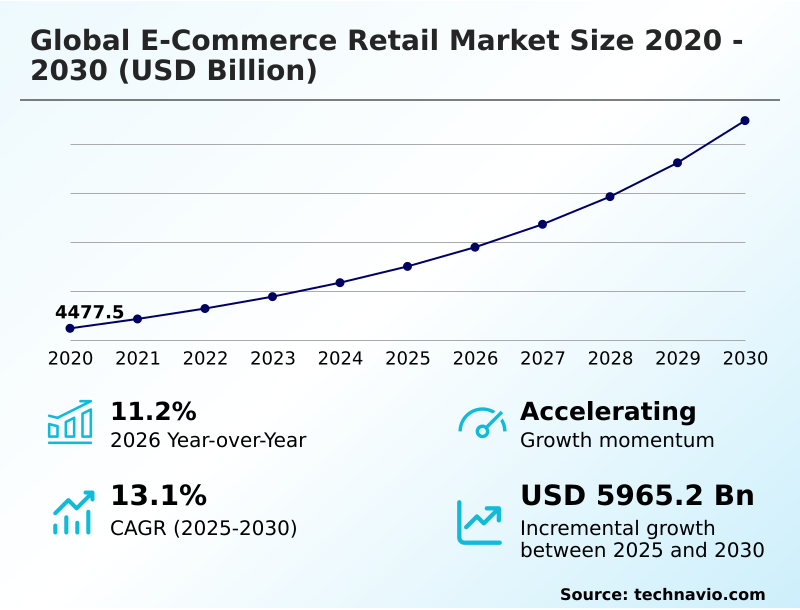
The e-commerce retail market size is valued to increase by USD 5965.2 billion, at a CAGR of 13.1% from 2025 to 2030. Rapid advancement and adoption of AI will drive the e-commerce retail market.
Major Market Trends & Insights
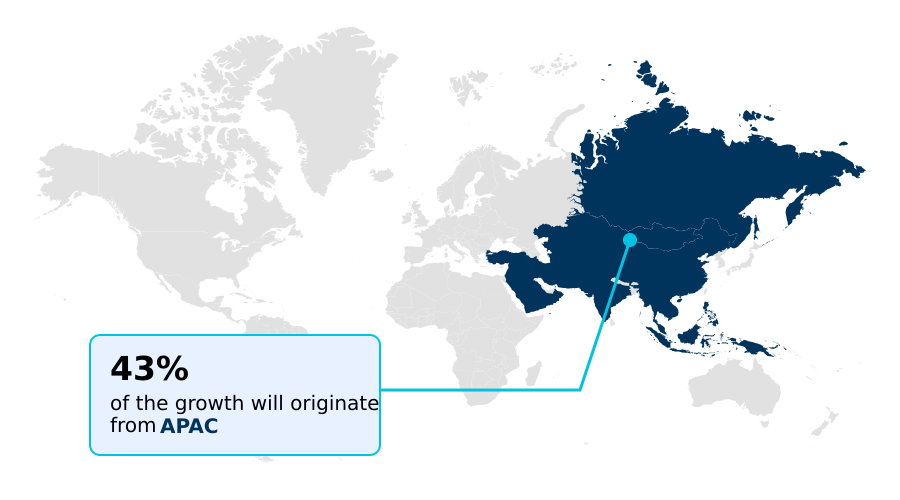
- APAC dominated the market and accounted for a 42.6% growth during the forecast period.
- By Product - Apparel and accessories segment was valued at USD 1897.5 billion in 2024
- By Modality - Business to business (B2B) segment accounted for the largest market revenue share in 2024
Market Size & Forecast
- Market Opportunities: USD 8498.2 billion
- Market Future Opportunities: USD 5965.2 billion
- CAGR from 2025 to 2030 : 13.1%
Market Summary
- The e-commerce retail market has evolved into a sophisticated arena where competitive advantage is dictated by technological prowess and operational excellence. Growth is now powered by the deep integration of artificial intelligence, which enables hyper-personalization at scale through advanced recommendation engines and conversational shopping assistants.
- Concurrently, the fusion of social media and retail, known as social commerce, has created powerful new channels for customer engagement and direct sales. For instance, a business can leverage live stream events to demonstrate products and create a sense of urgency, driving conversions directly within a social platform, a tactic that shortens the traditional sales funnel.
- However, this digital dependency introduces significant challenges. Firms must navigate a complex web of data privacy regulations and constant cybersecurity threats. Managing the escalating complexity and cost of last-mile delivery, where consumer expectations for speed are ever-increasing, also remains a central operational hurdle.
- Balancing these drivers and challenges requires a strategic focus on efficiency, customer retention, and resilient, technology-driven supply chains.
What will be the Size of the E-commerce Retail Market during the forecast period?
Get Key Insights on Market Forecast (PDF) Get Free Sample
How is the E-commerce Retail Market Segmented?
The e-commerce retail industry research report provides comprehensive data (region-wise segment analysis), with forecasts and estimates in "USD billion" for the period 2026-2030, as well as historical data from 2020-2024 for the following segments.
- Product
- Apparel and accessories
- Groceries
- Footwear
- Personal and beauty care
- Others
- Modality
- Business to business (B2B)
- Business to consumer (B2C)
- Consumer to consumer (C2C)
- Device
- Mobile
- Desktop
- Geography
- APAC
- China
- India
- Japan
- North America
- US
- Canada
- Mexico
- Europe
- UK
- Germany
- France
- South America
- Brazil
- Argentina
- Middle East and Africa
- Saudi Arabia
- UAE
- Turkey
- Rest of World (ROW)
- APAC
By Product Insights
The apparel and accessories segment is estimated to witness significant growth during the forecast period.
The apparel and accessories segment is evolving beyond transactional sales, driven by technological innovation and shifting consumer values. Hyper-personalized shopping journeys, powered by an ai-powered personalization engine and predictive ordering algorithms, are becoming standard.
Retailers are implementing augmented reality virtual try-on tools, which have been shown to reduce return rates by over 15%, directly addressing a primary challenge in online apparel sales.
The integration of a digital product passport is also gaining traction, aligning with demands for supply chain transparency.
Furthermore, the rise of user-generated content platforms and social commerce integration transforms discovery into an interactive experience, solidifying the trend toward experience-led retail.
The backend is also seeing transformation with api-driven e-commerce and real-time inventory management, which is crucial for a fast-fashion model.
This focus on a technology-driven, sustainable, and personalized experience, from customer data platform (cdp) insights to influencer marketing analytics, establishes a new competitive benchmark.
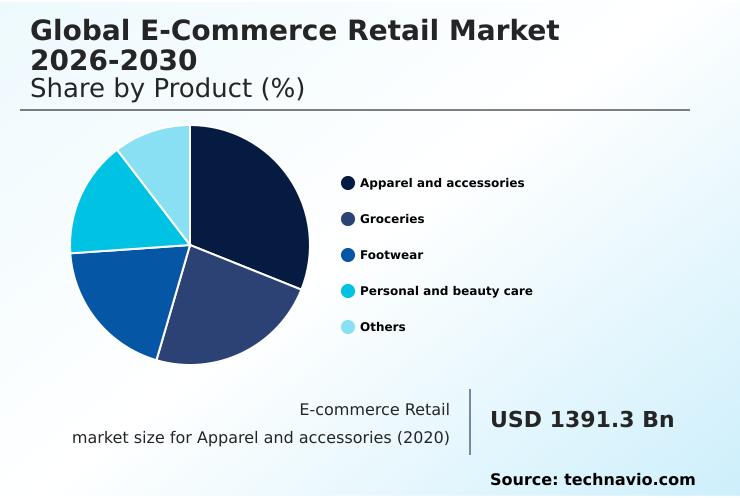
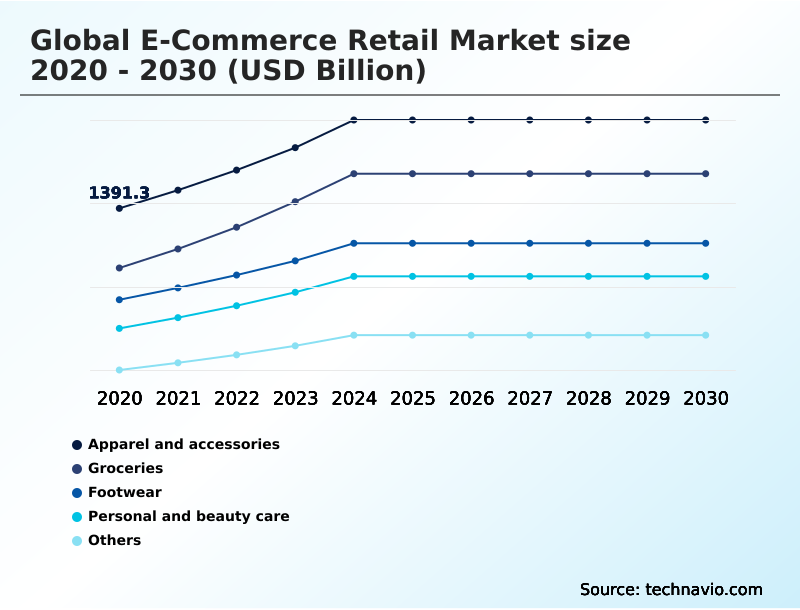
The Apparel and accessories segment was valued at USD 1897.5 billion in 2024 and showed a gradual increase during the forecast period.
Regional Analysis
APAC is estimated to contribute 42.6% to the growth of the global market during the forecast period.Technavio’s analysts have elaborately explained the regional trends and drivers that shape the market during the forecast period.
See How E-commerce Retail Market Demand is Rising in APAC Get Free Sample
The geographic landscape of the e-commerce retail market is led by APAC, which accounts for over 42% of the incremental growth.
This region's dynamism is fueled by mobile-first consumer behavior and the dominance of super-app ecosystems in countries like China and South Korea.
North America follows, driven by high consumer spending and heavy investment in last-mile delivery optimization and omnichannel fulfillment, with adoption of automated warehouse systems improving order processing speed by over 25%.
Europe is characterized by stringent data privacy compliance and a strong consumer preference for sustainable practices, influencing the rise of the re-commerce ecosystem.
The implementation of a warehouse management system (wms) has been shown to reduce fulfillment errors by 18% in this mature market.
Latin America and MEA represent high-growth frontiers, where mobile payment integration and social commerce integration are critical for unlocking market potential.
Market Dynamics
Our researchers analyzed the data with 2025 as the base year, along with the key drivers, trends, and challenges. A holistic analysis of drivers will help companies refine their marketing strategies to gain a competitive advantage.
- Strategic decisions in the current e-commerce landscape are heavily influenced by the impact of generative AI on product discovery, which is fundamentally changing how consumers interact with online catalogs. On the operational front, a major focus is on optimizing last-mile delivery in urban areas, a challenge that directly affects profitability.
- Many firms are now exploring how to implement a circular economy model in fashion retail, a move that resonates with consumer values. A key technological investment involves integrating AR virtual try-on for apparel, a feature that significantly reduces return rates. This is especially important considering the challenges of cross-border e-commerce compliance.
- Boardroom discussions frequently center on using AI to reduce customer acquisition cost, which has been escalating across digital channels. Bricks-and-mortar retailers are developing phygital strategies for brick-and-mortar stores to create seamless omnichannel experiences. In the B2B space, B2B e-commerce personalization techniques are proving essential for differentiation.
- Meanwhile, the role of blockchain in ensuring product authenticity is becoming critical for high-value goods. Successful companies are learning to leverage social commerce for D2C brands to build community and drive sales. This must be balanced with the impact of data privacy regulations on personalization.
- The future of logistics is tied to autonomous delivery drone regulatory hurdles and improving reverse logistics efficiency for profitability. Advanced firms are deploying AI-powered dynamic pricing strategies in retail and comparing headless commerce vs monolithic platforms to enhance agility.
- Success also depends on how to measure digital marketing ROI in e-commerce, implementing supply chain automation for peak season demand, and perfecting the best practices for mobile commerce checkout process. The foundation for these strategies involves building a customer data platform for retail and pursuing voice search optimization for online grocery shopping.
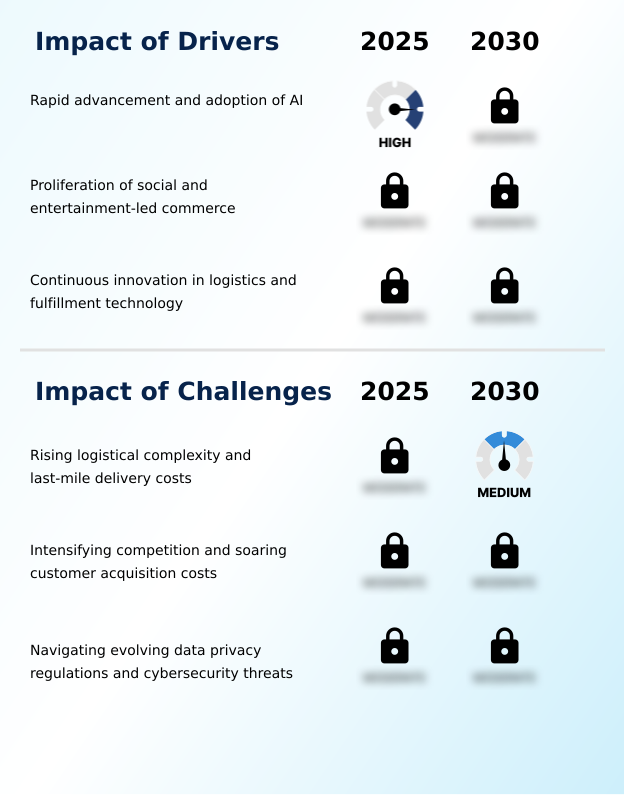
What are the key market drivers leading to the rise in the adoption of E-commerce Retail Industry?
- The rapid advancement and pervasive adoption of artificial intelligence are primary drivers propelling the market's growth and innovation.
- Market expansion is primarily fueled by the deep integration of advanced technology into core retail operations. The proliferation of generative AI shopping assistants is revolutionizing product discovery, shifting from keyword searches to intuitive, conversational commerce.
- This technology improves conversion rates by an average of 18% by providing highly relevant, personalized results. The continuous innovation in logistics, particularly through autonomous delivery solutions and the strategic placement of micro-fulfillment centers, is another critical driver.
- This focus on last-mile delivery optimization enables retailers to meet consumer expectations for rapid fulfillment. Furthermore, the seamless fusion of digital entertainment and retail through live stream shopping and social commerce integration is creating highly effective sales channels.
- The ability to leverage an AI-powered personalization engine for dynamic pricing algorithms and real-time inventory management allows for agile, data-driven strategies that enhance profitability.
What are the market trends shaping the E-commerce Retail Industry?
- A defining trend is the strategic adoption of circular economy principles, primarily through the integration of re-commerce, which is propelled by consumer values and economic incentives.
- Key trends are reshaping the market's value proposition, moving beyond mere transactions to immersive experiences. The rise of phygital retail is blurring the lines between online and offline, with indoor positioning technology and smart mirror technology creating interactive in-store journeys. This is complemented by the growth of headless commerce architecture, which offers greater flexibility.
- The ascendancy of the re-commerce ecosystem, underpinned by circular economy principles, is creating new revenue streams and meeting consumer demand for sustainability. Advanced platforms are using a blockchain authenticity ledger to verify high-value second-hand goods, increasing consumer trust by over 40%.
- The integration of augmented reality virtual try-on has become a critical tool, particularly in fashion, where it has reduced return rates by double digits. Voice search optimization for retail is also gaining traction, simplifying product discovery. These trends show a market pivoting towards experiential and ethical commerce.
What challenges does the E-commerce Retail Industry face during its growth?
- A key challenge affecting industry growth is the rising logistical complexity and escalating costs associated with last-mile delivery.
- The market grapples with significant operational and financial pressures that temper growth. Rising logistical complexity, especially the high cost of last-mile delivery, remains a primary restraint, with final-mile expenses accounting for up to 53% of total shipping costs.
- Concurrently, intensifying competition has inflated customer acquisition cost (CAC), making it difficult to achieve a positive return on advertising spend, with costs increasing by over 60% in some digital channels. Navigating the evolving landscape of data privacy compliance, including GDPR, presents a substantial operational burden.
- The ever-present risk of cybersecurity threat mitigation requires continuous investment, as a single data breach can have devastating financial and reputational consequences. Furthermore, inefficient reverse logistics management erodes profitability, representing a complex operational challenge that demands sophisticated, often automated, solutions.
Exclusive Technavio Analysis on Customer Landscape
The e-commerce retail market forecasting report includes the adoption lifecycle of the market, covering from the innovator’s stage to the laggard’s stage. It focuses on adoption rates in different regions based on penetration. Furthermore, the e-commerce retail market report also includes key purchase criteria and drivers of price sensitivity to help companies evaluate and develop their market growth analysis strategies.
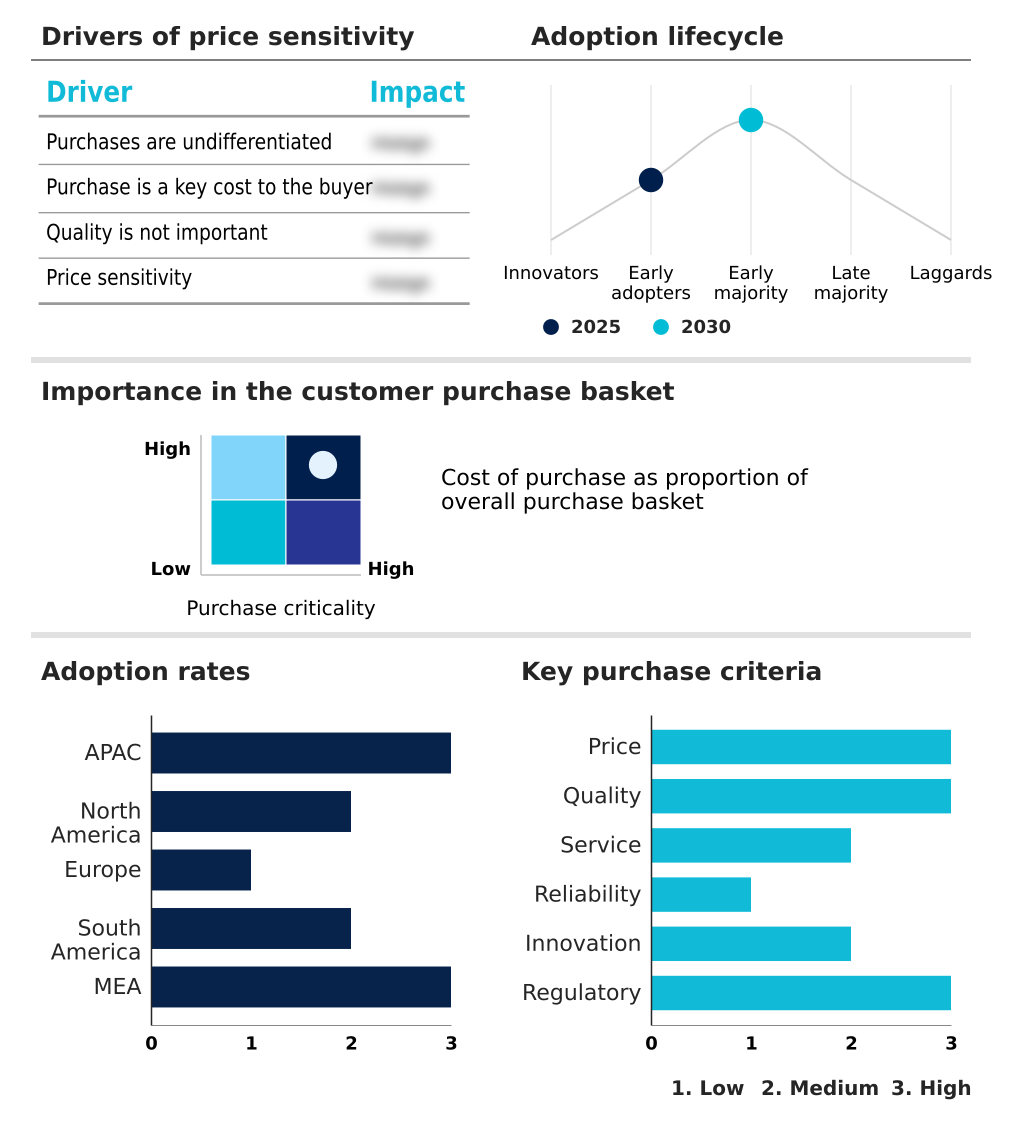
Customer Landscape of E-commerce Retail Industry
Competitive Landscape
Companies are implementing various strategies, such as strategic alliances, e-commerce retail market forecast, partnerships, mergers and acquisitions, geographical expansion, and product/service launches, to enhance their presence in the industry.
Alibaba Group Holding Ltd. - Offerings are centered on providing expansive digital marketplace ecosystems, integrated with proprietary logistics networks and advanced data analytic capabilities to enhance global commerce operations.
The industry research and growth report includes detailed analyses of the competitive landscape of the market and information about key companies, including:
- Alibaba Group Holding Ltd.
- Amazon.com Inc.
- Apple Inc.
- Best Buy Co. Inc.
- Carrefour SA
- Costco Wholesale Corp.
- Coupang Inc.
- eBay Inc.
- Etsy Inc.
- Jumia Technologies AG
- MercadoLibre Inc.
- Otto GmbH and Co. KG
- Rakuten Group Inc.
- Sea Ltd.
- SHEIN Group Ltd
- Target Corp.
- The Home Depot Inc.
- Walmart Inc.
- Wayfair Inc.
- Zalando SE
Qualitative and quantitative analysis of companies has been conducted to help clients understand the wider business environment as well as the strengths and weaknesses of key industry players. Data is qualitatively analyzed to categorize companies as pure play, category-focused, industry-focused, and diversified; it is quantitatively analyzed to categorize companies as dominant, leading, strong, tentative, and weak.
Recent Development and News in E-commerce retail market
- In May, 2025, Zara unveiled its Nexus store concept, which integrates its mobile app with physical stores to allow for in-app content viewing, digital fitting room booking, and checkout-free payment systems.
- In April, 2025, TikTok launched its Creator Marketplace Suite, a set of tools enabling brands to collaborate with creators on exclusive, shoppable product lines sold directly on the platform.
- In March, 2025, Google's drone delivery service, Wing, received regulatory approval to operate autonomous, beyond-visual-line-of-sight deliveries in several major US metropolitan areas, scaling its retail partnerships.
- In March, 2025, H and M Group disclosed a major ransomware attack that disrupted its global logistics and inventory systems, leading to a temporary shutdown of e-commerce operations in several European countries.
Dive into Technavio’s robust research methodology, blending expert interviews, extensive data synthesis, and validated models for unparalleled E-commerce Retail Market insights. See full methodology.
| Market Scope | |
|---|---|
| Page number | 305 |
| Base year | 2025 |
| Historic period | 2020-2024 |
| Forecast period | 2026-2030 |
| Growth momentum & CAGR | Accelerate at a CAGR of 13.1% |
| Market growth 2026-2030 | USD 5965.2 billion |
| Market structure | Fragmented |
| YoY growth 2025-2026(%) | 11.2% |
| Key countries | China, India, Japan, South Korea, Australia, Indonesia, US, Canada, Mexico, UK, Germany, France, Italy, Spain, The Netherlands, Brazil, Argentina, Chile, Saudi Arabia, UAE, Turkey, South Africa and Israel |
| Competitive landscape | Leading Companies, Market Positioning of Companies, Competitive Strategies, and Industry Risks |
Research Analyst Overview
- The e-commerce retail market is defined by a relentless pursuit of operational efficiency and customer centricity through technological innovation. A central theme is the deployment of autonomous delivery solutions and micro-fulfillment centers to meet escalating consumer demands for speed. This drive for efficiency extends to backend operations, with real-time inventory management and automated warehouse systems becoming standard.
- Boardroom strategy is increasingly focused on the circular economy, leading to the development of robust re-commerce ecosystem platforms. In this context, technologies like a blockchain authenticity ledger are being explored to build trust in second-hand markets.
- The customer-facing experience is being transformed by generative AI shopping assistants and conversational commerce, while augmented reality virtual try-on is mitigating a key friction point in apparel sales. For instance, companies that have effectively integrated such AR tools report a reduction in product returns of up to 15%.
- This intense focus on technology requires navigating significant hurdles, including data privacy compliance and cybersecurity threat mitigation, while managing rising customer acquisition cost (CAC). Omnichannel fulfillment and sophisticated reverse logistics management are no longer optional but critical for survival.
What are the Key Data Covered in this E-commerce Retail Market Research and Growth Report?
-
What is the expected growth of the E-commerce Retail Market between 2026 and 2030?
-
USD 5965.2 billion, at a CAGR of 13.1%
-
-
What segmentation does the market report cover?
-
The report is segmented by Product (Apparel and accessories, Groceries, Footwear, Personal and beauty care, and Others), Modality (Business to business (B2B), Business to consumer (B2C), and Consumer to consumer (C2C)), Device (Mobile, and Desktop) and Geography (APAC, North America, Europe, South America, Middle East and Africa)
-
-
Which regions are analyzed in the report?
-
APAC, North America, Europe, South America and Middle East and Africa
-
-
What are the key growth drivers and market challenges?
-
Rapid advancement and adoption of AI, Rising logistical complexity and last-mile delivery costs
-
-
Who are the major players in the E-commerce Retail Market?
-
Alibaba Group Holding Ltd., Amazon.com Inc., Apple Inc., Best Buy Co. Inc., Carrefour SA, Costco Wholesale Corp., Coupang Inc., eBay Inc., Etsy Inc., Jumia Technologies AG, MercadoLibre Inc., Otto GmbH and Co. KG, Rakuten Group Inc., Sea Ltd., SHEIN Group Ltd, Target Corp., The Home Depot Inc., Walmart Inc., Wayfair Inc. and Zalando SE
-
Market Research Insights
- The market's momentum is defined by a strategic shift from customer acquisition to profitable retention and operational excellence. Organizations leveraging a customer data platform (cdp) have seen a 20% improvement in marketing campaign effectiveness. The adoption of retail supply chain automation is critical, with automated returns processing systems reducing handling costs by up to 30%.
- E-commerce platform analytics inform digital marketing roi optimization, enabling a pivot from high-cost paid channels. In B2B e-commerce, personalization is proving effective, increasing average order values by 15% where implemented. Success now hinges on omnichannel customer journey mapping and executing a cohesive d2c brand strategy, supported by robust inventory forecasting models and secure online payment gateway security measures.
- This data-driven approach is essential for navigating the competitive landscape.
We can help! Our analysts can customize this e-commerce retail market research report to meet your requirements.
 RIA -
RIA -