



Drug Discovery Informatics Market Size 2026-2030
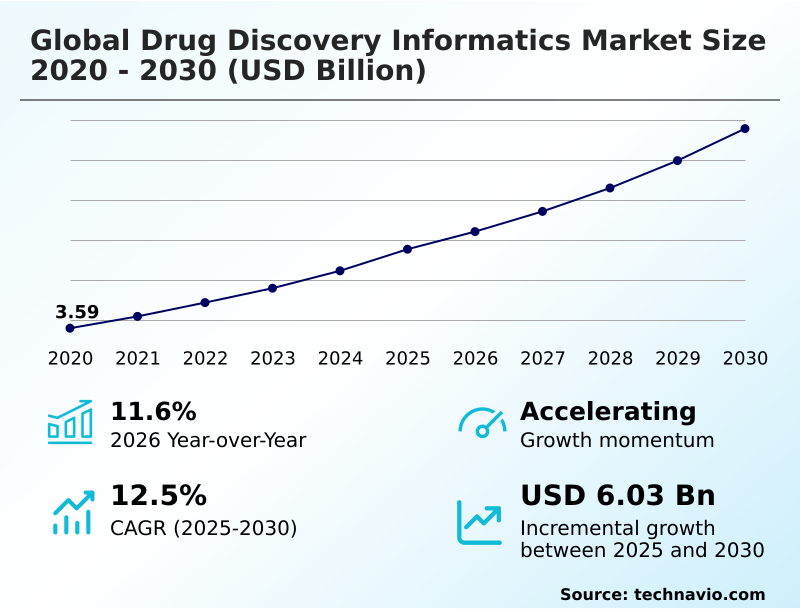
The Drug Discovery Informatics Market size was valued at USD 7.54 billion in 2025, growing at a CAGR of 12.5% during the forecast period 2026-2030.
Major Market Trends & Insights
- North America dominated the market and accounted for a 26.9% growth during the forecast period.
- By Application - Discovery informatics segment was valued at USD 3.30 billion in 2024
- By Solution - Software segment accounted for the largest market revenue share in 2024
Market Size & Forecast
- Historic Market Opportunities 2020-2024: USD 9.98 billion
- Market Future Opportunities 2025-2030: USD 6.03 billion
- CAGR from 2025 to 2030 : 12.5%
Market Summary
- The drug discovery informatics market is shaped by the exponential growth in biological data, with research projects now generating over 10 terabytes of data, a five-fold increase from five years ago. This surge necessitates advanced platforms for effective data integration and analysis.
- A key driver is the industry's push for data-driven drug discovery to improve efficiency; for instance, leveraging in silico modeling can reduce early-stage candidate attrition by up to 25%. A common operational scenario involves integrating a new electronic laboratory notebook (ELN) with legacy systems, a process that can take months and highlights the challenge of interoperability.
- Furthermore, the high cost of implementing comprehensive informatics solutions remains a significant barrier, particularly for smaller biotech firms, which often must choose between investing in lab equipment or scientific data management software. This dynamic forces a strategic balance between research ambition and fiscal reality.
What will be the Size of the Drug Discovery Informatics Market during the forecast period?
Get Key Insights on Market Forecast (PDF) Request Free Sample
How is the Drug Discovery Informatics Market Segmented?
The drug discovery informatics industry research report provides comprehensive data (region-wise segment analysis), with forecasts and analysis for the period 2026-2030, as well as historical data from 2020-2024 for the following segments.
- Application
- Discovery informatics
- Development informatics
- Solution
- Software
- Services
- End-user
- Pharma and biotech companies
- Contract research organizations
- Academic and research institutes
- Geography
- North America
- US
- Canada
- Mexico
- Europe
- Germany
- UK
- France
- Asia
- Rest of World (ROW)
- North America
How is the Drug Discovery Informatics Market Segmented by Application?
The discovery informatics segment is estimated to witness significant growth during the forecast period.
The discovery informatics segment is centered on early-stage R&D, where advanced platforms improve hit-to-lead identification rates by over 30%.
These systems utilize in silico modeling and high-throughput screening data to accelerate target validation, reducing manual analysis time by up to 50% compared to traditional methods.
By integrating genomic data and cheminformatics tools, organizations can prioritize promising drug candidates more efficiently.
This data-centric approach, leveraging predictive modeling and structure-based drug design, allows for more effective resource allocation and shortens the preclinical development phase, directly impacting pipeline velocity and research productivity for drug discovery informatics.
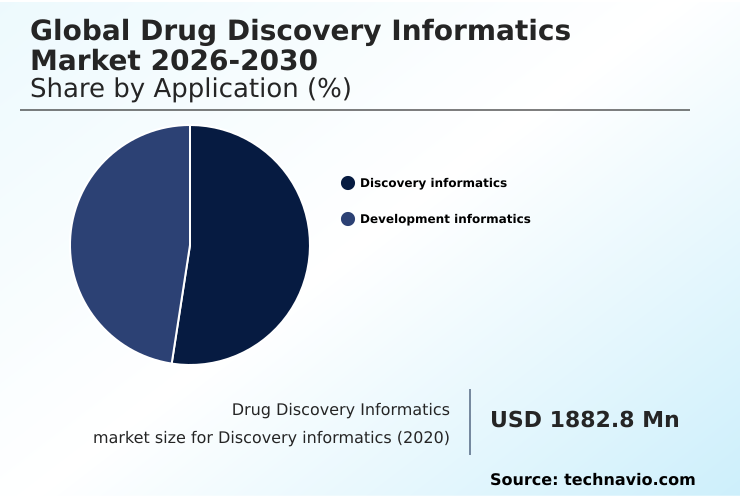
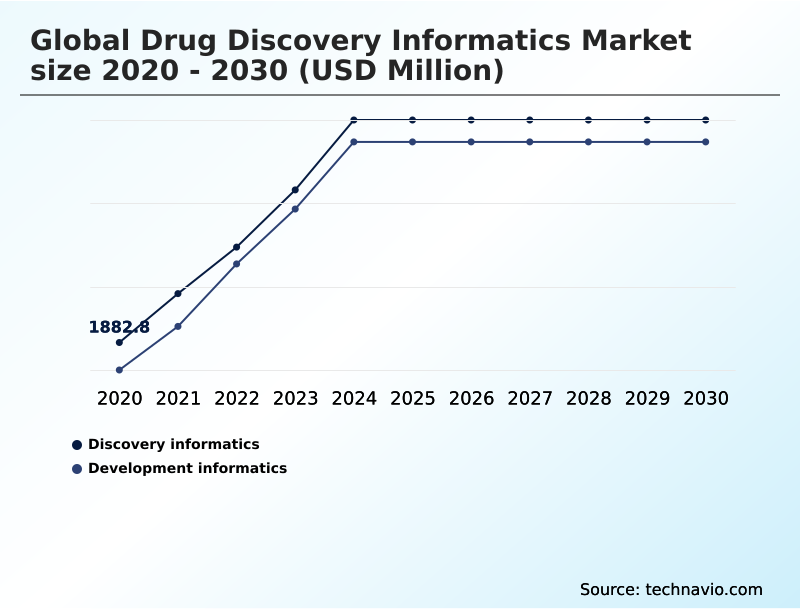
The Discovery informatics segment was valued at USD 3.30 billion in 2024 and showed a gradual increase during the forecast period.
How demand for the Drug Discovery Informatics market is rising in the leading region?
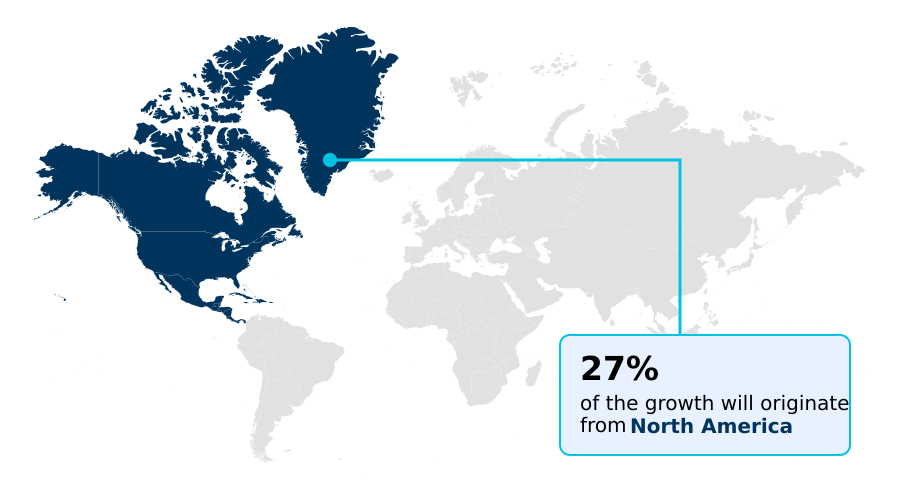
North America is estimated to contribute 26.9% to the growth of the global market during the forecast period.Technavio’s analysts have elaborately explained the regional trends and drivers that shape the market during the forecast period.
See How Drug Discovery Informatics Market demand is rising in North America Request Free Sample
The geographic landscape of the drug discovery informatics market is led by North America, which accounts for approximately 27% of the incremental growth.
The region's dominance is anchored by the United States, which represents over 80% of the regional market, driven by heavy R&D investment and a high concentration of pharmaceutical and biotechnology firms.
This contrasts with the Asian market, which, despite having a CAGR of 13.3%, shows more fragmented adoption.
In North America, the adoption of cloud-based infrastructure and AI-driven analytics is nearly ubiquitous in large pharma, while in many Asian markets, the focus remains on foundational laboratory information management system (LIMS) and cheminformatics tools.
This difference impacts collaborative research models and the regional demand for advanced bioinformatics services and target validation.
What are the key Drivers, Trends, and Challenges in the Drug Discovery Informatics Market?
Our researchers analyzed the data with 2025 as the base year, along with the key drivers, trends, and challenges. A holistic analysis of drivers will help companies refine their marketing strategies to gain a competitive advantage.
- Strategic adoption of informatics is critical for pharmaceutical pipelines, where drug discovery informatics for small molecules now benefits from computational methods that increase screening accuracy by over 20%. The role of AI in preclinical drug discovery is expanding, with machine learning models predicting compound efficacy with 15% greater precision than statistical methods alone, significantly impacting hit-to-lead identification.
- This evolution highlights the benefits of cloud-based LIMS platforms, which offer scalable scientific data management and enhance collaborative research models across global teams. However, significant hurdles remain, particularly the challenges in drug discovery data integration, as harmonizing disparate data from high-throughput screening and multi-omics data sources can consume up to 40% of a data scientist's time.
- To address these issues, the ecosystem of open source drug discovery informatics tools is growing, providing academic labs and startups with foundational capabilities for cheminformatics and in silico toxicology, though they often lack the comprehensive support and interoperability standards of commercial end-to-end informatics platforms.
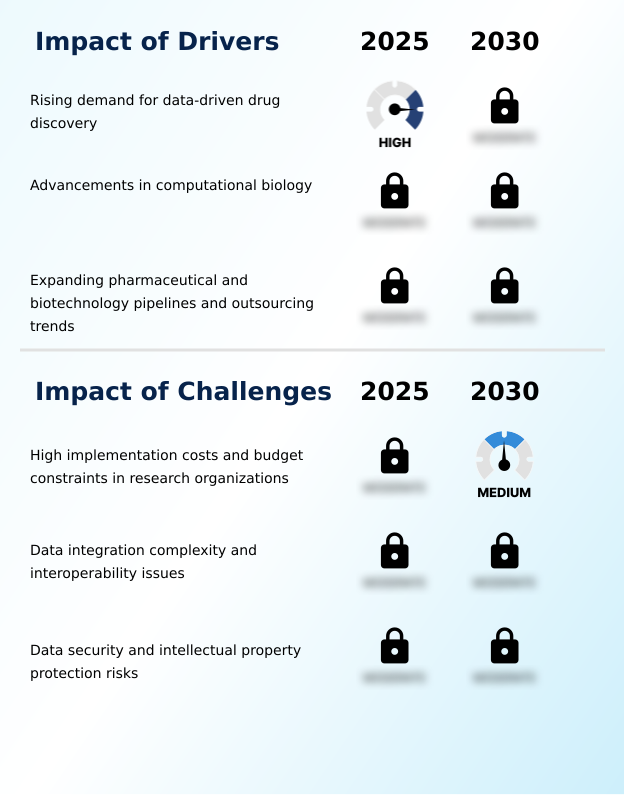
What are the key market drivers leading to the rise in the adoption of Drug Discovery Informatics Industry?
- The key driver fueling market expansion is the rising demand for data-driven approaches to accelerate and de-risk the drug discovery process.
- The increasing complexity of pharmaceutical R&D is a primary driver for the drug discovery informatics market, as research pipelines have expanded by an average of 15% in the last two years.
- This expansion generates massive data volumes, making traditional analysis methods inefficient. Informatics solutions address this by enabling data-driven drug discovery, which can accelerate lead optimization by up to 30% compared to manual processes.
- The adoption of computational biology and in silico modeling is a direct response to the pressure to reduce costs and improve success rates.
- As companies pursue more diverse therapeutic targets, the reliance on platforms that support target validation and structure-based drug design becomes essential for maintaining competitive R&D productivity.
What are the market trends shaping the Drug Discovery Informatics Industry?
- A primary market trend is the deepening integration of artificial intelligence and machine learning into informatics platforms. This enhances predictive modeling and accelerates data analysis across the discovery pipeline.
- The integration of AI into drug discovery informatics platforms is a dominant trend, with AI-driven approaches now reducing the time for target identification by up to 40%. This is driven by the need to analyze vast, complex datasets, where machine learning algorithms demonstrate a 25% higher accuracy in toxicity prediction compared to conventional statistical models.
- Consequently, pharmaceutical companies are increasingly adopting AI-driven analytics and end-to-end informatics platforms to improve research productivity and decision-making. The shift is also evident in operational workflows, where automated data integration from various sources, including genomic data and proteomic data, is becoming standard practice, accelerating the entire preclinical development pipeline.
What challenges does the Drug Discovery Informatics Industry face during its growth?
- A key challenge limiting market growth is the high implementation cost of advanced informatics platforms, coupled with significant budget constraints within research organizations.
- High implementation costs represent a significant challenge for drug discovery informatics, with comprehensive end-to-end informatics platforms requiring initial investments that are often 50% higher than standalone tools. This financial barrier disproportionately affects smaller biotech firms and academic labs.
- Another major hurdle is data integration complexity, as researchers report spending up to 40% of their time on data harmonization and cleaning rather than analysis. The lack of standardized interoperability standards between different systems and instruments creates data silos, undermining the effectiveness of advanced machine learning algorithms.
- This operational friction slows down collaborative research models and limits the full potential of scientific data management systems.
Exclusive Technavio Analysis on Customer Landscape
The drug discovery informatics market forecasting report includes the adoption lifecycle of the market, covering from the innovator’s stage to the laggard’s stage. It focuses on adoption rates in different regions based on penetration. Furthermore, the drug discovery informatics market report also includes key purchase criteria and drivers of price sensitivity to help companies evaluate and develop their market growth analysis strategies.
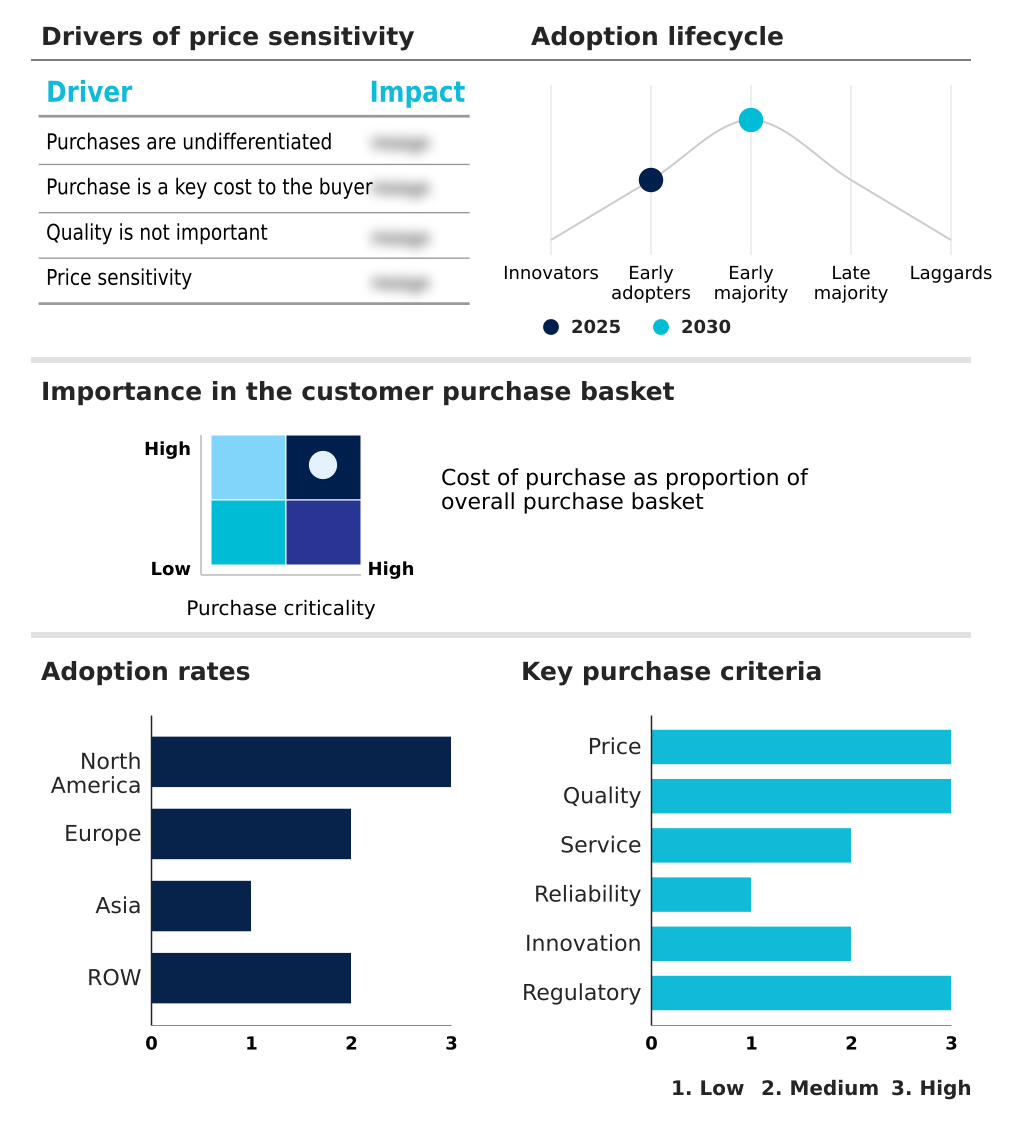
Customer Landscape of Drug Discovery Informatics Industry
Competitive Landscape
Companies are implementing various strategies, such as strategic alliances, drug discovery informatics market forecast, partnerships, mergers and acquisitions, geographical expansion, and product/service launches, to enhance their presence in the industry.
Accenture PLC - Integrated end-to-end informatics platforms unify scientific data management, streamlining workflows from discovery to preclinical development and improving research productivity in drug discovery informatics.
The industry research and growth report includes detailed analyses of the competitive landscape of the market and information about key companies, including:
- Accenture PLC
- Certara Inc.
- Charles River Laboratories
- Collaborative Drug Discovery
- Cresset Biomolecular Ltd.
- Curia Global Inc.
- Dassault Systemes SE
- Dotmatics
- Eurofins Scientific SE
- Evotec SE
- IBM Corp.
- Jubilant Pharmova Ltd.
- LabVantage Solutions Inc.
- OpenEye Scientific
- Revvity Inc.
- Schrodinger Inc.
- Selvita SA
- Thermo Fisher Scientific Inc.
Qualitative and quantitative analysis of companies has been conducted to help clients understand the wider business environment as well as the strengths and weaknesses of key industry players. Data is qualitatively analyzed to categorize companies as pure play, category-focused, industry-focused, and diversified; it is quantitatively analyzed to categorize companies as dominant, leading, strong, tentative, and weak.
Market Intelligence Radar: High-Impact Developments & Growth Signals
- In the Health Care Technology industry, the broad adoption of enterprise AI and machine learning frameworks provides a foundation for sophisticated AI-driven analytics in drug discovery informatics, enabling the analysis of complex multi-omics data for enhanced biomarker discovery.
- The increasing regulatory focus on data governance and interoperability standards is compelling drug discovery informatics platforms to enhance their data harmonization capabilities, directly impacting collaborative research models.
- A strategic shift toward personalized medicine and value-based care models drives demand for drug discovery informatics tools capable of integrating patient-specific genomic data to support precision target validation and preclinical development.
- The maturation of secure, compliant cloud-based infrastructure has accelerated the migration of drug discovery informatics systems, improving accessibility and scalability for decentralized clinical trials and real-world evidence gathering.
Dive into Technavio’s robust research methodology, blending expert interviews, extensive data synthesis, and validated models for unparalleled Drug Discovery Informatics Market insights. See full methodology.
| Market Scope | |
|---|---|
| Page number | 285 |
| Base year | 2025 |
| Historic period | 2020-2024 |
| Forecast period | 2026-2030 |
| Growth momentum & CAGR | Accelerate at a CAGR of 12.5% |
| Market growth 2026-2030 | USD 6027.4 million |
| Market structure | Fragmented |
| YoY growth 2025-2026(%) | 11.6% |
| Key countries | US, Canada, Mexico, Germany, UK, France, Italy, Spain, The Netherlands, China, Japan, India, South Korea, Thailand, Indonesia, Brazil, Israel, Saudi Arabia, UAE, Argentina, South Africa, Turkey and Colombia |
| Competitive landscape | Leading Companies, Market Positioning of Companies, Competitive Strategies, and Industry Risks |
Research Analyst Overview
- The drug discovery informatics market ecosystem is a complex network where technology providers, including cloud infrastructure suppliers, deliver foundational tools to software vendors. These vendors develop specialized platforms for data-driven drug discovery, which are then adopted by end-users like pharmaceutical firms and contract research organizations (CROs), which constitute over 70% of the user base.
- Regulatory bodies influence platform design by setting standards for data integrity and validation, while academic institutions often drive innovation. The value chain is heavily dependent on skilled labor, with a 25% higher demand for bioinformaticians compared to traditional IT roles.
- Distribution is increasingly cloud-based, with SaaS models dominating over 60% of new deployments, facilitating easier adoption and integration of tools like electronic laboratory notebooks (ELN) and LIMS.
What are the Key Data Covered in this Drug Discovery Informatics Market Research and Growth Report?
-
What is the expected growth of the Drug Discovery Informatics Market between 2026 and 2030?
-
The Drug Discovery Informatics Market is expected to grow by USD 6.03 billion during 2026-2030, registering a CAGR of 12.5%. Year-over-year growth in 2026 is estimated at 11.6%%. This acceleration is shaped by rising demand for data-driven drug discovery, which is intensifying demand across multiple end-use verticals covered in the report.
-
-
What segmentation does the market report cover?
-
The report is segmented by Application (Discovery informatics, and Development informatics), Solution (Software, and Services), End-user (Pharma and biotech companies, Contract research organizations, and Academic and research institutes) and Geography (North America, Europe, Asia, Rest of World (ROW)). Among these, the Discovery informatics segment is estimated to witness significant growth during the forecast period, driven by rising adoption across key application areas. Each segment includes detailed qualitative and quantitative analysis, along with historical data from 2020-2024 and forecasts through 2030 with year-over-year growth rates.
-
-
Which regions are analyzed in the report?
-
The report covers North America, Europe, Asia and Rest of World (ROW). North America is estimated to contribute 26.9% to market growth during the forecast period. Country-level analysis includes US, Canada, Mexico, Germany, UK, France, Italy, Spain, The Netherlands, China, Japan, India, South Korea, Thailand, Indonesia, Brazil, Israel, Saudi Arabia, UAE, Argentina, South Africa, Turkey and Colombia, with dedicated market size tables and year-over-year growth for each.
-
-
What are the key growth drivers and market challenges?
-
The primary driver is rising demand for data-driven drug discovery, which is accelerating investment and industry demand. The main challenge is high implementation costs and budget constraints in research organizations, creating operational barriers for key market participants. The report quantifies the impact of each driver and challenge across 2026 and 2030 with comparative analysis.
-
-
Who are the major players in the Drug Discovery Informatics Market?
-
Key vendors include Accenture PLC, Certara Inc., Charles River Laboratories, Collaborative Drug Discovery, Cresset Biomolecular Ltd., Curia Global Inc., Dassault Systemes SE, Dotmatics, Eurofins Scientific SE, Evotec SE, IBM Corp., Jubilant Pharmova Ltd., LabVantage Solutions Inc., OpenEye Scientific, Revvity Inc., Schrodinger Inc., Selvita SA and Thermo Fisher Scientific Inc.. The report provides qualitative and quantitative analysis categorizing companies as dominant, leading, strong, tentative, and weak based on their market positioning. Company profiles include business segment analysis, SWOT assessment, key offerings, and recent strategic developments.
-
Market Research Insights
- The competitive landscape of the drug discovery informatics market is moderately concentrated, with the top five vendors accounting for over 45% of total revenue. Key players like Schrodinger Inc. and Dassault Systemes SE are intensifying competition by embedding AI and machine learning into their core platforms, improving predictive accuracy by an estimated 15% to 20%.
- These advancements directly address the industry's need for faster hit-to-lead identification and more reliable toxicity prediction. For example, the recent focus on integrated, end-to-end informatics platforms is a direct response to the operational challenge of fragmented data silos.
- As pharmaceutical R&D pipelines expand, vendors are adapting by offering more flexible, cloud-based solutions to manage the increasing complexity and volume of discovery data.
We can help! Our analysts can customize this drug discovery informatics market research report to meet your requirements.
 RIA -
RIA -