


Decorative Accessories Market Size and Growth Forecast 2026-2030
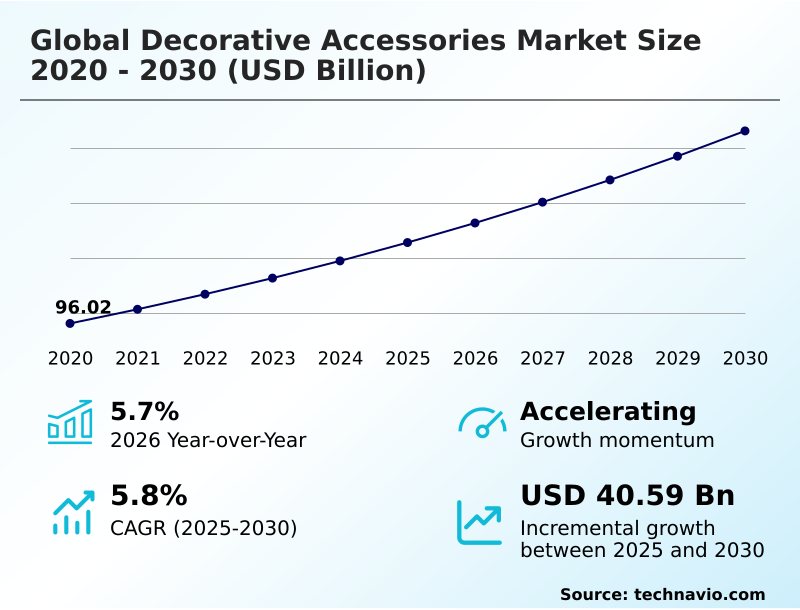
The Decorative Accessories Market size was valued at USD 125.44 billion in 2025 growing at a CAGR of 5.8% during the forecast period 2026-2030.
APAC accounts for 34.8% of incremental growth during the forecast period. The Lamp and lighting accessories segment by Product Type was valued at USD 39.76 billion in 2024, while the Metal segment holds the largest revenue share by Material.
The market is projected to grow by USD 70.01 billion from 2020 to 2030, with USD 40.59 billion of the growth expected during the forecast period of 2025 to 2030.
Get Key Insights on Market Forecast (PDF) Request Free Sample
Decorative Accessories Market Overview
The decorative accessories market is shaped by a consumer shift towards personal expression and environmental consciousness. With the APAC region contributing nearly 35% of incremental growth, driven by rapid urbanization, demand is surging for products that enhance compact living spaces while reflecting sustainable materials. This has pushed manufacturers to innovate beyond traditional aesthetics, embracing artisanal ceramics and reclaimed wood accessories. A key dynamic is the adoption of circular economy models, where lifecycle management becomes a critical vendor qualification criterion. For instance, a boutique hotel chain now employs generative AI design platforms to create unique, 3D-printed decor for each property, sourcing from suppliers with verifiable fair-trade certification. This strategy not only allows for extreme hyper-personalization but also aligns with corporate ESG mandates under frameworks like the Global Reporting Initiative, reducing waste by producing statement pieces on-demand and strengthening brand identity through heritage craftsmanship.
Drivers, Trends, and Challenges in the Decorative Accessories Market
The impact of urbanization on home decor trends is a primary force shaping the decorative accessories market, as smaller living spaces in metropolitan areas necessitate multi-functional and visually impactful items. This demographic shift amplifies the consumer demand for sustainable home accessories, compelling manufacturers to rethink material science and supply chains. However, meeting this demand presents challenges.
For example, a small artisanal cooperative specializing in hand-painted ceramics may struggle with the high costs of obtaining fair-trade certifications, making it difficult to compete with larger players despite offering authentic products. The role of social media in interior design purchases further complicates the landscape, creating hyper-accelerated trend cycles and putting immense pressure on inventory management.
These digital dynamics are a key reason the online channel's growth significantly outpaces that of traditional offline retail. Compounding these issues are systemic risks, including persistent supply chain challenges in the decorative accessories market and the rising tide of intellectual property infringement in furniture and decor design, which devalues original work.
Stricter regulations, such as the US Environmental Protection Agency's recent restrictions on chemical stabilizers in resins, add another layer of complexity, forcing costly product reformulations and heightening the need for robust compliance frameworks.
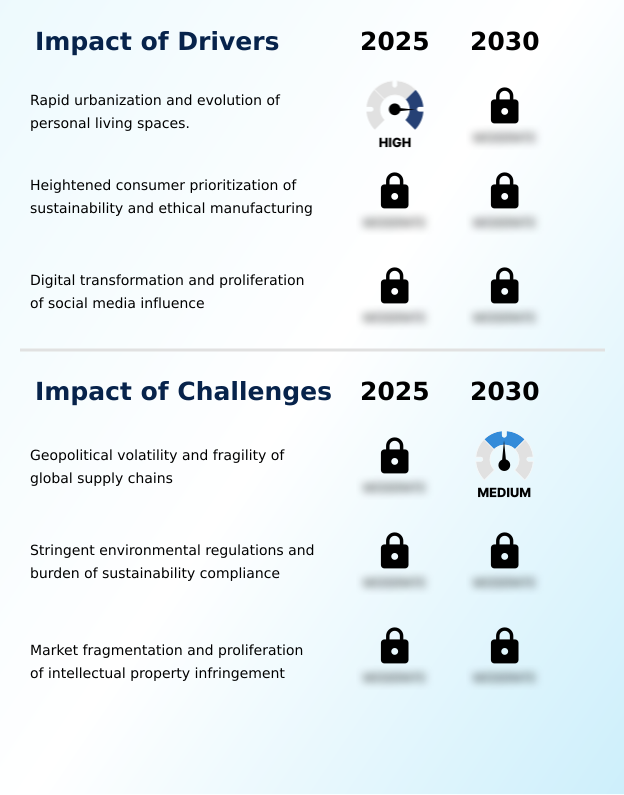
Primary Growth Driver: Rapid urbanization and the concurrent evolution of personal living spaces function as key drivers for the market.
Market growth is fundamentally driven by rapid urbanization and a corresponding evolution in consumer values. With APAC accounting for 34.8% of the market's incremental growth, the demand for accessories suited to compact urban dwellings is a significant catalyst.
This urban consumer is also increasingly ethically-minded, fueling the shift toward sustainable materials and transparent production. This is compelling manufacturers to adopt circular economy models and invest in ethical sourcing networks.
The influence of digital platforms further accelerates these shifts, as social media disseminates trends like biophilic design globally, while augmented reality visualization tools on e-commerce sites de-risk online purchases, driving conversion for items with rich organic textures.
Emerging Market Trend: A key market trend involves the integration of biophilic principles and natural aesthetics. This movement reflects a growing consumer desire to connect indoor environments with the natural world.
Market trends are defined by a divergence between technology-driven customization and a return to authentic craftsmanship. The push for hyper-personalization is being met with digital customization tools, including generative AI design platforms that allow consumers to create bespoke accessories.
This is particularly prevalent in the fast-growing APAC market, where technological adoption is high and contributes to a regional growth rate of 6.6%. Concurrently, a counter-trend sees a resurgence in demand for maximalism decor, celebrating heritage craftsmanship and handcrafted details.
This has elevated the importance of artisanal ceramics and unique statement pieces, moving consumer preferences away from mass-produced, fast-fashion home decor toward items with narrative and heirloom quality.
Key Industry Challenge: Geopolitical volatility and the inherent fragility of global supply chains present a primary challenge affecting industry growth and stability.
Significant structural challenges constrain the market, led by supply chain fragility and intense market fragmentation. Geopolitical instability disrupts the flow of raw materials, impacting the availability of key components for products like hand-woven textiles. Domestically, stringent environmental mandates, such as regulations governing the composition of eco-friendly glazes on ceramics, impose significant compliance costs, particularly on smaller artisans.
Furthermore, the proliferation of digital marketplaces has exacerbated the problem of intellectual property infringement, devaluing original design work from independent creators of sculptural lighting and other unique items. While frameworks from organizations like the World Intellectual Property Organization (WIPO) aim to combat counterfeiting, the sheer volume of unauthorized replicas makes enforcement a persistent and costly battle, stifling innovation.
Explore Full Market Dynamics Analysis Request Free Sample
Decorative Accessories Market Segmentation
The decorative accessories industry research report provides comprehensive data including region-wise segment analysis, with forecasts and analysis for the period 2026-2030, as well as historical data from 2020-2024 for the following segments.
Product Type Segment Analysis
The lamp and lighting accessories segment is estimated to witness significant growth during the forecast period.
The lamp and lighting accessories segment, a leading category by market share, is evolving beyond simple illumination to become a focal point of interior design strategy.
Procurement decisions are increasingly influenced by the dual demands for functionality and artistic expression, with sculptural lighting serving as a primary example of fixtures that function as art.
The integration of smart ornamentation allows for advanced control over ambiance, aligning with the trend toward hyper-personalization. A significant shift in materials is evident, with manufacturers incorporating innovative bio-based polymers and recycled components, meeting stringent environmental standards like RoHS.
Furthermore, the adoption of modular design principles offers consumers greater flexibility, reinforcing the trend toward contemporary aesthetics in residential and commercial spaces.
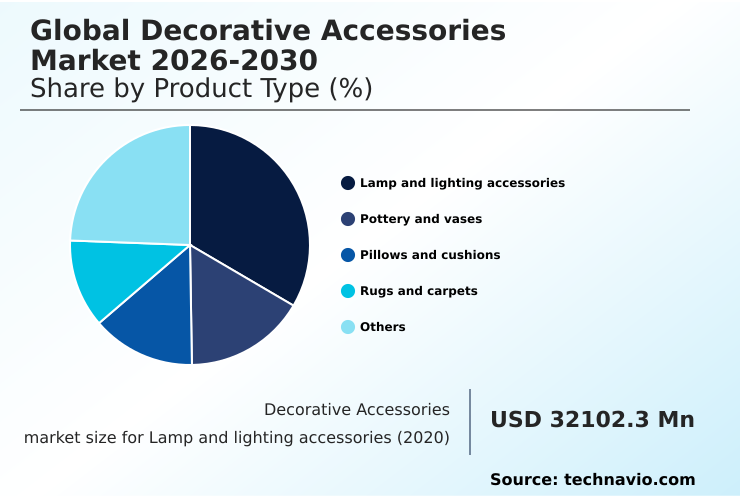
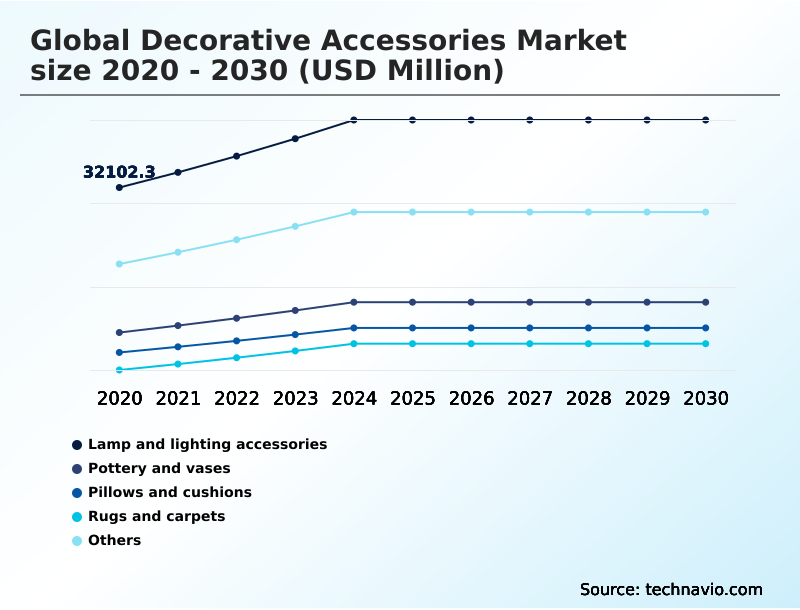
The Lamp and lighting accessories segment was valued at USD 39.76 billion in 2024 and showed a gradual increase during the forecast period.
Decorative Accessories Market by Region: APAC Leads with 34.8% Growth Share
APAC is estimated to contribute 34.8% to the growth of the global market during the forecast period.
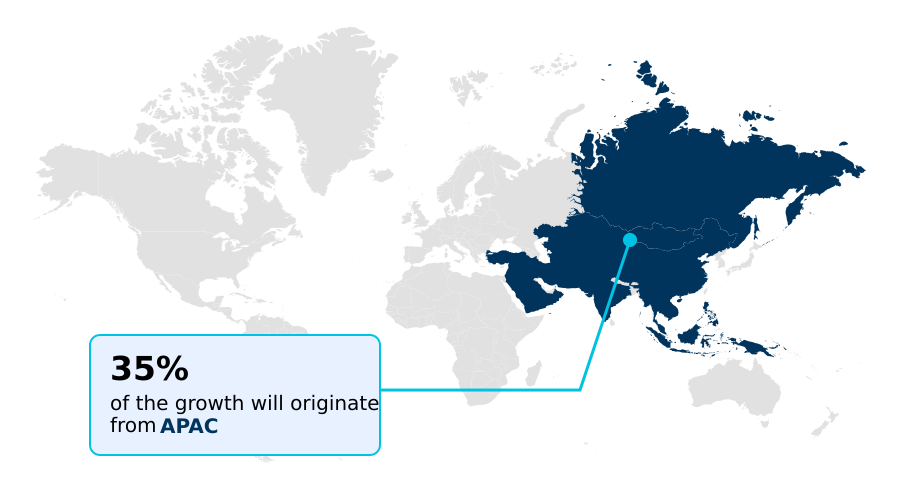
The geographic landscape of the decorative accessories market is increasingly centered on APAC, which commands over a third of the market opportunity and is forecast to expand at a rate of 6.6%.
This growth is fueled by a rising middle class in China and India demanding modern home personalization, blending global contemporary aesthetics with traditional cultural motifs.
In contrast, the mature markets of North America and Europe, while growing more slowly, are setting global standards for sustainability.
European consumers, in particular, are driving demand for biophilic design and products with clear ethical sourcing networks, pushing brands to comply with stringent regulations like REACH.
This regional divergence creates a complex operational environment where success depends on catering to both the volume-driven, trend-focused APAC market and the value-driven, eco-conscious Western markets.
Customer Landscape Analysis for the Decorative Accessories Market
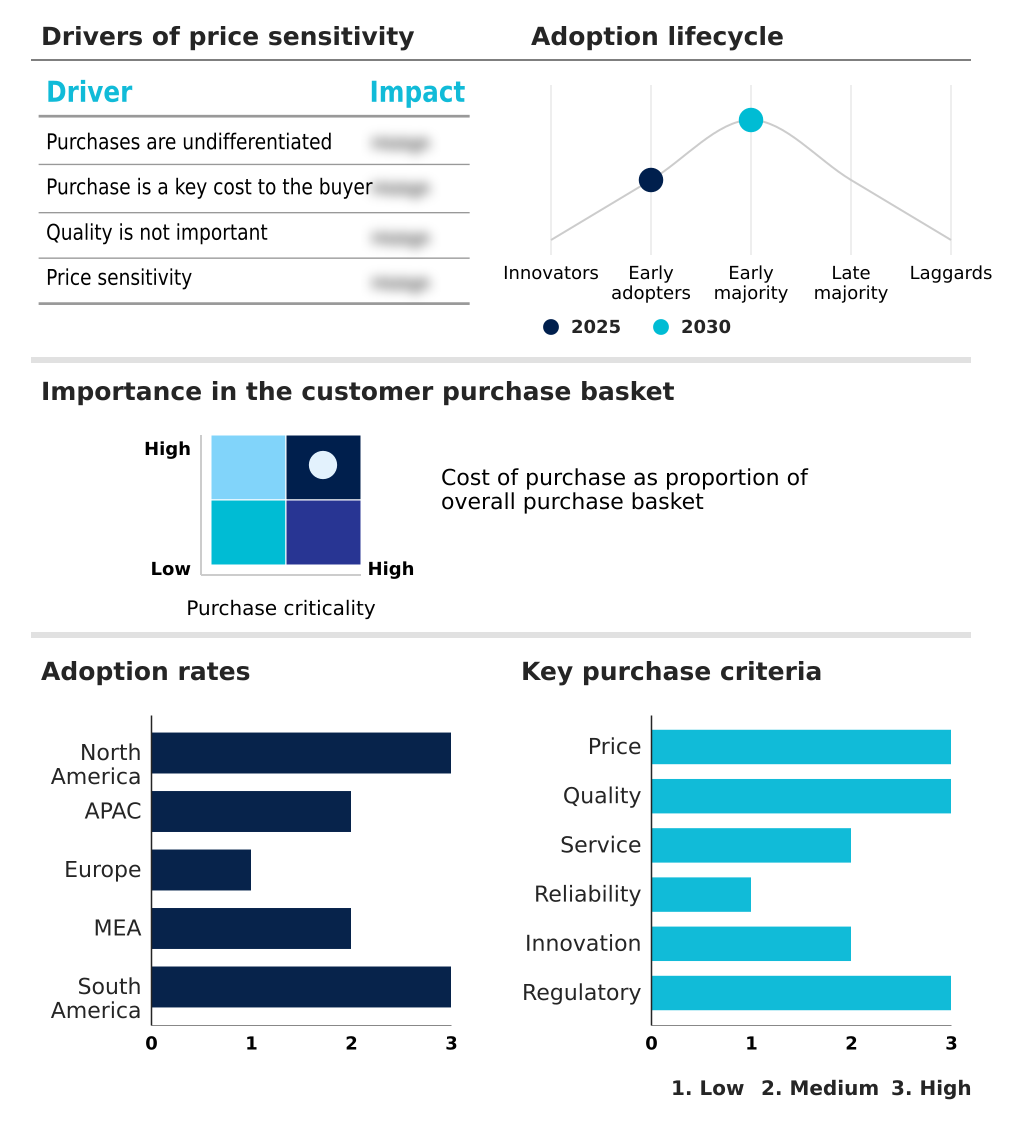
The decorative accessories market forecasting report includes the adoption lifecycle of the market, covering from the innovator’s stage to the laggard’s stage. It focuses on adoption rates in different regions based on penetration. Furthermore, the decorative accessories market report also includes key purchase criteria and drivers of price sensitivity to help companies evaluate and develop their market growth analysis strategies.
Competitive Landscape of the Decorative Accessories Market
Companies are implementing various strategies, such as strategic alliances, partnerships, mergers and acquisitions, geographical expansion, and product/service launches, to enhance their presence in the decorative accessories market industry.
Amazon.com Inc. - Offers a vast catalog of decorative accessories, including wall art and textiles, through its globally recognized e-commerce and subscription service segments.
The industry research and growth report includes detailed analyses of the competitive landscape of the market and information about key companies, including:
- Amazon.com Inc.
- Ashley Furniture Industries
- Crate and Barrel
- Ethan Allen Interiors Inc.
- Georg Jensen AS
- H and M Hennes and Mauritz GBC
- Inter IKEA Holding BV
- LaZBoy Inc.
- Maisons du Monde
- MillerKnoll Inc.
- Pier 1 Imports Online Inc.
- Restoration Hardware Inc.
- Swarovski AG
- Target Corp.
- Urban Outfitters Inc.
- Villeroy and Boch AG
- Walmart Inc.
- Wayfair Inc.
- Wedgwood
- Williams Sonoma Inc.
Qualitative and quantitative analysis of companies has been conducted to help clients understand the wider business environment as well as the strengths and weaknesses of key industry players. Data is qualitatively analyzed to categorize companies as pure play, category-focused, industry-focused, and diversified; it is quantitatively analyzed to categorize companies as dominant, leading, strong, tentative, and weak.
Recent Developments in the Decorative Accessories Market
- In March 2025, the International Maritime Organization enacted stringent new carbon intensity regulations for commercial shipping, impacting global logistics and delivery lead times for consumer goods.
- In May 2025, Williams Sonoma Inc. launched an initiative to increase Forest Stewardship Council certification for its decorative wooden accents, emphasizing its commitment to ethical sourcing.
- In June 2025, H and M Hennes and Mauritz GBC announced a partnership with a textile recycling firm to produce an autumn accessory line using circular fibers and non-toxic dyes.
- In August 2025, the US Environmental Protection Agency finalized new restrictions on chemical stabilizers in decorative plastic and resin items, requiring product reformulations across the industry.
Research Analyst Overview: Decorative Accessories Market
Boardroom-level strategy in the decorative accessories market is increasingly centered on navigating the twin pressures of sustainability compliance and technological disruption. While the lamp and lighting accessories segment remains a dominant revenue contributor, its growth is now contingent on integrating smart ornamentation and adhering to circular economy principles.
Investment decisions must now account for the total cost of ownership of establishing ethical sourcing networks and securing fair-trade certification, which are becoming non-negotiable for consumers in key Western markets. A critical operational focus is the adoption of sustainable materials, such as bio-based polymers and upcycled glass, in alignment with standards like those from the Forest Stewardship Council (FSC).
This shift away from linear production is essential for risk mitigation. The rise of generative AI design and on-demand 3D-printed decor offers a path to mitigate inventory risk associated with maximalism decor trends, enabling hyper-personalization while reducing waste. Firms that successfully integrate biophilic design principles with advanced manufacturing will capture a significant competitive advantage.
Dive into Technavio’s robust research methodology, blending expert interviews, extensive data synthesis, and validated models for unparalleled Decorative Accessories Market insights. See full methodology.
| Market Scope | |
|---|---|
| Page number | 311 |
| Base year | 2025 |
| Historic period | 2020-2024 |
| Forecast period | 2026-2030 |
| Growth momentum & CAGR | Accelerate at a CAGR of 5.8% |
| Market growth 2026-2030 | USD 40592.7 million |
| Market structure | Fragmented |
| YoY growth 2025-2026(%) | 5.7% |
| Key countries | US, Canada, Mexico, China, India, Japan, South Korea, Australia, Indonesia, Germany, UK, France, Italy, The Netherlands, Spain, Saudi Arabia, UAE, South Africa, Israel, Turkey, Brazil, Argentina and Colombia |
| Competitive landscape | Leading Companies, Market Positioning of Companies, Competitive Strategies, and Industry Risks |
Decorative Accessories Market: Key Questions Answered in This Report
-
What is the expected growth of the Decorative Accessories Market between 2026 and 2030?
-
The Decorative Accessories Market is expected to grow by USD 40.59 billion during 2026-2030, registering a CAGR of 5.8%. Year-over-year growth in 2026 is estimated at 5.7%%. This acceleration is shaped by rapid urbanization and evolution of personal living spaces., which is intensifying demand across multiple end-use verticals covered in the report.
-
-
What segmentation does the market report cover?
-
The report is segmented by Product Type (Lamp and lighting accessories, Pottery and vases, Pillows and cushions, Rugs and carpets, and Others), Material (Metal, Glass and ceramic, Wood, Textile, and Others), Distribution Channel (Offline, and Online) and Geography (North America, APAC, Europe, Middle East and Africa, South America). Among these, the Lamp and lighting accessories segment is estimated to witness significant growth during the forecast period, driven by rising adoption across key application areas. Each segment includes detailed qualitative and quantitative analysis, along with historical data from 2020-2024 and forecasts through 2030 with year-over-year growth rates.
-
-
Which regions are analyzed in the report?
-
The report covers North America, APAC, Europe, Middle East and Africa and South America. APAC is estimated to contribute 34.8% to market growth during the forecast period. Country-level analysis includes US, Canada, Mexico, China, India, Japan, South Korea, Australia, Indonesia, Germany, UK, France, Italy, The Netherlands, Spain, Saudi Arabia, UAE, South Africa, Israel, Turkey, Brazil, Argentina and Colombia, with dedicated market size tables and year-over-year growth for each.
-
-
What are the key growth drivers and market challenges?
-
The primary driver is rapid urbanization and evolution of personal living spaces., which is accelerating investment and industry demand. The main challenge is geopolitical volatility and fragility of global supply chains, creating operational barriers for key market participants. The report quantifies the impact of each driver and challenge across 2026 and 2030 with comparative analysis.
-
-
Who are the major players in the Decorative Accessories Market?
-
Key vendors include Amazon.com Inc., Ashley Furniture Industries, Crate and Barrel, Ethan Allen Interiors Inc., Georg Jensen AS, H and M Hennes and Mauritz GBC, Inter IKEA Holding BV, LaZBoy Inc., Maisons du Monde, MillerKnoll Inc., Pier 1 Imports Online Inc., Restoration Hardware Inc., Swarovski AG, Target Corp., Urban Outfitters Inc., Villeroy and Boch AG, Walmart Inc., Wayfair Inc., Wedgwood and Williams Sonoma Inc.. The report provides qualitative and quantitative analysis categorizing companies as dominant, leading, strong, tentative, and weak based on their market positioning. Company profiles include business segment analysis, SWOT assessment, key offerings, and recent strategic developments.
-
Decorative Accessories Market Research Insights
The decorative accessories market is expanding at a steady 5.7% year-over-year rate, a dynamic driven by the consumer quest for curated collections and handcrafted details. This is not merely about aesthetics; it is a shift toward values-based purchasing, where the story behind an object matters.
The rise of direct-to-consumer models has empowered smaller artisans, but the entire industry faces structural pressures from new International Maritime Organization carbon regulations, which complicate logistics for globally sourced goods. In response, many brands are leveraging augmented reality visualization to enhance the experiential retail journey online, allowing customers to virtually place mixed-media pieces in their homes.
This digital pivot is crucial for navigating supply chain disruptions while meeting demand for unique, personalized environments.
We can help! Our analysts can customize this decorative accessories market research report to meet your requirements.
 RIA -
RIA -