
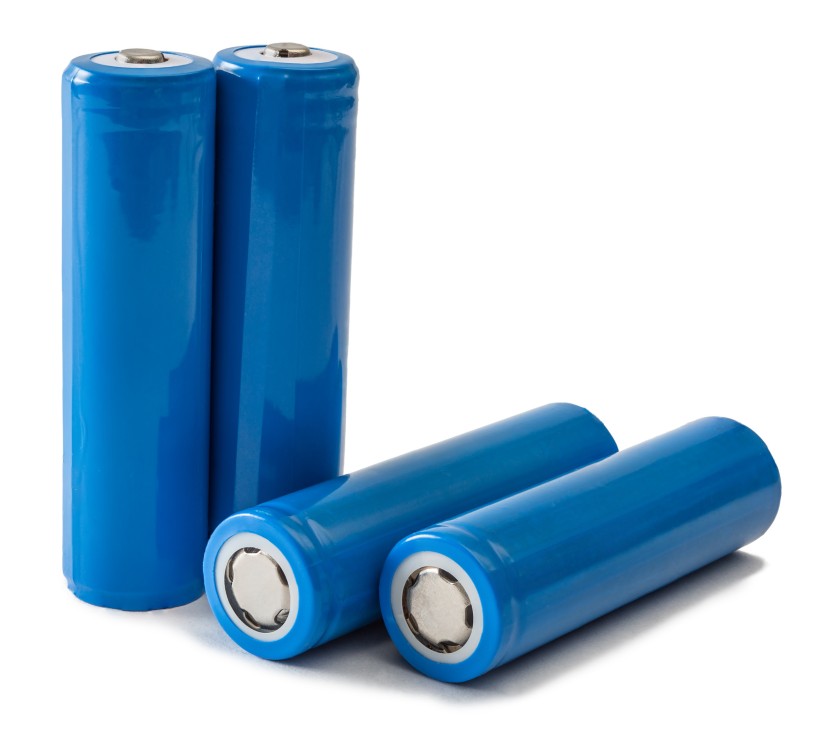


Cylindrical Cells Market Size 2026-2030
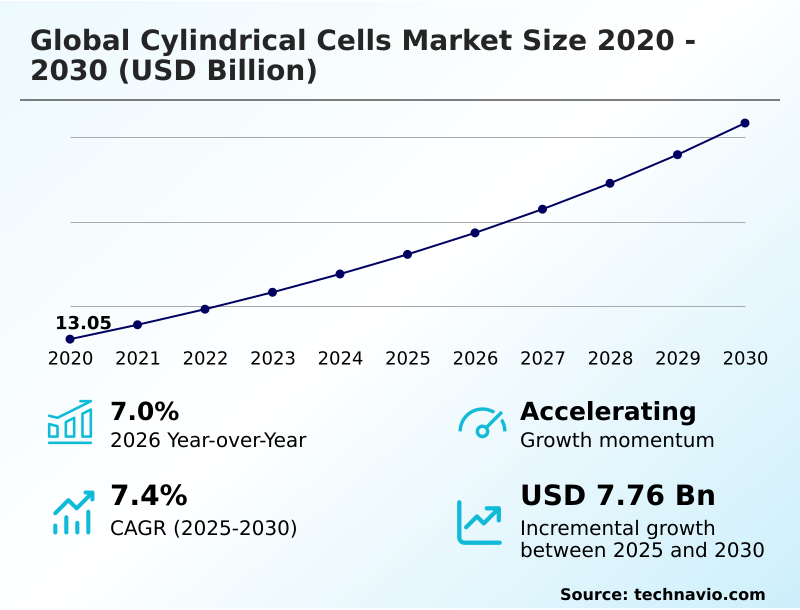
The cylindrical cells market size is valued to increase by USD 7.76 billion, at a CAGR of 7.4% from 2025 to 2030. Accelerating electrification and shift toward high-performance electric vehicles will drive the cylindrical cells market.
Major Market Trends & Insights
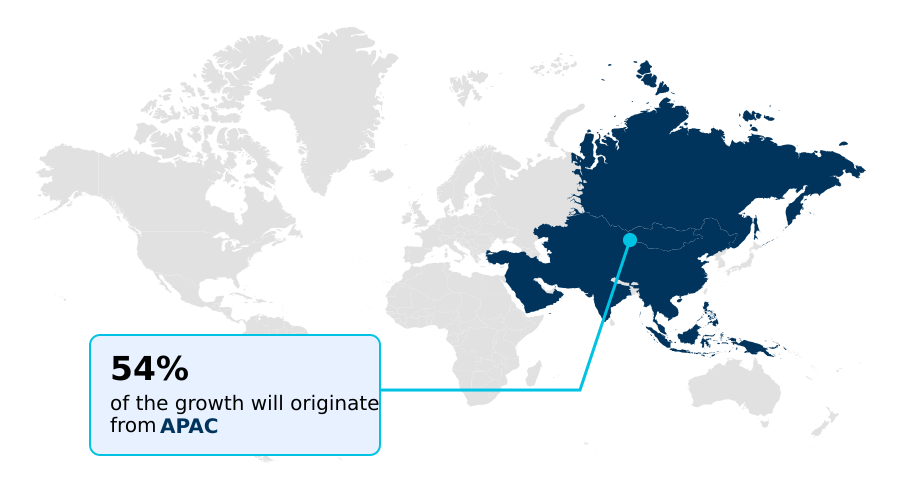
- APAC dominated the market and accounted for a 53.7% growth during the forecast period.
- By Type - NMC segment was valued at USD 7.47 billion in 2024
- By Application - Automotive segment accounted for the largest market revenue share in 2024
Market Size & Forecast
- Market Opportunities: USD 12.77 billion
- Market Future Opportunities: USD 7.76 billion
- CAGR from 2025 to 2030 : 7.4%
Market Summary
- The cylindrical cells market is defined by the production of electrochemical energy storage units with a distinct rigid, tubular geometry. These units are central to advancing high-performance power solutions across key industries, including electric mobility and renewable energy integration.
- Market dynamics are shaped by a strong push toward technological evolution, such as the development of high-nickel cathodes and silicon-carbon composite materials to boost specific energy. The industry is also driven by manufacturing efficiencies achieved through innovations like dry electrode coating and high-speed continuous motion assembly, which are critical for achieving high-volume scalability.
- As an example of operational improvement, one manufacturing scenario involves optimizing the jelly roll configuration within a new cell design to enhance thermal stability, which can extend the operational life of a battery pack in high-demand applications like heavy-duty transport.
- However, the market grapples with challenges from competing formats like prismatic cells and the technical complexities of thermal management in larger cell formats, which require sophisticated battery management systems.
What will be the Size of the Cylindrical Cells Market during the forecast period?
Get Key Insights on Market Forecast (PDF) Get Free Sample
How is the Cylindrical Cells Market Segmented?
The cylindrical cells industry research report provides comprehensive data (region-wise segment analysis), with forecasts and estimates in "USD million" for the period 2026-2030, as well as historical data from 2020-2024 for the following segments.
- Type
- NMC
- LFP
- LCO
- Others
- Application
- Automotive
- Consumer electronics
- Industrial equipment
- Energy storage systems
- Others
- Product
- 18650 format
- 21700 and 2170 format
- 46xx series
- Others
- Geography
- APAC
- China
- Japan
- South Korea
- North America
- US
- Canada
- Mexico
- Europe
- Germany
- France
- UK
- Middle East and Africa
- Saudi Arabia
- South Africa
- UAE
- South America
- Brazil
- Argentina
- Rest of World (ROW)
- APAC
By Type Insights
The nmc segment is estimated to witness significant growth during the forecast period.
The global cylindrical cells market 2026-2030 is segmented by type, application, and geography. Key chemistries such as NMC chemistry and LFP chemistry dominate different application segments.
The NMC segment, featuring high-nickel cathodes, is crucial for high-performance electric mobility, where high volumetric energy density is paramount. This chemistry involves a precise formulation of the anode, cathode, and separator.
Conversely, LFP chemistry is favored in stationary energy storage and certain industrial equipment due to its lower cost and enhanced safety profile.
Applications range from consumer electronics to large-scale grid systems, each demanding specific performance characteristics like high power output and structural integrity, with recent advancements in cell-to-pack integration improving overall system efficiency by 15%.
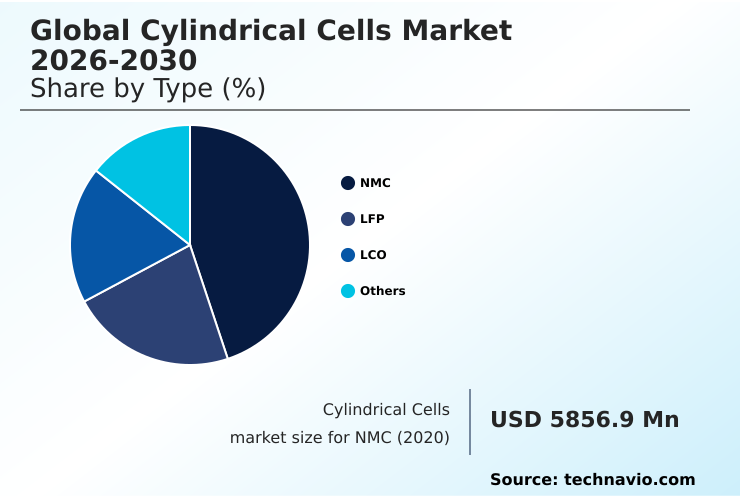
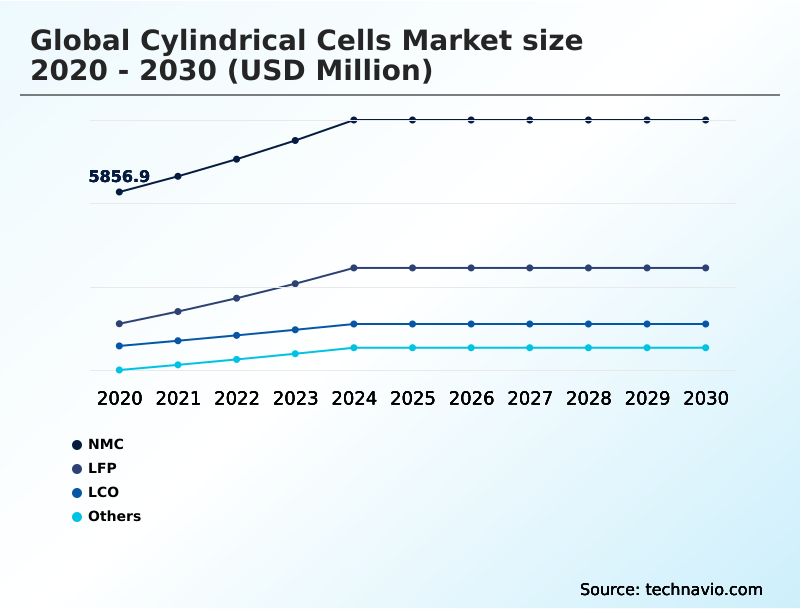
The NMC segment was valued at USD 7.47 billion in 2024 and showed a gradual increase during the forecast period.
Regional Analysis
APAC is estimated to contribute 53.7% to the growth of the global market during the forecast period.Technavio’s analysts have elaborately explained the regional trends and drivers that shape the market during the forecast period.
See How Cylindrical Cells Market Demand is Rising in APAC Get Free Sample
The APAC region, contributing over 53% of the incremental growth, leads the global cylindrical cells market 2026-2030, driven by its dominance in manufacturing and consumption.
North America is accelerating its onshoring efforts, establishing new gigafactories to secure supply chains for the automotive sector and for stationary energy storage. Europe is enforcing stringent sustainability mandates, pushing for localized production and high recycling rates.
Chemistries like LCO chemistry and NCA chemistry remain relevant in specialized sectors such as medical devices and emergency lighting. The 18650 format continues to be a workhorse in various applications.
Regions with unique demands, like heavy-duty transport, are exploring LTO chemistry for its durability and thermal stability. Meanwhile, research hubs are advancing technologies like direct lithium extraction and sulfidic based electrolytes, which could reshape regional resource dependencies.
Market Dynamics
Our researchers analyzed the data with 2025 as the base year, along with the key drivers, trends, and challenges. A holistic analysis of drivers will help companies refine their marketing strategies to gain a competitive advantage.
- A comprehensive understanding of the global cylindrical cells market 2026-2030 requires analyzing several interconnected factors. The debate over cylindrical vs prismatic cell efficiency continues, with each format offering distinct advantages in packaging and thermal performance. The 4680 cell manufacturing process, particularly the implementation of dry electrode coating production costs, is a key area of focus for achieving cost-per-kWh targets.
- Concurrently, mitigating silicon anode battery degradation is critical for next-generation, high-energy-density cells. Improving thermal management in battery packs remains a central engineering challenge, directly influencing safety and longevity. From an economic perspective, the NMC vs LFP cost performance trade-off guides procurement strategies for different vehicle segments.
- The technical advantages of tabless electrode benefits for EVs are clear, but scaling production presents hurdles. On the sustainability front, battery recycling and circular economy initiatives are gaining traction, supported by digital battery passport implementation. Sourcing sustainable cobalt for batteries continues to be a major ESG concern.
- Looking forward, solid-state battery commercialization challenges and the quest to improve sodium-ion battery energy density will define the long-term competitive landscape. Strategic decisions now revolve around balancing energy density and cycle life, optimizing BMS for cell longevity, and addressing challenges in scaling up gigafactories to meet soaring demand.
What are the key market drivers leading to the rise in the adoption of Cylindrical Cells Industry?
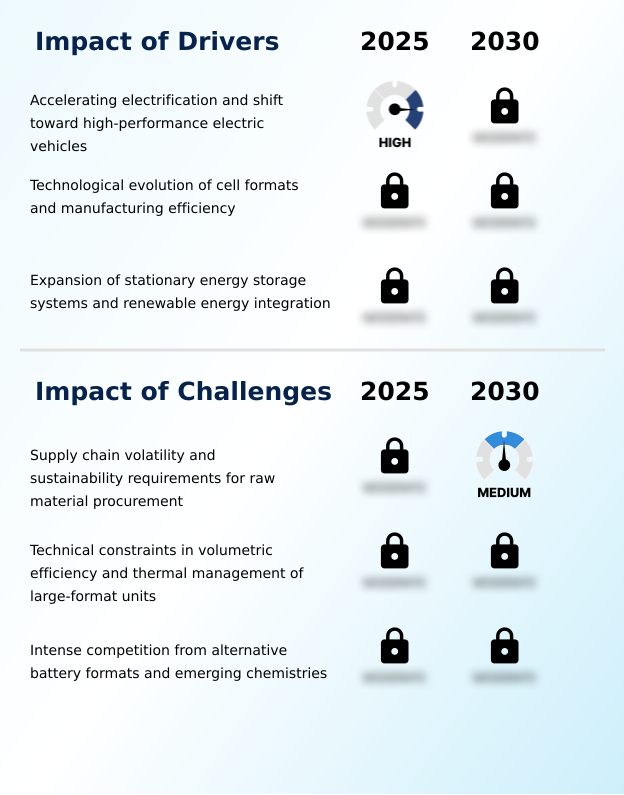
- The accelerating pace of electrification, coupled with a decisive shift toward high-performance electric vehicles, serves as the primary driver for market expansion.
- The automotive sector's expansion is a major market driver, with formats like the 2170 format becoming standard for their balance of specific energy and mechanical stability.
- Innovations in high-speed continuous motion assembly have reduced production costs by up to 25%, accelerating adoption in both passenger and light electric vehicles. The push for cobalt-free chemistry is also gaining momentum, addressing supply chain and ethical concerns.
- Advanced cell-to-chassis design concepts are further enhancing vehicle performance. Beyond vehicles, these cells are vital for professional power tools and systems supporting electric vehicle charging and grid stabilization.
- The efficiency of the thermal management system and the potential for automated disassembly at end-of-life are also key factors propelling market growth.
What are the market trends shaping the Cylindrical Cells Industry?
- The adoption of large-format cylindrical designs and tabless electrode technology represents a key emerging trend. This shift is reshaping battery pack architecture and performance expectations.
- A primary trend is the industry's shift toward larger designs like the 4680 format, which, combined with tabless electrode design principles, is enhancing electrochemical energy storage. This evolution in the jelly roll configuration enables better thermal performance and fast-charging capability, critical for high-performance electric vehicles.
- Innovations such as dry electrode coating are improving high-volume scalability, with some pilot lines demonstrating a 20% reduction in manufacturing energy consumption. Furthermore, the adoption of a digital battery passport is set to transform lifecycle management, supporting the circular economy and expanding use cases into demanding sectors like aerospace applications.
- This convergence of cell-to-pack technology and manufacturing innovation is paving the way for more efficient and sustainable battery systems that support renewable energy integration and deliver a longer cycle life.
What challenges does the Cylindrical Cells Industry face during its growth?
- Significant industry growth is constrained by supply chain volatility and the rigorous sustainability requirements associated with raw material procurement.
- Intense competition from alternative formats like prismatic cells and pouch cells presents a significant challenge, as they offer different advantages in space utilization for applications like warehouse automation. The long-term viability is also tested by emerging technologies such as solid-state batteries and sodium-ion batteries, which promise superior safety and a better power-to-weight ratio.
- Within cylindrical cells, managing the thermal gradient during high discharge rates remains a technical hurdle, requiring sophisticated battery management systems and current interrupt devices to ensure safety. This is especially true for residential backup power and telecommunications backup systems.
- Failure to innovate could see market share shift, with some OEMs reporting a 10% efficiency gain by adopting alternative cell architectures for material handling systems.
Exclusive Technavio Analysis on Customer Landscape
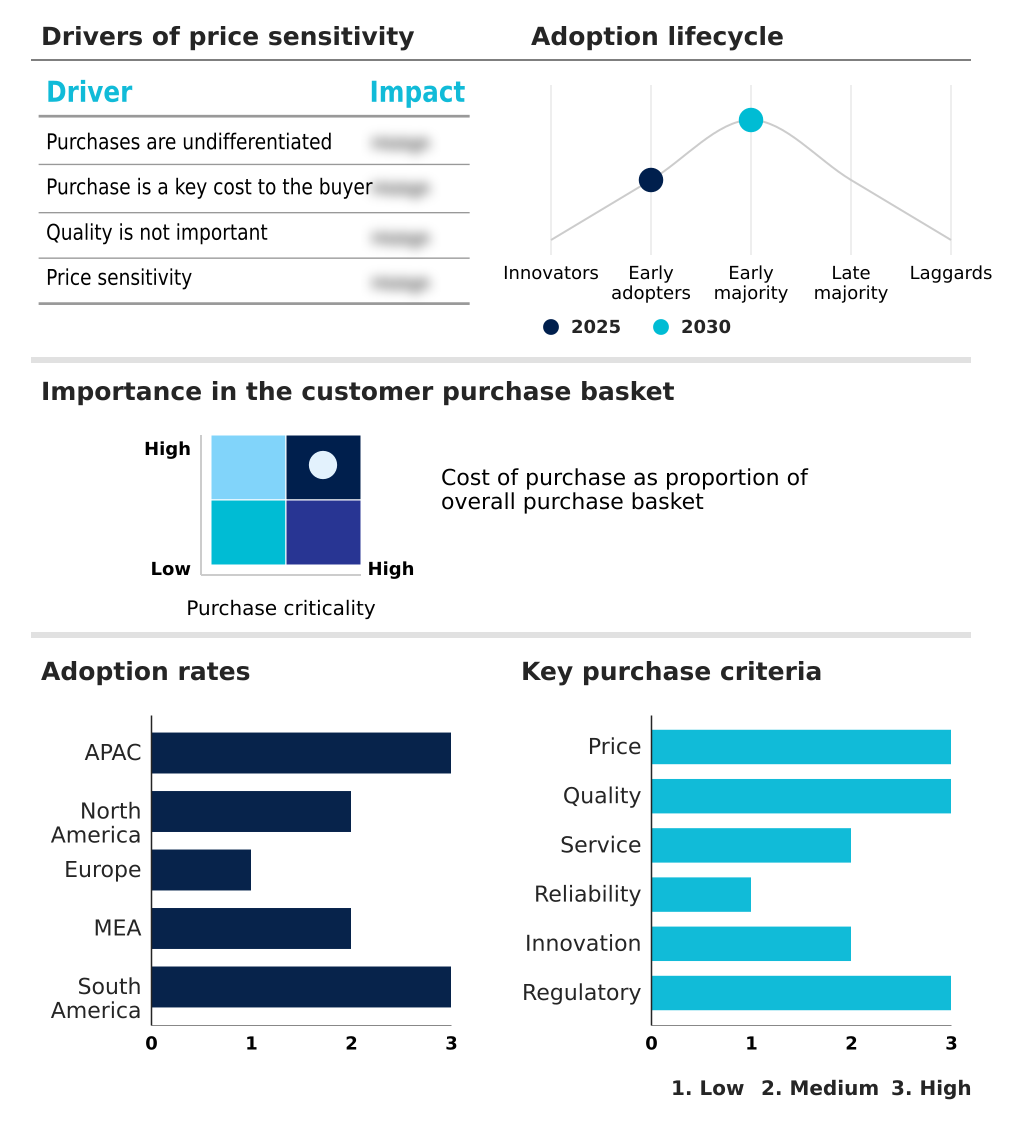
The cylindrical cells market forecasting report includes the adoption lifecycle of the market, covering from the innovator’s stage to the laggard’s stage. It focuses on adoption rates in different regions based on penetration. Furthermore, the cylindrical cells market report also includes key purchase criteria and drivers of price sensitivity to help companies evaluate and develop their market growth analysis strategies.
Customer Landscape of Cylindrical Cells Industry
Competitive Landscape
Companies are implementing various strategies, such as strategic alliances, cylindrical cells market forecast, partnerships, mergers and acquisitions, geographical expansion, and product/service launches, to enhance their presence in the industry.
Contemporary Amperex Ltd. - Offers advanced cylindrical lithium-ion cells and EV battery solutions for the automotive and energy storage sectors.
The industry research and growth report includes detailed analyses of the competitive landscape of the market and information about key companies, including:
- Contemporary Amperex Ltd.
- E One Moli Energy Corp.
- Envision Energy USA Ltd.
- EVE Energy Co. Ltd.
- FDK Corp.
- Gotion Inc.
- GP Batteries International Ltd.
- Jiangsu Highstar Battery Co.
- LG Energy Solution Ltd.
- Murata Manufacturing Co. Ltd.
- Northvolt AB
- Panasonic Holdings Corp.
- Saft Groupe SAS
- Samsung SDI Co. Ltd.
- Shenzhen BAK Battery Co. Ltd.
- Sunwoda Electronic Co. Ltd.
- SVOLT Energy Technology Co. Ltd.
- Tesla Inc.
- TianJin Lishen Battery Ltd.
- VARTA AG
Qualitative and quantitative analysis of companies has been conducted to help clients understand the wider business environment as well as the strengths and weaknesses of key industry players. Data is qualitatively analyzed to categorize companies as pure play, category-focused, industry-focused, and diversified; it is quantitatively analyzed to categorize companies as dominant, leading, strong, tentative, and weak.
Recent Development and News in Cylindrical cells market
- In February 2025, a prominent South Korean battery manufacturer finalized an agreement with a major American automotive group to establish a dedicated assembly line for 2170-format cylindrical cells in the state of Michigan.
- In March 2025, a major mining enterprise in Australia suspended the development of a high-grade lithium extraction site due to an administrative delay in environmental permits.
- In May 2025, a chemical research organization in Germany announced a breakthrough in the stabilization of silicon-carbon composite materials, allowing for a twenty percent increase in energy density.
- In June 2025, a thermal management engineering group in Germany disclosed that the thermal gradient within large-format cylindrical cells remained a significant hurdle for high-output power trains.
Dive into Technavio’s robust research methodology, blending expert interviews, extensive data synthesis, and validated models for unparalleled Cylindrical Cells Market insights. See full methodology.
| Market Scope | |
|---|---|
| Page number | 311 |
| Base year | 2025 |
| Historic period | 2020-2024 |
| Forecast period | 2026-2030 |
| Growth momentum & CAGR | Accelerate at a CAGR of 7.4% |
| Market growth 2026-2030 | USD 7760.0 million |
| Market structure | Fragmented |
| YoY growth 2025-2026(%) | 7.0% |
| Key countries | China, Japan, South Korea, India, Australia, Indonesia, US, Canada, Mexico, Germany, France, UK, Italy, Spain, The Netherlands, Saudi Arabia, South Africa, UAE, Israel, Turkey, Brazil, Argentina and Chile |
| Competitive landscape | Leading Companies, Market Positioning of Companies, Competitive Strategies, and Industry Risks |
Research Analyst Overview
- The cylindrical cells market is characterized by rapid technological progression and strategic manufacturing investments. The transition toward larger formats, such as the 4680 format, and the adoption of advanced manufacturing methods like high-speed continuous motion assembly, are pivotal. Innovations like tabless electrode design are fundamentally altering cell architecture to improve performance.
- For boardroom consideration, the implementation of a digital battery passport is becoming a critical compliance issue, impacting supply chain transparency and alignment with circular economy goals. A key development is the use of silicon-carbon composite materials, which has been shown to increase specific energy by up to 20% in some applications.
- This pursuit of higher volumetric energy density is balanced by the need for robust thermal management systems. The ongoing development of solid-state batteries and sodium-ion batteries presents a long-term competitive dynamic, pushing incumbents to innovate in areas like cell-to-chassis design and automated disassembly to maintain market leadership in electrochemical energy storage.
What are the Key Data Covered in this Cylindrical Cells Market Research and Growth Report?
-
What is the expected growth of the Cylindrical Cells Market between 2026 and 2030?
-
USD 7.76 billion, at a CAGR of 7.4%
-
-
What segmentation does the market report cover?
-
The report is segmented by Type (NMC, LFP, LCO, and Others), Application (Automotive, Consumer electronics, Industrial equipment, Energy storage systems, and Others), Product (18650 format, 21700 and 2170 format, 46xx series, and Others) and Geography (APAC, North America, Europe, Middle East and Africa, South America)
-
-
Which regions are analyzed in the report?
-
APAC, North America, Europe, Middle East and Africa and South America
-
-
What are the key growth drivers and market challenges?
-
Accelerating electrification and shift toward high-performance electric vehicles, Supply chain volatility and sustainability requirements for raw material procurement
-
-
Who are the major players in the Cylindrical Cells Market?
-
Contemporary Amperex Ltd., E One Moli Energy Corp., Envision Energy USA Ltd., EVE Energy Co. Ltd., FDK Corp., Gotion Inc., GP Batteries International Ltd., Jiangsu Highstar Battery Co., LG Energy Solution Ltd., Murata Manufacturing Co. Ltd., Northvolt AB, Panasonic Holdings Corp., Saft Groupe SAS, Samsung SDI Co. Ltd., Shenzhen BAK Battery Co. Ltd., Sunwoda Electronic Co. Ltd., SVOLT Energy Technology Co. Ltd., Tesla Inc., TianJin Lishen Battery Ltd. and VARTA AG
-
Market Research Insights
- Market dynamics are influenced by the diverse needs of end-use applications, from high-performance electric vehicles to stationary energy storage. The emphasis on long cycle life and fast-charging capability drives continuous innovation. For instance, the adoption of advanced materials has led to a 15% improvement in power-to-weight ratio in cells designed for aerospace applications, while maintaining structural integrity.
- In the automotive sector, securing a stable supply of high-quality cells is paramount, with some large buyers achieving a 10% cost reduction through long-term strategic sourcing agreements. The shift toward renewable energy integration also fuels demand for systems with exceptional thermal stability to ensure grid reliability.
- This requires a focus on high power output and mechanical stability, which are hallmarks of the cylindrical format, ensuring its relevance across a diversifying market landscape.
We can help! Our analysts can customize this cylindrical cells market research report to meet your requirements.
 RIA -
RIA -