


Cloud Computing In Government Sector Market Analysis, Size, and Forecast 2026-2030: North America (US, Canada, and Mexico), Europe (UK, Germany, and France), APAC (China, Japan, and India), South America (Brazil and Argentina), Middle East and Africa (UAE, Saudi Arabia, and South Africa), and Rest of World (ROW)

Cloud Computing In Government Sector Market Analysis, Size, and Forecast 2026-2030:
North America (US, Canada, and Mexico), Europe (UK, Germany, and France), APAC (China, Japan, and India), South America (Brazil and Argentina), Middle East and Africa (UAE, Saudi Arabia, and South Africa), and Rest of World (ROW)

Published: May 2026 304 Pages SKU: IRTNTR73257

Market Overview at a Glance

$38.76 B
Market Opportunity
16%
CAGR 2025 - 2030
44.4%
North America Growth
$12.62 B
Hardware segment 2024

Cloud Computing In Government Sector Market Size 2026-2030

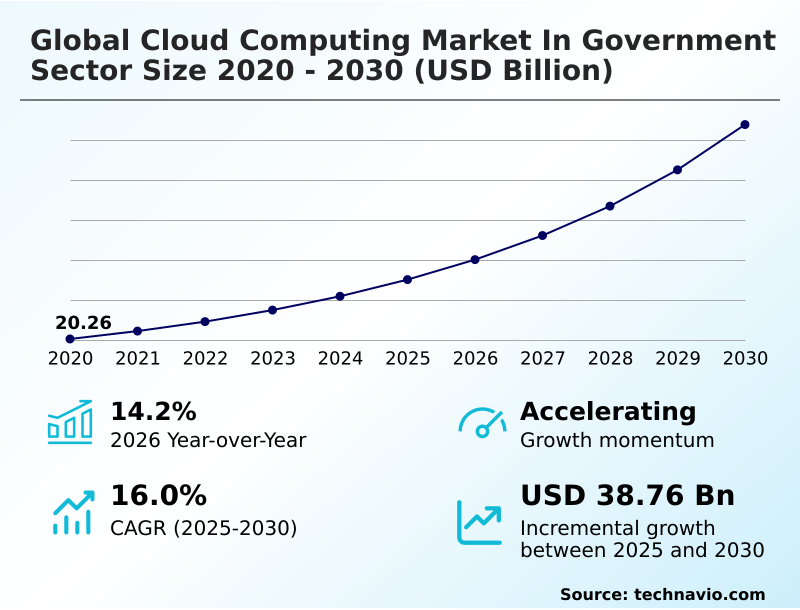
The Cloud Computing In Government Sector Market size was valued at USD 35.10 billion in 2025, growing at a CAGR of 16% during the forecast period 2026-2030.

Major Market Trends & Insights

  • North America dominated the market and accounted for a 44.4% growth during the forecast period.
  • By Product - Hardware segment was valued at USD 12.62 billion in 2024
  • By Deployment - Public segment accounted for the largest market revenue share in 2024

Market Size & Forecast

  • Historic Market Opportunities 2020-2024: USD 53.61 billion
  • Market Future Opportunities 2025-2030: USD 38.76 billion
  • CAGR from 2025 to 2030 : 16%

Market Summary

  • The cloud computing in government sector is defined by a strategic shift towards modernizing IT infrastructure to enhance service delivery and operational efficiency, with public cloud adoption reducing departmental IT capital expenditures by an average of 35%.
  • This transition is driven by the need for scalable, cost-efficient computing to support large-scale digital transformation initiatives, such as e-governance platforms that improve citizen engagement. For instance, a municipal government can leverage a hybrid multicloud infrastructure to manage traffic data in real time, improving congestion by 15% while keeping sensitive law enforcement data on a secure private cloud.
  • However, the market faces significant challenges from data sovereignty controls and the complexity of integrating new platforms with entrenched legacy systems. Without effective change management and clear regulatory compliance management, the full benefits of cloud migration, including enhanced cybersecurity resilience and inter-departmental collaboration, cannot be fully realized.

What will be the Size of the Cloud Computing In Government Sector Market during the forecast period?
Get Key Insights on Market Forecast (PDF) Request Free Sample

How is the Cloud Computing In Government Sector Market Segmented?

The cloud computing in government sector industry research report provides comprehensive data (region-wise segment analysis), with forecasts and analysis for the period 2026-2030, as well as historical data from 2020-2024 for the following segments.

  • Product
    • Hardware
    • Software
    • Services
  • Deployment
    • Public
    • Private
  • Type
    • IaaS
    • PaaS
    • SaaS
  • Geography
    • North America
      • US
      • Canada
      • Mexico
    • Europe
      • UK
      • Germany
      • France
    • APAC
      • China
      • Japan
      • India
    • South America
      • Brazil
      • Argentina
    • Middle East and Africa
      • UAE
      • Saudi Arabia
      • South Africa
    • Rest of World (ROW)

How is the Cloud Computing In Government Sector Market Segmented by Product?

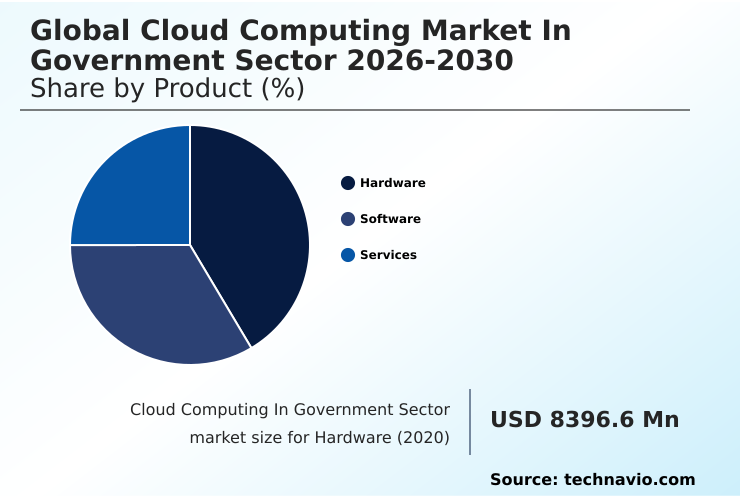
The hardware segment is estimated to witness significant growth during the forecast period.

Hardware procurement for government cloud initiatives now sees over 70% of RFPs specifying sovereign cloud compliance, reflecting a major shift in security priorities.

This segment, encompassing servers, storage, and networking equipment, underpins both private cloud infrastructure and public cloud deployments, with modern high-performance computing hardware improving data processing speeds by up to 40% compared to legacy systems.

The emphasis is on modular architectures that facilitate IaaS resource provisioning and provide greater energy efficiency than traditional monolithic data centers.

Furthermore, the integration of edge computing components is becoming standard for real-time data processing, reducing latency for public safety surveillance and smart traffic management, a critical factor for successful digital transformation initiatives.
Request Free Sample

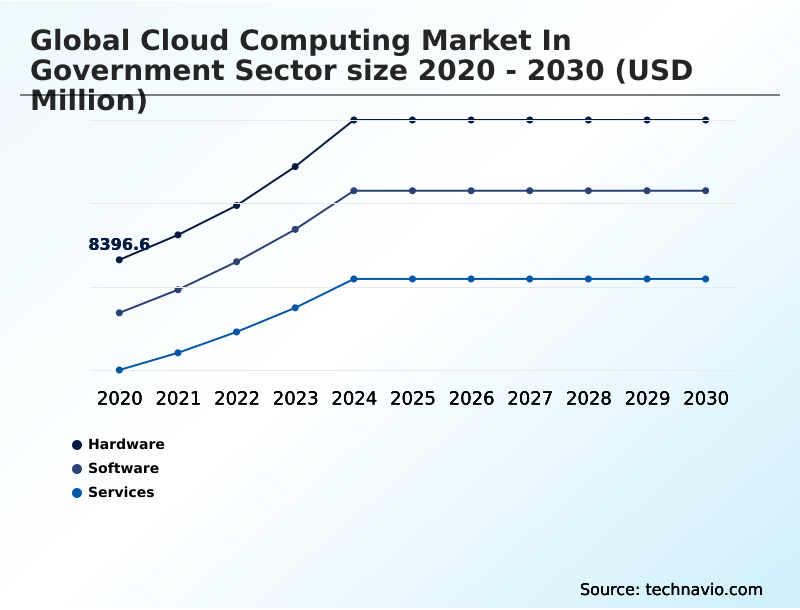
The Hardware segment was valued at USD 12.62 billion in 2024 and showed a gradual increase during the forecast period.
Request Free Sample

How demand for the Cloud Computing In Government Sector market is rising in the leading region?

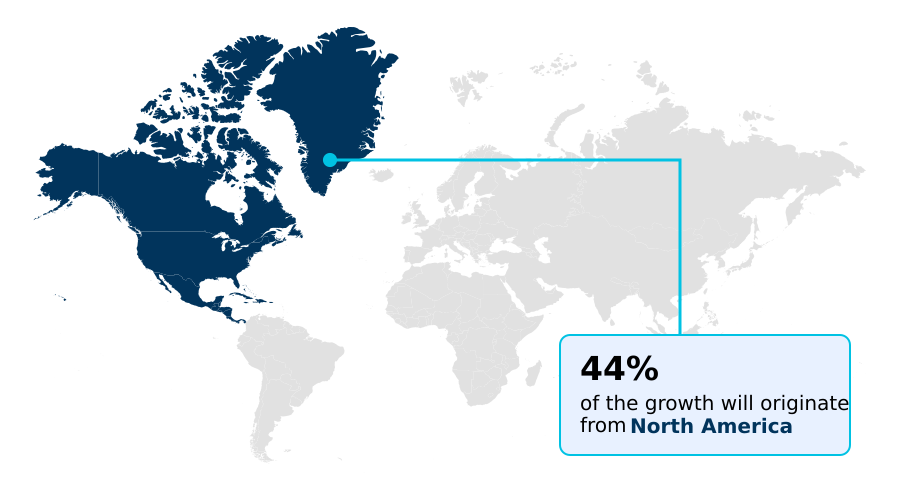
North America is estimated to contribute 44.4% to the growth of the global market during the forecast period.Technavio’s analysts have elaborately explained the regional trends and drivers that shape the market during the forecast period.
See How Cloud Computing In Government Sector Market demand is rising in North America Request Free Sample

The geographic landscape of the cloud computing market in government sector is led by North America, which accounts for 44.4% of the incremental growth, a rate approximately 1.5 times faster than that of the Middle East and Africa.

This dominance is driven by the United States, where robust procurement frameworks and large-scale public sector IT modernization programs accelerate adoption.

In contrast, Europe's market, while substantial, is shaped by stringent data privacy regulations like GDPR and a strong emphasis on sovereign cloud compliance, which influences vendor selection and deployment models.

APAC is the fastest-growing region, fueled by massive digital transformation in countries like India and Singapore, where governments are investing heavily in digital identity systems and citizen-centric service platforms to leapfrog legacy infrastructure.

What are the key Drivers, Trends, and Challenges in the Cloud Computing In Government Sector Market?

Our researchers analyzed the data with 2025 as the base year, along with the key drivers, trends, and challenges. A holistic analysis of drivers will help companies refine their marketing strategies to gain a competitive advantage.

  • Understanding the nuances of the global cloud computing market in government sector requires analyzing specific use cases and deployment strategies. For instance, determining the best government cloud security best practices is a top priority, as agencies handle sensitive data that demands robust protection beyond standard enterprise protocols.
  • Many decision-makers weigh the benefits of hybrid cloud for public sector, seeking a balance between the security of private infrastructure and the scalability of public services, a choice that impacts long-term operational costs by over 25%.
  • The debate between iaas vs paas for government agencies is also critical; IaaS offers greater control over the infrastructure, while PaaS can accelerate application development by an estimated 40%. However, cloud migration challenges for governments, including legacy system integration and workforce reskilling, remain significant hurdles.
  • Accurately assessing the total cost of cloud computing for government is complex, factoring in not just subscription fees but also migration expenses, security compliance, and ongoing management. These considerations are fundamental for public sector organizations aiming to successfully leverage the cloud for digital transformation and improved citizen services.
What are the key market drivers leading to the rise in the adoption of Cloud Computing In Government Sector Industry?

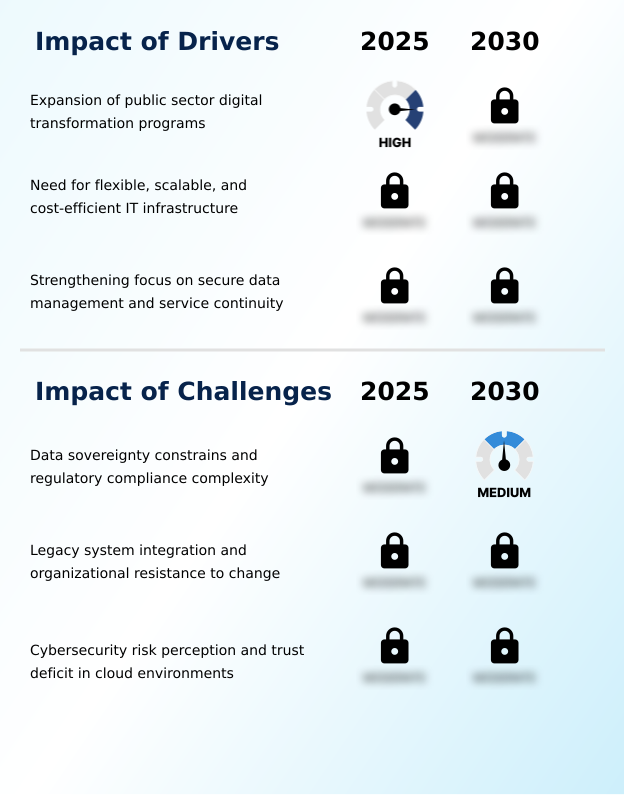
  • The expansion of public sector digital transformation programs is a key driver for the market.

  • Widespread digital transformation initiatives are the primary market driver, with public sector modernization programs increasing demand for cloud solutions by over 60% in the last three years.
  • These initiatives, including e-governance platform deployment and smart city projects, require a scalable IT infrastructure that legacy systems cannot provide.
  • Cloud computing offers a cost-efficient model, reducing upfront capital expenditure on physical data centers by as much as 45% and enabling governments to pay only for utilized resources. This financial efficiency is critical for budget-constrained public organizations.
  • Concurrently, the growing focus on secure data management and service continuity planning compels agencies to adopt cloud-based disaster recovery and security architectures to protect sensitive citizen and defense data.

What are the market trends shaping the Cloud Computing In Government Sector Industry?

  • The increasing adoption of hybrid and multi-cloud deployment models represents a significant upcoming trend, allowing government agencies to balance security, flexibility, and cost-efficiency.

  • Hybrid and multi-cloud strategies are now foundational to government IT, with agencies reporting a 30% improvement in workload portability and risk mitigation compared to single-provider models. This trend allows for sensitive data to remain on private or sovereign infrastructure, while leveraging public cloud platforms for less critical applications, enhancing both security and performance optimization.
  • Governments are also increasingly using cloud platforms to bolster data analytics capabilities for evidence-based policymaking, processing datasets 50% faster than with on-premise systems. This facilitates predictive insights for resource allocation and fraud detection. A corresponding trend is the expansion of cloud-based unified service portals, which are central to citizen-centric service design, improving accessibility and reducing administrative workflows through automation.

What challenges does the Cloud Computing In Government Sector Industry face during its growth?

  • Data sovereignty constraints and the complexity of regulatory compliance present a key challenge affecting industry growth.

  • Data sovereignty and complex regulatory compliance represent a significant market challenge, with data residency mandates increasing implementation timelines for cloud projects by up to 50% in certain jurisdictions. Government agencies must navigate a patchwork of national laws governing data storage and cross-border transfers, complicating procurement and regulatory compliance management.
  • Another major hurdle is the integration with legacy systems, which can account for over 60% of an agency's total IT modernization budget due to architectural incompatibility and the need for custom middleware. This technical complexity is compounded by organizational change management issues and a persistent cybersecurity risk perception, which slows the migration of mission-critical workloads.

Exclusive Technavio Analysis on Customer Landscape

The cloud computing in government sector market forecasting report includes the adoption lifecycle of the market, covering from the innovator’s stage to the laggard’s stage. It focuses on adoption rates in different regions based on penetration. Furthermore, the cloud computing in government sector market report also includes key purchase criteria and drivers of price sensitivity to help companies evaluate and develop their market growth analysis strategies.
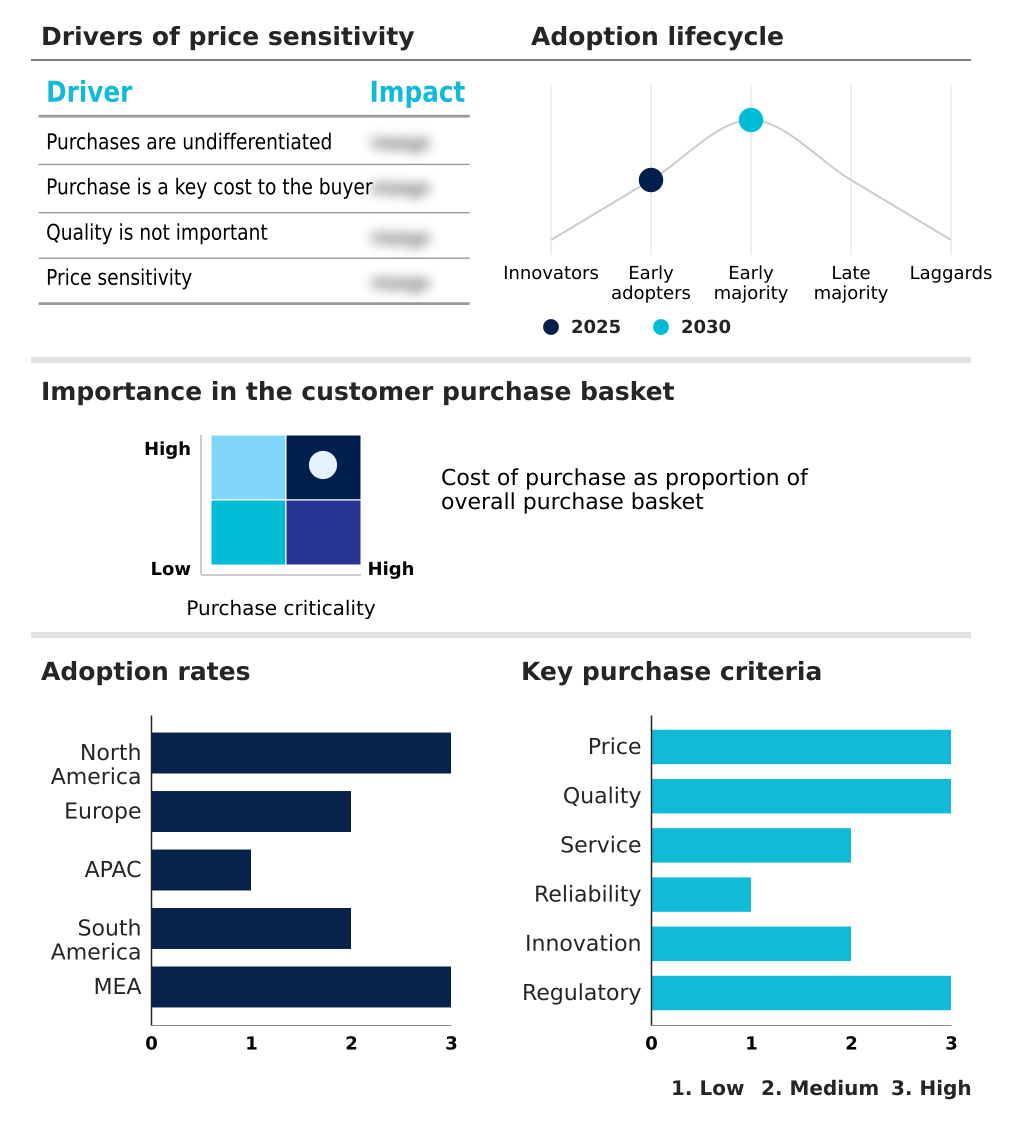
Customer Landscape of Cloud Computing In Government Sector Industry

Competitive Landscape

Companies are implementing various strategies, such as strategic alliances, cloud computing in government sector market forecast, partnerships, mergers and acquisitions, geographical expansion, and product/service launches, to enhance their presence in the industry.

Amazon Web Services Inc. - Offerings include sovereign, compliance-ready IaaS and PaaS solutions with AI and data analytics, tailored for secure public agency infrastructure and digital transformation initiatives.

The industry research and growth report includes detailed analyses of the competitive landscape of the market and information about key companies, including:

  • Amazon Web Services Inc.
  • Capgemini Service SAS
  • CGI Inc.
  • Cisco Systems Inc.
  • Citrix Systems Inc.
  • Dell Technologies Inc.
  • Equinix Inc.
  • Fujitsu Ltd.
  • Hewlett Packard
  • IBM Corp.
  • Informatica Inc.
  • Lumen Technologies Inc.
  • Microsoft Corp.
  • NEC Corp.
  • NetApp Inc.
  • NTT DATA Corp.
  • Oracle Corp.
  • Salesforce Inc.

Qualitative and quantitative analysis of companies has been conducted to help clients understand the wider business environment as well as the strengths and weaknesses of key industry players. Data is qualitatively analyzed to categorize companies as pure play, category-focused, industry-focused, and diversified; it is quantitatively analyzed to categorize companies as dominant, leading, strong, tentative, and weak.

Market Intelligence Radar: High-Impact Developments & Growth Signals

  • In the Systems Software industry, the proliferation of open-source platforms is creating new cost-efficient computing alternatives for government agencies, challenging the dominance of proprietary software vendors and influencing procurement frameworks that now favor solutions with greater flexibility and no vendor lock-in.
  • The widespread adoption of agile and DevOps methodologies within the Systems Software industry is accelerating application modernization for public entities, enabling faster deployment of citizen service delivery platforms and continuous improvement cycles, thereby enhancing responsiveness to public needs.
  • In the Systems Software industry, tightening data privacy regulations globally are compelling vendors to embed robust, auditable security features directly into their platforms, impacting the cloud computing in government sector market by prioritizing solutions with built-in sovereign cloud compliance and granular data sovereignty controls.
  • A significant increase in demand for AI and machine learning capabilities within enterprise platforms is driving the development of advanced data analytics capabilities in the Systems Software industry, directly benefiting government cloud strategies by providing tools for data-driven policymaking and predictive modeling.

Dive into Technavio’s robust research methodology, blending expert interviews, extensive data synthesis, and validated models for unparalleled Cloud Computing In Government Sector Market insights. See full methodology.

Market Scope
Page number 304
Base year 2025
Historic period 2020-2024
Forecast period 2026-2030
Growth momentum & CAGR Accelerate at a CAGR of 16%
Market growth 2026-2030 USD 38760.5 million
Market structure Fragmented
YoY growth 2025-2026(%) 14.2%
Key countries US, Canada, Mexico, UK, Germany, France, Italy, Spain, The Netherlands, China, Japan, India, South Korea, Australia, Indonesia, Brazil, Argentina, Chile, UAE, Saudi Arabia, South Africa, Egypt and Kenya
Competitive landscape Leading Companies, Market Positioning of Companies, Competitive Strategies, and Industry Risks

Request Free Sample

Research Analyst Overview

  • The cloud computing in government sector ecosystem is a complex interplay of stakeholders, with hyperscale infrastructure providers supplying over 70% of the foundational computing resources. These providers work through a channel of system integrators and specialized resellers who tailor solutions to meet stringent public sector procurement frameworks.
  • Regulatory bodies and standards organizations define the compliance landscape, mandating adherence to data sovereignty controls and security protocols that can increase project deployment times by up to 25% compared to commercial projects.
  • End-users, comprising federal, state, and local government agencies, are the primary consumers, driving demand for everything from SaaS delivery models for citizen-facing applications to private cloud infrastructure for sensitive defense workloads. Supporting entities, including cybersecurity firms and managed service providers, ensure service continuity planning and resilience solutions for critical government operations.

What are the Key Data Covered in this Cloud Computing In Government Sector Market Research and Growth Report?

  • What is the expected growth of the Cloud Computing In Government Sector Market between 2026 and 2030?

    • The Cloud Computing In Government Sector Market is expected to grow by USD 38.76 billion during 2026-2030, registering a CAGR of 16%. Year-over-year growth in 2026 is estimated at 14.2%%. This acceleration is shaped by expansion of public sector digital transformation programs, which is intensifying demand across multiple end-use verticals covered in the report.

  • What segmentation does the market report cover?

    • The report is segmented by Product (Hardware, Software, and Services), Deployment (Public, and Private), Type (IaaS, PaaS, and SaaS) and Geography (North America, Europe, APAC, South America, Middle East and Africa). Among these, the Hardware segment is estimated to witness significant growth during the forecast period, driven by rising adoption across key application areas. Each segment includes detailed qualitative and quantitative analysis, along with historical data from 2020-2024 and forecasts through 2030 with year-over-year growth rates.

  • Which regions are analyzed in the report?

    • The report covers North America, Europe, APAC, South America and Middle East and Africa. North America is estimated to contribute 44.4% to market growth during the forecast period. Country-level analysis includes US, Canada, Mexico, UK, Germany, France, Italy, Spain, The Netherlands, China, Japan, India, South Korea, Australia, Indonesia, Brazil, Argentina, Chile, UAE, Saudi Arabia, South Africa, Egypt and Kenya, with dedicated market size tables and year-over-year growth for each.

  • What are the key growth drivers and market challenges?

    • The primary driver is expansion of public sector digital transformation programs, which is accelerating investment and industry demand. The main challenge is data sovereignty constrains and regulatory compliance complexity, creating operational barriers for key market participants. The report quantifies the impact of each driver and challenge across 2026 and 2030 with comparative analysis.

  • Who are the major players in the Cloud Computing In Government Sector Market?

    • Key vendors include Amazon Web Services Inc., Capgemini Service SAS, CGI Inc., Cisco Systems Inc., Citrix Systems Inc., Dell Technologies Inc., Equinix Inc., Fujitsu Ltd., Hewlett Packard, IBM Corp., Informatica Inc., Lumen Technologies Inc., Microsoft Corp., NEC Corp., NetApp Inc., NTT DATA Corp., Oracle Corp. and Salesforce Inc.. The report provides qualitative and quantitative analysis categorizing companies as dominant, leading, strong, tentative, and weak based on their market positioning. Company profiles include business segment analysis, SWOT assessment, key offerings, and recent strategic developments.

Market Research Insights

  • The competitive landscape features a concentrated group of hyperscale providers, with the top three vendors capturing over 65% of government contracts. Major players like Amazon Web Services Inc. and Microsoft Corp. are intensely focused on deploying sovereign cloud regions to meet stringent data residency mandates.
  • Recent developments show a strategic push towards specialized solutions, with vendors launching AI-powered analytics platforms for public sector use, leading to a 20% improvement in processing speeds for policy modeling. These actions directly address the government demand for advanced data analytics capabilities and secure, compliant infrastructure.
  • This innovation is critical as providers navigate the persistent challenge of legacy system integration, which requires significant investment in hybrid cloud management tools and professional services to ensure seamless workload portability and operational continuity for government agencies.

We can help! Our analysts can customize this cloud computing in government sector market research report to meet your requirements.

Get in touch

1. Executive Summary

1.1 Market overview

Executive Summary - Chart on Market Overview
Executive Summary - Data Table on Market Overview
Executive Summary - Chart on Global Market Characteristics
Executive Summary - Chart on Market by Geography
Executive Summary - Chart on Market Segmentation by Product
Executive Summary - Chart on Market Segmentation by Deployment
Executive Summary - Chart on Market Segmentation by Type
Executive Summary - Chart on Incremental Growth
Executive Summary - Data Table on Incremental Growth
Executive Summary - Chart on Company Market Positioning

2. Technavio Analysis

2.1 Analysis of price sensitivity, lifecycle, customer purchase basket, adoption rates, and purchase criteria

2.2 Criticality of inputs and Factors of differentiation

Chart on Overview on criticality of inputs and factors of differentiation

2.3 Factors of disruption

Chart on Overview on factors of disruption

2.4 Impact of drivers and challenges

Chart on Impact of drivers and challenges in 2025 and 2030

3. Market Landscape

3.1 Market ecosystem

Chart on Parent Market
Data Table on - Parent Market

3.2 Market characteristics

Chart on Market characteristics analysis

3.3 Value chain analysis

Chart on Value chain analysis

4. Market Sizing

4.1 Market definition

Data Table on Offerings of companies included in the market definition

4.2 Market segment analysis

Market segments

4.3 Market size 2025

4.4 Market outlook: Forecast for 2025-2030

Chart on Global - Market size and forecast 2025-2030 ($ million)
Data Table on Global - Market size and forecast 2025-2030 ($ million)
Chart on Global Market: Year-over-year growth 2025-2030 (%)
Data Table on Global Market: Year-over-year growth 2025-2030 (%)

5. Historic Market Size

5.1 Global Cloud Computing Market In Government Sector 2020 - 2024

Historic Market Size - Data Table on Global Cloud Computing Market In Government Sector 2020 - 2024 ($ million)

5.2 Product segment analysis 2020 - 2024

Historic Market Size - Product Segment 2020 - 2024 ($ million)

5.3 Deployment segment analysis 2020 - 2024

Historic Market Size - Deployment Segment 2020 - 2024 ($ million)

5.4 Type segment analysis 2020 - 2024

Historic Market Size - Type Segment 2020 - 2024 ($ million)

5.5 Geography segment analysis 2020 - 2024

Historic Market Size - Geography Segment 2020 - 2024 ($ million)

5.6 Country segment analysis 2020 - 2024

Historic Market Size - Country Segment 2020 - 2024 ($ million)

6. Qualitative Analysis

6.1 The AI Impact on Global Cloud Computing Market in Government Sector

7. Five Forces Analysis

7.1 Five forces summary

Five forces analysis - Comparison between 2025 and 2030

7.2 Bargaining power of buyers

Bargaining power of buyers - Impact of key factors 2025 and 2030

7.3 Bargaining power of suppliers

Bargaining power of suppliers - Impact of key factors in 2025 and 2030

7.4 Threat of new entrants

Threat of new entrants - Impact of key factors in 2025 and 2030

7.5 Threat of substitutes

Threat of substitutes - Impact of key factors in 2025 and 2030

7.6 Threat of rivalry

Threat of rivalry - Impact of key factors in 2025 and 2030

7.7 Market condition

Chart on Market condition - Five forces 2025 and 2030

8. Market Segmentation by Product

8.1 Market segments

Chart on Product - Market share 2025-2030 (%)
Data Table on Product - Market share 2025-2030 (%)

8.2 Comparison by Product

Chart on Comparison by Product
Data Table on Comparison by Product

8.3 Hardware - Market size and forecast 2025-2030

Chart on Hardware - Market size and forecast 2025-2030 ($ million)
Data Table on Hardware - Market size and forecast 2025-2030 ($ million)
Chart on Hardware - Year-over-year growth 2025-2030 (%)
Data Table on Hardware - Year-over-year growth 2025-2030 (%)

8.4 Software - Market size and forecast 2025-2030

Chart on Software - Market size and forecast 2025-2030 ($ million)
Data Table on Software - Market size and forecast 2025-2030 ($ million)
Chart on Software - Year-over-year growth 2025-2030 (%)
Data Table on Software - Year-over-year growth 2025-2030 (%)

8.5 Services - Market size and forecast 2025-2030

Chart on Services - Market size and forecast 2025-2030 ($ million)
Data Table on Services - Market size and forecast 2025-2030 ($ million)
Chart on Services - Year-over-year growth 2025-2030 (%)
Data Table on Services - Year-over-year growth 2025-2030 (%)

8.6 Market opportunity by Product

Market opportunity by Product ($ million)
Data Table on Market opportunity by Product ($ million)

9. Market Segmentation by Deployment

9.1 Market segments

Chart on Deployment - Market share 2025-2030 (%)
Data Table on Deployment - Market share 2025-2030 (%)

9.2 Comparison by Deployment

Chart on Comparison by Deployment
Data Table on Comparison by Deployment

9.3 Public - Market size and forecast 2025-2030

Chart on Public - Market size and forecast 2025-2030 ($ million)
Data Table on Public - Market size and forecast 2025-2030 ($ million)
Chart on Public - Year-over-year growth 2025-2030 (%)
Data Table on Public - Year-over-year growth 2025-2030 (%)

9.4 Private - Market size and forecast 2025-2030

Chart on Private - Market size and forecast 2025-2030 ($ million)
Data Table on Private - Market size and forecast 2025-2030 ($ million)
Chart on Private - Year-over-year growth 2025-2030 (%)
Data Table on Private - Year-over-year growth 2025-2030 (%)

9.5 Market opportunity by Deployment

Market opportunity by Deployment ($ million)
Data Table on Market opportunity by Deployment ($ million)

10. Market Segmentation by Type

10.1 Market segments

Chart on Type - Market share 2025-2030 (%)
Data Table on Type - Market share 2025-2030 (%)

10.2 Comparison by Type

Chart on Comparison by Type
Data Table on Comparison by Type

10.3 IaaS - Market size and forecast 2025-2030

Chart on IaaS - Market size and forecast 2025-2030 ($ million)
Data Table on IaaS - Market size and forecast 2025-2030 ($ million)
Chart on IaaS - Year-over-year growth 2025-2030 (%)
Data Table on IaaS - Year-over-year growth 2025-2030 (%)

10.4 PaaS - Market size and forecast 2025-2030

Chart on PaaS - Market size and forecast 2025-2030 ($ million)
Data Table on PaaS - Market size and forecast 2025-2030 ($ million)
Chart on PaaS - Year-over-year growth 2025-2030 (%)
Data Table on PaaS - Year-over-year growth 2025-2030 (%)

10.5 SaaS - Market size and forecast 2025-2030

Chart on SaaS - Market size and forecast 2025-2030 ($ million)
Data Table on SaaS - Market size and forecast 2025-2030 ($ million)
Chart on SaaS - Year-over-year growth 2025-2030 (%)
Data Table on SaaS - Year-over-year growth 2025-2030 (%)

10.6 Market opportunity by Type

Market opportunity by Type ($ million)
Data Table on Market opportunity by Type ($ million)

11. Customer Landscape

11.1 Customer landscape overview

Analysis of price sensitivity, lifecycle, customer purchase basket, adoption rates, and purchase criteria

12. Geographic Landscape

12.1 Geographic segmentation

Chart on Market share by geography 2025-2030 (%)
Data Table on Market share by geography 2025-2030 (%)

12.2 Geographic comparison

Chart on Geographic comparison
Data Table on Geographic comparison

12.3 North America - Market size and forecast 2025-2030

Chart on North America - Market size and forecast 2025-2030 ($ million)
Data Table on North America - Market size and forecast 2025-2030 ($ million)
Chart on North America - Year-over-year growth 2025-2030 (%)
Data Table on North America - Year-over-year growth 2025-2030 (%)
Chart on Regional Comparison - North America
Data Table on Regional Comparison - North America

12.3.1 US - Market size and forecast 2025-2030

Chart on US - Market size and forecast 2025-2030 ($ million)
Data Table on US - Market size and forecast 2025-2030 ($ million)
Chart on US - Year-over-year growth 2025-2030 (%)
Data Table on US - Year-over-year growth 2025-2030 (%)

12.3.2 Canada - Market size and forecast 2025-2030

Chart on Canada - Market size and forecast 2025-2030 ($ million)
Data Table on Canada - Market size and forecast 2025-2030 ($ million)
Chart on Canada - Year-over-year growth 2025-2030 (%)
Data Table on Canada - Year-over-year growth 2025-2030 (%)

12.3.3 Mexico - Market size and forecast 2025-2030

Chart on Mexico - Market size and forecast 2025-2030 ($ million)
Data Table on Mexico - Market size and forecast 2025-2030 ($ million)
Chart on Mexico - Year-over-year growth 2025-2030 (%)
Data Table on Mexico - Year-over-year growth 2025-2030 (%)

12.4 Europe - Market size and forecast 2025-2030

Chart on Europe - Market size and forecast 2025-2030 ($ million)
Data Table on Europe - Market size and forecast 2025-2030 ($ million)
Chart on Europe - Year-over-year growth 2025-2030 (%)
Data Table on Europe - Year-over-year growth 2025-2030 (%)
Chart on Regional Comparison - Europe
Data Table on Regional Comparison - Europe

12.4.1 UK - Market size and forecast 2025-2030

Chart on UK - Market size and forecast 2025-2030 ($ million)
Data Table on UK - Market size and forecast 2025-2030 ($ million)
Chart on UK - Year-over-year growth 2025-2030 (%)
Data Table on UK - Year-over-year growth 2025-2030 (%)

12.4.2 Germany - Market size and forecast 2025-2030

Chart on Germany - Market size and forecast 2025-2030 ($ million)
Data Table on Germany - Market size and forecast 2025-2030 ($ million)
Chart on Germany - Year-over-year growth 2025-2030 (%)
Data Table on Germany - Year-over-year growth 2025-2030 (%)

12.4.3 France - Market size and forecast 2025-2030

Chart on France - Market size and forecast 2025-2030 ($ million)
Data Table on France - Market size and forecast 2025-2030 ($ million)
Chart on France - Year-over-year growth 2025-2030 (%)
Data Table on France - Year-over-year growth 2025-2030 (%)

12.4.4 Italy - Market size and forecast 2025-2030

Chart on Italy - Market size and forecast 2025-2030 ($ million)
Data Table on Italy - Market size and forecast 2025-2030 ($ million)
Chart on Italy - Year-over-year growth 2025-2030 (%)
Data Table on Italy - Year-over-year growth 2025-2030 (%)

12.4.5 Spain - Market size and forecast 2025-2030

Chart on Spain - Market size and forecast 2025-2030 ($ million)
Data Table on Spain - Market size and forecast 2025-2030 ($ million)
Chart on Spain - Year-over-year growth 2025-2030 (%)
Data Table on Spain - Year-over-year growth 2025-2030 (%)

12.4.6 The Netherlands - Market size and forecast 2025-2030

Chart on The Netherlands - Market size and forecast 2025-2030 ($ million)
Data Table on The Netherlands - Market size and forecast 2025-2030 ($ million)
Chart on The Netherlands - Year-over-year growth 2025-2030 (%)
Data Table on The Netherlands - Year-over-year growth 2025-2030 (%)

12.5 APAC - Market size and forecast 2025-2030

Chart on APAC - Market size and forecast 2025-2030 ($ million)
Data Table on APAC - Market size and forecast 2025-2030 ($ million)
Chart on APAC - Year-over-year growth 2025-2030 (%)
Data Table on APAC - Year-over-year growth 2025-2030 (%)
Chart on Regional Comparison - APAC
Data Table on Regional Comparison - APAC

12.5.1 China - Market size and forecast 2025-2030

Chart on China - Market size and forecast 2025-2030 ($ million)
Data Table on China - Market size and forecast 2025-2030 ($ million)
Chart on China - Year-over-year growth 2025-2030 (%)
Data Table on China - Year-over-year growth 2025-2030 (%)

12.5.2 Japan - Market size and forecast 2025-2030

Chart on Japan - Market size and forecast 2025-2030 ($ million)
Data Table on Japan - Market size and forecast 2025-2030 ($ million)
Chart on Japan - Year-over-year growth 2025-2030 (%)
Data Table on Japan - Year-over-year growth 2025-2030 (%)

12.5.3 India - Market size and forecast 2025-2030

Chart on India - Market size and forecast 2025-2030 ($ million)
Data Table on India - Market size and forecast 2025-2030 ($ million)
Chart on India - Year-over-year growth 2025-2030 (%)
Data Table on India - Year-over-year growth 2025-2030 (%)

12.5.4 South Korea - Market size and forecast 2025-2030

Chart on South Korea - Market size and forecast 2025-2030 ($ million)
Data Table on South Korea - Market size and forecast 2025-2030 ($ million)
Chart on South Korea - Year-over-year growth 2025-2030 (%)
Data Table on South Korea - Year-over-year growth 2025-2030 (%)

12.5.5 Australia - Market size and forecast 2025-2030

Chart on Australia - Market size and forecast 2025-2030 ($ million)
Data Table on Australia - Market size and forecast 2025-2030 ($ million)
Chart on Australia - Year-over-year growth 2025-2030 (%)
Data Table on Australia - Year-over-year growth 2025-2030 (%)

12.5.6 Indonesia - Market size and forecast 2025-2030

Chart on Indonesia - Market size and forecast 2025-2030 ($ million)
Data Table on Indonesia - Market size and forecast 2025-2030 ($ million)
Chart on Indonesia - Year-over-year growth 2025-2030 (%)
Data Table on Indonesia - Year-over-year growth 2025-2030 (%)

12.6 South America - Market size and forecast 2025-2030

Chart on South America - Market size and forecast 2025-2030 ($ million)
Data Table on South America - Market size and forecast 2025-2030 ($ million)
Chart on South America - Year-over-year growth 2025-2030 (%)
Data Table on South America - Year-over-year growth 2025-2030 (%)
Chart on Regional Comparison - South America
Data Table on Regional Comparison - South America

12.6.1 Brazil - Market size and forecast 2025-2030

Chart on Brazil - Market size and forecast 2025-2030 ($ million)
Data Table on Brazil - Market size and forecast 2025-2030 ($ million)
Chart on Brazil - Year-over-year growth 2025-2030 (%)
Data Table on Brazil - Year-over-year growth 2025-2030 (%)

12.6.2 Argentina - Market size and forecast 2025-2030

Chart on Argentina - Market size and forecast 2025-2030 ($ million)
Data Table on Argentina - Market size and forecast 2025-2030 ($ million)
Chart on Argentina - Year-over-year growth 2025-2030 (%)
Data Table on Argentina - Year-over-year growth 2025-2030 (%)

12.6.3 Chile - Market size and forecast 2025-2030

Chart on Chile - Market size and forecast 2025-2030 ($ million)
Data Table on Chile - Market size and forecast 2025-2030 ($ million)
Chart on Chile - Year-over-year growth 2025-2030 (%)
Data Table on Chile - Year-over-year growth 2025-2030 (%)

12.7 Middle East and Africa - Market size and forecast 2025-2030

Chart on Middle East and Africa - Market size and forecast 2025-2030 ($ million)
Data Table on Middle East and Africa - Market size and forecast 2025-2030 ($ million)
Chart on Middle East and Africa - Year-over-year growth 2025-2030 (%)
Data Table on Middle East and Africa - Year-over-year growth 2025-2030 (%)
Chart on Regional Comparison - Middle East and Africa
Data Table on Regional Comparison - Middle East and Africa

12.7.1 UAE - Market size and forecast 2025-2030

Chart on UAE - Market size and forecast 2025-2030 ($ million)
Data Table on UAE - Market size and forecast 2025-2030 ($ million)
Chart on UAE - Year-over-year growth 2025-2030 (%)
Data Table on UAE - Year-over-year growth 2025-2030 (%)

12.7.2 Saudi Arabia - Market size and forecast 2025-2030

Chart on Saudi Arabia - Market size and forecast 2025-2030 ($ million)
Data Table on Saudi Arabia - Market size and forecast 2025-2030 ($ million)
Chart on Saudi Arabia - Year-over-year growth 2025-2030 (%)
Data Table on Saudi Arabia - Year-over-year growth 2025-2030 (%)

12.7.3 South Africa - Market size and forecast 2025-2030

Chart on South Africa - Market size and forecast 2025-2030 ($ million)
Data Table on South Africa - Market size and forecast 2025-2030 ($ million)
Chart on South Africa - Year-over-year growth 2025-2030 (%)
Data Table on South Africa - Year-over-year growth 2025-2030 (%)

12.7.4 Egypt - Market size and forecast 2025-2030

Chart on Egypt - Market size and forecast 2025-2030 ($ million)
Data Table on Egypt - Market size and forecast 2025-2030 ($ million)
Chart on Egypt - Year-over-year growth 2025-2030 (%)
Data Table on Egypt - Year-over-year growth 2025-2030 (%)

12.7.5 Kenya - Market size and forecast 2025-2030

Chart on Kenya - Market size and forecast 2025-2030 ($ million)
Data Table on Kenya - Market size and forecast 2025-2030 ($ million)
Chart on Kenya - Year-over-year growth 2025-2030 (%)
Data Table on Kenya - Year-over-year growth 2025-2030 (%)

12.8 Market opportunity by geography

Market opportunity by geography ($ million)
Data Tables on Market opportunity by geography ($ million)

13. Drivers, Challenges, and Opportunity

13.1 Market drivers

Expansion of public sector digital transformation programs
Need for flexible, scalable, and cost-efficient IT infrastructure
Strengthening focus on secure data management and service continuity

13.2 Market challenges

Data sovereignty constrains and regulatory compliance complexity
Legacy system integration and organizational resistance to change
Cybersecurity risk perception and trust deficit in cloud environments

13.3 Impact of drivers and challenges

Impact of drivers and challenges in 2025 and 2030

13.4 Market opportunities

Increasing adoption of hybrid and multi-cloud deployment models
Growing use of cloud platforms for data analytics and policy intelligence
Expansion of cloud-based citizen service delivery platforms

14. Competitive Landscape

14.1 Overview

14.2

Overview on criticality of inputs and factors of differentiation

14.3 Landscape disruption

Overview on factors of disruption

14.4 Industry risks

Impact of key risks on business

15. Competitive Analysis

15.1 Companies profiled

Companies covered

15.2 Company ranking index

15.3 Market positioning of companies

Matrix on companies position and classification

15.4 Amazon Web Services Inc.

Amazon Web Services Inc. - Overview
Amazon Web Services Inc. - Product / Service
Amazon Web Services Inc. - Key news
Amazon Web Services Inc. - Key offerings
SWOT

15.5 Capgemini Service SAS

Capgemini Service SAS - Overview
Capgemini Service SAS - Business segments
Capgemini Service SAS - Key news
Capgemini Service SAS - Key offerings
Capgemini Service SAS - Segment focus
SWOT

15.6 CGI Inc.

CGI Inc. - Overview
CGI Inc. - Business segments
CGI Inc. - Key news
CGI Inc. - Key offerings
CGI Inc. - Segment focus
SWOT

15.7 Cisco Systems Inc.

Cisco Systems Inc. - Overview
Cisco Systems Inc. - Business segments
Cisco Systems Inc. - Key news
Cisco Systems Inc. - Key offerings
Cisco Systems Inc. - Segment focus
SWOT

15.8 Dell Technologies Inc.

Dell Technologies Inc. - Overview
Dell Technologies Inc. - Business segments
Dell Technologies Inc. - Key news
Dell Technologies Inc. - Key offerings
Dell Technologies Inc. - Segment focus
SWOT

15.9 Equinix Inc.

Equinix Inc. - Overview
Equinix Inc. - Business segments
Equinix Inc. - Key news
Equinix Inc. - Key offerings
Equinix Inc. - Segment focus
SWOT

15.10 Fujitsu Ltd.

Fujitsu Ltd. - Overview
Fujitsu Ltd. - Business segments
Fujitsu Ltd. - Key news
Fujitsu Ltd. - Key offerings
Fujitsu Ltd. - Segment focus
SWOT

15.11 Hewlett Packard

Hewlett Packard - Overview
Hewlett Packard - Business segments
Hewlett Packard - Key news
Hewlett Packard - Key offerings
Hewlett Packard - Segment focus
SWOT

15.12 IBM Corp.

IBM Corp. - Overview
IBM Corp. - Business segments
IBM Corp. - Key news
IBM Corp. - Key offerings
IBM Corp. - Segment focus
SWOT

15.13 Informatica Inc.

Informatica Inc. - Overview
Informatica Inc. - Product / Service
Informatica Inc. - Key news
Informatica Inc. - Key offerings
SWOT

15.14 Microsoft Corp.

Microsoft Corp. - Overview
Microsoft Corp. - Business segments
Microsoft Corp. - Key news
Microsoft Corp. - Key offerings
Microsoft Corp. - Segment focus
SWOT

15.15 NetApp Inc.

NetApp Inc. - Overview
NetApp Inc. - Product / Service
NetApp Inc. - Key news
NetApp Inc. - Key offerings
SWOT

15.16 NTT DATA Corp.

NTT DATA Corp. - Overview
NTT DATA Corp. - Product / Service
NTT DATA Corp. - Key news
NTT DATA Corp. - Key offerings
SWOT

15.17 Oracle Corp.

Oracle Corp. - Overview
Oracle Corp. - Business segments
Oracle Corp. - Key news
Oracle Corp. - Key offerings
Oracle Corp. - Segment focus
SWOT

15.18 Salesforce Inc.

Salesforce Inc. - Overview
Salesforce Inc. - Product / Service
Salesforce Inc. - Key news
Salesforce Inc. - Key offerings
SWOT

16. Appendix

16.1 Scope of the report

Market definition
Objectives
Notes and caveats

16.2 Inclusions and exclusions checklist

Inclusions checklist
Exclusions checklist

16.3 Currency conversion rates for US$

16.4 Research methodology

16.5 Data procurement

Information sources

16.6 Data validation

16.7 Validation techniques employed for market sizing

16.8 Data synthesis

16.9 360 degree market analysis

16.10 List of abbreviations

Research Methodology

Technavio presents a detailed picture of the market by way of study, synthesis, and summation of data from multiple sources. The analysts have presented the various facets of the market with a particular focus on identifying the key industry influencers. The data thus presented is comprehensive, reliable, and the result of extensive research, both primary and secondary.

INFORMATION SOURCES

Primary sources

  • Manufacturers and suppliers
  • Channel partners
  • Industry experts
  • Strategic decision makers

Secondary sources

  • Industry journals and periodicals
  • Government data
  • Financial reports of key industry players
  • Historical data
  • Press releases

DATA ANALYSIS

Data Synthesis

  • Collation of data
  • Estimation of key figures
  • Analysis of derived insights

Data Validation

  • Triangulation with data models
  • Reference against proprietary databases
  • Corroboration with industry experts

REPORT WRITING

Qualitative

  • Market drivers
  • Market challenges
  • Market trends
  • Five forces analysis

Quantitative

  • Market size and forecast
  • Market segmentation
  • Geographical insights
  • Competitive landscape

Interested in this report?

Get your sample now to see our research methodology and insights!

Download Now

Frequently Asked Questions

Cloud Computing In Government Sector market growth will increase by USD 38760.5 million during 2026-2030.

The Cloud Computing In Government Sector market is expected to grow at a CAGR of 16% during 2026-2030.

Cloud Computing In Government Sector market is segmented by Product (Hardware, Software, Services) Deployment (Public, Private) Type (IaaS, PaaS, SaaS)

Amazon Web Services Inc., Capgemini Service SAS, CGI Inc., Cisco Systems Inc., Citrix Systems Inc., Dell Technologies Inc., Equinix Inc., Fujitsu Ltd., Hewlett Packard, IBM Corp., Informatica Inc., Lumen Technologies Inc., Microsoft Corp., NEC Corp., NetApp Inc., NTT DATA Corp., Oracle Corp., Salesforce Inc. are a few of the key vendors in the Cloud Computing In Government Sector market.

North America will register the highest growth rate of 44.4% among the other regions. Therefore, the Cloud Computing In Government Sector market in North America is expected to garner significant business opportunities for the vendors during the forecast period.

US, Canada, Mexico, UK, Germany, France, Italy, Spain, The Netherlands, China, Japan, India, South Korea, Australia, Indonesia, Brazil, Argentina, Chile, UAE, Saudi Arabia, South Africa, Egypt, Kenya

  • Expansion of public sector digital transformation programs is the driving factor this market.

The Cloud Computing In Government Sector market vendors should focus on grabbing business opportunities from the Product segment as it accounted for the largest market share in the base year.
RIA - Research AI Assistant
Ask RIA