


Beauty And Personal Care Products Market Size 2026-2030
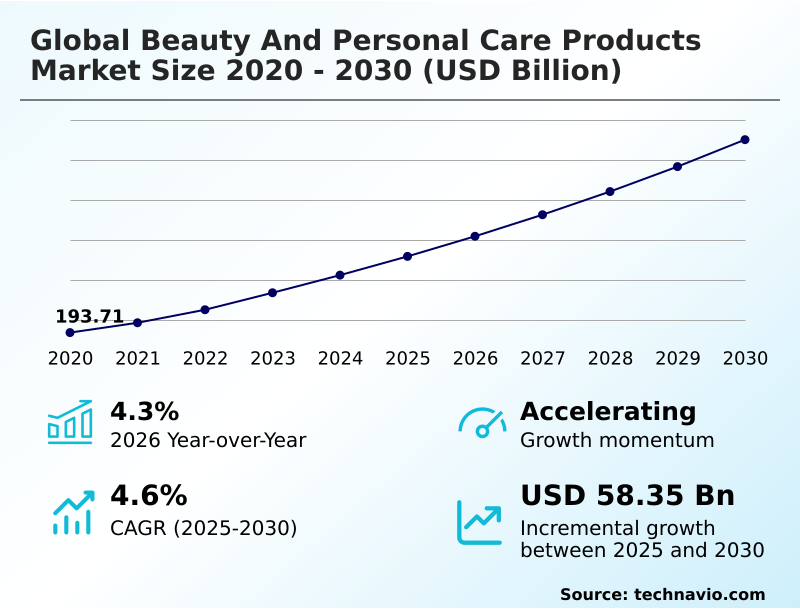
The beauty and personal care products market size is valued to increase by USD 58.35 billion, at a CAGR of 4.6% from 2025 to 2030. Expansion of e-commerce and digital transformation initiatives will drive the beauty and personal care products market.
Major Market Trends & Insights
- APAC dominated the market and accounted for a 45.7% growth during the forecast period.
- By Product - Skincare products segment was valued at USD 56.31 billion in 2024
- By Channel - Offline segment accounted for the largest market revenue share in 2024
Market Size & Forecast
- Market Opportunities: USD 96.45 billion
- Market Future Opportunities: USD 58.35 billion
- CAGR from 2025 to 2030 : 4.6%
Market Summary
- The beauty and personal care products market is undergoing a significant transformation, driven by a confluence of technological innovation and evolving consumer values. A key market dynamic is the pivot towards hyper-personalization and diagnostic beauty technologies, enabling brands to offer bespoke solutions.
- This trend is supported by the increasing consumer demand for transparent beauty, with a focus on sustainable formulations and ethically sourced ingredients. Consequently, dermo-cosmetics and products featuring biotechnology-derived ingredients are gaining prominence. For instance, a mid-sized company can now leverage AI-driven skin analysis to optimize its supply chain, forecasting demand for specific organic formulations with 30% greater accuracy.
- This not only reduces waste but also enhances its ability to compete against larger players by offering highly sought-after, niche products. However, the industry grapples with challenges such as navigating complex regulatory landscapes and managing the volatility of raw materials.
- The expansion of the men grooming segment and the integration of augmented reality tools in digital commerce further illustrate the market's dynamism and avenues for future growth.
What will be the Size of the Beauty And Personal Care Products Market during the forecast period?
Get Key Insights on Market Forecast (PDF) Get Free Sample
How is the Beauty And Personal Care Products Market Segmented?
The beauty and personal care products industry research report provides comprehensive data (region-wise segment analysis), with forecasts and estimates in "USD million" for the period 2026-2030, as well as historical data from 2020-2024 for the following segments.
- Product
- Skincare products
- Haircare products
- Color cosmetics
- Fragrances
- Others
- Channel
- Offline
- Online
- Gender
- Female
- Male
- Unisex
- Geography
- APAC
- China
- Japan
- South Korea
- North America
- US
- Canada
- Mexico
- Europe
- Germany
- UK
- France
- South America
- Brazil
- Argentina
- Middle East and Africa
- Saudi Arabia
- UAE
- Turkey
- Rest of World (ROW)
- APAC
By Product Insights
The skincare products segment is estimated to witness significant growth during the forecast period.
The beauty and personal care products market is shifting away from a mass-market approach toward an individual-centric model, where segmentation is increasingly granular.
This evolution is heavily influenced by the ability to process environmental stressors data and conduct genetic markers analysis, creating highly personalized offerings.
Firms are abandoning one-size-fits-all strategies, instead focusing on a consumer engagement strategy that leverages data to meet unique needs. This has intensified the focus on ingredient safety standards and new methods like nanotechnology encapsulation.
However, this complex landscape faces threats from the proliferation of counterfeiting and illicit trade networks, which exploit global supply chain disruption and raw material volatility.
To compete, legitimate brands must prioritize a faster speed to market, with some innovators reporting a 25% reduction in development timelines by using lab-grown ingredients.
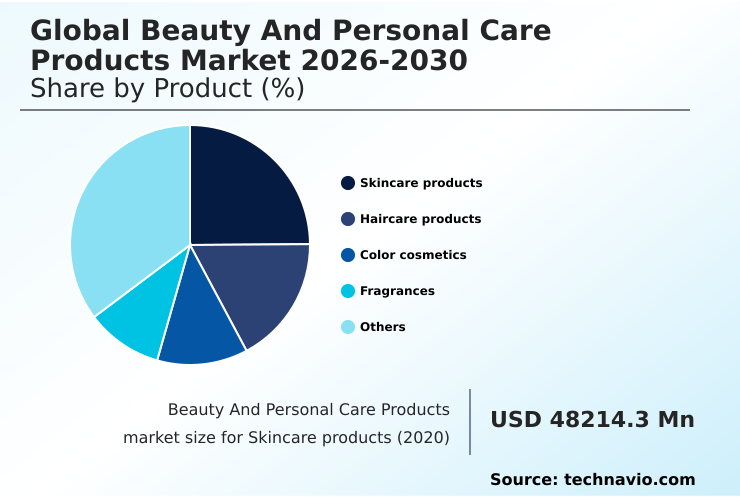
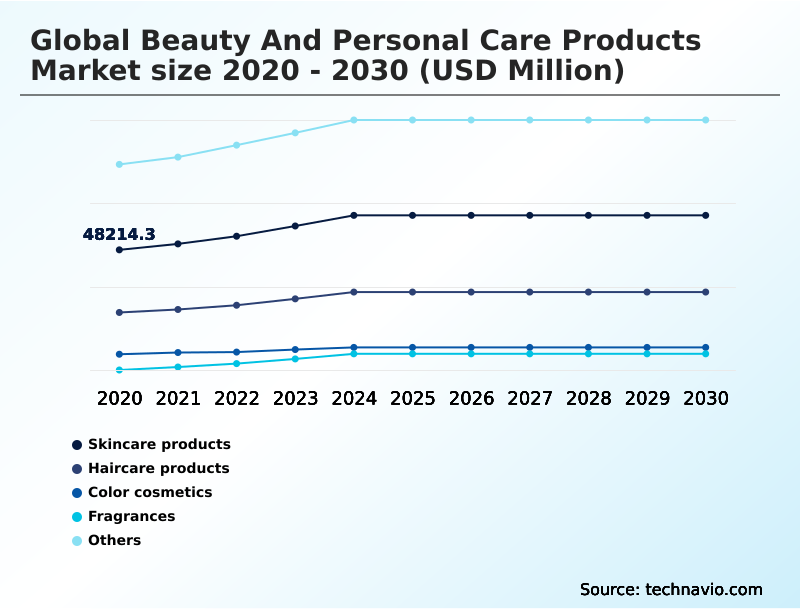
The Skincare products segment was valued at USD 56.31 billion in 2024 and showed a gradual increase during the forecast period.
Regional Analysis
APAC is estimated to contribute 45.7% to the growth of the global market during the forecast period.Technavio’s analysts have elaborately explained the regional trends and drivers that shape the market during the forecast period.
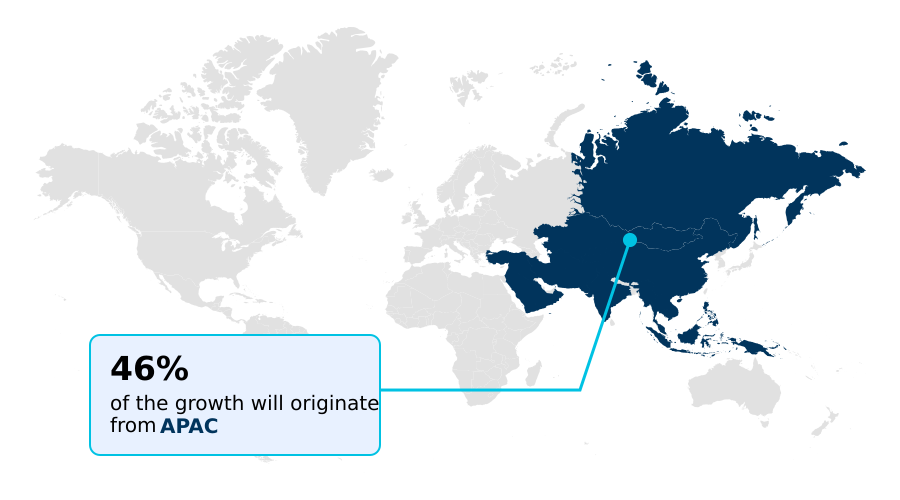
See How Beauty And Personal Care Products Market Demand is Rising in APAC Get Free Sample
The geographic landscape is being reshaped by a global push toward sustainability, influencing both product development and consumer perception. The demand for multi-functional products that offer holistic benefits is universal, driving innovation in clinical skincare.
A focus on wellness and self-care is compelling brands to adopt carbon-neutral operations and eco-friendly packaging, with firms that do so seeing a 15% higher brand loyalty score in key demographics.
Compliance with stringent environmental impact assessment protocols and labeling requirements is a critical operational hurdle. Navigating regional differences in microplastics regulation and rules for volatile organic compounds requires significant investment in computational chemistry and the substantiation of clinical claims.
Adherence to new toxicological data standards can reduce regulatory delays by up to 25%, providing a significant competitive advantage in a fast-moving market.
Market Dynamics
Our researchers analyzed the data with 2025 as the base year, along with the key drivers, trends, and challenges. A holistic analysis of drivers will help companies refine their marketing strategies to gain a competitive advantage.
- Understanding the contemporary beauty and personal care products market requires a deep dive into its multifaceted drivers and trends. The impact of digital commerce on beauty is undeniable, fundamentally altering how brands connect with consumers. This is amplified by the role of AI in personalized skincare, which moves beyond generic solutions to meet individual needs.
- A major force is the growing consumer demand for sustainable beauty products, influencing everything from sourcing to packaging. Parallel to this is the growth of the men's grooming market, which has become a significant revenue stream.
- Technologically, the integration of AR in virtual try-on is a key differentiator, with brands that adopt it seeing customer engagement metrics improve by over 50% compared to those that don't. These platforms often lead to hyper-personalization in color cosmetics.
- On the formulation front, neurocosmetics and emotional wellness trends are emerging, while prejuvenation as a beauty market driver gains traction among younger consumers. Innovation is further fueled by microbiome skincare research and development and biotechnology's role in ingredient innovation. Direct-to-consumer strategies for beauty brands are proving highly effective, especially when coupled with the importance of clean and transparent beauty.
- The rise of dermo-cosmetics in skincare highlights a shift towards science-backed solutions, and a holistic wellness approach in personal care is becoming standard. However, businesses must contend with supply chain challenges in cosmetics and the constant need for strategies to combat counterfeit beauty products.
- Navigating fragmented regulatory frameworks in beauty remains a significant operational hurdle, even as the impact of social media on beauty trends continues to accelerate the market's pace. Finally, developing eco-friendly packaging solutions for cosmetics is no longer optional but a core strategic imperative.
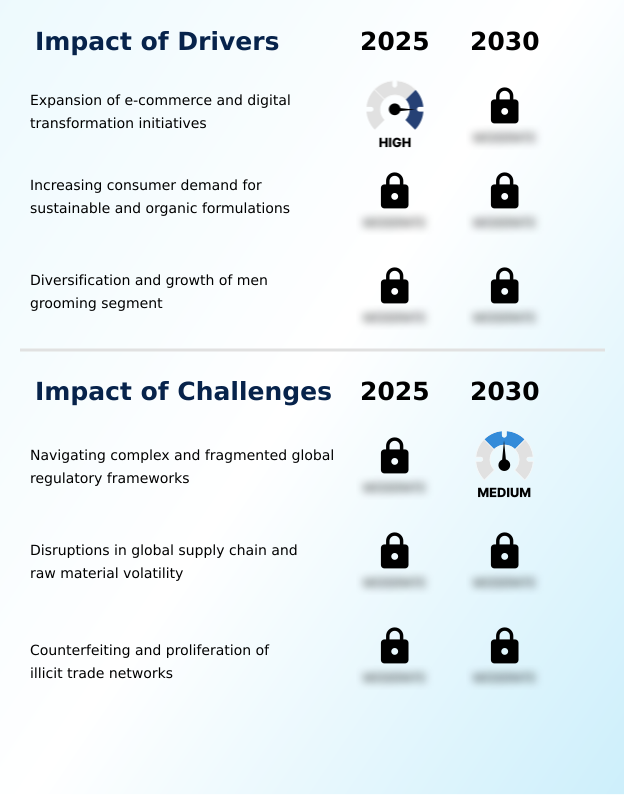
What are the key market drivers leading to the rise in the adoption of Beauty And Personal Care Products Industry?
- The market's growth is significantly driven by the expansion of e-commerce channels and broader digital transformation initiatives across the industry.
- Market growth is increasingly driven by product efficacy and consumer trust, pushing dermo-cosmetics and biotechnology-derived ingredients to the forefront.
- The demand for sustainable formulations and organic formulations is compelling a strategic portfolio repositioning across the industry, with a focus on the rapidly expanding natural product space.
- This consumer value alignment is critical, as brands with high clinical credibility report a 15% greater market share in premium categories. The men grooming segment continues its strong growth trajectory, adding a new dimension to the market.
- Technological enablers like augmented reality tools and AI-driven skin analysis are becoming standard, allowing for unprecedented personalization.
- Securing patented formulations and proprietary ingredients is now a key competitive strategy, with companies investing in R&D seeing a 2x return on innovation spending compared to those focused solely on marketing.
What are the market trends shaping the Beauty And Personal Care Products Industry?
- The proliferation of hyper-personalization, driven by advanced diagnostic beauty technologies, is emerging as a defining trend. This shift is steering the market towards bespoke solutions tailored to individual consumer profiles.
- Key trends are reshaping the market, led by the fusion of technology and personalization. The rise of hyper-personalization is enabled by diagnostic beauty technologies that analyze individual needs, leading to the development of microbiome-based skincare and emotional wellness formulations. This move toward longevity-focused aesthetics is evident in the popularity of prejuvenation regimens.
- On the supply side, advancements in computational chemistry simulation are accelerating the development of sustainable raw materials. For example, using virtual environment modeling to test cosmetic formulation data has been shown to reduce material waste reduction by up to 20%. This technological push is also driving portfolio modernization, as companies phase out legacy products in favor of innovative neurocosmetics.
- This trend is resulting in a market where scientific innovation directly addresses consumer demand for tailored, effective, and conscious products.
What challenges does the Beauty And Personal Care Products Industry face during its growth?
- Navigating complex and fragmented global regulatory frameworks presents a significant challenge to the industry's growth trajectory.
- The proliferation of digital commerce and direct-to-consumer models presents both opportunities and significant challenges. While virtual try-on features enhance online sales, they also intensify niche brand competition, requiring established players to develop a robust market penetration strategy. Ensuring supply chain resilience is a primary concern, as disruptions can quickly erode market share.
- Firms are now investing heavily in regulatory compliance monitoring, which can decrease the incidence of costly product reformulation efforts by over 30%. The push for clean beauty and transparent beauty necessitates rigorous ingredient safety assessment for all ethically sourced ingredients.
- The complexity of this landscape is magnified by the need to manage a global footprint while adhering to diverse regional standards, making strategic agility a crucial factor for sustained success and avoiding market access delays of up to 18 months.
Exclusive Technavio Analysis on Customer Landscape
The beauty and personal care products market forecasting report includes the adoption lifecycle of the market, covering from the innovator’s stage to the laggard’s stage. It focuses on adoption rates in different regions based on penetration. Furthermore, the beauty and personal care products market report also includes key purchase criteria and drivers of price sensitivity to help companies evaluate and develop their market growth analysis strategies.
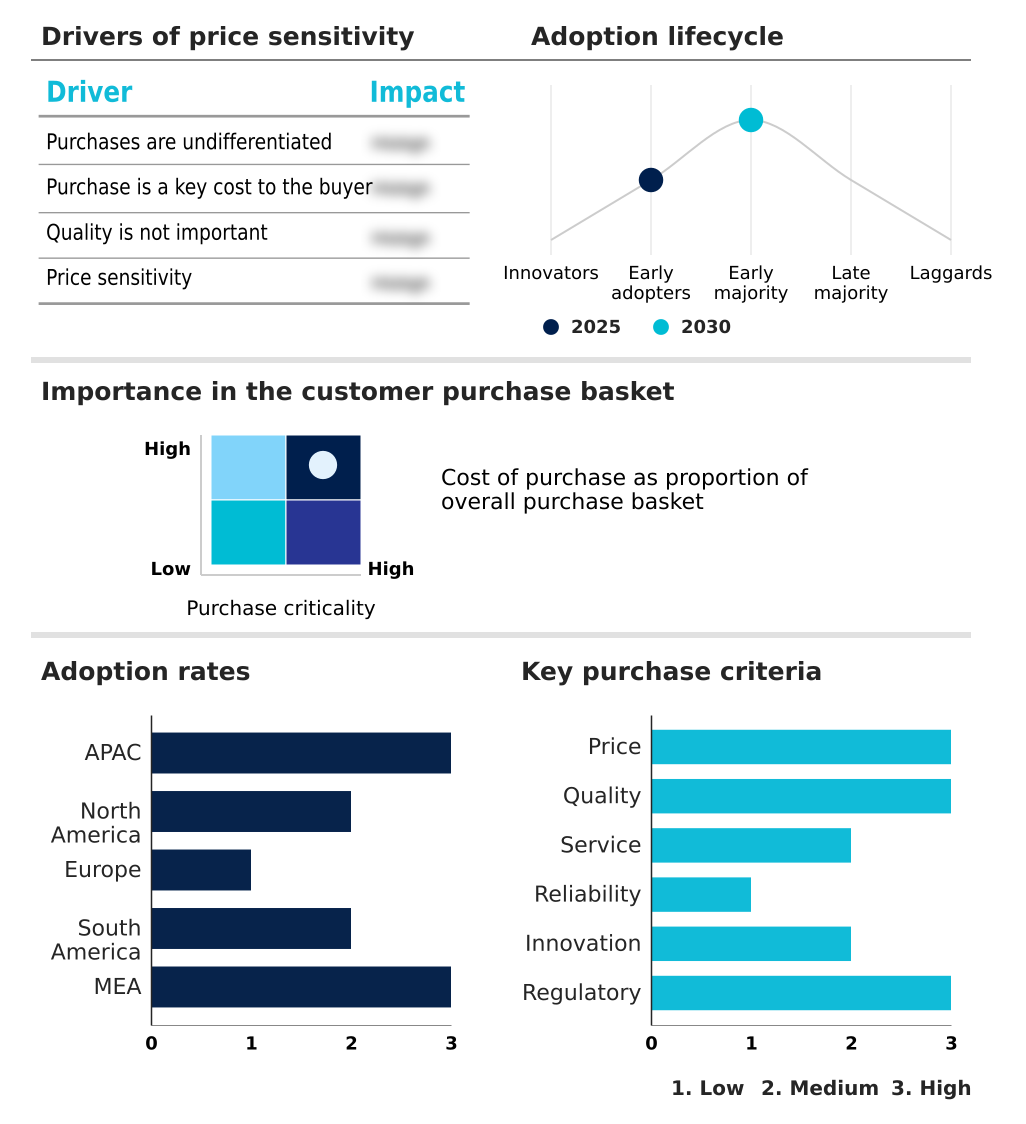
Customer Landscape of Beauty And Personal Care Products Industry
Competitive Landscape
Companies are implementing various strategies, such as strategic alliances, beauty and personal care products market forecast, partnerships, mergers and acquisitions, geographical expansion, and product/service launches, to enhance their presence in the industry.
AMOREPACIFIC Group Inc. - Analysis indicates a focus on innovative, quality beauty products, leveraging a unified sales model to reach a broad female demographic through direct-to-consumer channels.
The industry research and growth report includes detailed analyses of the competitive landscape of the market and information about key companies, including:
- AMOREPACIFIC Group Inc.
- Avon Products Inc.
- Beiersdorf AG
- Colgate Palmolive Co.
- Coty Inc.
- Edgewell Personal Care Co.
- Henkel AG and Co. KGaA
- Johnson and Johnson Services
- Kao Corp.
- Loreal SA
- LVMH Moet Hennessy
- Mary Kay Inc.
- Natura and Co. Holding SA
- Oriflame Cosmetics SA
- Procter and Gamble Co.
- Revlon Inc.
- Shiseido Co. Ltd.
- The Clorox Co.
- The Estee Lauder Co. Inc.
- Unilever PLC
Qualitative and quantitative analysis of companies has been conducted to help clients understand the wider business environment as well as the strengths and weaknesses of key industry players. Data is qualitatively analyzed to categorize companies as pure play, category-focused, industry-focused, and diversified; it is quantitatively analyzed to categorize companies as dominant, leading, strong, tentative, and weak.
Recent Development and News in Beauty and personal care products market
- In September 2024, The Procter & Gamble Co. launched a new line of waterless-formulation personal care products, including solid shampoos and conditioner bars, to meet growing consumer demand for sustainable options.
- In January 2025, L'Oréal SA partnered with IBM to utilize generative artificial intelligence for creating sustainable cosmetic formulations, aiming to analyze formulation data to incorporate sustainable raw materials and minimize energy consumption.
- In March 2025, Shiseido Co. Ltd. announced it received regulatory approval in the EU for a novel, lab-grown skincare ingredient that enhances collagen production, paving the way for its use in next-generation anti-aging products.
- In May 2025, The Estee Lauder Co. Inc. completed its acquisition of a niche fragrance brand known for its ethically sourced ingredients and transparent supply chain, strengthening its position in the conscious luxury market.
Dive into Technavio’s robust research methodology, blending expert interviews, extensive data synthesis, and validated models for unparalleled Beauty And Personal Care Products Market insights. See full methodology.
| Market Scope | |
|---|---|
| Page number | 296 |
| Base year | 2025 |
| Historic period | 2020-2024 |
| Forecast period | 2026-2030 |
| Growth momentum & CAGR | Accelerate at a CAGR of 4.6% |
| Market growth 2026-2030 | USD 58353.8 million |
| Market structure | Fragmented |
| YoY growth 2025-2026(%) | 4.3% |
| Key countries | China, Japan, South Korea, India, Australia, Indonesia, US, Canada, Mexico, Germany, UK, France, Italy, Spain, The Netherlands, Brazil, Argentina, Chile, Saudi Arabia, UAE, Turkey, Israel and South Africa |
| Competitive landscape | Leading Companies, Market Positioning of Companies, Competitive Strategies, and Industry Risks |
Research Analyst Overview
- The beauty and personal care products market is characterized by rapid innovation, where diagnostic beauty technologies and hyper-personalization are redefining consumer expectations. The industry is moving toward longevity-focused aesthetics, with prejuvenation regimens and microbiome-based skincare at the forefront of research and development.
- Boardroom decisions now often center on whether to internally develop biotechnology-derived ingredients or acquire brands that have mastered sustainable formulations and organic formulations. This strategic crossroad is influenced by the burgeoning men grooming segment and the rise of dermo-cosmetics.
- The integration of advanced augmented reality tools, including AI-driven skin analysis and virtual try-on features, is critical for success in digital commerce. Firms adopting such platforms report up to a 30% increase in conversion rates.
- The shift to direct-to-consumer models and subscription-based models is reshaping distribution, while the principles of clean beauty, transparent beauty, and ethically sourced ingredients have become table stakes. A key challenge is maintaining brand integrity while expanding offerings in a competitive market.
What are the Key Data Covered in this Beauty And Personal Care Products Market Research and Growth Report?
-
What is the expected growth of the Beauty And Personal Care Products Market between 2026 and 2030?
-
USD 58.35 billion, at a CAGR of 4.6%
-
-
What segmentation does the market report cover?
-
The report is segmented by Product (Skincare products, Haircare products, Color cosmetics, Fragrances, and Others), Channel (Offline, and Online), Gender (Female, Male, and Unisex) and Geography (APAC, North America, Europe, South America, Middle East and Africa)
-
-
Which regions are analyzed in the report?
-
APAC, North America, Europe, South America and Middle East and Africa
-
-
What are the key growth drivers and market challenges?
-
Expansion of e-commerce and digital transformation initiatives, Navigating complex and fragmented global regulatory frameworks
-
-
Who are the major players in the Beauty And Personal Care Products Market?
-
AMOREPACIFIC Group Inc., Avon Products Inc., Beiersdorf AG, Colgate Palmolive Co., Coty Inc., Edgewell Personal Care Co., Henkel AG and Co. KGaA, Johnson and Johnson Services, Kao Corp., Loreal SA, LVMH Moet Hennessy, Mary Kay Inc., Natura and Co. Holding SA, Oriflame Cosmetics SA, Procter and Gamble Co., Revlon Inc., Shiseido Co. Ltd., The Clorox Co., The Estee Lauder Co. Inc. and Unilever PLC
-
Market Research Insights
- Market dynamics are increasingly shaped by strategic portfolio repositioning, where firms divest legacy lines to invest in the high-growth natural product space. This consumer value alignment is critical, as effective regulatory compliance monitoring can reduce the risk of costly product reformulation efforts by up to 40%.
- The competitive landscape is intensifying with niche brand competition, forcing established players to secure proprietary ingredients and patented formulations to maintain differentiation. A resilient supply chain is paramount, as a clear market penetration strategy is insufficient without it.
- Companies that prioritize clinical credibility in their claims and invest in ingredient safety assessment from the outset are better positioned to build consumer trust and loyalty. This proactive stance significantly mitigates downstream risks compared to reactive strategies.
We can help! Our analysts can customize this beauty and personal care products market research report to meet your requirements.
 RIA -
RIA -