


Aluminium Profiles Market Size and Growth Forecast 2026-2030
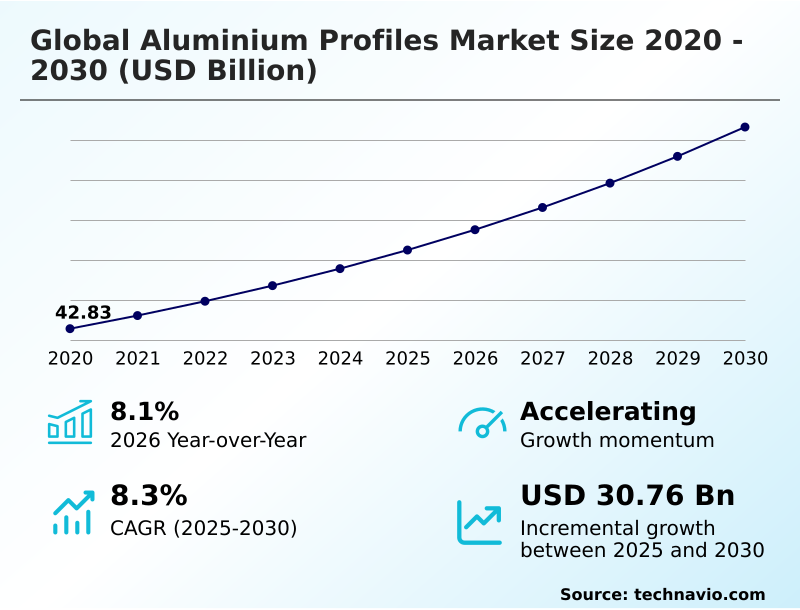
The Aluminium Profiles Market size was valued at USD 62.49 billion in 2025 growing at a CAGR of 8.3% during the forecast period 2026-2030.
APAC accounts for 54.6% of incremental growth during the forecast period. The Hollow profiles segment by Product Type was valued at USD 24.70 billion in 2024, while the Building and construction segment holds the largest revenue share by End-user.
The market is projected to grow by USD 50.41 billion from 2020 to 2030, with USD 30.76 billion of the growth expected during the forecast period of 2025 to 2030.
Get Key Insights on Market Forecast (PDF) Request Free Sample
Aluminium Profiles Market Overview
The aluminium profiles market is navigating a complex environment defined by the twin pressures of industrial efficiency and decarbonization. Demand is strong, particularly from the automotive sector's shift to vehicle electrification, where lightweighting is essential for extending battery range and performance. In a typical automotive assembly plant, the adoption of advanced joining techniques like friction stir welding enables the integration of extruded aluminium chassis components into multi-material architectures, reducing vehicle mass without compromising crashworthiness. Concurrently, the building and construction sector, which commands a majority share of consumption, increasingly specifies aluminium for curtain walls and window frames in projects targeting LEED certification. However, the energy-intensive nature of the extrusion process and primary smelting creates significant exposure to fluctuating energy costs. This dynamic is accelerating the industry's pivot toward a circular economy, with a focus on sourcing post-consumer scrap and secondary aluminium to mitigate cost volatility and reduce the carbon footprint associated with manufacturing aluminium alloy billets.
Drivers, Trends, and Challenges in the Aluminium Profiles Market
Strategic decision-making in the aluminium profiles market is increasingly dictated by the convergence of technological innovation and regulatory pressure. The push for decarbonization, codified by measures like the EU's Carbon Border Adjustment Mechanism, is forcing a systemic re-evaluation of supply chains and production methods.
This impacts everything from the supply chain risks in bauxite and alumina to the intricacies of carbon accounting for green aluminium production. In response, leading firms are leveraging advancements in extrusion die simulation software to optimize the production of complex components like hollow profiles for automotive battery cooling, reducing trial-and-error costs and material waste.
The aerospace sector continues to drive demand for high-performance 7000 series alloys for aerospace structures, where fatigue resistance is non-negotiable. Similarly, architects are specifying thermal break profiles for curtain wall systems and increasingly demand anodized finishes for architectural corrosion resistance, particularly in harsh environments.
The shift toward a circular economy is not just a trend but a competitive necessity, with a focus on using recycled aluminium in building construction. This pivot is supported by technologies such as X-ray fluorescence for scrap sorting.
The industrial sector benefits from T-slot profiles for modular factory automation, while innovations in friction stir welding for multi-material joints open new applications. As energy costs remain a key factor, the fact that secondary production uses approximately 95% less energy than primary smelting provides a compelling economic and environmental case for expanding circular economy models in aluminium extrusion.
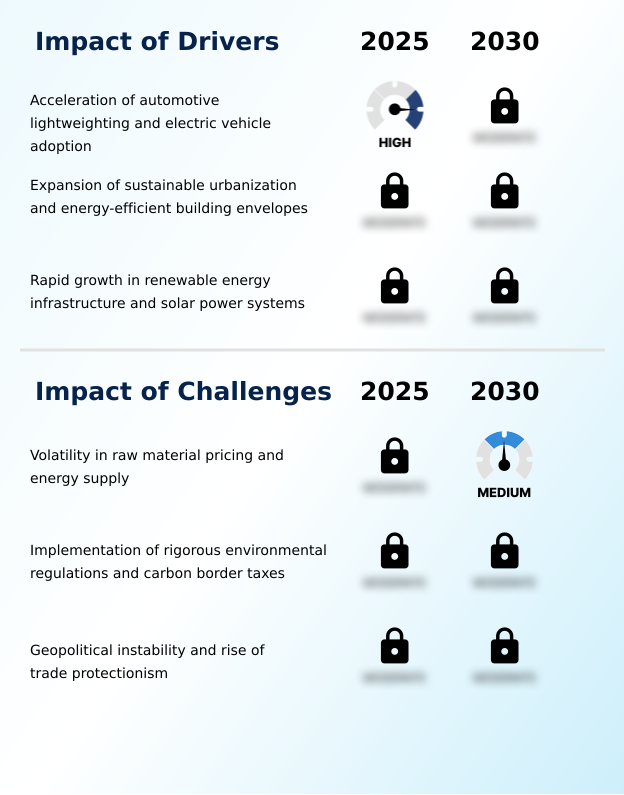
Primary Growth Driver: The acceleration of automotive lightweighting and electric vehicle adoption is a key driver, increasing demand for high-strength, low-weight aluminium profiles.
Demand is being fueled by three core pillars: automotive lightweighting, sustainable construction, and the expansion of renewable energy infrastructure.
In the automotive sector, the transition to vehicle electrification makes the high strength-to-weight ratio of aluminium profiles critical for manufacturing battery enclosures and chassis components that maximize range.
The building and construction sector, which constitutes the largest end-user segment, is driven by global urbanization and stringent energy efficiency regulations, spurring demand for profiles with thermal breaks for curtain walls and window frames.
Lastly, the global build-out of solar power relies heavily on the corrosion resistance and durability of aluminium profiles for solar panel mounting systems, creating a consistent and growing demand pipeline tied to clean energy targets.
Emerging Market Trend: The integration of AI and advanced automation in extrusion facilities is an upcoming trend. This digitalization optimizes production efficiency and minimizes material waste.
The market is advancing on two primary fronts: digitalization and material science. Within extrusion facilities, the adoption of Industry 4.0 principles is accelerating, with digital twins being used to simulate the extrusion process for complex hollow profiles before committing to physical production. This reduces scrap and shortens lead times.
Concurrently, a significant trend is the development of advanced alloy chemistry, moving beyond standard 6000 series alloys to customized 7000 series and aluminium-scandium variants for high-stress applications in aerospace and defense. This is complemented by a market-wide pivot toward a circular economy, where manufacturers are investing in technologies to process post-consumer scrap into high-quality secondary aluminium.
This move addresses sustainability demands and mitigates exposure to volatile primary aluminium prices, underpinning the market's 8.1% year-over-year growth.
Key Industry Challenge: Volatility in raw material pricing and energy supply, critical inputs for the energy-intensive smelting process, presents a key challenge affecting industry growth and profitability.
The industry faces a triad of interconnected challenges that threaten profitability and supply chain stability. First, extreme volatility in raw material and energy prices, with electricity accounting for up to 40% of smelting costs, creates significant margin pressure and complicates long-term planning.
Second, an increasingly stringent regulatory environment, exemplified by Europe's Carbon Border Adjustment Mechanism, imposes significant compliance costs and administrative burdens related to carbon accounting and material traceability. This requires substantial capital investment in green aluminium production and advanced recycling technologies.
Finally, geopolitical instability and trade protectionism, including anti-dumping duties and tariffs, disrupt global trade flows, leading to regional price disparities and forcing manufacturers to constantly re-evaluate their supply chain strategies to mitigate risks.
Explore Full Market Dynamics Analysis Request Free Sample
Aluminium Profiles Market Segmentation
The aluminium profiles industry research report provides comprehensive data including region-wise segment analysis, with forecasts and analysis for the period 2026-2030, as well as historical data from 2020-2024 for the following segments.
Product Type Segment Analysis
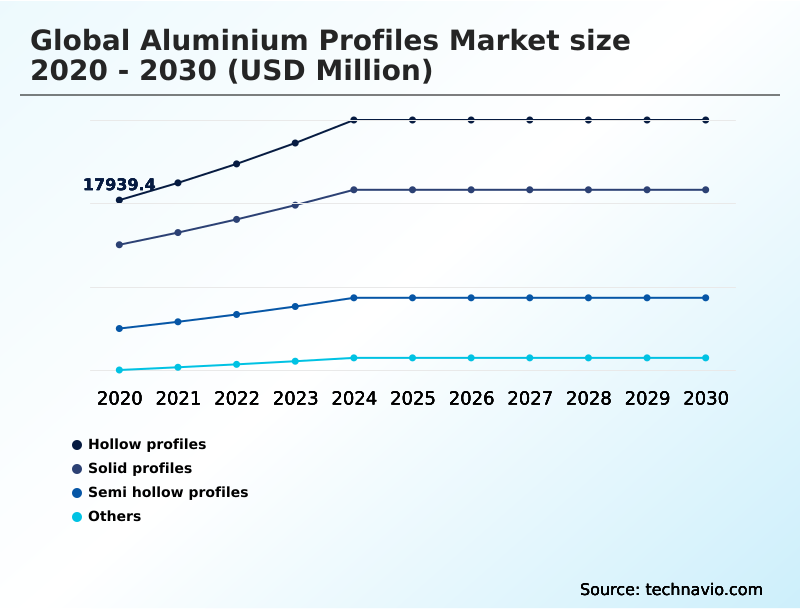
The hollow profiles segment is estimated to witness significant growth during the forecast period.
Hollow profiles, defined by one or more enclosed voids, are manufactured using complex porthole dies to achieve a high moment of inertia with minimal material.
This lightweighting characteristic is critical in applications requiring an advanced strength-to-weight ratio, such as in automotive and aerospace manufacturing.
Their design, which can integrate functions like thermal breaks or fluid channels, makes them invaluable for energy-efficient building envelopes and thermal management systems.
The extrusion process for these components demands significant technical expertise to manage the metal flow and maintain structural integrity.
This segment's importance is underscored by its contribution, accounting for over 43% of the market, driven by the escalating need for high-performance, multifunctional components in advanced engineering sectors.
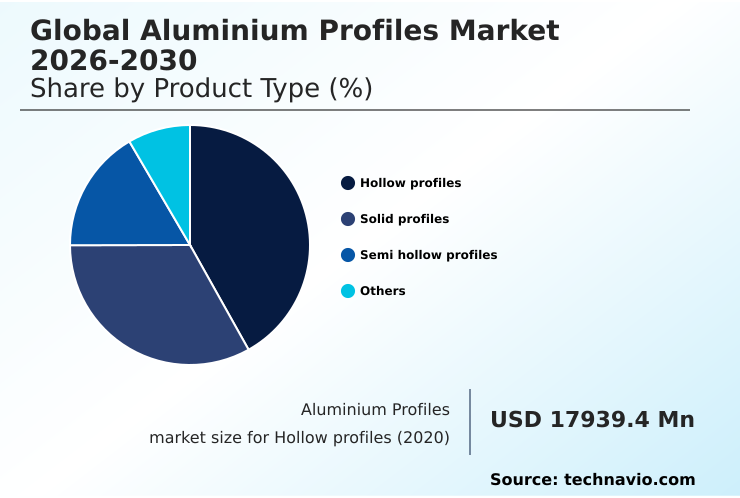
The Hollow profiles segment was valued at USD 24.70 billion in 2024 and showed a gradual increase during the forecast period.
Aluminium Profiles Market by Region: APAC Leads with 54.6% Growth Share
APAC is estimated to contribute 54.6% to the growth of the global market during the forecast period.
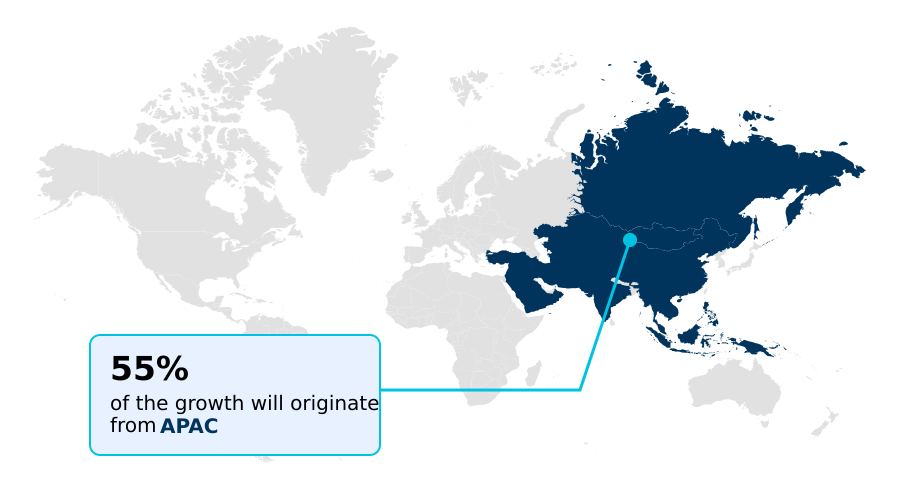
The geographic landscape is dominated by APAC, which is set to contribute over 54% of the market's growth, fueled by massive renewable energy infrastructure projects and rapid urbanization in China and India.
Government-led initiatives in these countries are promoting prefabricated construction and the development of high-speed rail, creating sustained demand for architectural extrusion and structural framing.
In this region, manufacturers are quickly adopting digital twins and automated handling systems to enhance production efficiency and meet stringent quality standards for both domestic consumption and export.
European and North American markets, while more mature, are focused on high-value applications, including aerospace components and advanced thermal management systems, where superior dimensional tolerances and complex cross-sectional geometry are critical.
Compliance with frameworks like the Carbon Border Adjustment Mechanism is a key strategic consideration for all regions trading with Europe.
Customer Landscape Analysis for the Aluminium Profiles Market
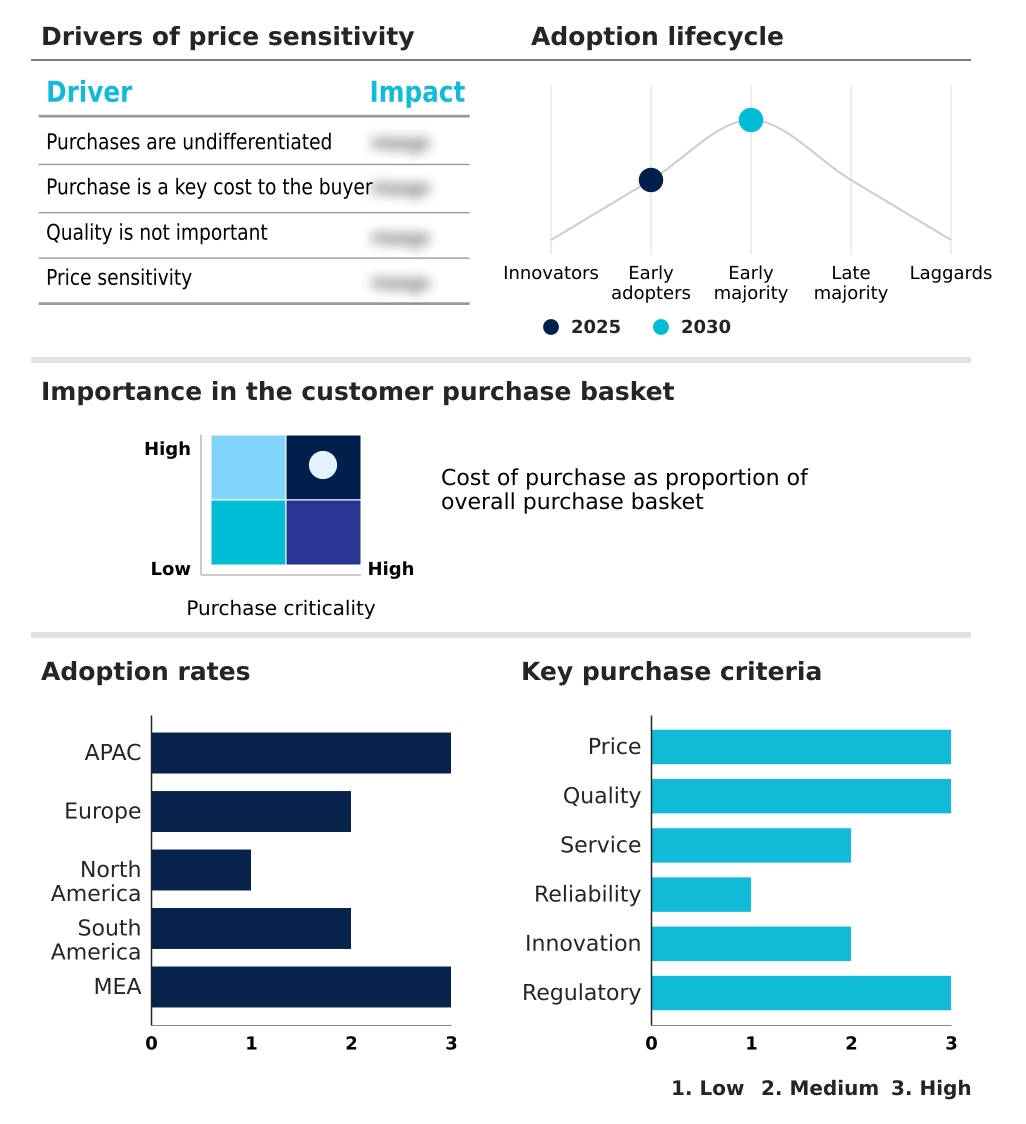
The aluminium profiles market forecasting report includes the adoption lifecycle of the market, covering from the innovator’s stage to the laggard’s stage. It focuses on adoption rates in different regions based on penetration. Furthermore, the aluminium profiles market report also includes key purchase criteria and drivers of price sensitivity to help companies evaluate and develop their market growth analysis strategies.
Competitive Landscape of the Aluminium Profiles Market
Companies are implementing various strategies, such as strategic alliances, partnerships, mergers and acquisitions, geographical expansion, and product/service launches, to enhance their presence in the aluminium profiles market industry.
Alumil S.A. - Delivering specialized aluminium profiles, from standard architectural extrusions to customized thermal break and industrial sections, engineered for diverse applications.
The industry research and growth report includes detailed analyses of the competitive landscape of the market and information about key companies, including:
- Alumil S.A.
- AluPure
- Arconic Corp.
- Bonnell Aluminum Inc.
- Capral Ltd.
- Constellium SE
- Exlabesa
- Hindalco Industries
- Impol Group
- Kaiser Aluminum Corp.
- Metra S.p.A.
- Minalex Corp
- Norsk Hydro ASA
- Oldcastle BuildingEnvelope
- Pennex Aluminum Co LLC
- Reynaers Aluminium NV
- Schuco International KG
- Taber Extrusions LLC
- Western Extrusions Corp.
- Xingfa Aluminium Holdings Ltd.
Qualitative and quantitative analysis of companies has been conducted to help clients understand the wider business environment as well as the strengths and weaknesses of key industry players. Data is qualitatively analyzed to categorize companies as pure play, category-focused, industry-focused, and diversified; it is quantitatively analyzed to categorize companies as dominant, leading, strong, tentative, and weak.
Recent Developments in the Aluminium Profiles Market
- In May 2025, Tesla Inc. expanded production at its Texas Gigafactory to include a new extrusion wing for monolithic aluminium side-rail profiles for next-generation passenger vehicles.
- In April 2025, SMS Group introduced a specialized software suite for real-time monitoring of aluminium extrusion presses, using machine learning to predict die wear and optimize energy consumption.
- In August 2025, the European Space Agency finalized testing of a new aluminium-scandium extruded profile for satellite structural frames to improve thermal stability and reduce launch payload mass.
- In October 2s025, Companhia Brasileira de Aluminio launched a circularity program in South America, integrating post-consumer scrap into primary extrusion billets for a new line of low-carbon building profiles.
Research Analyst Overview: Aluminium Profiles Market
Boardroom-level decisions are now centered on balancing high capital expenditures for technological upgrades against the long-term competitive advantages of sustainability and operational efficiency. The integration of digital twins and automated extrusion press controls is no longer a luxury but a necessity for achieving the tight dimensional tolerances required by the automotive and aerospace sectors.
With the building and construction segment commanding over half the market, compliance with green building standards like LEED is a primary driver for specifying profiles with integrated thermal breaks and high-recycled content. This pivot toward a circular economy is compelling investments in sophisticated sorting technologies for post-consumer scrap to produce high-quality secondary aluminium.
The market's 8.1% year-over-year growth is not just a measure of volume but of a fundamental shift toward higher-value products, including specialized 6000 and 7000 series alloys. Firms that master the complexities of the extrusion process for these advanced materials, while navigating volatile energy costs and stringent environmental product declarations, will be best positioned to capture this growth.
Dive into Technavio’s robust research methodology, blending expert interviews, extensive data synthesis, and validated models for unparalleled Aluminium Profiles Market insights. See full methodology.
| Market Scope | |
|---|---|
| Page number | 307 |
| Base year | 2025 |
| Historic period | 2020-2024 |
| Forecast period | 2026-2030 |
| Growth momentum & CAGR | Accelerate at a CAGR of 8.3% |
| Market growth 2026-2030 | USD 30757.3 million |
| Market structure | Fragmented |
| YoY growth 2025-2026(%) | 8.1% |
| Key countries | China, India, Japan, South Korea, Australia, Indonesia, Germany, Italy, UK, France, Spain, Russia, US, Canada, Mexico, Brazil, Argentina, Chile, UAE, Saudi Arabia, South Africa, Egypt and Turkey |
| Competitive landscape | Leading Companies, Market Positioning of Companies, Competitive Strategies, and Industry Risks |
Aluminium Profiles Market: Key Questions Answered in This Report
-
What is the expected growth of the Aluminium Profiles Market between 2026 and 2030?
-
The Aluminium Profiles Market is expected to grow by USD 30.76 billion during 2026-2030, registering a CAGR of 8.3%. Year-over-year growth in 2026 is estimated at 8.1%%. This acceleration is shaped by acceleration of automotive lightweighting and electric vehicle adoption, which is intensifying demand across multiple end-use verticals covered in the report.
-
-
What segmentation does the market report cover?
-
The report is segmented by Product Type (Hollow profiles, Solid profiles, Semi hollow profiles, and Others), End-user (Building and construction, Automotive and transportation, Electrical and electronics, Industrial, and Others), Type (Mill finished, Anodized, and Others) and Geography (APAC, Europe, North America, South America, Middle East and Africa). Among these, the Hollow profiles segment is estimated to witness significant growth during the forecast period, driven by rising adoption across key application areas. Each segment includes detailed qualitative and quantitative analysis, along with historical data from 2020-2024 and forecasts through 2030 with year-over-year growth rates.
-
-
Which regions are analyzed in the report?
-
The report covers APAC, Europe, North America, South America and Middle East and Africa. APAC is estimated to contribute 54.6% to market growth during the forecast period. Country-level analysis includes China, India, Japan, South Korea, Australia, Indonesia, Germany, Italy, UK, France, Spain, Russia, US, Canada, Mexico, Brazil, Argentina, Chile, UAE, Saudi Arabia, South Africa, Egypt and Turkey, with dedicated market size tables and year-over-year growth for each.
-
-
What are the key growth drivers and market challenges?
-
The primary driver is acceleration of automotive lightweighting and electric vehicle adoption, which is accelerating investment and industry demand. The main challenge is volatility in raw material pricing and energy supply, creating operational barriers for key market participants. The report quantifies the impact of each driver and challenge across 2026 and 2030 with comparative analysis.
-
-
Who are the major players in the Aluminium Profiles Market?
-
Key vendors include Alumil S.A., AluPure, Arconic Corp., Bonnell Aluminum Inc., Capral Ltd., Constellium SE, Exlabesa, Hindalco Industries, Impol Group, Kaiser Aluminum Corp., Metra S.p.A., Minalex Corp, Norsk Hydro ASA, Oldcastle BuildingEnvelope, Pennex Aluminum Co LLC, Reynaers Aluminium NV, Schuco International KG, Taber Extrusions LLC, Western Extrusions Corp. and Xingfa Aluminium Holdings Ltd.. The report provides qualitative and quantitative analysis categorizing companies as dominant, leading, strong, tentative, and weak based on their market positioning. Company profiles include business segment analysis, SWOT assessment, key offerings, and recent strategic developments.
-
Aluminium Profiles Market Research Insights
Market dynamics are shaped by a push-pull between performance requirements and sustainability mandates. The growing demand for green aluminium, driven by regulations such as Europe's Sustainable Structures Act, compels manufacturers to provide detailed environmental product declarations and ensure material traceability throughout the supply chain.
This is particularly relevant as the automotive and transportation segment, with a growth rate outpacing some traditional sectors, increasingly requires low-carbon primary metal for electric vehicle battery enclosures. The market is responding with innovations in advanced alloy chemistry and an emphasis on modular framing systems that allow for design flexibility.
Simultaneously, the need for robust thermal management systems in electronics and high-power applications maintains steady demand for profiles with superior thermal conductivity, ensuring the material's relevance across a diverse industrial base.
We can help! Our analysts can customize this aluminium profiles market research report to meet your requirements.
 RIA -
RIA -