



4K2K Tv Market Size and Growth Forecast 2026-2030
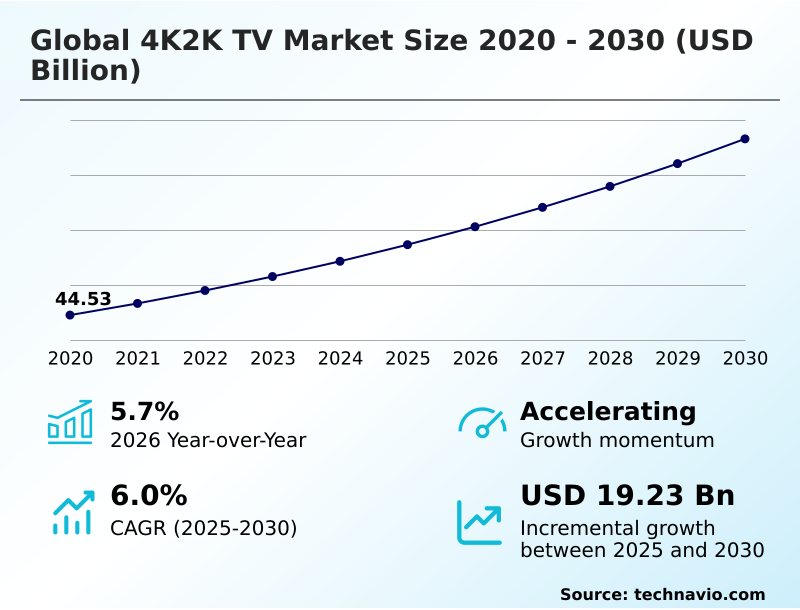
The 4K2K Tv Market size was valued at USD 57.33 billion in 2025 growing at a CAGR of 6% during the forecast period 2026-2030.
APAC accounts for 49.8% of incremental growth during the forecast period. The 60 to 69 inches segment by Display Size was valued at USD 21.85 billion in 2024, while the Offline segment holds the largest revenue share by Distribution Channel.
The market is projected to grow by USD 32.04 billion from 2020 to 2030, with USD 19.23 billion of the growth expected during the forecast period of 2025 to 2030.
Get Key Insights on Market Forecast (PDF) Request Free Sample
4K2K Tv Market Overview
The 4k2k tv market is undergoing a significant transformation, driven by the standardization of ultra-high-definition as the baseline for modern home entertainment. This evolution is defined by the convergence of advanced panel architectures like mini-led backlighting and organic light-emitting diode technology, which deliver superior color and contrast. Growth is further propelled by a robust content ecosystem, where high-bandwidth streaming and next-generation gaming consoles make 4k resolution an essential requirement. In the commercial sector, a premium hotel chain might deploy a network of 4k2k tv displays for digital signage solutions and in-room entertainment, leveraging a unified smart tv operating system for content management and guest services, resulting in a consistent brand experience and new ancillary revenue streams. North America is a key region, contributing over 22% of the market's incremental growth, fueled by a premium consumer demographic demanding larger screens and integrated home entertainment hubs. The focus on eco-design requirements, compliant with standards like RoHS, is also shaping manufacturing processes and vendor qualification criteria. This dynamic environment necessitates continuous innovation in both hardware, with features like hdmi 2.1 connectivity, and software, including sophisticated image enhancement algorithms.
Drivers, Trends, and Challenges in the 4K2K Tv Market
The global 4k2k tv market 2026-2030 is advancing on multiple fronts, with procurement decisions heavily influenced by specific use cases. The demand for 4k2k tv for competitive esports and high-refresh-rate displays for console gaming is driving the adoption of panels with a 4k tv with 120hz native refresh rate and features ensuring low input lag for responsive gaming.
Concurrently, manufacturers are addressing the content gap with sophisticated ai-enhanced upscaling for legacy content and ai-powered image processing for sports, powered by vision ai for conversational interaction that personalizes the viewing experience.
Aesthetically, bezel-less designs for seamless integration and art mode features in premium televisions cater to design-conscious buyers, while the wireless zero connect box for minimalist installation declutters living spaces. In terms of display technology, tandem oled for increased panel lifespan and mini-led with high local dimming zones are key differentiators.
For streaming, hdr format support for streaming services is a baseline expectation, supported by av1 and vvc video codec implementation and integrated wi-fi 7 modules for buffer-free streaming. Beyond entertainment, the use of 4k display for medical imaging diagnostics and 4k resolution for large-format digital signage highlights growing commercial applications.
These innovations are developed within strict regulatory frameworks, such as the EU's RoHS directive, compelling investment in energy-efficient oled panel manufacturing. This contrasts with the growing popularity of ultra-short-throw laser projectors vs 4k tv, a substitute that offers scale but often trades off brightness and smart features.
The integration of a smart tv with integrated voice control solidifies the television's role as a central smart home hub.
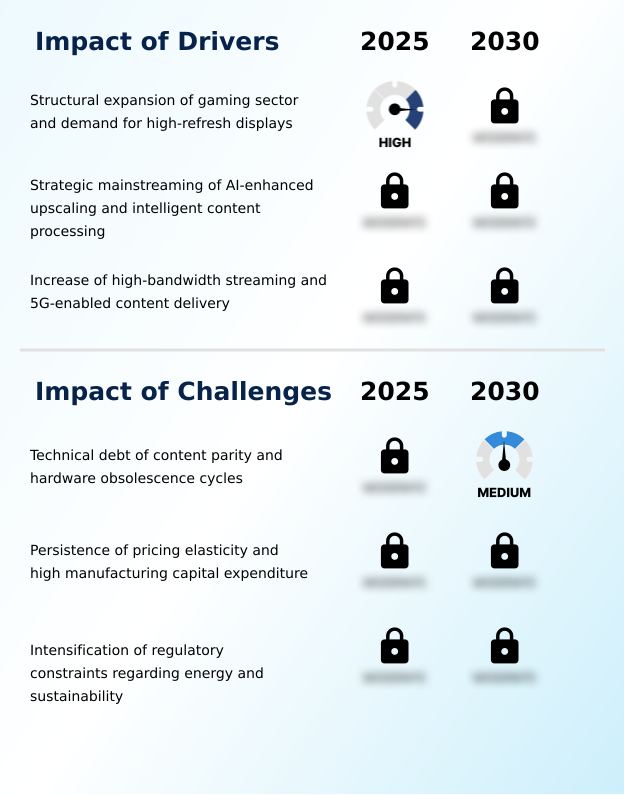
Primary Growth Driver: The structural expansion of the global gaming sector, coupled with persistent demand for high-refresh-rate displays, serves as a key driver for market adoption.
Demand from the console gaming and competitive esports sectors for gaming-optimized displays is a powerful driver, pushing for features like variable refresh rate and auto low latency mode as standard.
This is compelling manufacturers to deliver panels with high refresh rates and minimal input lag.
A second major driver is the strategic mainstreaming of ai-enhanced upscaling for legacy content, where advanced neural processing units use on-device machine learning to improve lower-resolution source material for a consistent UHD experience.
This software-led enhancement is critical for user satisfaction. Finally, the proliferation of high-bandwidth streaming, enabled by fiber and 5G infrastructure, is a fundamental catalyst.
With over two-thirds of streaming revenue coming from 4K services, the demand for hardware capable of seamless, high-fidelity playback is assured.
Emerging Market Trend: The inclusion of generative artificial intelligence and cognitive vision processing represents a significant upcoming trend, shifting televisions from passive displays toward active, intelligent content enhancement platforms.
A primary trend is the institutionalization of generative AI and cognitive vision processing, shifting image enhancement from static algorithms to dynamic, vision ai platforms. These systems analyze content frame-by-frame, a crucial feature for ultra-large displays.
Another significant shift is toward advanced panel architectures like rgb tandem oled and high-density mini-led backlighting, which are engineered to achieve unprecedented peak luminance and color volume for vibrant HDR performance. This technology, once reserved for flagship models, is now being integrated into more accessible product tiers, representing a democratization of premium features.
Furthermore, the market is expanding toward ultra-thin aesthetics, with wallpaper form factors and wireless connectivity ecosystems eliminating visible cabling to create a minimalist, integrated look that aligns with modern interior design priorities.
Key Industry Challenge: A key challenge affecting industry growth is the technical debt created by the disparity between hardware capabilities and native content availability, compounded by rapid hardware obsolescence cycles.
A significant challenge is the technical debt arising from the gap between advanced hardware capabilities and the limited availability of native 4K content, which creates issues of hardware obsolescence. While ai-driven upscaling helps, it adds cost and complexity to the smart tv operating system. Secondly, the market grapples with intense price elasticity and high manufacturing capital expenditure.
Investing in next-generation fabs for organic light-emitting diode or mini-led backlighting is costly, yet commoditization compresses margins, especially in emerging economies. Finally, intensifying regulatory constraints, particularly the EU's eco-design requirements under Regulation (EU) 2023/826, pose a technical threat.
These stringent power consumption mandates require heavy R&D investment in energy-efficient components like blue phosphorescent oled panels, creating significant compliance burdens and risking market exclusion for non-compliant high-performance models.
Explore Full Market Dynamics Analysis Request Free Sample
4K2K Tv Market Segmentation
The 4k2k tv industry research report provides comprehensive data including region-wise segment analysis, with forecasts and analysis for the period 2026-2030, as well as historical data from 2020-2024 for the following segments.
Display Size Segment Analysis
The 60 to 69 inches segment is estimated to witness significant growth during the forecast period.
The 60 to 69 inches segment is a high-growth tier, increasingly becoming the default choice for consumers seeking a balance between immersive scale and practical fit for residential spaces.
This category, particularly 65-inch models, benefits from manufacturing efficiencies that make premium technologies more accessible. The integration of advanced neural processing units facilitates superior ai-driven upscaling and real-time picture optimization, delivering cinematic picture quality from varied sources.
Technologies like organic light-emitting diode (OLED) and backlights with dense local dimming zones are pivotal, offering the contrast and peak luminance necessary for a compelling home cinema experience.
As fabrication costs for large panels decline, this segment is capturing a substantial share of the upgrade market, especially within the premium consumer demographic.
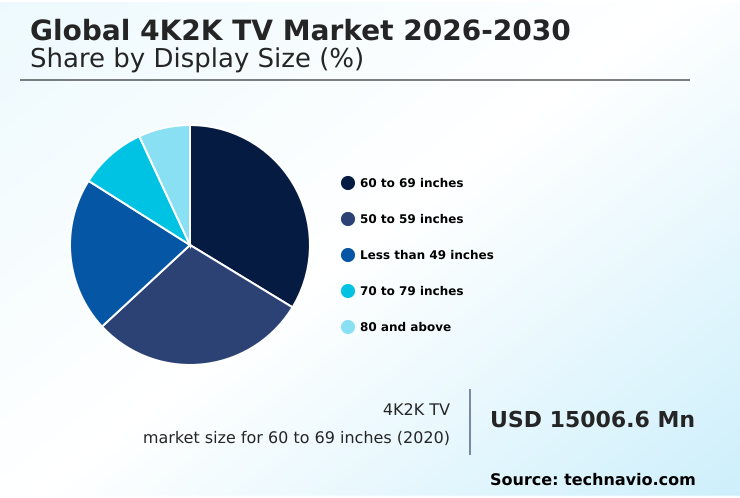
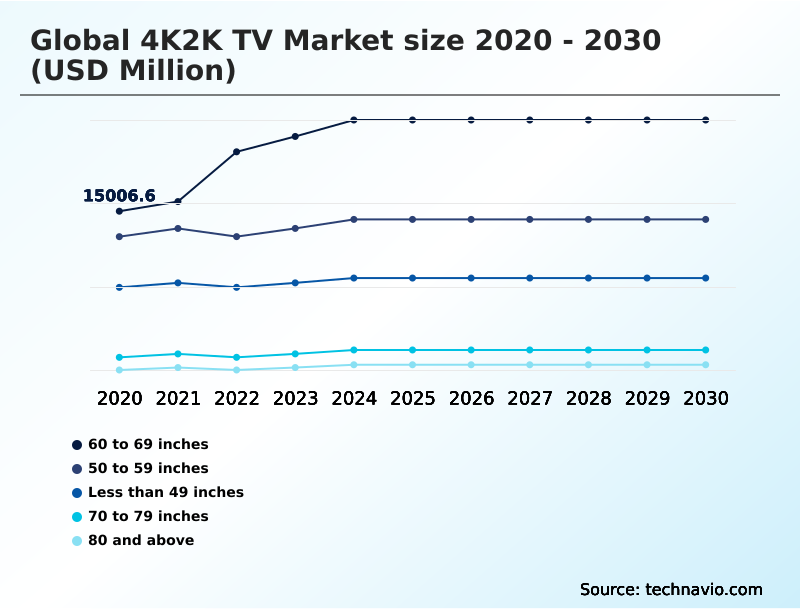
The 60 to 69 inches segment was valued at USD 21.85 billion in 2024 and showed a gradual increase during the forecast period.
4K2K Tv Market by Region: APAC Leads with 49.8% Growth Share
APAC is estimated to contribute 49.8% to the growth of the global market during the forecast period.
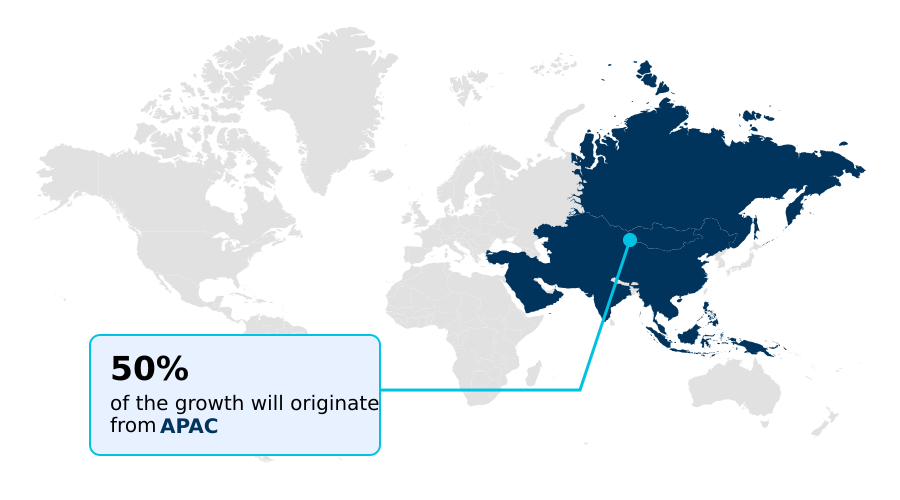
The APAC region is the largest and most dynamic geography, serving as the market's primary growth engine and contributing nearly 50% of the global incremental growth.
This dominance is fueled by a massive manufacturing base, rapid urbanization, and aggressive government initiatives promoting domestic production of display components. In countries like China and India, the convergence of affordable hardware and localized digital content has democratized high-definition viewing.
The regional market is defined by a rapid adoption of smart features, including ai-driven upscaling and integration with cloud gaming platforms.
This focus on connectivity, supported by widespread 5G deployment, provides the necessary infrastructure for seamless 4K streaming and interactive immersion, positioning the region as the epicenter for both production and consumption of advanced digital signage solutions and professional monitoring displays.
Customer Landscape Analysis for the 4K2K Tv Market
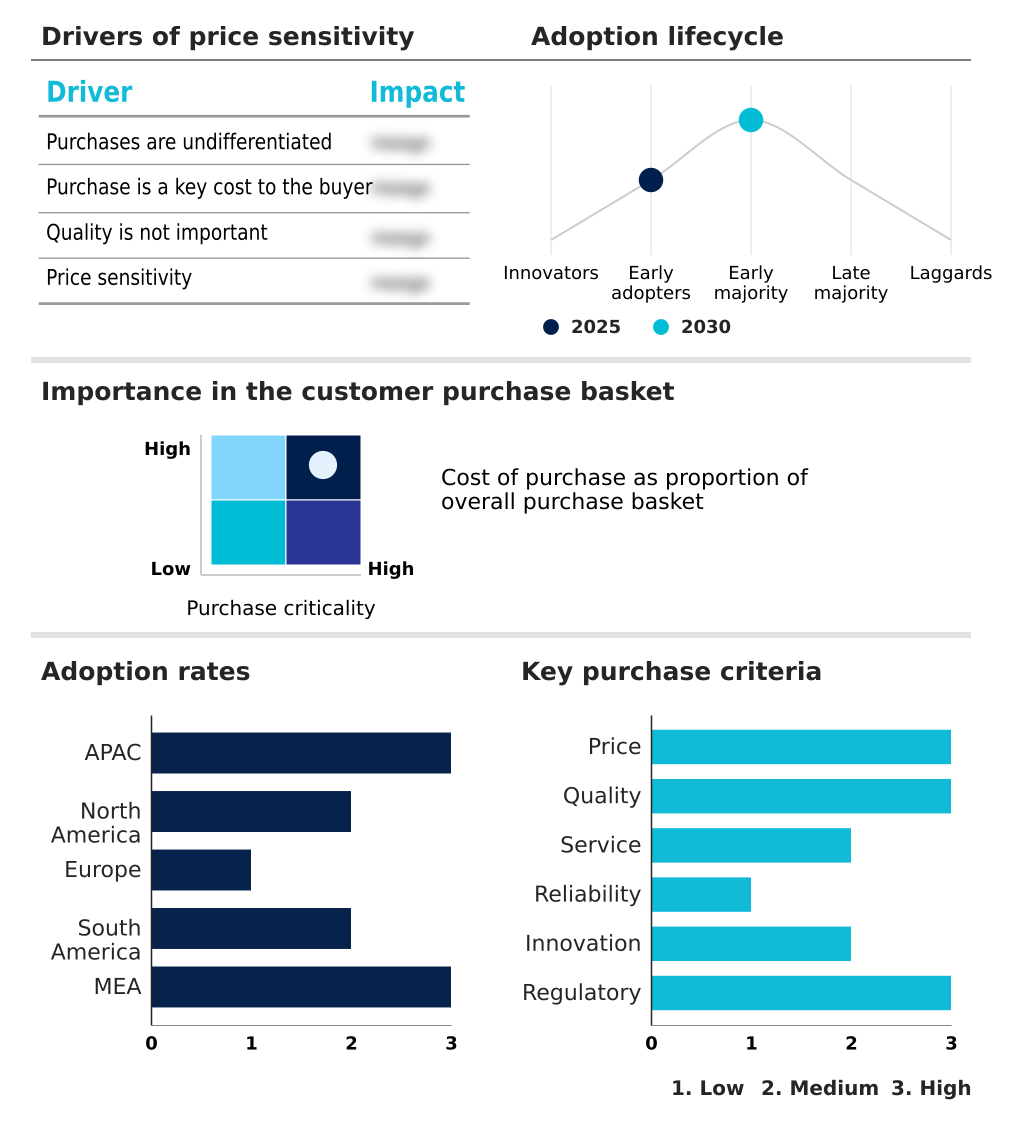
The 4k2k tv market forecasting report includes the adoption lifecycle of the market, covering from the innovator’s stage to the laggard’s stage. It focuses on adoption rates in different regions based on penetration. Furthermore, the 4k2k tv market report also includes key purchase criteria and drivers of price sensitivity to help companies evaluate and develop their market growth analysis strategies.
Competitive Landscape of the 4K2K Tv Market
Companies are implementing various strategies, such as strategic alliances, partnerships, mergers and acquisitions, geographical expansion, and product/service launches, to enhance their presence in the 4k2k tv market industry.
Element Electronics Holdings LLC - A key portfolio integrates advanced QLED and OLED displays with high-resolution smart entertainment platforms, focusing on premium visual performance and robust connectivity.
The industry research and growth report includes detailed analyses of the competitive landscape of the market and information about key companies, including:
- Element Electronics Holdings LLC
- Funai Electric Co. Ltd.
- Grundig Intermedia GmbH
- Haier Smart Home Co. Ltd.
- Hisense International Co. Ltd.
- Koninklijke Philips NV
- LG Electronics Inc.
- OnePlus Technology Co. Ltd.
- Panasonic Holdings Corp.
- Realme Chongqing Mobile Corp.
- Samsung Electronics Co. Ltd.
- Sharp Corp.
- Skyworth Group Ltd.
- Sony Group Corp.
- TCL Industries Holdings Ltd.
- Toshiba Corp.
- TPV Technology Co. Ltd.
- VIZIO Holding Corp.
- Vu Technologies Pvt. Ltd.
- Xiaomi Corp.
Qualitative and quantitative analysis of companies has been conducted to help clients understand the wider business environment as well as the strengths and weaknesses of key industry players. Data is qualitatively analyzed to categorize companies as pure play, category-focused, industry-focused, and diversified; it is quantitatively analyzed to categorize companies as dominant, leading, strong, tentative, and weak.
Recent Developments in the 4K2K Tv Market
- In January 2025, Samsung Electronics Co. Ltd. unveiled its 130-inch Micro RGB television at CES, equipped with the AI-driven NQ4 Gen3 processor and the Vision AI Companion platform.
- In March 2025, LG Electronics Inc. introduced its OLED evo series featuring the Alpha 11 AI Processor Gen3 and Hyper Radiant Color technology, designed to deliver significantly enhanced brightness levels.
- In February 2025, Skyworth Group Ltd. completed the acquisition of Panasonic's television business operations in Europe and the United States, a move that reshapes regional market influence and distribution networks.
- In April 2025, TCL Industries Holdings Ltd. showcased its next-generation SQD-Mini LED technology, demonstrating panels capable of achieving peak brightness levels of 10,000 nits for high-impact HDR performance.
Research Analyst Overview: 4K2K Tv Market
The market's competitive intensity is forcing a strategic pivot from resolution commoditization to value creation through integrated intelligence and specialized hardware. While the 50-59 inch segment continues to drive volume, boardroom focus is shifting to the high capital expenditure required for next-generation fabrication lines producing micro-led displays and rgb tandem oled panels.
This investment is critical for achieving the performance metrics demanded by both consumers and stringent regulations like the EU's energy-efficiency standards, which favor innovations such as blue phosphorescent oled technology. Adherence to technical standards like hdmi 2.1 connectivity is now table stakes, with differentiation coming from proprietary neural processing units that enable superior cognitive vision processing and ai-driven upscaling.
For procurement decision-makers, this means evaluating not just the panel but the entire smart tv operating system and its vision ai platforms, as these software layers increasingly define the product's long-term value and capability for on-device machine learning and real-time picture optimization.
Vendor qualification now extends to assessing a supplier's roadmap for 8k upscaling and support for advanced codecs like the av1 video codec.
Dive into Technavio’s robust research methodology, blending expert interviews, extensive data synthesis, and validated models for unparalleled 4K2K Tv Market insights. See full methodology.
| Market Scope | |
|---|---|
| Page number | 300 |
| Base year | 2025 |
| Historic period | 2020-2024 |
| Forecast period | 2026-2030 |
| Growth momentum & CAGR | Accelerate at a CAGR of 6% |
| Market growth 2026-2030 | USD 19234.6 million |
| Market structure | Fragmented |
| YoY growth 2025-2026(%) | 5.7% |
| Key countries | China, India, Japan, South Korea, Indonesia, Australia, US, Canada, Mexico, Germany, UK, France, Italy, Spain, The Netherlands, Brazil, Argentina, Chile, Saudi Arabia, UAE, South Africa, Turkey and Israel |
| Competitive landscape | Leading Companies, Market Positioning of Companies, Competitive Strategies, and Industry Risks |
4K2K Tv Market: Key Questions Answered in This Report
-
What is the expected growth of the 4K2K Tv Market between 2026 and 2030?
-
The 4K2K Tv Market is expected to grow by USD 19.23 billion during 2026-2030, registering a CAGR of 6%. Year-over-year growth in 2026 is estimated at 5.7%%. This acceleration is shaped by structural expansion of gaming sector and demand for high-refresh displays, which is intensifying demand across multiple end-use verticals covered in the report.
-
-
What segmentation does the market report cover?
-
The report is segmented by Display Size (60 to 69 inches, 50 to 59 inches, Less than 49 inches, 70 to 79 inches, and 80 and above), Distribution Channel (Offline, and Online), Application (Household, and Commercial) and Geography (APAC, North America, Europe, South America, Middle East and Africa). Among these, the 60 to 69 inches segment is estimated to witness significant growth during the forecast period, driven by rising adoption across key application areas. Each segment includes detailed qualitative and quantitative analysis, along with historical data from 2020-2024 and forecasts through 2030 with year-over-year growth rates.
-
-
Which regions are analyzed in the report?
-
The report covers APAC, North America, Europe, South America and Middle East and Africa. APAC is estimated to contribute 49.8% to market growth during the forecast period. Country-level analysis includes China, India, Japan, South Korea, Indonesia, Australia, US, Canada, Mexico, Germany, UK, France, Italy, Spain, The Netherlands, Brazil, Argentina, Chile, Saudi Arabia, UAE, South Africa, Turkey and Israel, with dedicated market size tables and year-over-year growth for each.
-
-
What are the key growth drivers and market challenges?
-
The primary driver is structural expansion of gaming sector and demand for high-refresh displays, which is accelerating investment and industry demand. The main challenge is technical debt of content parity and hardware obsolescence cycles, creating operational barriers for key market participants. The report quantifies the impact of each driver and challenge across 2026 and 2030 with comparative analysis.
-
-
Who are the major players in the 4K2K Tv Market?
-
Key vendors include Element Electronics Holdings LLC, Funai Electric Co. Ltd., Grundig Intermedia GmbH, Haier Smart Home Co. Ltd., Hisense International Co. Ltd., Koninklijke Philips NV, LG Electronics Inc., OnePlus Technology Co. Ltd., Panasonic Holdings Corp., Realme Chongqing Mobile Corp., Samsung Electronics Co. Ltd., Sharp Corp., Skyworth Group Ltd., Sony Group Corp., TCL Industries Holdings Ltd., Toshiba Corp., TPV Technology Co. Ltd., VIZIO Holding Corp., Vu Technologies Pvt. Ltd. and Xiaomi Corp.. The report provides qualitative and quantitative analysis categorizing companies as dominant, leading, strong, tentative, and weak based on their market positioning. Company profiles include business segment analysis, SWOT assessment, key offerings, and recent strategic developments.
-
4K2K Tv Market Research Insights
Market dynamics are increasingly shaped by the push for interactive immersion and the need to manage hardware obsolescence. As display technologies mature, differentiation is shifting toward software-driven features like intelligent content recommendation engines and seamless integration into wireless connectivity ecosystems. This pivot addresses consumer demand for a cohesive home cinema experience without the clutter of traditional setups.
However, manufacturers must navigate strict eco-design requirements, such as the European Union's Regulation (EU) 2023/826, which imposes rigorous power consumption limits. This regulatory pressure influences capital expenditure decisions, steering investment toward more efficient panel technologies.
Geographically, APAC's growth, driven by markets like China, outpaces Europe, reflecting different consumer priorities and regulatory landscapes influencing the adoption of gaming-optimized displays and other premium features.
We can help! Our analysts can customize this 4k2k tv market research report to meet your requirements.
 RIA -
RIA -