


21700 Lithium-ion Battery Market Size 2026-2030
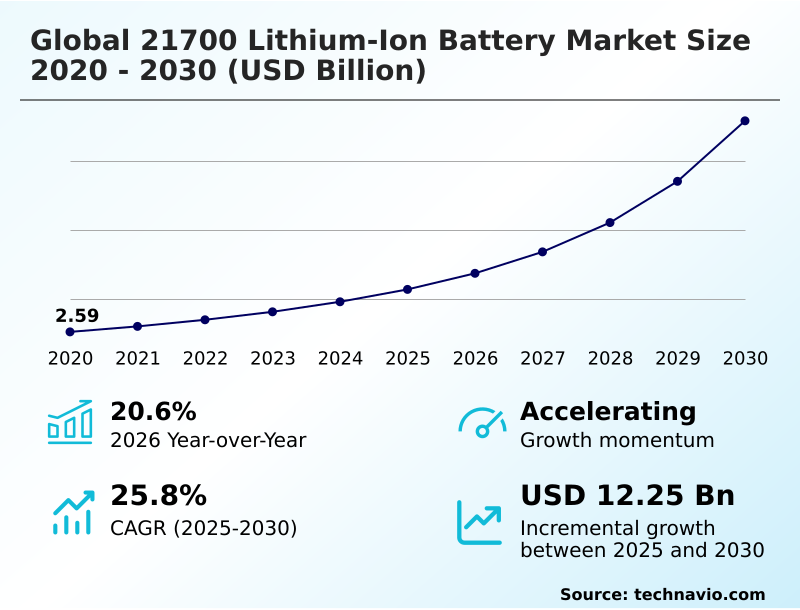
The 21700 Lithium-ion Battery Market size was valued at USD 5.68 billion in 2025, growing at a CAGR of 25.8% during the forecast period 2026-2030.
Major Market Trends & Insights
- APAC dominated the market and accounted for a 50.8% growth during the forecast period.
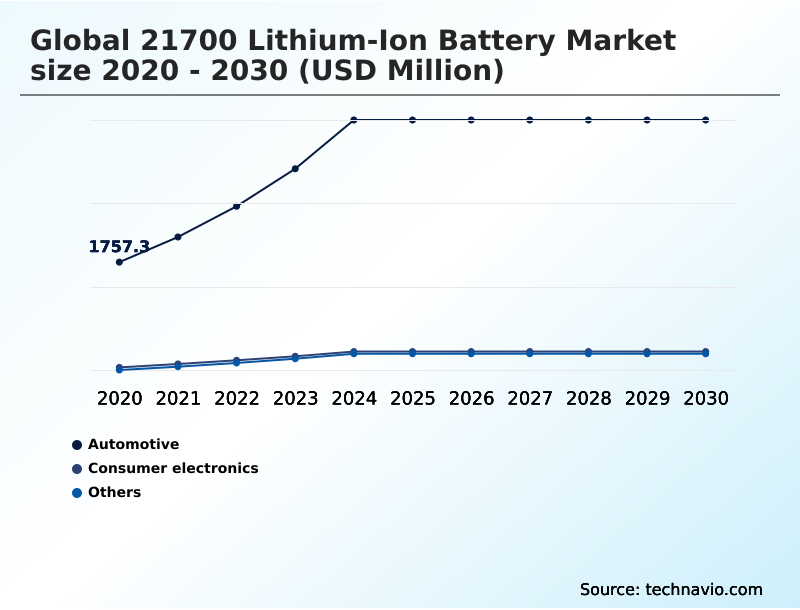
- By Application - Automotive segment was valued at USD 3.54 billion in 2024
- By Type - Lithium nickel manganese cobalt segment accounted for the largest market revenue share in 2024
Market Size & Forecast
- Historic Market Opportunities 2020-2024: USD 15.34 billion
- Market Future Opportunities 2025-2030: USD 12.25 billion
- CAGR from 2025 to 2030 : 25.8%
Market Summary
- The 21700 lithium-ion battery market is defined by a rapid transition to higher energy density formats, with modern cells offering up to 20% more capacity than the legacy 18650 standard.
- This performance gain directly impacts product design in the automotive sector, where an EV manufacturer can now reduce the number of cells in a battery pack by 15%, lowering both weight and assembly complexity. A primary driver is the declining cost of lithium-ion technology, which expands its viability into new applications.
- However, the market faces a significant challenge from supply chain bottlenecks for critical raw materials like high-purity lithium and cobalt, which can disrupt production schedules and increase cost volatility. The continuous innovation in cathode materials and anode powders is essential for overcoming these hurdles and meeting the escalating demand from electric vehicles and large-scale energy storage systems.
What will be the Size of the 21700 Lithium-ion Battery Market during the forecast period?
Get Key Insights on Market Forecast (PDF) Request Free Sample
How is the 21700 Lithium-ion Battery Market Segmented?
The 21700 lithium-ion battery industry research report provides comprehensive data (region-wise segment analysis), with forecasts and analysis for the period 2026-2030, as well as historical data from 2020-2024 for the following segments.
- Application
- Automotive
- Consumer electronics
- Others
- Type
- Lithium nickel manganese cobalt
- Lithium titanate
- Lithium iron phosphate
- Lithium cobalt oxide
- Distribution channel
- Offline
- Online
- Geography
- APAC
- China
- India
- South Korea
- Europe
- Germany
- UK
- France
- North America
- US
- Canada
- Mexico
- South America
- Brazil
- Argentina
- Middle East and Africa
- Saudi Arabia
- UAE
- South Africa
- Rest of World (ROW)
- APAC
How is the 21700 Lithium-ion Battery Market Segmented by Application?
The automotive segment is estimated to witness significant growth during the forecast period.
The automotive segment's market dominance is driven by the 21700 format's ability to reduce battery pack complexity by up to 15% due to its higher individual cell capacity.
This improved cylindrical cell architecture, often utilizing advanced lithium nickel manganese cobalt chemistry, delivers a 20% greater energy density than legacy formats, which directly extends electric vehicle driving range.
The adoption of these high-energy-density cells simplifies battery management system engineering and enhances overall vehicle reliability.
Consequently, this format has become the preferred choice for global OEMs seeking to balance performance, cost, and manufacturing scalability in next-generation electric mobility platforms, where thermal stability and fast charging capabilities are critical.
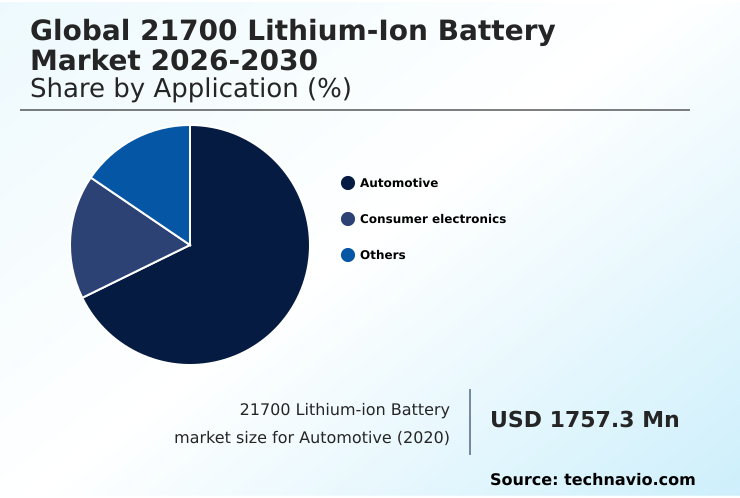
The Automotive segment was valued at USD 3.54 billion in 2024 and showed a gradual increase during the forecast period.
How demand for the 21700 Lithium-ion Battery market is rising in the leading region?
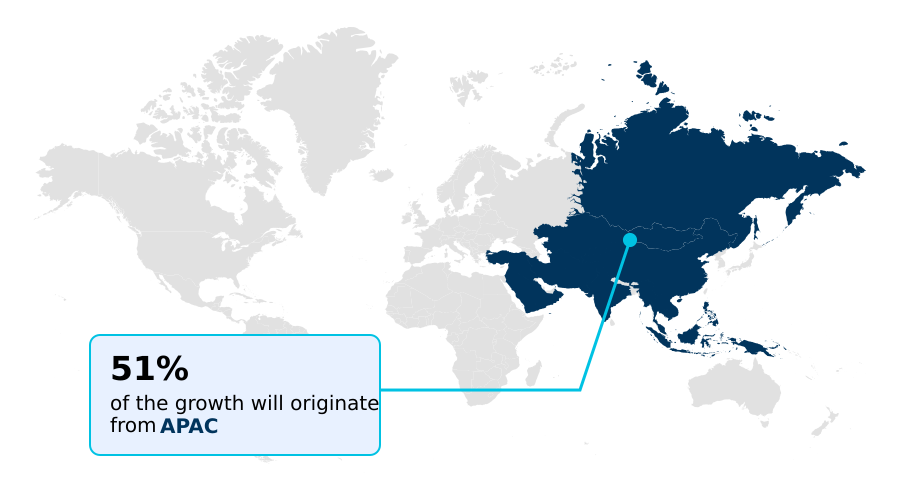
APAC is estimated to contribute 50.8% to the growth of the global market during the forecast period.Technavio’s analysts have elaborately explained the regional trends and drivers that shape the market during the forecast period.
See How 21700 Lithium-ion Battery Market demand is rising in APAC Request Free Sample
The geographic landscape of the 21700 lithium-ion battery market is dominated by APAC, which accounts for over 50% of the global market opportunity, significantly outpacing Europe at 34.1%.
This leadership is anchored by a deeply integrated manufacturing ecosystem in countries like China, which represents a market value of 1,462 million, supported by extensive raw material sourcing and high-volume production efficiency.
In contrast, North America's strategy focuses on building supply chain resilience through localized production, incentivized by government policies aimed at reducing dependence on imports by over 40%.
This regional divergence influences everything from battery pack architecture to cost structures, as European and North American markets prioritize vehicle-to-grid technology and circular economy principles, while APAC continues to lead in scale and speed of innovation for high-energy-density cells.
What are the key Drivers, Trends, and Challenges in the 21700 Lithium-ion Battery Market?
Our researchers analyzed the data with 2025 as the base year, along with the key drivers, trends, and challenges. A holistic analysis of drivers will help companies refine their marketing strategies to gain a competitive advantage.
- The ongoing debate over 21700 battery vs 18650 energy density is decisively settling, with the 21700 format consistently delivering up to 20% more capacity, fundamentally altering battery pack design in electric vehicles.
- This advantage drives intense research into improving 21700 lithium-ion battery cycle life, where advancements in cathode materials are extending operational longevity by over 30%, a critical factor for both consumer electronics and energy storage systems.
- Effective thermal management for 21700 battery packs has become a key area of innovation, as superior heat dissipation is essential for enabling fast charging and ensuring safety by mitigating thermal runaway risks.
- The choice between 21700 LFP vs NMC for EVs illustrates a key market bifurcation; LFP is favored for standard-range models due to its lower cost and enhanced safety, while NMC is reserved for high-performance vehicles requiring maximum energy density.
- Addressing 21700 cell manufacturing process challenges, such as maintaining high-speed electrode coating uniformity and minimizing defects, remains a primary focus for achieving cost-per-kilowatt-hour reductions. The future of 21700 battery technology appears to be centered on integrating silicon-graphite anodes and solid-state electrolytes to push performance boundaries even further.
What are the key market drivers leading to the rise in the adoption of 21700 Lithium-ion Battery Industry?
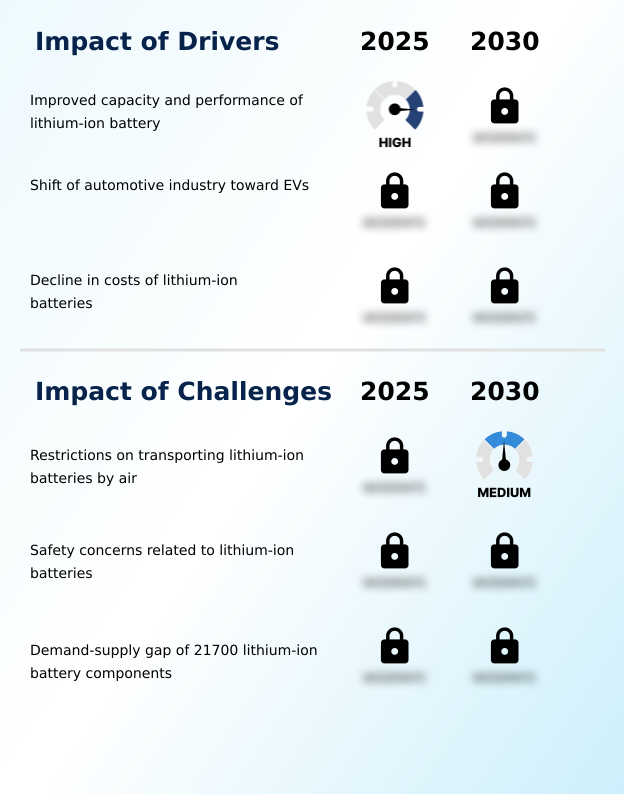
- The market's growth is primarily driven by the continuous improvement in the capacity and performance of lithium-ion batteries.
- A significant decline in the cost per kilowatt-hour, which has dropped by over 80% in the last decade, is a primary driver fueling the widespread adoption of 21700 lithium-ion batteries.
- This cost reduction is the result of massive economies of scale in automated manufacturing, driven largely by the booming electric vehicle market.
- Lower prices have expanded the technology's accessibility, making it a viable power source for a wider range of consumer electronics and industrial applications.
- This increased affordability enhances production efficiency for downstream manufacturers and accelerates the overall transition toward electrified systems, reinforcing the demand for high-performance and reliable energy storage systems.
What are the market trends shaping the 21700 Lithium-ion Battery Industry?
- The rise in battery recycling initiatives is emerging as a significant market trend, reshaping supply chain economics and promoting a circular economy for critical materials.
- The market is experiencing a definitive shift toward higher energy density cells, a trend driven by commercial demand for longer-lasting and more powerful devices. This transition enables performance gains of 15-20% in energy capacity compared to older formats, directly benefiting applications from power tools to electric vehicles.
- As a result, manufacturers are redesigning battery pack architecture to be more compact and efficient. This trend also accelerates the importance of developing a robust circular economy to manage end-of-life recovery for these advanced cells, ensuring the sustainability of raw material sourcing. The focus on improving cycle life and thermal stability remains paramount as cell capacity increases.
What challenges does the 21700 Lithium-ion Battery Industry face during its growth?
- Stringent restrictions on the transportation of lithium-ion batteries by air present a key challenge, impacting global supply chain logistics and delivery timelines.
- Safety concerns, particularly the risk of thermal runaway in high-energy-density cells, remain a persistent challenge that can increase the cost of battery management systems by up to 25%. Mitigating this risk requires significant investment in advanced quality control measures and sophisticated thermal management technologies, creating high barriers for new entrants.
- Furthermore, these safety standards place intense pressure on supply chain resilience, as manufacturers must ensure the purity and consistency of raw materials like cathode powders and separators. Navigating these safety and supply chain complexities is critical for maintaining market access and consumer trust in all applications.
Exclusive Technavio Analysis on Customer Landscape
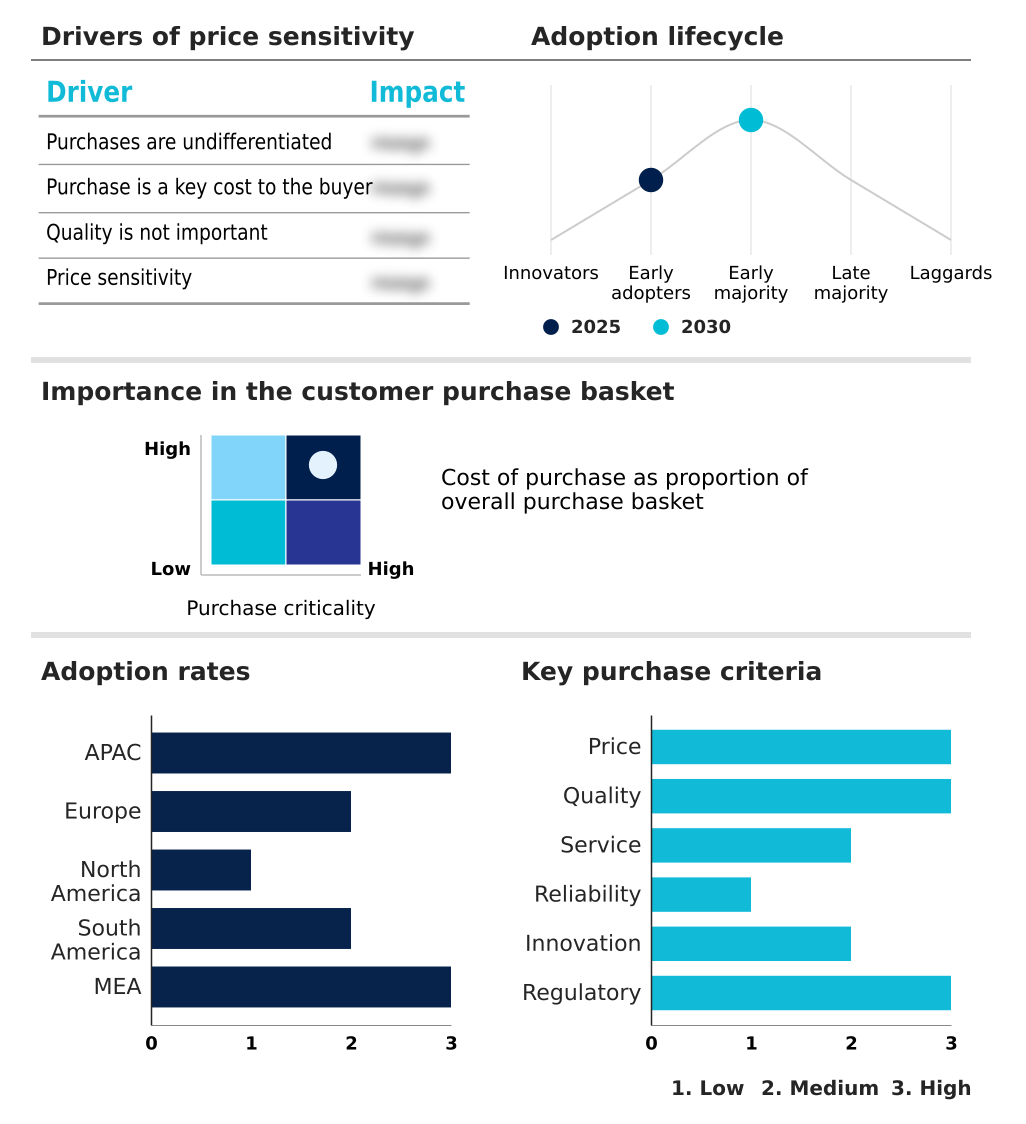
The 21700 lithium-ion battery market forecasting report includes the adoption lifecycle of the market, covering from the innovator’s stage to the laggard’s stage. It focuses on adoption rates in different regions based on penetration. Furthermore, the 21700 lithium-ion battery market report also includes key purchase criteria and drivers of price sensitivity to help companies evaluate and develop their market growth analysis strategies.
Customer Landscape of 21700 Lithium-ion Battery Industry
Competitive Landscape
Companies are implementing various strategies, such as strategic alliances, 21700 lithium-ion battery market forecast, partnerships, mergers and acquisitions, geographical expansion, and product/service launches, to enhance their presence in the industry.
Ace Battery Co. Ltd. - Key offerings include high-performance cylindrical cells and integrated battery systems for electric mobility, energy storage, and high-drain industrial applications.
The industry research and growth report includes detailed analyses of the competitive landscape of the market and information about key companies, including:
- Ace Battery Co. Ltd.
- CBAK Energy Technology Inc.
- Cham Battery Technology Co.
- DLG Battery Co. Ltd.
- E One Moli Energy Corp.
- EVE Energy Co. Ltd.
- Godi India Pvt. Ltd.
- Howell Energy Co. Ltd.
- Jiangsu Highstar Battery Co.
- LG Energy Solution Ltd.
- Murata Manufacturing Co. Ltd.
- Nanotech Energy Inc.
- Panasonic Holdings Corp.
- Samsung SDI Co. Ltd.
- Shenzhen BAK Battery Co. Ltd.
- Shenzhen Sinowatt Power Co.
- Sunwoda Electronic Co. Ltd.
- Tenpower Supply Co. Ltd.
- TianJin Lishen Battery Ltd.
- Ufine Technology Co. Ltd.
Qualitative and quantitative analysis of companies has been conducted to help clients understand the wider business environment as well as the strengths and weaknesses of key industry players. Data is qualitatively analyzed to categorize companies as pure play, category-focused, industry-focused, and diversified; it is quantitatively analyzed to categorize companies as dominant, leading, strong, tentative, and weak.
Market Intelligence Radar: High-Impact Developments & Growth Signals
- In the Renewable Electricity industry, supportive government policies mandating renewable power deployment have accelerated the need for grid-scale energy storage systems, directly boosting demand for 21700 lithium-ion batteries in modular ESS and promoting vehicle-to-grid integration.
- The declining levelized cost of electricity from solar and wind sources has made them more economical than many fossil fuels, increasing the necessity for cost-effective battery storage and favoring the 21700 format due to its falling cost per kilowatt-hour and high production efficiency.
- A focus on grid resilience and a shift from centralized power generation are driving the adoption of microgrids and distributed energy resources, which creates new applications for 21700-based battery packs in both residential and commercial settings, thereby enhancing supply chain resilience.
- The global change in the energy mix toward renewables to meet decarbonization goals is fundamentally expanding the total addressable market for energy storage, with 21700 cells being a key technology for both automated manufacturing and stationary storage.
Dive into Technavio’s robust research methodology, blending expert interviews, extensive data synthesis, and validated models for unparalleled 21700 Lithium-ion Battery Market insights. See full methodology.
| Market Scope | |
|---|---|
| Page number | 296 |
| Base year | 2025 |
| Historic period | 2020-2024 |
| Forecast period | 2026-2030 |
| Growth momentum & CAGR | Accelerate at a CAGR of 25.8% |
| Market growth 2026-2030 | USD 12254.8 million |
| Market structure | Fragmented |
| YoY growth 2025-2026(%) | 20.6% |
| Key countries | China, India, South Korea, Japan, Australia, Indonesia, Germany, UK, France, Italy, Spain, The Netherlands, US, Canada, Mexico, Brazil, Argentina, Chile, Saudi Arabia, UAE, South Africa, Israel and Turkey |
| Competitive landscape | Leading Companies, Market Positioning of Companies, Competitive Strategies, and Industry Risks |
Research Analyst Overview
- The 21700 lithium-ion battery market ecosystem is a complex value chain that begins with a concentrated group of raw material suppliers providing lithium, nickel, and cobalt, whose pricing volatility can impact final product costs by up to 40%. These materials are processed by cathode and anode powder manufacturers before reaching cell producers, who operate large-scale automated manufacturing facilities.
- The manufactured cylindrical cells are then sold through direct and distributed channels to OEMs in the electric vehicle, power tool, and consumer electronics sectors. Regulatory bodies impose stringent safety standards for transport and use, adding a layer of compliance complexity.
- Supporting this ecosystem are R&D institutions focused on advancing cell capacity and cycle life, with a 15% improvement in energy density being a key competitive benchmark.
What are the Key Data Covered in this 21700 Lithium-ion Battery Market Research and Growth Report?
-
What is the expected growth of the 21700 Lithium-ion Battery Market between 2026 and 2030?
-
The 21700 Lithium-ion Battery Market is expected to grow by USD 12.25 billion during 2026-2030, registering a CAGR of 25.8%. Year-over-year growth in 2026 is estimated at 20.6%%. This acceleration is shaped by improved capacity and performance of lithium-ion battery, which is intensifying demand across multiple end-use verticals covered in the report.
-
-
What segmentation does the market report cover?
-
The report is segmented by Application (Automotive, Consumer electronics, and Others), Type (Lithium nickel manganese cobalt, Lithium titanate, Lithium iron phosphate, and Lithium cobalt oxide), Distribution Channel (Offline, and Online) and Geography (APAC, Europe, North America, South America, Middle East and Africa). Among these, the Automotive segment is estimated to witness significant growth during the forecast period, driven by rising adoption across key application areas. Each segment includes detailed qualitative and quantitative analysis, along with historical data from 2020-2024 and forecasts through 2030 with year-over-year growth rates.
-
-
Which regions are analyzed in the report?
-
The report covers APAC, Europe, North America, South America and Middle East and Africa. APAC is estimated to contribute 50.8% to market growth during the forecast period. Country-level analysis includes China, India, South Korea, Japan, Australia, Indonesia, Germany, UK, France, Italy, Spain, The Netherlands, US, Canada, Mexico, Brazil, Argentina, Chile, Saudi Arabia, UAE, South Africa, Israel and Turkey, with dedicated market size tables and year-over-year growth for each.
-
-
What are the key growth drivers and market challenges?
-
The primary driver is improved capacity and performance of lithium-ion battery, which is accelerating investment and industry demand. The main challenge is restrictions on transporting lithium-ion batteries by air, creating operational barriers for key market participants. The report quantifies the impact of each driver and challenge across 2026 and 2030 with comparative analysis.
-
-
Who are the major players in the 21700 Lithium-ion Battery Market?
-
Key vendors include Ace Battery Co. Ltd., CBAK Energy Technology Inc., Cham Battery Technology Co., DLG Battery Co. Ltd., E One Moli Energy Corp., EVE Energy Co. Ltd., Godi India Pvt. Ltd., Howell Energy Co. Ltd., Jiangsu Highstar Battery Co., LG Energy Solution Ltd., Murata Manufacturing Co. Ltd., Nanotech Energy Inc., Panasonic Holdings Corp., Samsung SDI Co. Ltd., Shenzhen BAK Battery Co. Ltd., Shenzhen Sinowatt Power Co., Sunwoda Electronic Co. Ltd., Tenpower Supply Co. Ltd., TianJin Lishen Battery Ltd. and Ufine Technology Co. Ltd.. The report provides qualitative and quantitative analysis categorizing companies as dominant, leading, strong, tentative, and weak based on their market positioning. Company profiles include business segment analysis, SWOT assessment, key offerings, and recent strategic developments.
-
Market Research Insights
- The competitive landscape for the 21700 lithium-ion battery is highly concentrated, with the top three manufacturers commanding over 60% of the market share. In response to surging demand from the electric vehicle sector, key players are aggressively expanding their manufacturing footprint.
- For instance, companies like LG Energy Solution and Panasonic are scaling up production, with new facilities designed to increase output by more than 30% to serve North American and European automotive OEMs. This expansion is directly tied to the industry's shift toward localized supply chains to mitigate geopolitical risks and reduce logistics costs.
- While vendors are heavily investing in R&D to improve energy density and fast charging capabilities, they concurrently face the challenge of securing long-term contracts for raw materials amid volatile pricing and increasing competition.
We can help! Our analysts can customize this 21700 lithium-ion battery market research report to meet your requirements.
 RIA -
RIA -